Why It Still Takes Weeks to Start a Business in the Philippines (And Who Benefits)
If starting a business feels like a test of endurance, it’s not accidental. It’s structural.
Why It Still Takes Weeks to Start a Business in the Philippines (And Who Benefits)

If starting a business feels like a test of endurance, it’s not accidental. It’s structural.
Despite years of reform, starting a business in the Philippines remains slow, fragmented, and unpredictable. This essay argues that delays are not simply inefficiencies but the result of a system built on multi-agency fragmentation, manual workflows, and discretionary approvals. These conditions not only discourage entrepreneurs but also create environments where delay becomes leverage. Real reform requires unified systems, automation, and the elimination of redundant steps — not just digital front-ends.
Starting a business in the Philippines should be simple.
You have an idea. You register it. You start operating.
That’s the theory.
In practice, it looks very different.
You move from office to office. You secure multiple clearances. You wait for approvals that depend on availability, interpretation, or timing. You submit the same information repeatedly.
And somewhere along the process, you realize:
This is not just slow. It’s designed this way.
The Illusion of Reform
On paper, the Philippines has improved.
There are:
- online registration options,
- simplified forms,
- and initiatives to ease doing business.
But the lived experience hasn’t caught up.
Why?
Because most reforms:
- digitize individual steps,
- but do not unify the system.
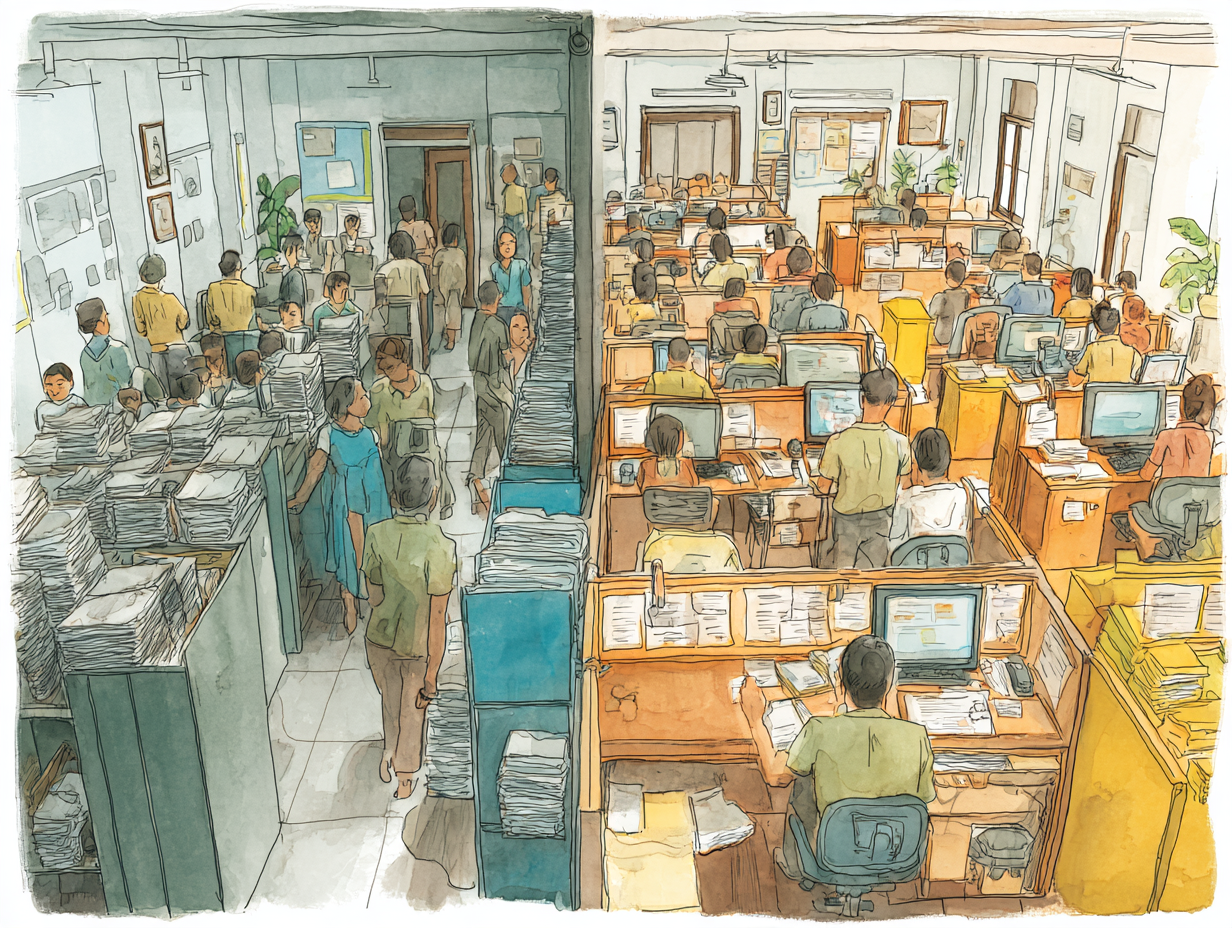
So instead of one process becoming faster, multiple processes remain — and are simply moved online.
The number of steps stays the same. Only the interface changes.
One Business, Multiple Governments
Starting a business requires interacting with:
- national agencies
- city or municipal offices
- barangay-level clearances
Each operates independently.
Each has:
- its own requirements,
- its own timelines,
- its own interpretation of rules.
There is no single system coordinating all of them.
So the entrepreneur becomes the coordinator.
You are not just starting a business. You are navigating a fragmented government.
Redundancy Is Built Into the Process
The same data is requested repeatedly:
- name
- address
- ownership
- identification
You provide it:
- to one agency,
- then to another,
- then again for verification.
Why?
Because systems do not share information.
So instead of one verified record, there are multiple disconnected ones.
This is not caution.
It is inefficiency at scale.
Manual Approvals Create Delay by Default
Many steps still require:
- physical signatures
- in-person verification
- discretionary review
Even when applications are submitted online, approval processes often remain manual.
So timelines depend on:
- workload
- staffing
- availability
- interpretation
Not on rules.
When approval depends on people instead of systems, delay becomes inevitable.
Delay Becomes Leverage
This is where the system reveals its deeper problem.
When processes are:
- slow,
- unclear,
- and unpredictable,
speed becomes valuable.
And anything valuable becomes negotiable.
Not always through obvious corruption.
Sometimes through:
- “assistance”
- “facilitation”
- “connections”
The longer the delay, the greater the leverage.
This is why inefficiency is not neutral.
It creates opportunity.
Small Businesses Pay the Highest Price
Large companies can:
- hire consultants
- assign teams
- absorb delays
Small entrepreneurs cannot.
For them:
- every day of delay means lost income
- every requirement means additional cost
- every visit means time away from operations
So the system unintentionally filters who can enter the market.
Not based on merit.
But on endurance.
The Hidden Economic Cost
When starting a business is difficult:
- fewer people formalize
- more operate informally
- tax compliance decreases
- job creation slows
The economy loses:
- potential revenue
- potential employment
- potential innovation
A difficult entry system does not just inconvenience individuals.
It limits growth.
Why the System Hasn’t Changed
If this problem is so visible, why does it persist?
Because fragmentation creates:
- control
- discretion
- and localized authority
Each layer of approval:
- holds influence
- defines pace
- controls outcomes
Simplifying the system reduces that control.
And systems rarely simplify themselves voluntarily.
What Real Reform Looks Like
Fixing business registration is not about adding more portals.
It requires structural change.
1. One Unified Registration System
A single platform that:
- connects all agencies
- standardizes requirements
- processes applications end-to-end
Not separate systems.
One system.
2. Data Submitted Once
Information should be:
- entered once
- verified once
- reused across agencies
No repetition. No revalidation.
3. Rule-Based Approvals
If requirements are complete:
- approval should be automatic
Not dependent on availability. Not dependent on interpretation.
4. Elimination of Redundant Steps
Before digitizing, remove:
- duplicate clearances
- overlapping approvals
- unnecessary certifications
Simplify first. Then automate.
5. Transparent Timelines
Every step should have:
- a defined processing time
- real-time tracking
- visible status
Uncertainty is what creates friction.
What a 3–7 Day Process Actually Looks Like
This is not unrealistic.
With proper systems:
- Day 1: Submit unified application
- Day 2–3: Automatic validation and cross-agency checks
- Day 3–5: Inspection scheduling (if required)
- Day 5–7: Final approval and issuance
No repeated submissions. No physical follow-ups. No uncertainty.
Speed becomes standard.
Who Benefits From a Better System
Everyone.
- Entrepreneurs start faster
- Government collects sooner
- Jobs are created earlier
- Compliance improves
- The economy grows
Efficiency is not just convenience.
It is economic strategy.
Starting a Business Should Not Be a Test of Endurance
Right now, the system tests patience more than it enables productivity.
It rewards persistence over efficiency. Endurance over innovation.
But it doesn’t have to be this way.
The problem is not complexity. It is design.
When systems are:
- unified,
- automated,
- and transparent,
starting a business becomes what it should have been all along:
Simple. Predictable. Accessible.
Because in the end, a country that makes it hard to start a business is a country that makes it hard to grow.
메타데이터
- post_id
- debfa2f6c594
- slug
- why-it-still-takes-weeks-to-start-a-business-in-the-philippines-and-who-benefits-debfa2f6c594
- url
- https://medium.com/@crmlmcchia2/why-it-still-takes-weeks-to-start-a-business-in-the-philippines-and-who-benefits-debfa2f6c594
- canonical_url
- https://medium.com/@crmlmcchia2/why-it-still-takes-weeks-to-start-a-business-in-the-philippines-and-who-benefits-debfa2f6c594
- author_url
- https://medium.com/@crmlmcchia2
- status
- ok
- fetched_at
- 2026-06-09 15:37:30