The Three Keys That Open — or Close — the Door to NDC Power
The Three Keys That Open — or Close — the Door to NDC Power
The Three Keys That Open — or Close — the Door to NDC Power
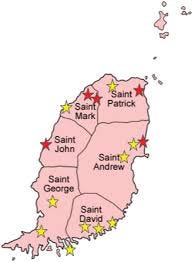
Grenada map 2026
The Three Keys That Open — or Close — the Door to NDC Power
When Grenadians go to the polls — either before the year is out or by the constitutional deadline of 2027 — the result, in my opinion, will almost certainly be decided in three constituencies: St. John, Carriacou & Petite Martinique, and the Town of St. George. Two of them the National Democratic Congress (NDC) must hold at all costs. The third it must capture to end any argument about who governs this country. Together, these three seats tell the entire story of Grenadian politics as it stands today.
To understand why, you need to begin with what I call “the arithmetic of power.” Let us dive in. Grenada elects 15 members to the House of Representatives, one from each constituency. A party needs eight seats for a simple majority. In 2022, the NDC under Prime Minister and party leader, Dickon Mitchell, won exactly nine — enough to govern, but with a margin of just one seat above the threshold. That is a narrow ledge on which to stand when political winds shift.
Since 2022, the NDC has actually grown its parliamentary presence to ten seats, following the defection of St. Andrew North West’s Delma Thomas from the NNP to the ruling party. That is encouraging. But elections, as any seasoned campaigner will tell you, reset the clock. What matters on polling day is not what you hold, but what you can win and keep.
The Numbers That Should Worry Every NDC Strategist
THE THREE DECISIVE CONSTITUENCIES — 2022 RESULTS
St. John
NDC: Kerryne James — 2,216 votes (49.64%)
NNP: Martin DaBreo — 2,209 votes (49.48%)
7-vote NDC margin
Carriacou & Petite Martinique
NDC: Tevin Andrews — 1,954 votes (51.69%)
NNP: Kindra Stewart — 1,805 votes (47.75%)
149-vote NDC margin
Town of St. George
NNP: Peter David — 1,329 votes (53.98%)
NDC: Claudette Joseph — 1,118 votes (45.41%)
211-vote NNP lead — NDC target
Look closely at those three numbers — 7 votes, 149 votes, 211 votes — and you begin to see the entire architecture of the NDC’s electoral challenge. St. John was the closest constituency fight in the entire 2022 election. The NDC’s Kerryne James beat NNP’s Martin DaBreo by a margin so thin — just seven votes out of more than 4,400 cast — that it barely registers as a win. A bad day’s weather, a slight shift in turnout from one community, a different candidate: any one of those things changes the result.
Carriacou & Petite Martinique was not much more comfortable. A 149-vote cushion sounds reasonable until you remember that in 2003, this very constituency settled a national election with the NNP winning by just seven ballots. The sister isles have a proud tradition of tilting the political scales, and they can do it again. “In 2003, the entire national election hinged on a seven-vote margin in Carriacou & Petite Martinique. History does not forgive those who assume it cannot repeat itself.”
Part I — St. John: The Razor’s Edge
St. John is the seat that should keep NDC strategists awake at night, and rightly so. With an electorate of 6,392 registered voters and a turnout of just under 70 percent in 2022, every single vote in this constituency counts with terrifying precision. The seven-vote victory by Kerryne James over Martin DaBreo is the most marginal NDC win in the entire country. To put that into perspective: on a normal polling day, that is the equivalent of roughly one polling station’s worth of voters. If the NNP manages to increase its organisation, energize its base slightly more effectively, or peel away even a handful of swing voters in St. John, the seat flips — and the NDC loses its majority.
Political analysts have for months pointed to St. John and St. George South East as the two most vulnerable NDC-held seats heading into the next general election. Commentary in the Grenadian press has repeatedly flagged a high level of discontent among voters in these constituencies. If that discontent translates into lower NDC turnout or protest votes for one of the new third parties — the newly launched Democratic People’s Movement (DPM) of Peter David or the People’s National Party (PNP) of Jonathan La Crette — the arithmetic could easily turn against the NDC without the NNP even having to dramatically improve its own performance.
The lesson is stark: St. John is not merely a seat the NDC holds. It is a seat the NDC must fight for with the same intensity as if it were starting from zero.
Part II — Carriacou & Petite Martinique: The Emotional Heartbeat
For the NDC, Carriacou & Petite Martinique carries weight that goes beyond its 5,414 registered voters. It is a constituency with deep emotional and symbolic significance — and one that, in the next election, will be shaped by a chapter of national crisis that the entire Caribbean watched with alarm.
On July 1, 2024, Hurricane Beryl, the strongest June hurricane ever recorded in the Atlantic, made direct landfall on Carriacou as a Category 4 storm with winds up to 240 kilometres per hour. The United Nations described the island as ‘literally 100 percent affected.’ Every household on Carriacou and Petite Martinique experienced damage or destruction. The State of Emergency for the sister isles continued long after it was lifted for mainland Grenada.
How the NDC government managed — and is still managing — the recovery from Beryl will be the central question for voters in this constituency. Commentary in the Grenadian press has been mixed. Observers noted that the government’s response, while physically visible, was slowed by what some described as an inherited ‘NNP deep state’ within the public service (something that has also been observed in other parts of the government. Like for example, the Ministry of Education) — senior bureaucrats loyal to the previous administration whose slow-walking of programs frustrated frontline relief efforts.
So, if reconstruction is visibly progressing by election day, if roofs are back over people’s heads and livelihoods are being restored, the NDC can reasonably expect to be rewarded. If voters feel forgotten or let down, this constituency — which the NDC won by just 149 votes in 2022 — could easily swing back to the NNP or be siphoned away by a new third party. In the end public party and government messaging will be key in keeping the NDC’s voter base intact, mobilized and energized. And, most importantly, adding to that base by convincing new (first time) and undecided voters to give the NDC another term in office.
Historical Note: Why Carriacou Has Always Been the Tipping Point
In the 2003 general election — one of the most dramatic in Grenada’s history — the NNP and NDC were locked in a near-dead heat nationally. The final outcome rested entirely on the constituency of Carriacou & Petite Martinique, where the NNP crossed the finish line ahead of the NDC by just seven ballots. That razor-thin result gave the NNP its majority and kept it in power. The sister isles have decided national governments before. They can do it again.
The NDC must approach this constituency with humility and visible action, not assumptions. Winning it in 2022 was a remarkable achievement. Winning it again requires the government to show the people of Carriacou and Petite Martinique that the party which campaigned for their votes also championed their recovery when the storm came. This transformation process and policy in action will cement and concretize the NDC’s “Build Back Better” slogan. Done right, the chaos of Hurricane Beryl now presents an opportunity for the NDC to deepen and sink its roots in this vital constituency.
Part III — The Town of St. George: From Fortress to Opportunity
For most of Grenada’s modern political history, the Town of St. George constituency has been a personal fiefdom of one man: Peter David. Since he first won the seat in 2003 under the NDC banner, David has held it through three different party jerseys — NDC, then NNP, now as an independent and founder of the newly formed Democratic People’s Movement (DPM). His personal vote in this small urban constituency of just 3,781 registered voters has always been formidable.
But David’s dramatic resignation from the NNP in January 2025, and his subsequent founding of the DPM in November 2025, has transformed what was a safe NNP seat into the most politically volatile patch of ground on the entire island. In 2022, Peter David, running under NNP colors, beat the NDC’s Claudette Joseph by 211 votes. Now, David sits in Parliament as an independent, and the NNP must find a candidate to hold a seat that was essentially held by David’s personality rather than the party’s infrastructure.
This is the critical strategic point: the NDC did not lose the Town of St. George in 2022 to the NNP as an institution. It lost it to Peter David as an individual. Now that David has severed ties with the NNP, the constituency is genuinely up for grabs in a way it has not been in decades.
“The Town of St. George was never truly an NNP stronghold. It was a Peter David stronghold. Those are very different things — and that difference is now the NDC’s greatest opportunity.”
Observers say that the NDC hierarchy believes the seat is now winnable with Senator and Attorney-General Claudette Joseph — who came within 211 votes of winning it in 2022 — is now re-confirmed as the party’s candidate. The complication, of course, is Peter David himself. Having founded the DPM, he is unlikely to walk away from the Town of St. George without a fight. A three-way race in this small constituency — NDC, NNP, and DPM — could split the anti-incumbent vote in unpredictable ways. The NNP’s own new political leader, Emmalin Pierre, suggested publicly that the NDC would be ‘more negatively impacted’ by David’s departure than the NNP, though she declined to explain the basis for that claim.
That may be wishful thinking given the fact that die-hard NNP voters are not likely to abandon the party and throw their support for David’s DPM. In my opinion the NNP/DPM split works FOR the NDC given that the threshold for the ruling party’s victory will be reduced by this split. Moreover, if Claudette Joseph runs a strong, organized and targeted campaign and if the NDC INVESTS in this constituency and treats it as a “must win” then the possibility of an NDC flip is more of a reality than ever before. Add to this the fact that Attorney General Joseph IS a quality candidate than the NDC has the ball in its political court.
However, what is certain is this: with a new and untested NNP candidate facing a DPM candidate with local roots and an NDC candidate with name recognition, the 211-vote gap from 2022 is entirely erasable. The Town of St. George is a prize that has become achievable — but it requires a targeted, disciplined campaign.
The Wider Picture: Why These Three — And Not Others
One may reasonably ask: why am I focused on these three and not, say, St. Patrick East, where the NDC’s Dennis Cornwall won by only 121 votes? The answer lies in the different nature of each constituency’s vulnerability and strategic value. St. Patrick East is at risk, yes. That’s my opinion based on the numbers. So are St. Andrew South West and St. George South East. But the framework presented here rests on a specific electoral logic: to retain power, the NDC must hold St. John and Carriacou & Petite Martinique because those are the two seats where its majority is most structurally exposed. To make its victory unchallengeable, it must capture the Town of St. George, because that is the one NNP-held seat now genuinely within reach.
So, in a nutshell if the NDC holds its nine seats from 2022, it will govern. If it loses St. John or Carriacou & Petite Martinique, it risks falling to eight seats — a bare majority that any single by-election or parliamentary defection could threaten. If it adds the Town of St. George to its column, it commands ten seats — a cushion that gives it genuine breathing room and cements its democratic mandate.
The New Political Landscape: Third Parties and the Vote-Split Problem
Any analysis of the coming election would be incomplete without acknowledging how profoundly different the political landscape is compared to 2022. When Dickon Mitchell led the NDC to its nine-seat victory, the contest was essentially a two-horse race. GULP, the IFP, and the Grenada Renaissance Party together collected fewer than 250 votes combined across all 15 constituencies. They were irrelevant to the final count.
The 2027 election — or whenever it is called — will be a very different contest. At least three new or revived political organisations are preparing to field candidates: Peter David’s Democratic People’s Movement, which held its first full congress in March 2026 and drew diplomats, trade unionists, and former NNP executives to its launch; Jonathan La Crette’s People’s National Party, whose leader was the NDC’s 2022 candidate in St. George North West; and potentially others.
The presence of credible third parties in marginal constituencies changes everything. For example, in St. John, where the NDC’s margin was seven votes, a DPM candidate taking even fifty votes from either side could swing the seat. In the Town of St. George, David’s DPM is the single biggest variable. In Carriacou & Petite Martinique, any new candidate who captures even a fraction of the electorate’s Hurricane Beryl grievances could tip the balance.
The NDC’s path to power in the next election is not simply about mobilising its base. It is about understanding how the new political geography fragments the vote — and making sure the fragmentation works in its favor rather than against it.
The NNP’s Structural Advantage — and Its Fatal Weakness
One recent analysis by a regional electoral research firm projected the NNP winning up to nine seats if elections were held in mid-2026, based on what it called the NNP’s superior ‘vote conversion rate’ — meaning its support is more efficiently spread across more constituencies, while the NDC’s support is concentrated in urban strongholds that produce large but ‘wasted’ majorities. That’s a fact. And another fact its the NNP’s numerical advantage in terms of voter base.
The NDC must therefore be surgical: running up huge margins in safe seats is electoral vanity and political stupidity. The party needs to focus its energy and resources on the razor-thin margins in St. John and Carriacou, and the targeted campaign needed to flip the Town of St. George.
The NNP’s weakness, meanwhile, is structural fragmentation: two prominent recent departures — Delma Thomas and Peter David — have stripped it of sitting MPs, and its new political leader Emmalin Pierre has not yet demonstrated the capacity to rebuild the coalition that kept Keith Mitchell in power for so long. Then there is still the looming, outsized personage of Dr. Keith Mitchell and his unpredictability behavior.
What the NDC Must Do — NOW
First, it must treat St. John as a national-priority constituency. The seven-vote margin is not a badge of honor — it is a warning. The party needs to understand at a granular level which communities within St. John delivered those votes, which communities fell short, and what it will take to secure a more comfortable buffer. Constituency service, candidate profile, and community investment all matter here in ways they do not in safer NDC seats.
Second, it must make the Carriacou & Petite Martinique recovery a centrepiece of its governing record. The sister isles were devastated by Hurricane Beryl. The government’s response — for better or worse — will be the lens through which voters there evaluate the NDC’s fitness to govern. Visible, tangible progress in housing reconstruction, livelihood restoration, and public services is not optional. In my humble opinion — It is the campaign.
Third, it must support the candidate in the Town of St. George and invest in that campaign with the seriousness the opportunity demands. A seat that was NNP-held by one man’s personal popularity, in which that man has now walked away, is a genuine prize. Missing the chance to claim it would be a strategic failure of the first order.
Conclusion: Three Seats, One Government
Grenadian politics has always been decided at the margins. The famous seven-ballot margin of Carriacou & Petite Martinique in 2003. The remarkable 2022 comeback in which the NDC went from zero seats to nine in a single election. The seven-vote margin in St. John that gave the NDC its working majority.
Understand this — The next general election will be no different. With at least four parties now competing for votes, with Hurricane Beryl’s shadow still falling over the sister isles, with the Town of St. George more open than it has been in a generation, and with the NNP simultaneously regrouping under new leadership and haemorrhaging talent to rivals — the contest ahead is one of the most genuinely uncertain in Grenada’s recent history.
But uncertainty cuts both ways. For the NDC, the path to a second term is visible and achievable. Hold St. John. Reward the sister isles for their faith with genuine recovery. Seize the Town of St. George while the window is open. Do all three, and Prime Minister Dickon Mitchell does not merely win re-election — he wins it with a mandate that is difficult to dispute.
On the other hand, fail to hold St. John or Carriacou, and the arithmetic of power becomes very uncomfortable indeed. The majority evaporates, and with it, the ability to govern with confidence. Three constituencies. One government. The door swings both ways — and the NDC must make absolutely sure it has the right keys.
[Michael Roberts is a veteran communications and political strategist now based in Temple, Texas, USA. He is also a member of the NDC New York Chapter and its Public Relations Officer (PRO) and Senior Consultant, Political Connect (www.politicalconnect.org) a political communications agency].
메타데이터
- post_id
- dec27e035c8e
- slug
- the-three-keys-that-open-or-close-the-door-to-ndc-power-dec27e035c8e
- url
- https://medium.com/@mdvrobert101/the-three-keys-that-open-or-close-the-door-to-ndc-power-dec27e035c8e
- canonical_url
- https://medium.com/@mdvrobert101/the-three-keys-that-open-or-close-the-door-to-ndc-power-dec27e035c8e
- author_url
- https://medium.com/@mdvrobert101
- status
- ok
- fetched_at
- 2026-06-22 05:41:33