The Telephone’s Greatest Idea: It Never Sends Your Voice
After understanding that a voice is nothing more than a pattern of vibrations, another question naturally follows.
The Telephone’s Greatest Idea: It Never Sends Your Voice
After understanding that a voice is nothing more than a pattern of vibrations, another question naturally follows.
If a voice is just a pattern moving through the air.
How can a wire carry that pattern?
At first, this seems impossible.
A wire is made of metal.
Your voice is vibrating air.
How can one become the other?
The answer became one of the greatest engineering breakthroughs in history.
The Biggest Misconception
When I first started learning networking, I imagined something like this:
text
My Voice
↓
Wire
↓
Your Ear
Almost as if my voice somehow travelled inside the wire.
But that’s not what happens.
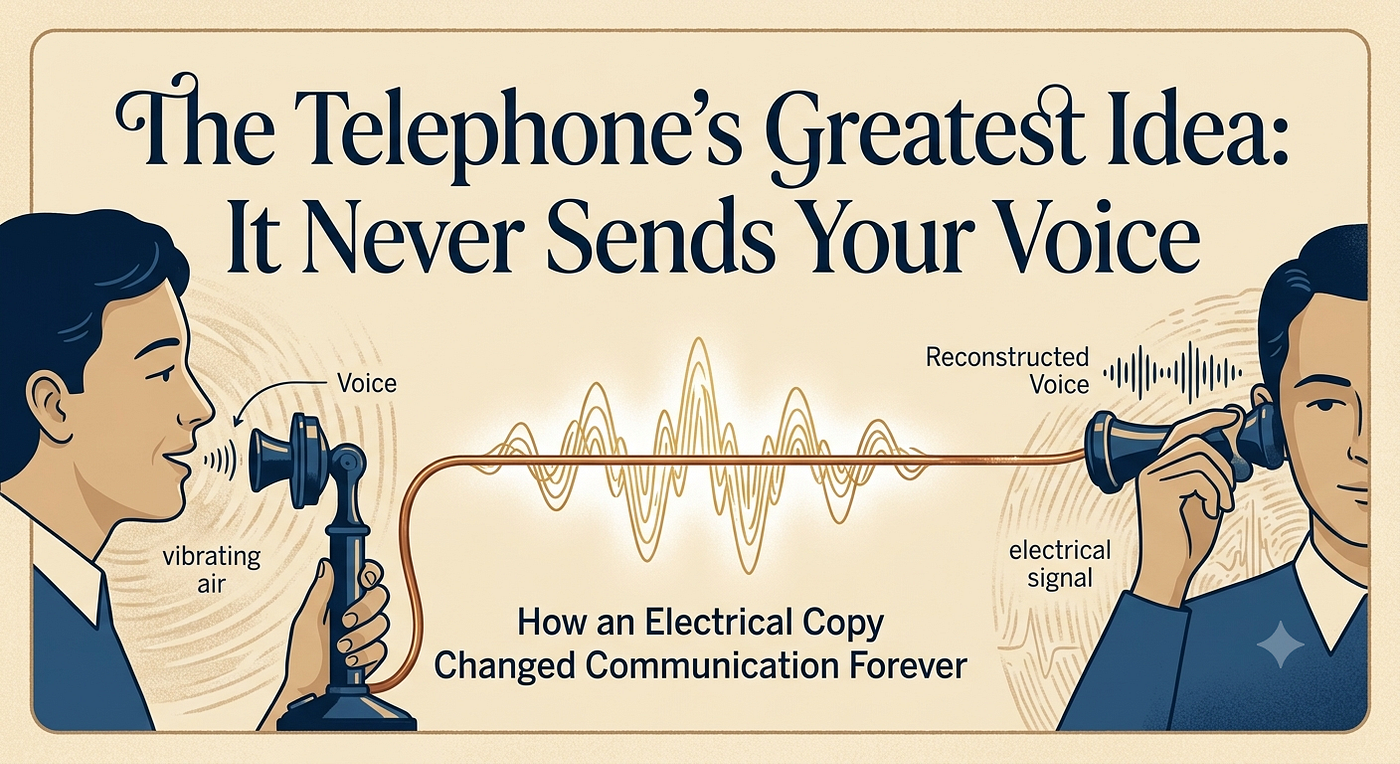
Your voice never enters the wire.
Not even for a moment.
Think About a Shadow

Imagine you’re standing in sunlight.
Your body creates a shadow on the ground.
Now suppose you wave your hand.
Does your real hand travel across the ground?
Of course not.
Only the shadow changes.
The shadow copies your movement.
Your voice and an electrical signal have a very similar relationship.
The electrical signal is not your voice.
It is a copy of your voice’s pattern.
A Simple Example
Imagine you clap your hands once.
text
👏The sound is loud at first.
Then it gradually fades away.
If we drew that sound, it might look something like this:
text
        /\
       /  \
______/    \________
Now imagine a device that watches this pattern and creates an electrical signal with exactly the same shape.
Instead of sending sound through the wire, it sends this electrical pattern:
text
        /\
       /  \
______/    \________
The pattern is the same.
Only the medium has changed.
The Wire Doesn’t Carry Sound
This was the genius behind the telephone.
The telephone does not push air through hundreds of kilometres of wire.
That would be impossible.
Instead, it continuously converts:
text
Sound Pattern
↓
Electrical Pattern
↓
Wire
↓
Electrical Pattern
↓
Sound Pattern
Notice something remarkable.
At no point does the wire know what you are saying.
It doesn’t know English.
It doesn’t know Hindi.
It doesn’t know whether you’re laughing, singing, or crying.
It simply carries a changing electrical pattern.
Meaning exists only in the minds of the people at each end.

The Hidden Principle
Every communication system ever built follows the same philosophy:
text
Original Information
↓
Convert into a Representation
↓
Transmit the Representation
↓
Reconstruct the Original Information
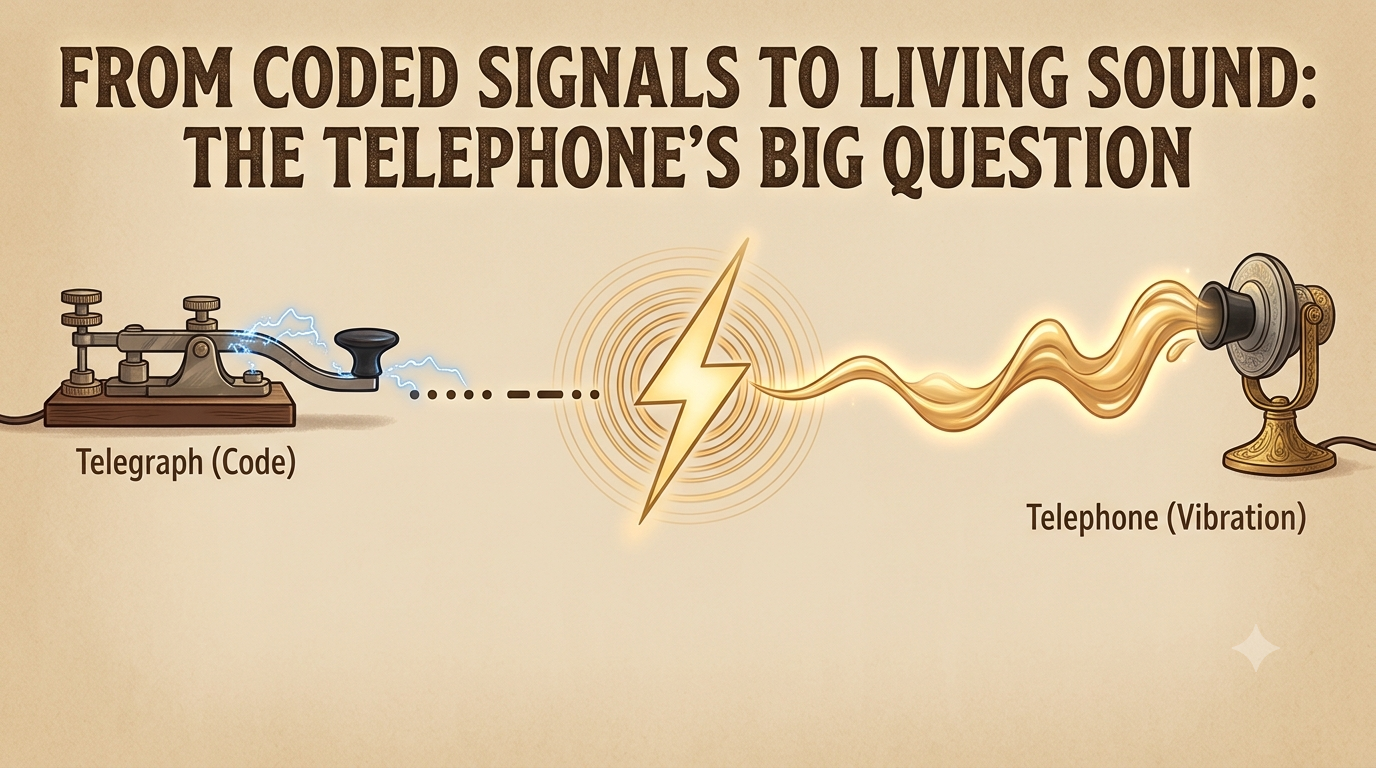
The telegraph did this with dots and dashes.
The telephone did it with electrical waves.
Radio, television, the internet — all of them do it too.
The medium keeps changing.
The idea never does.
But Something Was Still Missing
The telephone was an incredible invention.
For the first time, two people could have a natural conversation across enormous distances.
Yet it had one fundamental limitation.
It was built for humans.
What if, instead of two people talking, we wanted two machines to exchange information?
Computers don’t understand voices.
They don’t understand language.
They don’t even understand pictures.
They only understand one thing.
And that one thing turned out to be the foundation of every network we use today.

메타데이터
- post_id
- dec7c5c8abd0
- slug
- the-telephones-greatest-idea-it-never-sends-your-voice-dec7c5c8abd0
- url
- https://medium.com/@PranjaliMandavi/the-telephones-greatest-idea-it-never-sends-your-voice-dec7c5c8abd0
- canonical_url
- https://medium.com/@PranjaliMandavi/the-telephones-greatest-idea-it-never-sends-your-voice-dec7c5c8abd0
- author_url
- https://medium.com/@PranjaliMandavi
- status
- ok
- fetched_at
- 2026-07-20 00:23:16