Would a Rational Investor Back an OpenAI IPO?
I first met Sam Altman in 2006. Gigi Wang had invited me to speak at a Stanford-MIT VLAB event on the Stanford campus. The other speaker…
Would a Rational Investor Back an OpenAI IPO?
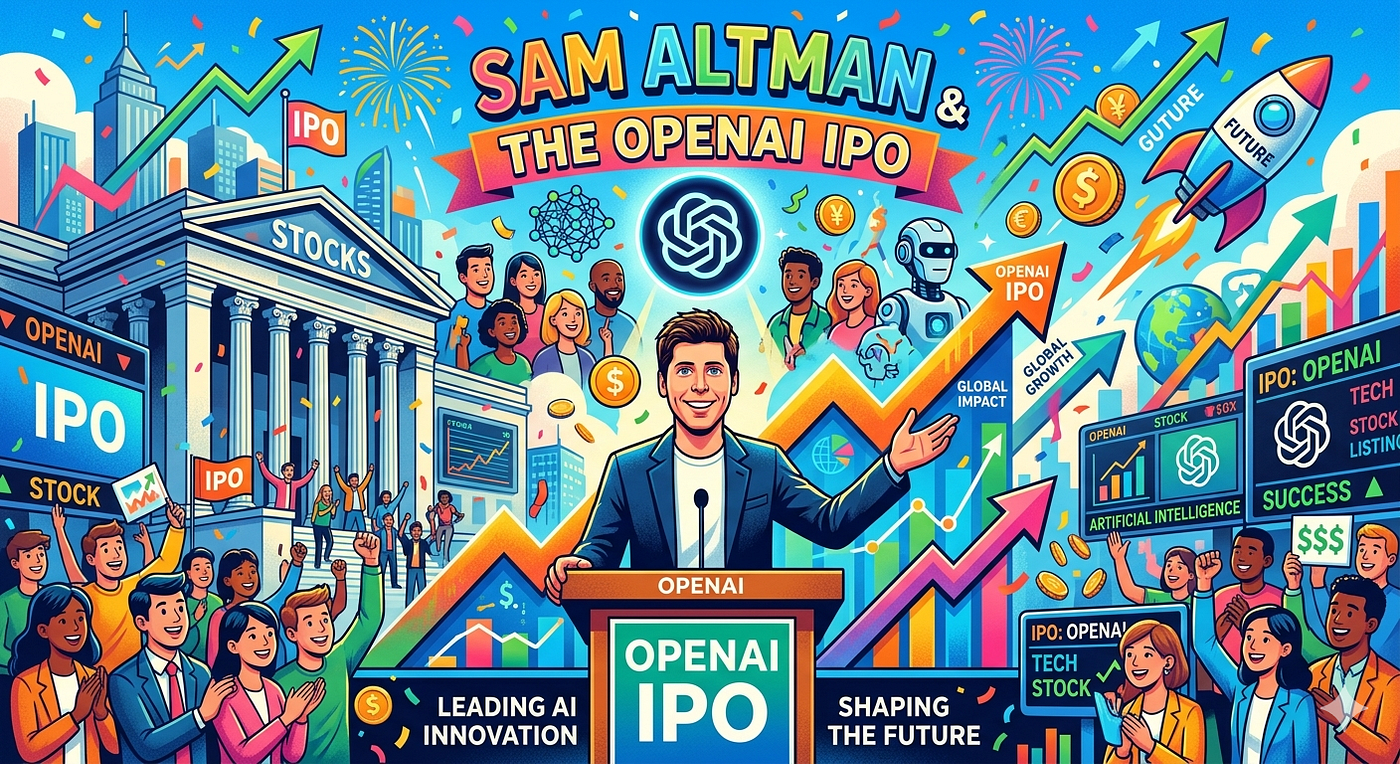
Created with Gemini
I first met Sam Altman in 2006. Gigi Wang had invited me to speak at a Stanford-MIT VLAB event on the Stanford campus. The other speaker that evening was Sam — then the 21-year-old CEO of Loopt, an innovative location-based social mobile app. I was Director of Strategic Planning for the B2B division of Sprint. I represented the “establishment” hoping to remain relevant. Sam represented the innovation about to flip our business model upside down.
I was impressed. Even as a Stanford dropout barely old enough to rent a car, Sam radiated the kind of intelligence and conviction that makes you lean forward in your chair. I continued to follow his career as he became President of Y Combinator and then CEO of OpenAI. His trajectory from college dropout to billionaire architect of the most consequential technology company of our era is simply extraordinary.
And yet, as I watch OpenAI’s march toward a public offering, I find myself asking a question that I suspect more institutional investors should be asking: Is OpenAI actually ready to be a public company — and would being public even be good for it?
The Pivot Problem
OpenAI’s most recent valuation sits at $852 billion. But valuations are stories about the future, and lately OpenAI’s story has been hard to follow.
Consider just the last several months. The company reversed course on whether ChatGPT would carry advertising. It agreed to serve the U.S. military under their terms — then tried to walk it back. It cancelled Sora, giving Disney a single hour’s notice. These aren’t minor course corrections. They are the moves of an organization operating with startup agility: fast, responsive, and willing to disrupt its own commitments when circumstances shift.
In a private company, this is a feature. In a public company, it is a liability.
Public markets price predictability. Quarterly guidance, consistent strategic narrative, and board-level governance that prevents any single leader — however brilliant — from making billion-dollar pivots on instinct. Public investors are not buying a startup’s right to experiment. They are buying a reasonable expectation of how value will be created and protected over time.
Sam Altman has never been constrained by reasonable expectations. That is precisely what makes him exceptional — and precisely what makes an OpenAI IPO complicated.
Are Investors Still Rational?
Of course, one could argue that rationality left the building long before OpenAI arrived. Retail investors and even some institutional players have demonstrated a remarkable appetite for story stocks — companies priced not on discounted cash flows but on narrative momentum. If enough people believe the story, the valuation becomes self-reinforcing, at least for a while.
So perhaps the question isn’t whether a rational investor should invest in an OpenAI IPO. Perhaps the more honest question is: are there enough rational investors left to matter?
And yet, even in a market that tolerates narrative-driven valuations, there are thresholds. The SEC requires disclosure. Shareholder lawsuits punish misleading guidance. Board fiduciary duties constrain the kind of unilateral pivots that Sam has executed with apparent ease as a private company CEO. Going public doesn’t just change the capital structure — it changes the operating environment in ways that can genuinely impede the kind of fast, adaptive strategy that has made OpenAI what it is.
Or Maybe OpenAI Is Exactly Right for This Moment
Here’s the tension I can’t quite resolve: what if OpenAI’s behavior — the pivots, the reversals, the relentless reconfiguration — isn’t a bug but the only rational response to the environment we’re actually in?
I’ve been working with Chengbin Wang to develop a framework we call GENIE to describe what’s happening in the strategic environment right now. The future is no longer predictable — it is Generative. Major disruptors Emerge without warning. Competition has become Networked, ecosystem against ecosystem rather than firm against firm. Intelligence is accelerating the pace of all this change. And organizations that survive are Evolving continuously rather than executing a fixed plan.
In a GENIE world, the traditional strategic logic of Forecast → Plan → Execute is a recipe for obsolescence. By the time a long-range plan is finished, it’s already wrong. The organizations that win are those that build what we call a cognitive flywheel — a continuous loop of scanning for changed assumptions, forming new hypotheses, testing them, and evolving accordingly — all within the guardrails of a clear Mission, Vision, and Values.
If you squint at OpenAI through this lens, Sam Altman looks less like an impulsive executive and more like someone who has internalized GENIE logic at an instinctive level. He’s not executing a plan. He’s operating a cognitive flywheel at extraordinary speed. The pivots aren’t recklessness — they’re rapid hypothesis testing in conditions of absolute uncertainty.
The problem is that public markets were not designed for cognitive flywheels. They were designed for plans.
The Real Question
So we arrive at a genuine strategic dilemma, not just for investors but for OpenAI itself: can an IPO give OpenAI the capital and legitimacy it wants without constraining the adaptive capacity it needs?
The history of technology IPOs offers a mixed answer. Google managed the transition. Meta has. Amazon has, though not without turbulence. But those companies, for all their disruption of others, maintained relatively consistent core business logic over the years following their offerings.
OpenAI’s core business logic is disruption. Of itself as much as anyone else.
There may be a version of a public OpenAI that threads this needle — one where investors genuinely understand that they are buying into an adaptive enterprise rather than a predictable one, and where the governance structures give Sam Altman and his team enough room to keep spinning the flywheel. But that would require a new kind of investor relations, a new kind of disclosure, and frankly, a new kind of investor.
Whether Wall Street is ready for that is, perhaps, the most uncertain question of all.
A note on process: Not surprisingly, this article was developed in collaboration with AI tools. The research, opinions, and editorial judgment are my own; AI assisted in drafting and refinement.
메타데이터
- post_id
- ded9f97f9283
- slug
- would-a-rational-investor-back-an-openai-ipo-ded9f97f9283
- url
- https://clearpurpose.media/would-a-rational-investor-back-an-openai-ipo-ded9f97f9283
- canonical_url
- https://clearpurpose.media/would-a-rational-investor-back-an-openai-ipo-ded9f97f9283
- author_url
- https://medium.com/@russ_13760
- status
- ok
- fetched_at
- 2026-06-09 15:37:30