Florence Cathedral - The Monument That Raised a City Toward the Sky
The Cathedral of Santa Maria del Fiore is the main church of Florence and one of the most recognizable monuments in Italy. Located in…
Florence Cathedral - The Monument That Raised a City Toward the Sky
The Cathedral of Santa Maria del Fiore is the main church of Florence and one of the most recognizable monuments in Italy. Located in Piazza del Duomo, it forms the heart of a monumental religious complex that also includes Giotto’s Bell Tower, the Baptistery of San Giovanni, and the Opera del Duomo Museum. Together, these buildings define the spiritual and architectural center of the city.
Commonly called Florence Cathedral, the church replaced the older cathedral of Santa Reparata, whose archaeological remains can still be visited beneath the present building. The new cathedral was conceived as a statement of faith, civic pride, and political ambition. It was designed to express the wealth and confidence of medieval Florence, then one of the most powerful cities in Tuscany.
Construction began on September 8, 1296, when the first stone was laid. The first architect was Arnolfo di Cambio, who designed a vast Gothic church with a basilican body and an ambitious eastern area intended to support a great dome. His original plan was later enlarged, but several elements of the present cathedral still reflect his early vision.
After Arnolfo’s death in 1302, construction slowed for decades. A major revival came in 1334, when Giotto di Bondone was appointed master builder by the Arte della Lana, the wool guild responsible for supervising the works. Giotto focused mainly on the bell tower, but he died in 1337, leaving the project to later architects.
Andrea Pisano continued the works after Giotto, but the Black Death of 1348 interrupted construction again. In 1349, Francesco Talenti became master builder and gave the cathedral its monumental scale. He enlarged the plan, reduced the number of bays, and made them taller and wider, creating the spacious nave that visitors experience today.
By the late 14th century, the nave and side aisles were largely complete. The remaining challenge was the enormous octagonal opening above the crossing. Traditional wooden centering could not safely support a dome of such size at such height, so Florence needed a revolutionary solution. That solution came from Filippo Brunelleschi.
In 1418, a public competition was launched to solve the problem of the dome. Brunelleschi developed an extraordinary double-shell structure, built without full wooden centering. Work began in 1420 and continued until 1436. His design used masonry rings, ribs, herringbone brickwork, and special construction machines to lift materials to unprecedented heights.
Brunelleschi’s dome remains the cathedral’s greatest architectural achievement. It has an external diameter of about 55 meters and an internal diameter of about 45.5 meters. Its external height, including the lantern and cross, reaches about 116.5 meters, making it one of the dominant features of Florence’s skyline and the largest masonry dome ever constructed.
The cathedral was consecrated by Pope Eugene IV on March 25, 1436, after the completion of the dome. Brunelleschi died in 1446 and did not see the lantern finished. The white marble lantern, about 21 meters high, was completed after his death, while Verrocchio’s golden ball was placed above it in 1471.
The name Santa Maria del Fiore refers to the Virgin Mary and to the “flower” of Florence. The city’s emblem is the lily, and the Latin name Florentia evokes the idea of blooming. The dedication therefore connects religious meaning with civic identity, making the cathedral a symbol of both faith and the city itself.
Architecturally, the cathedral is vast. It measures 153 meters in internal length, about 90 meters across the transept, and around 38 meters in nave width. The vaults rise to approximately 45 meters, while the building covers about 8,300 square meters, excluding the underground remains of Santa Reparata.
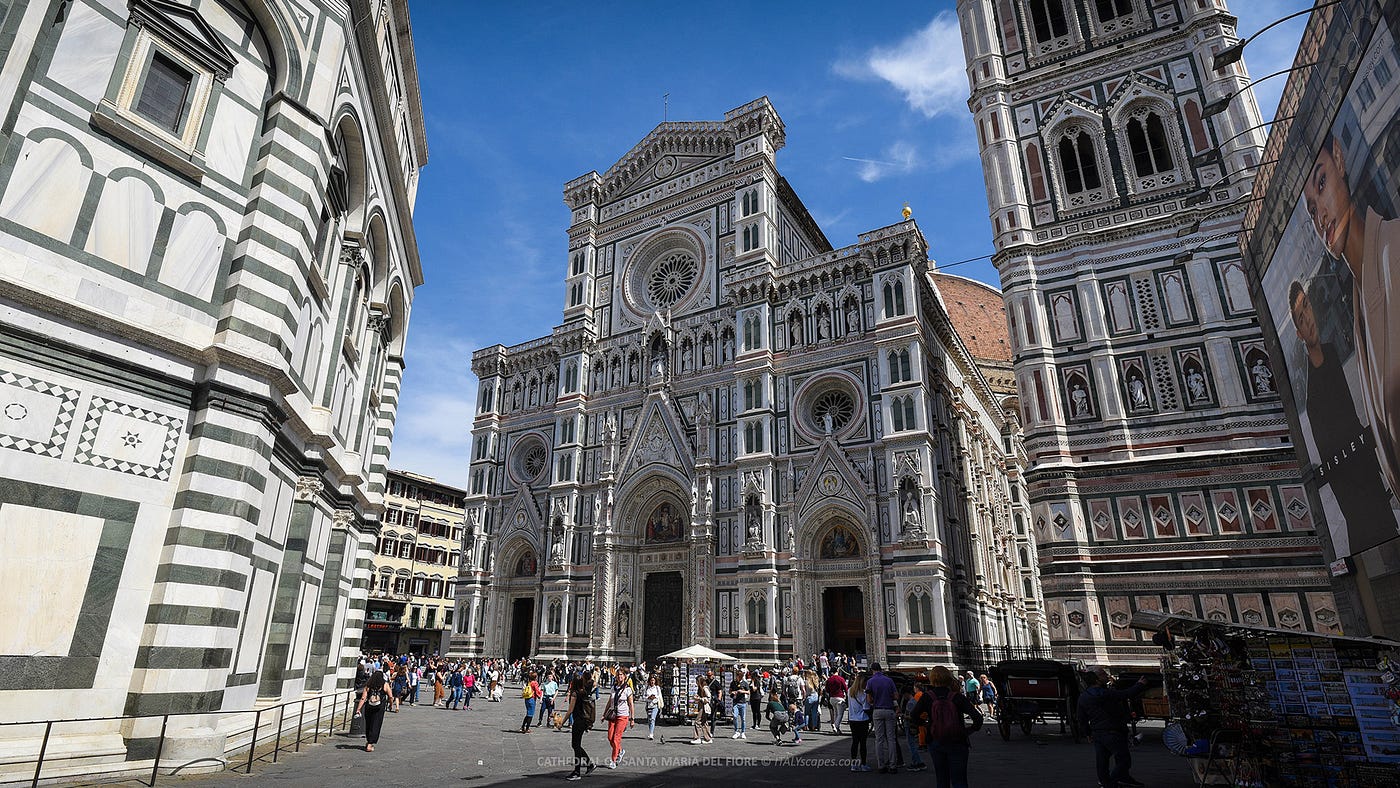
The exterior is covered with white Carrara marble, green marble from Prato, and red marble from the Maremma area. These colors visually connect the cathedral with the Baptistery and Giotto’s Bell Tower. Although the building was constructed over many centuries, the repeated use of colored marble gives the complex a sense of unity.
The present façade is not medieval. Arnolfo’s original façade was never completed and was dismantled in 1587. For centuries, the cathedral stood without a permanent monumental front. The current Neo-Gothic façade was designed by Emilio De Fabris, continued by Luigi del Moro, and completed in 1887.
The façade uses the same white, green, and red marble as the rest of the complex. Its decoration focuses on religious themes, especially the life of the Virgin Mary. The three large bronze doors, added between 1899 and 1903, show scenes from the life of the Madonna and complete the monumental front.
Inside, the cathedral is surprisingly restrained. Compared with the colorful exterior, the interior feels sober, open, and almost civic. Massive pillars, pointed arches, and enormous bays create a sense of scale rather than dense decoration. The marble floor, designed mainly between the 16th and 17th centuries, adds geometry and color.
The cathedral also contains important artworks. On the counter-façade is Paolo Uccello’s liturgical clock, painted in 1443 and based on the historical hora italica time system. The nave includes Domenico di Michelino’s Dante with the Divine Comedy and two frescoed equestrian monuments by Paolo Uccello and Andrea del Castagno.
The stained-glass windows form one of the richest cycles in Italy. Created mainly between 1434 and 1455, they were designed by major artists including Lorenzo Ghiberti, Donatello, Paolo Uccello, and Andrea del Castagno. Their images include saints, prophets, New Testament scenes, and episodes connected with the Virgin Mary.
The interior of the dome is covered by the enormous Last Judgment fresco, painted between 1572 and 1579. The work was begun by Giorgio Vasari and completed by Federico Zuccari and collaborators. Covering about 3,600 square meters, it includes Christ in Glory, the Virgin Mary, saints, angels, virtues, beatitudes, Hell, and the deadly sins.
Beneath the cathedral lie the remains of Santa Reparata, revealed by excavations carried out between 1965 and 1974. The underground area preserves traces of Roman, early Christian, and medieval Florence. It also contains the tomb of Filippo Brunelleschi, an exceptional honor for the architect who solved the dome’s great challenge.
Florence Cathedral also has a scientific side. In 1475, Paolo dal Pozzo Toscanelli installed a gnomonic instrument that projected sunlight through a small opening high in the lantern area. Later, Leonardo Ximenes added a graduated bronze meridian line, allowing observations connected with the summer solstice and the solar year.
The cathedral is easy to reach on foot. From Firenze Santa Maria Novella railway station, the walk is about 800 meters and usually takes around 10 minutes. It is also close to Piazza della Signoria, the Uffizi Gallery, and Ponte Vecchio, making it central to any first-time Florence itinerary.
Entry to the cathedral itself is free, but tickets are required for the dome, bell tower, baptistery, museum, and Santa Reparata. Visitors can climb Brunelleschi’s dome by following 463 steps between the two shells, a route that combines architecture, history, and panoramic views over Florence.
The Cathedral of Santa Maria del Fiore is not only a church. It is a record of Florence’s medieval ambition, Renaissance innovation, artistic excellence, religious devotion, and civic identity. Its dome changed architectural history, its scale transformed the city, and its silhouette remains one of the clearest symbols of Florence.
메타데이터
- post_id
- dede6efc29ae
- slug
- florence-cathedral-the-monument-that-raised-a-city-toward-the-sky-dede6efc29ae
- url
- https://medium.com/@ovidiu.tutunaru/florence-cathedral-the-monument-that-raised-a-city-toward-the-sky-dede6efc29ae
- canonical_url
- https://medium.com/@ovidiu.tutunaru/florence-cathedral-the-monument-that-raised-a-city-toward-the-sky-dede6efc29ae
- author_url
- https://medium.com/@ovidiu.tutunaru
- status
- ok
- fetched_at
- 2026-07-10 21:50:49