From DEI Backlash to Inclusive Resilience
How Social Enterprises Can Lead Through Opposition and Build Sustainable Inclusion
From DEI Backlash to Inclusive Resilience
How Social Enterprises Can Lead Through Opposition and Build Sustainable Inclusion

Source: JLco — Julia Amaral via iStockPhoto
In “The DEI Advantage,” I explained why diversity, equity, and inclusion (DEI) are vital for fostering innovation, ensuring financial sustainability, and enhancing market competitiveness. The article demonstrated that social enterprises employing inclusive organizational models tend to outperform their competitors, broaden their market reach, and develop long-term resilience.
However, DEI is currently facing an unprecedented backlash. Political, regulatory, and cultural resistance has turned inclusion into a target rather than a standard expectation. The issue isn’t whether DEI is valuable but how to maintain it in an environment of opposition. In my opinion, social enterprises need to shift from advocacy to resilience.
This article builds upon the ideas presented in “The DEI Advantage” by changing the focus from the importance of inclusion to practical strategies for leaders to protect, integrate, and sustain DEI in the face of resistance. I believe that the most successful social enterprises do not just advocate for diversity; they embed it into their economic foundation, supply chains, workforce strategies, and long-term organizational models.
“The Accelerate Impact Model approach to Advance Diverse Talent offers more than just a roadmap; it provides a vision for a genuinely inclusive and impactful social enterprise. It challenges us to think bigger, to act bolder, and to relentlessly pursue a model of operation that not only advances our business objectives but also contributes to a more equitable and just society. As we navigate this path, let us remember that pursuing diverse talent is about unleashing the full potential of human creativity and collaboration for the greater good.” Advancing Diverse Talent. Barry J Barresi April 2020

Embedding DEI Into Core Operations
The backlash against Diversity, Equity, and Inclusion (DEI) is significant, but retreating is not an option for mission-driven organizations. The key is to move beyond mere rhetoric and seamlessly integrate inclusion into the organizational framework, making it resilient to external pressures. Opposition to DEI can take many forms — such as presidential edicts, legislative rollbacks, investor skepticism, and public resistance — but the solution remains the same: align DEI with core organizational strategy, financial sustainability, and competitive advantage.
Leaders who view DEI as an isolated initiative make it an easy target for criticism. Instead, reframe inclusion as an operational advantage and thus a driver of profitability, innovation, and risk mitigation. DEI transforms from a potential vulnerability into a structural necessity when effectively embedded.
It is crucial to shift the narrative to counter resistance effectively. DEI is about fairness and expanding talent pipelines, increasing workforce productivity, reducing turnover, enhancing market relevance, and mitigating financial risk. Leaders must steer the conversation away from politics and compliance and focus on organizational growth and long-term economic impact.
Sustaining DEI in a hostile environment requires proactive adaptation. Design inclusion into hiring practices, leadership pathways, supply chain strategies, and investment frameworks. Organizations that excel in this integration will make DEI initiatives indispensable.
How Leaders Embed DEI for Resilience
Reframing DEI as an Economic Strategy
Leaders must change the conversation about Diversity, Equity, and Inclusion (DEI) to thrive in a challenging environment. When DEI is framed as a social obligation, it becomes an easy target for backlash. However, when positioned as an economic necessity, it becomes essential for operational success.
Organizations with diverse leadership consistently outperform their peers regarding revenue growth, innovation, and risk management. Investing in inclusive hiring practices, leadership development, and supplier diversity helps reduce turnover, lower operational costs, and provide access to new markets. Investors should note that DEI is a crucial metric for risk assessment in impact investing, Environmental, Social, and Governance (ESG) scoring, and corporate governance.
Inclusion is not solely about growth; it is also about resilience. Organizations that lack diverse leadership, workforce agility, and inclusive supply chains are more susceptible to economic downturns and regulatory changes. Organizations that do not invest in diverse talent face workforce shortages, and those that overlook inclusive product design risk losing relevance with emerging consumer demographics.
Organizations that remain committed to inclusion retain the trust of beneficiaries and contributors and broaden their reach. In contrast, those who waver risk significant brand damage and loss of loyalty. In an economy where brand loyalty is about trust and values, DEI is a market differentiator rather than a political statement.

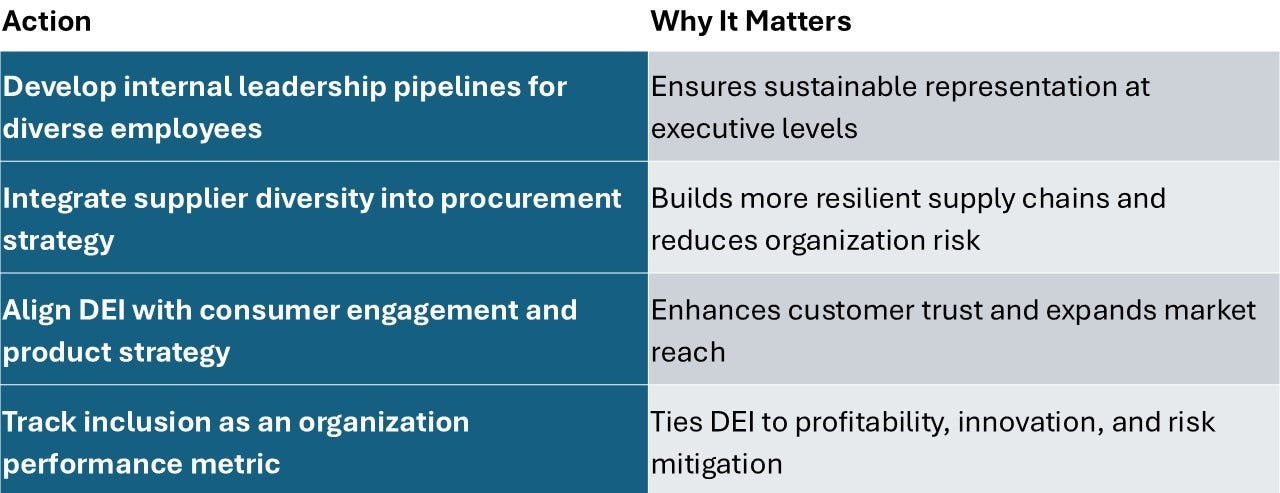
Strategic Actions to Position DEI as an Economic Driver
Building Inclusive Resilience for Long-Term Impact
DEI (Diversity, Equity, and Inclusion) initiatives often fail when seen as mere programs instead of essential organizational elements. Leaders must create self-reinforcing systems where diversity is integral, enhancing financial health, stability, and innovation. DEI should be monitored as a performance indicator, highlighting its significance in employee retention, market share, earned income, philanthropy, and efficiency.
Collaboration with impact investors, contributors, policy advocates, and industry coalitions is crucial to positioning DEI as a shared standard and counteracting regulatory and funding challenges. Additionally, organizations should shape the narrative around inclusion, showcasing its benefits, such as reduced hiring costs, innovative, diverse teams, and supplier diversity leading to competitive pricing.
Leaders who frame DEI as a strategic asset will embed it in their organizations’ frameworks, ensuring its importance amid external pressures. The future of DEI is not about mere defense but about making it essential for hiring, operations, and growth, setting the standard for resilient organizations.

Key Leadership Actions to Build Inclusive Resilience
The Future of Inclusive Resilience
Social enterprises must respond to growing resistance to inclusion by demonstrating steady leadership and implementing a clear, mission-driven strategy. The most resilient social enterprises will integrate inclusion into their operating model, ensuring inclusion is viewed as an economic advantage rather than a vulnerability.
Social enterprises have historically balanced purpose with financial sustainability, showing that mission and financial stability are not at odds but are, in fact, interdependent. The challenge lies in embedding diversity, equity, and inclusion (DEI) so deeply within hiring practices, governance, partnerships, and revenue models that it cannot easily be dismantled. Social enterprise leaders should move beyond advocacy to operational integration, where inclusion becomes a valuable and measurable driver of enterprise success.
The path forward is clear: DEI must be more than just a statement; it should be evident in earned revenue strategies, workforce models, and investor engagement. Social enterprise leaders who frame inclusion as a market strategy, a risk-mitigation tool, and an investment in long-term stability will set the standard for the future of impact-driven organizations. Those who hesitate, fearing backlash or scaling back their commitments, risk losing the momentum that established their leadership in social innovation.
The future belongs to those social enterprises that treat DEI as a core operational function rather than an external initiative. Social enterprises do not just withstand DEI hostility; they should lead with Inclusive Resilience.

Sources and References
Primary Sources
The DEI Advantage: Unlocking Growth, Impact, and Resilience in Social Enterprises Barry J. Barresi, Accelerate Impact Playbook (2025)
How Integrating DEI Into Strategy Lifts Performance. MIT Sloan Management Review (2024)
Diversity Matters even more: The case for holistic impact. McKinsey & Organization (2023).
How and Where Diversity Drives Financial Performance Harvard Business Review (2018).
Overcoming Racial Equity Fatigue. Stanford Social Innovation Review. (2021)
Business Case for Racial Equity Mississippi. Altarum WK Kellogg Foundation (2018)
Expanding Equity. W.K. Kellogg Foundation (2023)
The Case for Inclusive Capitalism. Council for Inclusive Capitalism. (2024)
Additional Resources
Inclusive Innovation for Sustainable Social Impact. Barry J Barresi, PhD. Accelerate Impact Playbook. Key Insight: Embedding diversity into organizational culture accelerates social innovation and expands market reach. February 2024
Building Inclusive Digital Mental Health Platforms for Diverse Youth. Barry J Barresi, PhD. Accelerate Impact Playbook. Key Insight: Co-creating solutions with diverse communities improves adoption, engagement, and long-term impact. October 2024.
Empowering Economic Inclusion: Leadership Strategies for Social Entrepreneurs. Barry J Barresi, PhD. Accelerate Impact Playbook. Key Insight: Economic inclusion strategies, workforce development, and impact-driven funding models enhance financial sustainability. June 2024.
메타데이터
- post_id
- dedfc826472b
- slug
- from-dei-backlash-to-inclusive-resilience-dedfc826472b
- url
- https://avplaybook.com/from-dei-backlash-to-inclusive-resilience-dedfc826472b
- canonical_url
- https://avplaybook.com/from-dei-backlash-to-inclusive-resilience-dedfc826472b
- author_url
- https://medium.com/@barrybarresi
- status
- ok
- fetched_at
- 2026-08-18 22:33:10



