Beyond the Mainland: The Forgotten Eras of Island Football Giants
There are plenty of islands in Europe. The Mediterranean Sea alone is home to more than a hundred. Beyond that, Portugal claims Madeira…
**Beyond the Mainland: The Forgotten Eras of Island Football Giants**
There are plenty of islands in Europe. The Mediterranean Sea alone is home to more than a hundred. Beyond that, Portugal claims Madeira, while Spain governs the Canary Islands. Many of these islands boast sizeable cities, and some host football clubs that — despite their geographic isolation from the mainland — periodically achieve success. And we are not just talking about domestic leagues or cups, but the international stage as well. A few of these “island” teams have even managed to lift domestic league titles and reach major European finals.
To be clear, this article is not about island nations. UEFA has plenty of those, and their football ecosystems are entirely self-contained. Instead, our focus is on clubs representing islands that belong to mainland states, often located far from the continent itself.
Denmark also deserves a special mention here. While Denmark is a mainland nation, its capital, Copenhagen, is situated on the island of Zealand. The city is home to famous clubs that currently set the tone in the domestic league (FC Copenhagen) or did so in the past (Brøndby). However, Zealand houses nearly half of Denmark’s population. Furthermore, the country is tiny — excluding Greenland — and is highly compact. Therefore, terms like “geographic isolation” simply do not apply here.
Below is the story of the loudest European achievements by true “island” teams. The list is structured as a countdown, moving from the lesser achievements to the absolute peaks.
Crete: OFI Crete FC (Greece)
Crete is a Greek island in the Mediterranean Sea. Its largest city, Heraklion, is home to OFI Crete FC. The club’s finest hour on the continental stage came during the 1993/94 UEFA Cup campaign. OFI embarked on a memorable run, navigating through the first two rounds by eliminating two formidable opponents: Slavia Prague and the mighty Atlético Madrid. However, the third round proved to be a bridge too far. OFI was comprehensively outclassed by Portugal’s Boavista, crashing out 1–6 on aggregate.
In total, the Cretan side has featured in major European competitions six times — five in the UEFA Cup and once in the European Cup Winners’ Cup. They also had a brief stint in the Intertoto Cup back in 2007, but that tournament can hardly be classified as a proper, elite European competition.

Photo: Wikimedia Commons / Public Domain
All things considered, OFI’s record pales in comparison to the historic achievements of Athens giants like Panathinaikos or Olympiacos. In fact, despite these occasional European exploits, OFI cannot even be considered a consistent mid-table side in the Greek domestic league.
Madeira: Marítimo and Nacional (Portugal)
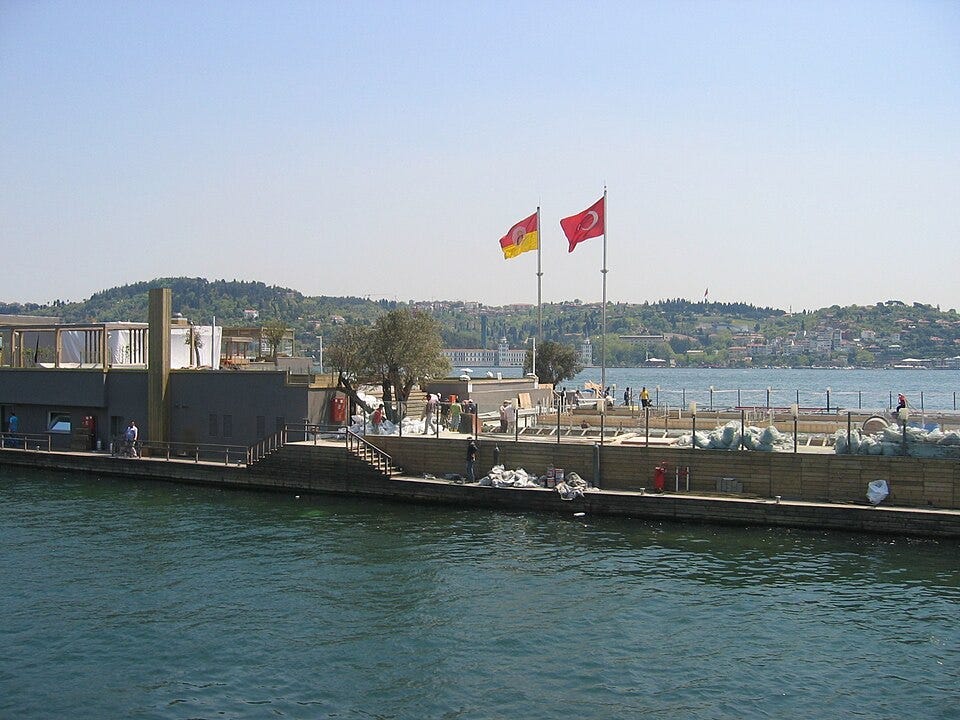
The Portuguese island of Madeira is the birthplace of two distinct clubs that have tasted European football: Marítimo and Nacional, both hailing from the city of Funchal. To date, both sides have competed exclusively in the UEFA Cup and its successor, the UEFA Europa League.
Nacional made their European debut in 2004, but their first real breakthrough came in 2009. In a shocking upset, Nacional eliminated Zenit Saint Petersburg in the play-off round (winning 4–3 at home and drawing 1–1 away) to qualify for the group stage of the newly rebranded Europa League. Drawn into a brutal group alongside Werder Bremen, Athletic Bilbao, and Austria Wien, the islanders managed to collect five points and secure a respectable third-place finish.
Marítimo, on the other hand, stepped onto the continental stage much earlier, back in 1993. For many years, the club struggled to advance past the opening rounds. A notable exception came in 1998, when they pushed a formidable Leeds United side to the absolute limit, losing only on penalties after the teams traded 1–0 home wins.
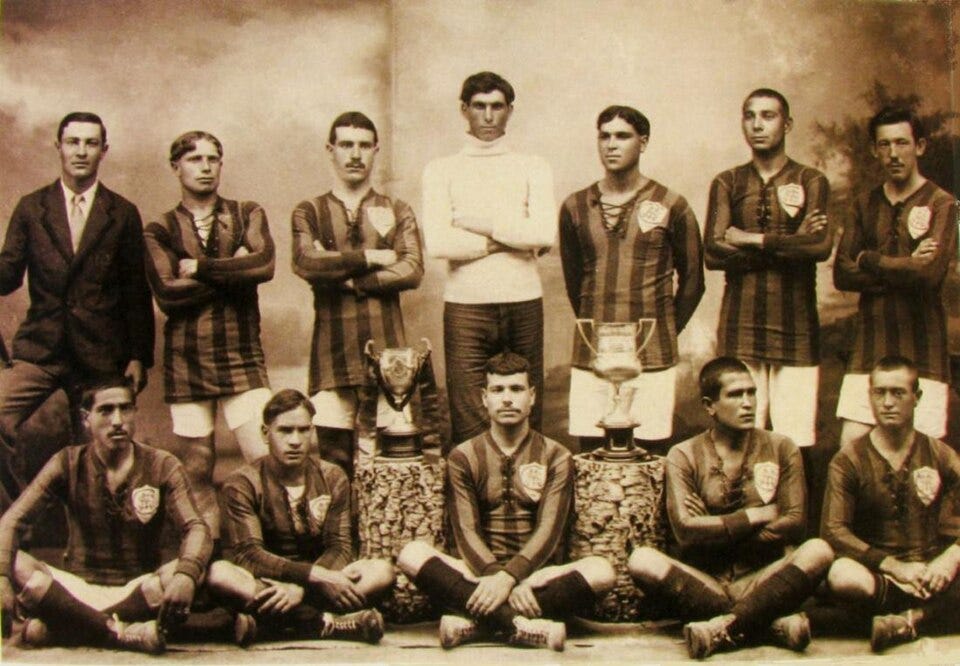
Photo: Wikimedia Commons / Public Domain
Marítimo’s finest hour arrived in the 2012/13 season when they successfully navigated the qualifiers to reach the Europa League group stage. Facing Bordeaux, Newcastle United, and Club Brugge, the Portuguese side earned six points, finishing third and famously bowing out ahead of the Belgian giants.
An impressive tactical footnote: since a home defeat to BATE Borisov in 2010, Marítimo has remained unbeaten at their stadium for seven consecutive European matches. While Madeira’s clubs have certainly carved out their own proud moments, their achievements still pale in comparison to Portugal’s continental powerhouses like Porto, Sporting CP, Benfica, Braga, or Boavista.
Sicily: Palermo (Italy)
Sicily is the largest island in the Mediterranean Sea and an integral part of Italy. Spanning 25,000 square kilometres, its landmass is larger than Slovenia and only slightly smaller than Belgium. Home to over five million people, the island sits in immediate proximity to the Italian mainland.
In the Sicilian capital of Palermo — a city of nearly 700,000 residents — belongs the football club of the same name. Surprisingly, given the scale of the region, the team has never achieved major success in European competitions.

Photo: Wikimedia Commons / Public Domain
Palermo made their continental debut in the UEFA Cup as late as 2005, managing a run to the Round of 16. The club returned to the UEFA Cup and Europa League in 2006, 2007, 2010, and 2011, but failed to progress past the group stage on any of those occasions.
Sicily boasts two other clubs with significant history in Serie A: Catania and Messina. However, neither side ever managed to qualify for European football. Thus, despite possessing all the necessary ingredients — wealth, population, and passion — Sicily is far from being Italy’s ultimate footballing hotbed. And unlike other entries on this list, their lack of silverware certainly cannot be chalked down to geographic isolation.
Sardinia: Cagliari (Italy)
Sardinia is another massive Mediterranean island belonging to Italy. Today, the local side, Cagliari Calcio, mostly finds itself battling in the lower half of the Serie A table. However, the club boasts a legendary history, highlighted by their historic Scudetto triumph in 1970. Discounting the old Inter-Cities Fairs Cup, Cagliari has featured on the major European stage three times.
In 1970, fresh off their league title, the club eliminated Saint-Étienne in the first round of the European Cup. However, their journey was cut short in the Round of 16 by Atlético Madrid, who overturned Cagliari’s 1–0 first-leg home victory. Two years later, the Sardinians suffered a disappointing first-round exit in the UEFA Cup, losing both legs to Greece’s Olympiacos.

Photo: Wikimedia Commons / Public Domain
Cagliari’s third — and, to date, final — European campaign came in the 1993/94 season, and it turned into an absolute fairy tale. Competing in the UEFA Cup, the islanders went on a spectacular run all the way to the semi-finals. Along the way, they knocked out Dinamo București, Trabzonspor, and Mechelen.
But the undisputed crown jewel of that run came in the quarter-finals, where Cagliari faced the formidable tournament holders, Juventus. After grinding out a 1–0 victory at home in Sardinia, Cagliari doubled down in Turin, stunning the bianconeri with a 2–1 away win to complete a historic aggregate victory.
In the semi-finals, they crossed paths with yet another domestic powerhouse, Inter Milan. Cagliari won a thrilling first leg at home 3–2, but their European dream finally evaporated in Milan, where they were overwhelmed 0–3. The club has not returned to Europe since, but that 1994 UEFA Cup semi-final remains a monumental testament to the sheer strength of that island side.
The Balearic Islands: Mallorca (Spain)
The Balearics are a stunning Mediterranean archipelago belonging to Spain. In 1998, the island’s flagship club, RCD Mallorca, made its unforgettable debut on the continental stage. Managed by the tactical mastermind Héctor Cúper, the team embarked on an unbeaten run all the way to the European Cup Winners’ Cup final, where they finally fell to Italy’s star-studded Lazio.
Was it a total miracle? Not quite. In its final years, the Cup Winners’ Cup had notably declined in quality, and Mallorca were arguably expected to reach the semi-finals at the very least. Opponents like Scotland’s Hearts, Belgium’s Genk, and Croatia’s Varteks were heavy underdogs compared to the ambitious Spanish debutants. However, knocking out Chelsea in the semi-finals (grabbing a 1–1 draw in London and sealing it with a 1–0 home victory) commands immense respect.
The following 1999/2000 season brought immediate heartbreak, as Mallorca failed to qualify for the UEFA Champions League group stage. They were stunningly locked out by Norway’s Molde. Dropping into the UEFA Cup, Mallorca dusted themselves off and marched all the way to the quarter-finals.

Photo: Wikimedia Commons / Public Domain
In 2001, Mallorca made amends, successfully navigating the qualifiers on their second attempt to reach the Champions League group stage. Placed in a fiercely competitive group alongside Panathinaikos, Arsenal, and Schalke 04, the Balearic islanders finished third, accumulating a highly respectable nine points. Mallorca missed out on the knockout stages to Arsenal purely on head-to-head record, having beaten the Gunners 1–0 at home before losing 1–3 at Highbury.
Mallorca’s final European adventure to date took place in the 2003/04 season, capping off a golden era with another deep continental run to the UEFA Cup Round of 16.
Corsica: Bastia (France)
Corsica is a rugged French island in the Mediterranean Sea, situated just north of Italian Sardinia. SC Bastia, hailing from the city of the same name, rightfully claims the undisputed number-one spot in our ranking. In the 1977/78 season, this modest island side achieved a monumental feat, becoming the first-ever French club to reach a UEFA Cup final.
Throughout that historic campaign, Bastia looked absolutely unstoppable. They ruthlessly marched through the tournament, eliminating Sporting CP, Newcastle United, Torino, Carl Zeiss Jena, and Grasshopper. Remarkably, they won both legs against their first three opponents. Bastia did not suffer a single defeat in that UEFA Cup run until the quarter-final second leg; however, after demolishing Carl Zeiss Jena 7–2 in the home leg, a 2–4 away loss was easily forgiven.
Their semi-final clash against Grasshopper, however, was a masterclass in tension, with Bastia advancing strictly on away goals. The Swiss side had won the first leg 3–2 in Zurich, giving themselves a massive chance to reach the final. But back on their home turf, Bastia ground out a crucial 1–0 victory, scoring the decisive goal in the second half.
In the two-legged final, Bastia ultimately fell to PSV Eindhoven. A tense 0–0 draw in the first leg in Corsica kept their dreams alive, but PSV proved too strong in the return leg, comfortably defeating the French side 3–0 on Dutch soil.
It is vital to contextually understand the weight of this achievement: back then, the UEFA Cup was arguably the toughest tournament in the world. It was the only competition where a country’s allocation of spots depended directly on its position in the UEFA coefficient table. In contrast, the European Cup and the Cup Winners’ Cup allowed only one representative per nation, regardless of how strong their domestic league was. This meant the UEFA Cup was packed with the finest second, third, and fourth-placed teams from Europe’s elite leagues, making a run to the final just as difficult — if not harder — than in the European Cup.
Unfortunately, this spectacular triumph proved to be a one-off. Over the subsequent four decades, Bastia features in major European competitions just twice. In the 1981/82 season, they were eliminated by Dinamo Tbilisi in the second round of the Cup Winners’ Cup, and in 1997, their UEFA Cup journey was cut short in the Round of 32 by Steaua București. Domestically, the golden era has long faded, with Bastia’s last appearance in Ligue 1 dating back to the 2016/17 season.
메타데이터
- post_id
- dee0a3564e00
- slug
- beyond-the-mainland-the-forgotten-eras-of-island-football-giants-dee0a3564e00
- url
- https://medium.com/@vladimir20865/beyond-the-mainland-the-forgotten-eras-of-island-football-giants-dee0a3564e00
- canonical_url
- https://medium.com/@vladimir20865/beyond-the-mainland-the-forgotten-eras-of-island-football-giants-dee0a3564e00
- author_url
- https://medium.com/@vladimir20865
- status
- ok
- fetched_at
- 2026-07-13 09:45:54