What the Library of Alexandria Was Hiding About the Great Pyramid
Four remote viewers, two ancient sites, and one blueprint that refuses to make sense
What the Library of Alexandria Was Hiding About the Great Pyramid
Four remote viewers, two ancient sites, and one blueprint that refuses to make sense
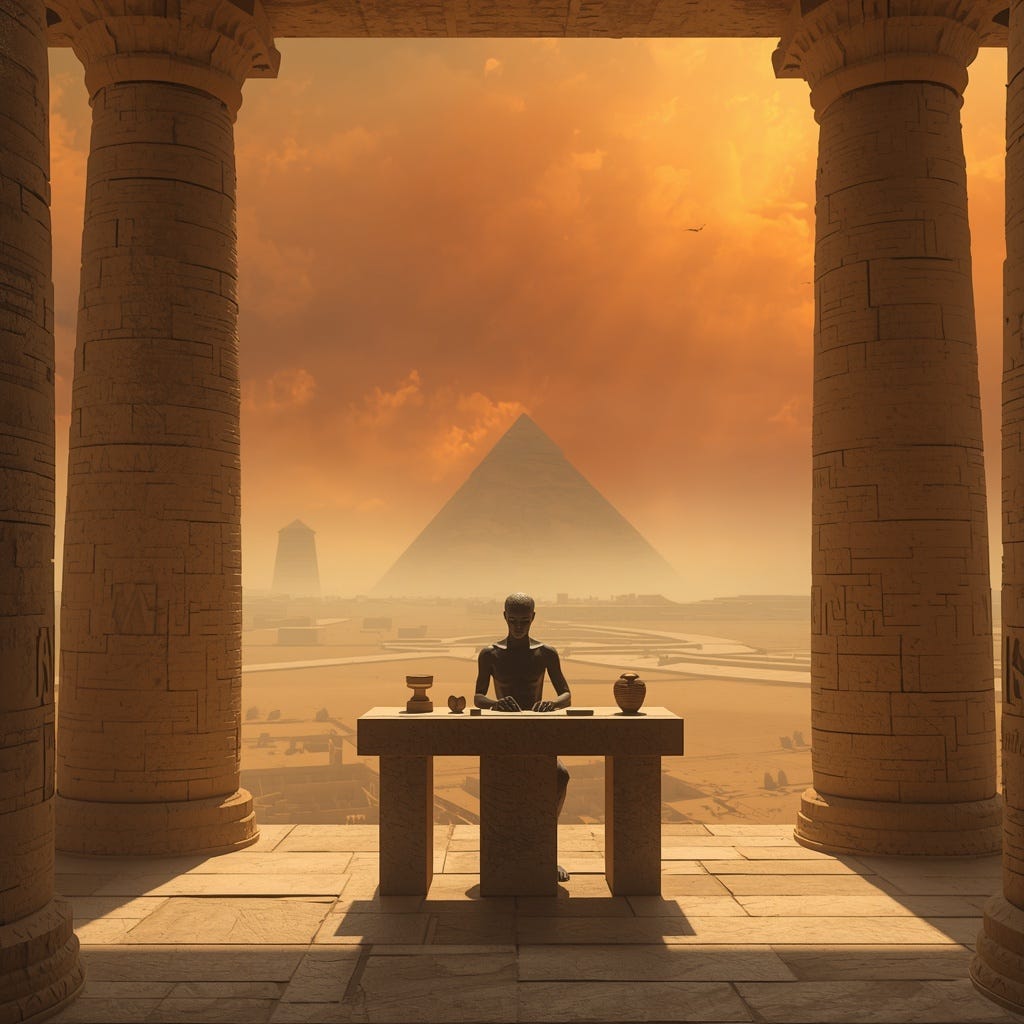
“Remote Viewing Target 0453: The figure who knew what the pyramid was really for” - author’s work with leonardo.ai
There is a place on Earth that refuses to behave like a ruin.
It has stood for more than thousands of years. Millions have visited it. Hundreds of scientists have studied it. And yet, the more we know, the less we understand.
The Great Pyramid at Giza isn’t just the world’s greatest ancient mystery. It’s starting to look like a device whose instruction manual we no longer have. Or perhaps we never had it in the first place.
The Experiment That Didn’t Fail (Or Succeeded Too Well)
Some time ago, a group of Remote Viewing practitioners decided to look at the pyramid not like archaeologists, but like engineers. They didn’t ask “Who built this?” They asked something far more unsettling:
“What does it do?”
The protocol was classic: blind targets, independent viewers, zero prior information. Sessions separated by time and space. And then came the comparison of results. That’s where the problem started. Because there shouldn’t have been this much coherence.
Viewer One: “This Isn’t a Building. It’s… a Protocol.”
The first viewer entered the perception of the structure and immediately felt a temporal dissonance. Something was wrong with when this thing was made. Yes, the stone is there. But the stone behaves like a carrier of function, not like building material.
Geometry perceived as intention, not as shape. Precision that isn’t architectural but systemic. And something else, something that shouldn’t exist in an ancient tomb: pulsing. Barely perceptible, but constant. As if the structure were still operating.
“I didn’t feel like I was looking at a building,” the first viewer reported. “I felt like I was entering a machine.”
Viewer Two: “It’s an Interface. Between Earth and… Something.”
The second viewer saw something different, yet strangely similar. Astronomical orientation was obvious. But this wasn’t about “observing” the stars. This was about targeting. As if the structure were an antenna. Or a gate.
The interior didn’t behave like architecture. It behaved like layered functionality. Physical level: yes, stone. Energy level: flows that aren’t physical. And a level of something else entirely? The strangest part came when time began to slow inside. Not metaphorically. Literally. The perception of time expanded, as if someone had turned a dial on reality itself.
“It wasn’t like sightseeing,” the second viewer said. “It was like… logging in.”
Viewer Three: “There’s No Owner Here. Only a System.”
The third viewer searched for the architect. Didn’t find one. Or rather, found the absence of an architect. Not in the sense that “nobody built this,” but in the sense that this didn’t arise like a building. It was initiated like a process.
Organized energy, but not human in character. Something that operates like an algorithm. Something that reacts to the observer. The strangest moment of the session came when trying to “reach the source,” to find who designed this. Instead of an image of a person, there was silence. Not emptiness. Silence like in a communication protocol waiting for the correct query.
“Like trying to talk to an operating system,” the third viewer explained. “Which doesn’t understand the language of ‘who,’ only ‘how.’”
And Then a Fourth Viewer Appeared
This wasn’t a planned target. This was the Library of Alexandria. A different session. A different day. A different objective. But a strange coincidence nonetheless.
What Shouldn’t Have Been There
Target 0453. Blind protocol. The viewer entered perception.
Warmth. Light. A large room with a semicircular ceiling. A group of figures, uniformly dressed like monks, deliberating. They stand far from the great doors. They’re afraid.
Behind the doors: darkness. Not physical darkness. Symbolic. Something that wants to come out but cannot. Not without permission. And then came the flash: blueprints.
Schematics of structures. Schematics of machines. Information about a specific location in space. Something from longer ago than we think. And all of it recorded in a strange way, as if the author didn’t quite think like a human.

The mechanism seen during the session — author’s work based on their sketches/GPT Image
The Being at the Stone Table
That’s when he appeared. Sitting in shadow, at a stone table. Behind him, structures of sandstone. Above his head, a stone roof of a “veranda.” Around him, dust and a dimmed, reddish sky. Very warm.
His description reads like something from a nightmare. Or from mythology. Or from something else entirely. Long, thin, skeletal arms. Protruding elbows like insect joints. An elongated, unnaturally long face. A goatee. Piercing, large eyes. Gray hair swept back. Brown torso, the color of coffee with milk. Wrapped in a sash.
Old. Tall. Focused. Bent over his work, sketching something on stone. Every so often, he glances to the sides. As if checking whether anyone is watching. And then he returns to the blueprints.
“I felt that he lives longer than we do,” the viewer reported. “Much longer.”
The Thought That Changes Everything
“Similar in origin to us.”
Not “this was a vision” in the sense of fantasy. This was a feeling, deep, atypical for normal perception. Hybrids. Not in the science fiction sense. In the sense of something that connects. Something between humanity and something older.
And those blueprints? Somewhere in the world, in fragments, they still exist.
The Question That Connects Everything
What if those three viewers at the pyramid plus the fourth at the library saw the same system from two sides?
Pyramid equals device. Library equals instruction manual.
The pyramid viewers described a system without an owner, a structure that operates like a protocol, something that reacts to consciousness. The library viewer saw blueprints of devices, schematics of “machines,” a being that thinks differently than humans, and knowledge that is difficult to understand, recorded “in a strange way.”
What if the Library of Alexandria didn’t burn because someone wanted to destroy knowledge, but because someone wanted to destroy the instructions? Instructions to something that still stands. And still operates.
The Most Important Question
Can you see it yourself?
Remote Viewing isn’t a gift. It’s not a paranormal power. It’s not something you either have or don’t have. It’s a perception protocol. You can learn it. Like riding a bike. Or programming.
There are courses. There are exercises. There are training structures developed by the CIA in the 1970s. Project Stargate isn’t a conspiracy theory; it’s declassified documentation available to anyone willing to look.
Anyone can try.
You are gifted. You need patience, willingness to experiment, and acceptance that your first attempts will be weird. But then something shifts. You start seeing things that shouldn’t be there. And either all of this is hallucination and wishful thinking, or there exists a layer of reality that archaeology cannot touch. Because you can’t excavate it. You have to experience it.
Final Thought
The Great Pyramid still stands. The Library of Alexandria does not. But the blueprints, as the viewer says, are still somewhere. In fragments.
Maybe in other libraries. Maybe in structures we don’t understand. Or maybe in the perceptions of people who dare to ask “What does it DO?” instead of “Who built it?”
Want to Try?
Remote Viewing isn’t magic. It’s perception training. And you can start today. You don’t have to believe in it. You only have to be curious.
And curiosity is the only thing that cannot be burned. Even if you burn the entire library.
This article is based on our group’s Remote Viewing sessions. Remote Viewing is not a scientific method — it is a subjective perceptual experience. But sometimes the subjectivity of many people begins to be… strangely coherent.
And then either everyone is wrong…
…or they’re seeing something science hasn’t yet learned to measure.
Sources for Further Exploration
Books: “Mind Trek” by Joseph McMoneagle, former viewer for Project Stargate. “Remote Viewing Secrets” by Joseph McMoneagle. “Reading the Enemy’s Mind” by Paul H. Smith.
Online Courses: IRVA (International Remote Viewing Association). Farsight Institute (scientific approach). Controlled Remote Viewing (Ingo Swann’s method).
Declassified CIA Documents: Project Stargate available through reading.gov. CIA Analysis and Assessment available online.
The question isn’t: “Does it work?”
The question is: “What will you see when you try?”
메타데이터
- post_id
- dee2822236f1
- slug
- what-the-library-of-alexandria-was-hiding-about-the-great-pyramid-dee2822236f1
- url
- https://medium.com/@krindiri/what-the-library-of-alexandria-was-hiding-about-the-great-pyramid-dee2822236f1
- canonical_url
- https://medium.com/@krindiri/what-the-library-of-alexandria-was-hiding-about-the-great-pyramid-dee2822236f1
- author_url
- https://medium.com/@krindiri
- status
- ok
- fetched_at
- 2026-06-09 15:37:30