The Tasawwuf of Cobra Kai, I
Warning: Season 4 spoilers.
The Tasawwuf of Cobra Kai, I
Warning: Season 4 spoilers.
When I was 5 years old, I took after my older cousins and joined a local karate dojo. I remember the excitement of buying my first karategi, stepping foot into the warehouse that had been converted into our dojo, and practicing my katas. Our sensei were practitioners of the Okinawan Gōjū-Ryū style. Gō means “hard,” and is the aspect of the curriculum which emphasizes closed hand techniques and hard strikes for attacking, while jū means “soft,” and refers to open hand techniques (karatedo literally means “way of the empty hand”) and circular motion useful for blocking and controlling opponents.
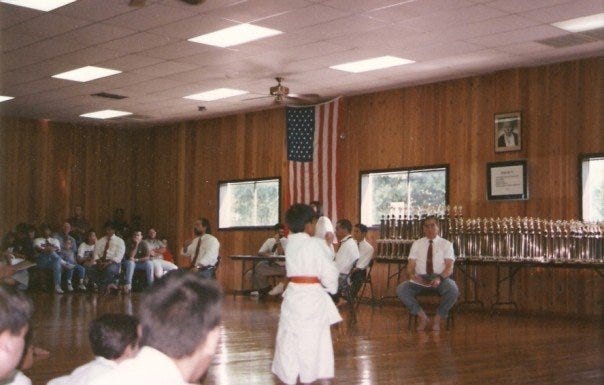
Performing a kata at a karate competition, circa 1996.
Within a year or so, my sister took up martial arts as well. However, she took after a friend and joined another dojo; one that taught Taekwondo. I remember watching my sister and her peers sparring and thinking to myself, “these kids kick, a lot.” I came to learn my assessment was correct: Taekwondo tends to place more emphasis on kicking techniques with hand strikes as back-up, while karate generally teaches the opposite. Each martial art had different origins (Karate was founded in Japan and Taekwondo in Korea) and different areas of emphasis, but both were well established styles, with respected teachers who leaned upon histories that demanded respect and authority. This was the first time I wrestled with the concept of manāhij, differences in methodology between practitioners of a science. It is with this background that I find myself interested in analyzing the characters and themes of the successful Netflix series Cobra Kai.
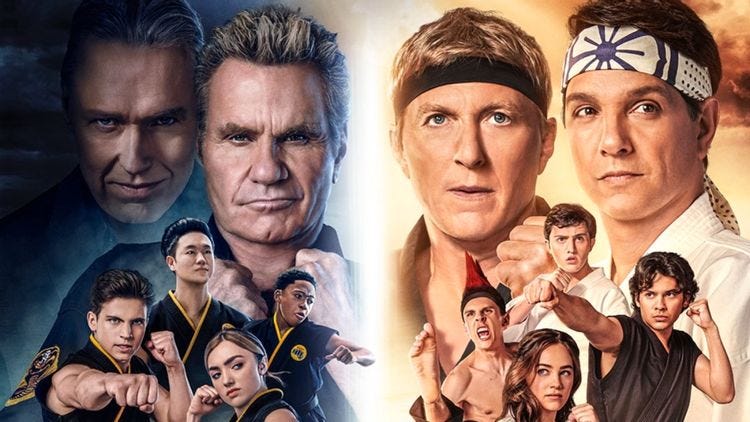
Shuyūkh and their murīds (season 4) | Source: Movieweb
The recently released Cobra Kai Season 4 follows the first three seasons of the show and further explores a number of themes, including but not limited to: friendship, love, parenting, coming of age, bullying (including cyberbullying), regret, nostalgia, and honor. One theme explored more directly in season 4 centers upon reconciling differences in technique and methodology. Throughout the season, the show highlights differences between Miyagi-Do, Eagle Fang, and Cobra Kai. In reality, this is an exploration of the difference in the men behind each dojo: their teaching serves as a portrayal of the development of their worldview (weltanschauung). Perhaps its no coincidence that the tagline for season 4 is “fight for the soul of the valley.”
As someone interested in the study of various Islamic Sciences, I could not help but think about a number of parallels between the show and aspects of tasawwuf. As the Prophet Muhammad ﷺ mentioned in the famous hadith of the Archangel Gabriel, spirituality (ihsān, tasawwuf) is one of the key components of Islām, alongside jurisprudence (fiqh) and belief (‘aqīdah). Just as various schools (madhāhib) developed over a thousand years to systematize a Muslim’s daily practice (e.g. Hanafī, Mālikī, Shāfi‘ī, Ḥanbalī, Ja‘farī) and belief (e.g. ‘Ash‘arī, Māturīdī) so too have various spiritual paths (ṭuruq, singular: ṭarīqa) formalized to guide believers on their path to attaining gnosis of God and self (e.g. Shādhilī, Qādirī, Ba ‘Alawī, Chisti, Suhrawardī).

Photo by Lukas Hartmann from Pexels
The word ṭarīqa is derived from the triliteral root ṭ-r-q. The root indicates “knocking,” e.g. taraqtu al-bāb “I knocked on the door,” as well as treading or taking a path. One could liken a ṭarīqa to a path one notices in a grassy field, which has turned brown due to the many feet that have tread (i.e. knocked) upon it. The path is formed by folks repeatedly walking it, leaving their imprint and making it clearer for others to reach their destination. Similarly, the ṭuruq of tasawwuf are paths trodden by true practitioners of the Muhammadan way, who themselves sought (and achieved) gnosis, and developed practices which they’ve left for others to take up. While possible for someone to reach gnosis of God and self without a spiritual guide, the journey becomes all the more difficult.
While all ṭuruq are based on strict adherence to the Prophetic law (sharī‘a), they may differ in the details of their devotional practices. For example, each ṭarīqa calls adherents to recitation of daily litanies (adhkār) along with the Qur’ān, but may differ in frequency and type of adkār to recite. Some call for recitation of dhikr in groups and audibly (jahran) while others do so silently (sirran). Some call to complete divestment from the world (tajrīd) and dropping of one’s agency in worldly affairs (isqāṭ al-tadbīr), others call to a methodology that is not completely devoid of worldly engagement.
In reality, sensei Larusso, Lawrence, Kreese, and Silver are archetypes of the leaders of the spiritual path (murabbī, shaykh, murshid, pir) who have (or have not) traversed the path of gnosis and can lead and develop others who seek the same. Their dojos are their zāwiyas or khanqas wherein they train the hearts, minds, and limbs of their students. In this piece, I set out to analyze the qualities of each major shaykh: Larusso, Lawrence, and Kreese.
Let’s start with sensei Daniel Larusso. Larusso represents the muqaddam (student who has been authorized to teach) of the sage shaykh, Nariyoshi Miyagi. Miyagi learned karate from his father, just as many of the shuyūkh of tasawwuf learn the foundations of their tarīqa from their fathers. In The Karate Kid Part II, Miyagi explains a 300+ year old history of karate in his family, originating from its founder Shimpo Miyagi. It is this connection and lineage (silsila) that gives Larusso the confidence that Miyagi-Do is a time tested tradition that can ultimately defeat any other style of karate. Larusso sees Mr. Miyagi as the quṭb of his time, the perfect teacher through which ultimate truth can be realized. This also partially explains Larusso’s arrogance, as he struggles to see the benefit in other styles. So much so, that he initially deems Miyagi-Do worthy of absorbing Lawrence’s Eagle Fang, not the other way around. Larusso even has various aphorisms (hikam) of Miyagi at his disposal, echoing the common practice within sufi ṭuruq of students (murīds) collecting and disseminating statements of their shuyūkh. In Episode 10, during the 51st All Valley Tournament, Larusso confronts a former murīd in Robbie, asking him why he taught Miyagi-Do techniques to Kreese and Silver’s Cobra Kai. Robbie responds that he’ll do whatever it takes to win, prompting Larusso to quote his shaykh (from The Karate Kid II): “Never put passion before principle. Even if you win, you lose.” Larusso, out of all the other sensei, most aligns with the archetypal shaykh who, though not without flaw, truly wishes for his students to develop as practitioners and as human beings.



The Archetypes (L to R): The Muqaddam , The Sālik, and The False Shaykh | Source: Hayden Schlossberg
The archnemesis of Miyagi-Do is Cobra Kai, headed by sensei John Kreese. In The Karate Kid movies, Kreese is portrayed as someone without any principles. He is willing to do whatever it takes to win, and when his students lose, rages against them for doing so. Interestingly, the writer of The Karate Kid stated the film was loosely based on personal experience, with his first sensei being a violent Marine captain who served as an inspiration for the character Kreese. In this portrayal, Kreese is the archetypal false shaykh, a wolf in a karategi. He promises glory and salvation from the troubles of the world yet exploits the vulnerabilities of his murīds to further his personal aspirations, leaving murīds damaged in his wake.
In season 3 of Cobra Kai, viewers learn that Kreese was asked to join a special team in Vietnam lead by a Captain Turner. Turner teaches Kreese and team the martial art he learned when serving in Korea, from Master Kim Sun-Yung, known as Tang Soo Do (made famous in America by Chuck Norris). This revelation connects Kreese, Terry Silver (co-founder of Cobra Kai), and even Lawrence to a proper silsila, for the first time in the entire Karate Kid franchise. However, Turner is portrayed as bullying Kreese and Silver, only concerned with doing what is absolutely necessary to survive the war, even if it means turning on weaker members of the team. Kreese and Silver inevitably learn a false representation of the Tang Soo Do path. Kreese, pained by the news his love interest Betsy has died, and that Turner withheld that information from him, kills Turner as they are liberated from their prisoner of war camp. Considering those circumstances, it would be hard to argue that Kreese ever took Turner as a shaykh in the way that Lawrence studies under Kreese or Larusso under Miyagi. Kreese merely saw utility in what Turner taught him and ultimately opened his own dojo, Cobra Kai, without connecting himself to any silsila. Cobra Kai’s renegade methods end up leading to the dojo’s banning after events in The Karate Kid III, and leaves Kreese a disgraced former sensei.
This brings us to sensei Johnny Lawrence. Kreese’s pain and suffering, primarily during his time in Vietnam, heavily influences his approach to karate and his relationship with his primary murīd, Lawrence. Nevertheless, he is Kreese’s prized student. Throughout the movies, Lawrence is a staunch murīd of the Cobra Kai tarīqa. The zealous partisanship (‘aṣṣabiyya) is strong with Lawrence, as he sticks by what Cobra Kai stands for even after Kreese almost kills him (only to be saved by Mr. Miyagi). Many years later, Cobra Kai is reborn through Lawrence as shown in the Netflix series. Sensei Lawrence names his dojo “Cobra Kai,” despite the pain and anguish its original founder has inflicted on him.
While in charge of Cobra Kai, he finds himself straying from the purist teachings of Kreese, advocating a more balanced approach as he works on balancing his life. While clinging to the mantra of “strike first, strike hard,” he realizes there are moments when “no mercy” will not work. As he states in season 3: “Life’s not black and white. More often than not, it’s grey. And it’s in those grey areas when Johnny Lawrence’s Cobra Kai sometimes shows mercy.”
With those words, Lawrence clearly declares his intention to forge a new path for Cobra Kai. This is his official split from his shaykh and the previous Cobra Kai ṭarīqa. However, his newfound Cobra Kai does not last long, as he is forced to form a new dojo, Eagle Fang, after Kreese usurps Cobra Kai.
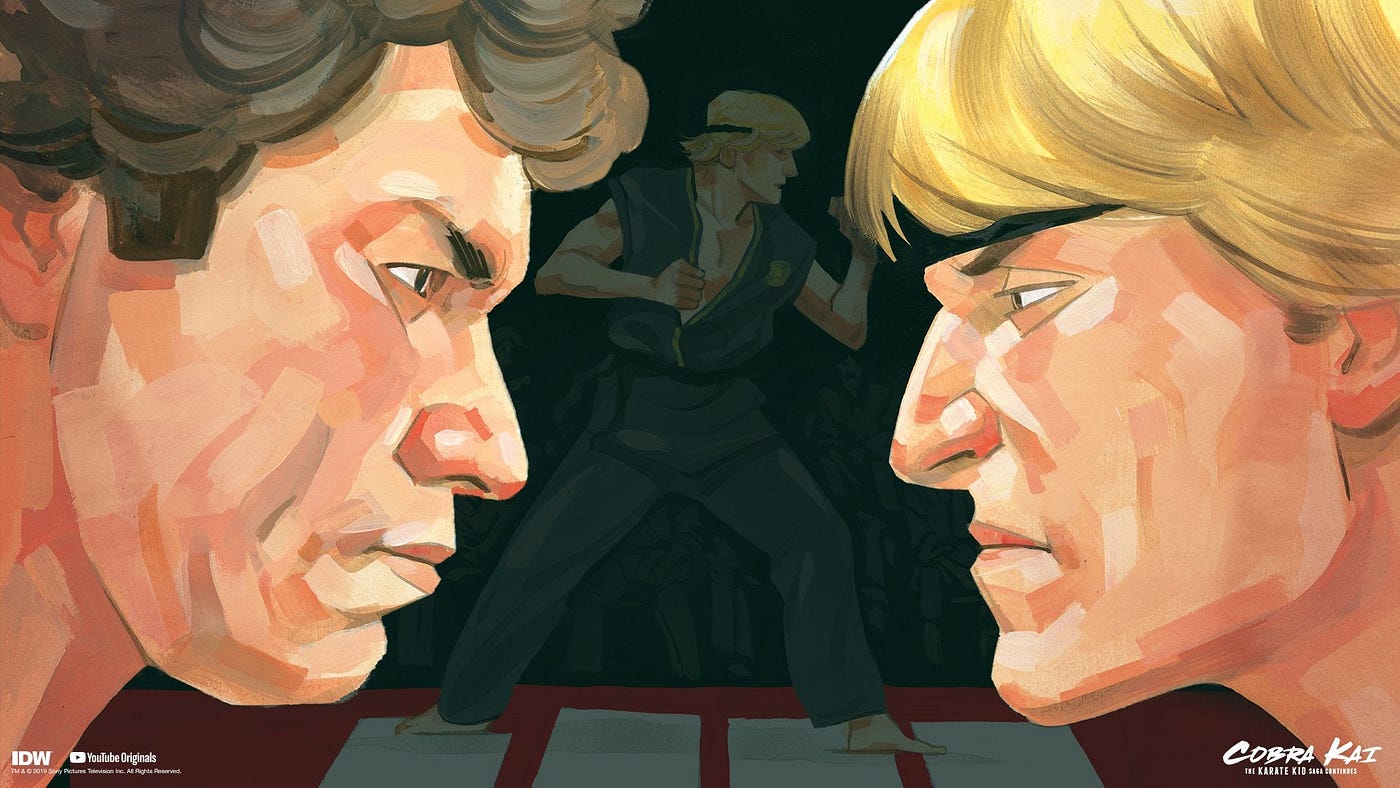
The false shaykh and his prized pupil | Source: Reddit
Despite Lawrence’s blatant desire to stay far away, Kreese deeply wants Lawrence’s approval and loyalty. During the final scene of season 4, Silver confesses to Kreese that he believes Kreese’s one weakness is Lawrence, as demonstrated earlier that day at the All Valley Tournament. When Tory is told by sensei Silver to strike Samantha illegally, Kreese glances at Lawrence and recalls the time he told Lawrence to illegally strike Larusso in their famous All Valley finals match. Momentarily realizing the pain he has caused Lawrence all these years as a result of his instruction, he tells Tory to do what she thinks is best, undermining the advice of Silver. Finally, a tiny crack in Kreese’s “no mercy” shields manifests by a momentary display of mercy inspired by his lifelong murīd. Like a father wanting the best for his son, this shaykh ultimately wants the best for his murīd, even if he cannot get his murīd to agree that is his actual objective. Here we see that while the false shaykh may have moments of inspiration, they are, perhaps, not to be taken as anything more than that.
Examples of cyclical abuse, as portrayed by Kreese and a number of his students, are abound in ṭarīqas throughout the Muslim world, and initiatives such as In Shaykh’s Clothing are documenting such transgressions and providing resources for murīds who are the victims.
So where does this leave Lawrence? Lawrence has learned remnants of a true martial art that actually has a silsila, albeit via a false shaykh (who also learned from a false shaykh). He is skilled as a practitioner and teacher, yet has no shaykh to call upon and guide him. His development throughout the series is almost entirely through self-realization and the companionship (suḥba) he finds with Larusso and his students. In this way, perhaps Lawrence is but a seeker (sālik) who must continue wayfaring. He pulls from the tradition based on his own foundational principles (uṣūl) and does his best to exercise his own judgment (ijtihād). This is perhaps the reality for many who wish to tread the spiritual path. They are unable to find a teacher or are too scared or scarred to trust a shaykh with their heart. As many of our scholars soberingly admit, the time of true shuyūkh is gone. They are few and hidden. Those who we look to as shuyūkh today are really advanced sāliks who can take the true beginners, like myself, along for the walk.
In the next post, we turn to the murīds of the show: namely Miguel, Sam, Robbie, Tory, and Hawk.
وآخر دعوانا أن الحمد لله رب العالمين
메타데이터
- post_id
- dee95ec55ea
- slug
- the-tasawwuf-of-cobra-kai-part-i-dee95ec55ea
- url
- https://medium.com/@ismail.ibnali/the-tasawwuf-of-cobra-kai-part-i-dee95ec55ea
- canonical_url
- https://medium.com/@ismail.ibnali/the-tasawwuf-of-cobra-kai-part-i-dee95ec55ea
- author_url
- https://medium.com/@ismail.ibnali
- status
- ok
- fetched_at
- 2026-07-08 18:29:56