Why Studies Alone Can’t Explain Disease From Environment
Modern health science measures fragments. Biophysics asks what the whole organism is adapting to.
Why Studies Alone Can’t Explain Disease From Environment
Modern health science measures fragments. Biophysics asks what the whole organism is adapting to.
By Kendall Toerner — Founder of Unlearn Health
Originally published on Unlearn Health: https://unlearnhealth.com/content/why-studies-alone-cant-explain-disease-from-environment
Key Takeaways
- Modern disease is usually studied through isolated variables, but biology lives inside whole environments.
- Long-term environmental disease cannot be perfectly proven with conventional studies because humans cannot be locked into one controlled world for years.
- Cell studies are useful, but they often remove cells from the water, light, tissue tension, temperature, and electrical context that makes them alive.
- Water is not passive filler. It is part of redox biology, protein folding, charge separation, mitochondrial function, and light-sensitive cellular organization.
- First principles matter because they begin with the environment humans evolved in: sunlight, darkness, movement, animal-based nutrition, temperature variation, microbial exposure, earth contact, and seasonal rhythm.
- High-quality anecdotes are not “proof,” but they are often the first signal that a living system is responding to something science cannot yet measure cleanly.
The Problem With Waiting for Perfect Proof
Modern health science is powerful, but it has a narrow field of vision. It is very good at measuring what can be isolated, extracted, stained, sequenced, averaged, and analyzed. It is much weaker at understanding what happens when a whole human body is exposed to a whole environment for years.
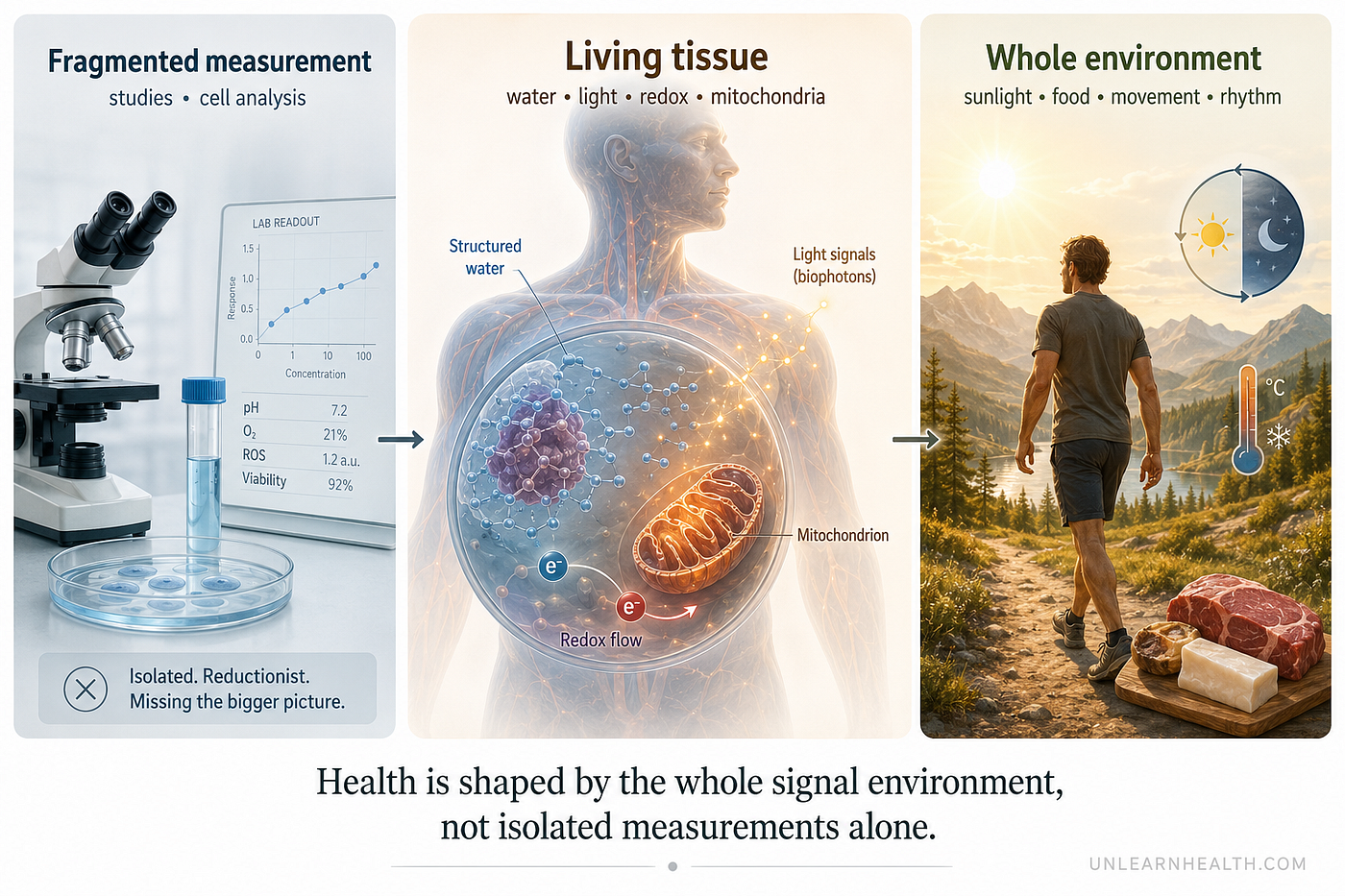
This matters because disease is not usually created by one variable. It is created by signal patterns. Light, darkness, food, temperature, sleep, stress, movement, toxins, microbes, EMF, season, ancestry, the womb, and culture all become information the body must interpret.
The fantasy of perfect proof would require a statistically significant group of humans living inside fully controlled environments for long periods of time, with every light exposure, meal, sleep cycle, stressor, toxin, social input, electromagnetic field, temperature shift, and movement pattern measured and standardized. That is not how human life works. It is also not ethically or practically possible.
So we study pieces. We study a nutrient, a gene, a toxin, a drug, a biomarker, a cell line, a tissue sample, or an exposure window. These studies can be useful, but they are not the same thing as understanding disease from environment. They are snapshots of fragments taken from a system that is fundamentally whole.
For the full implementation protocols and experiments, see the Unlearn Health Protocols Library.
The Body Is Not a Petri Dish
Cell studies are often treated as if they reveal the deepest truth about biology. Sometimes they do reveal something important. But a cell in a dish is not a cell inside a living body.
Inside the body, cells are surrounded by structured water, extracellular matrix, mechanical tension, light gradients, redox gradients, temperature gradients, blood flow, mitochondrial signaling, nervous system input, immune surveillance, and rhythmic environmental timing. Remove the cell from that context and you have changed the object you are studying.
This is especially important for water. Much of conventional biology treats water as the background medium where “real” biochemical events occur. But water is part of the event. Water influences protein folding, charge movement, enzyme behavior, membrane organization, mitochondrial function, and the way biological structures interact with radiant energy.
When cells are fixed, dried, stained, lysed, frozen, centrifuged, or otherwise processed, the water state is altered. That does not make the data useless. It means the data is incomplete. You can learn something about the remains of a system without fully learning how the living system was operating before you interrupted it.
Water Is Biological Infrastructure
The living cell is not a bag of chemicals. It is a hydrated, charged, light-sensitive, redox-active structure.
Water helps determine how proteins fold, how electrons move, how membranes behave, how mitochondria function, and how information spreads across biological surfaces. Interfacial water near proteins, membranes, collagen, and other hydrophilic surfaces may behave differently from bulk water. This is why exclusion-zone water and structured water research matters for biology, even if the field remains debated and technically difficult.
In the Unlearn Health framework, water is not just hydration. It is biological infrastructure. It helps hold charge, organize surfaces, couple light to matter, support redox chemistry, and maintain the physical conditions that allow proteins to function.
A dehydrated protein is not simply “less wet.” It is a different physical object. Its folding, charge behavior, optical behavior, and interaction with surrounding water can change. This matters because proteins are not just chemical machines. They are also physical structures with electronic, vibrational, and light-interacting properties.
The Missing Layer: Light Inside the Body
Biology is full of light-sensitive molecules. Melanin, hemoglobin, cytochromes, flavins, opsins, porphyrins, aromatic amino acids, and many other structures absorb specific wavelengths of light. Their absorption patterns are not decorative. They point toward function.
A molecule’s spectral fingerprint tells us what kind of energy it can receive, transform, or respond to. This is one of the deepest clues in biology. If a compound absorbs a certain frequency, that frequency is part of its possible language.
Cells also emit ultraweak photons, sometimes called biophotons or ultraweak photon emission. These emissions are extremely faint and linked to metabolism, oxidative processes, mitochondrial activity, and cellular state. The problem is not that light is absent from biology. The problem is that the most important light signals may be too weak, too fast, too spatially complex, or too context-dependent for our current tools to fully read inside living tissue.
We can measure fragments of biological light. We cannot yet fully measure the living photonic conversation occurring inside hydrated tissue, in real time, across the whole organism, while the organism remains alive and embedded in its environment.
That limitation should make us more humble. It should not make us pretend chemistry is the whole story.
Why Biophysics Must Come Before Chemistry
Chemistry is measurable. Biology is observable. Biophysics is foundational.
The body does not begin with chemistry floating in emptiness. Chemistry happens inside physical conditions: light, charge, water, temperature, pressure, magnetism, electric fields, molecular geometry, tissue structure, and time.
A chemical reaction changes when the water changes. It changes when the protein folds differently. It changes when the redox state changes. It changes when the membrane voltage changes. It changes when sunlight, infrared, ultraviolet, darkness, cold, heat, or EMF changes the physical conditions of the system.
This is why biophysics should be the foundation of health. Not because chemistry and biology are wrong, but because they are downstream of physical organization.
Just because we can measure blood chemistry more easily than intracellular light does not mean blood chemistry is more fundamental. It only means blood chemistry is easier to measure.
First Principles Begin With Evolution
When perfect studies are impossible, first principles become essential. The first question is not “what does a randomized controlled trial say?” The first question is: what environment built this organism?
Humans did not evolve under LED light, indoor heating, seed oils, Wi-Fi, processed grains, chronic social stress, synthetic fragrances, midnight screens, and year-round summer food. We evolved in sunlight, darkness, temperature variation, movement, natural electromagnetic conditions, microbial richness, seasonal scarcity, animal foods, social bonds, and direct contact with the living world.
Our body plan reflects this. Long legs, long arms, spring-like fascia, sweating, upright posture, sophisticated hands, visual intelligence, social cognition, endurance capacity, and large brains all point toward an organism built for movement, hunting, making, tracking, carrying, throwing, gathering information, reading landscapes, and solving problems in the real world.
The human brain did not become metabolically expensive so we could farm wheat under artificial light or forage for spinach in a grocery store. It emerged inside a high-information environment where animal foods, fire, tools, social complexity, sunlight, movement, and ecological pressure shaped the nervous system.
First principles do not require pretending we know every detail. They require respecting the environment that selected for our design.
DNA Does Not Act Alone
The common story says DNA is the blueprint. That is partly true, but it is incomplete.
DNA contains instructions, but mitochondria help determine execution. Mitochondria regulate energy availability, redox state, metabolite signaling, calcium dynamics, reactive oxygen signaling, and retrograde signaling to the nucleus. This means mitochondrial state can influence nuclear gene expression and cellular behavior.
In plain terms: the genome is not operating in isolation. The cell’s energy and redox environment help decide which genetic possibilities become active realities.
This matters for protein folding. A protein is not finished when the gene is transcribed. It must be translated, folded, modified, hydrated, charged, placed, and integrated into a living system. That final form depends on cellular conditions. Mitochondria help shape those conditions.
So disease cannot be understood only as a genetic problem. Genes are biological memory. Mitochondria are environmental interpreters. Proteins are the executed structure. Water and light help determine whether that structure functions correctly.
Proteins as Biological Semiconductors
A semiconductor is a material whose electrical behavior can change depending on energy, structure, impurities, light, charge, and environment. That concept should sound familiar, because biological proteins also move electrons, shift charge, absorb energy, change conformation, and respond to their surroundings.
This does not mean every protein is identical to a silicon chip. It means proteins have electronic properties that matter. Electron transfer through proteins is central to respiration, photosensitivity, redox biology, enzyme function, and mitochondrial energy flow.
An LED is a basic semiconductor device that emits light when electrical energy moves through it. Biology is more complex, hydrated, dynamic, and soft, but the principle still matters: structure, charge, and energy flow can produce optical behavior.
Proteins made from DNA are not just blobs of chemistry. They are shaped, hydrated, electronically active structures. Many absorb and emit energy in specific ways. Their spectral behavior gives clues about their role in the body.
This is why we should study proteins, pigments, metals, cofactors, and biological compounds as light-interacting structures. Their absorption fingerprints are not random. They reveal what parts of nature they are tuned to.
Sunlight Is the Master Reference Signal
If the body is full of structures that absorb specific wavelengths, the obvious next question is: where did those wavelengths come from?
The answer is nature, primarily sunlight.
Sunlight is not just brightness. It is a structured electromagnetic signal containing ultraviolet, visible, and infrared wavelengths, delivered in a daily and seasonal rhythm. Biology evolved under that rhythm. The atmosphere filters it. Water modifies it. Skin, blood, melanin, cytochromes, collagen, and other tissues interact with it.
This is why artificial environments are not neutral. Indoor light is not simply “less light.” It is a different spectral signal. Darkness interrupted by screens is not simply “modern convenience.” It is biological timing confusion. EMF is not harmless simply because it is non-ionizing. Ionization is not the only way a physical signal can matter to a hydrated, charged, redox-active organism.
The safety question should not begin with whether a signal breaks DNA directly. It should begin with whether the signal matches the environment biology was built to interpret.
Why High-Quality Anecdotes Matter
Anecdotes are often dismissed because they are not controlled studies. That dismissal is too simple.
Low-quality anecdotes are noisy. They can be biased, exaggerated, confused, or coincidental. But high-quality anecdotes are different. They are careful observations from real organisms in real environments, especially when they are repeated, specific, mechanistically plausible, and consistent with first principles.
If thousands of people report that morning sunlight improves sleep, mood, cravings, energy, immune regulation, or circadian rhythm, we should not treat that as irrelevant just because it is not a perfect trial. We should ask whether the pattern matches known biology. In this case, it does.
If people report feeling worse under artificial light, poorly grounded environments, chronic indoor living, blue-heavy screens at night, or high-EMF bedrooms, we should not immediately dismiss them because the mechanism is hard to measure. We should ask whether the body is a hydrated electrical system that evolved under natural light and natural electromagnetic conditions. It is.
Anecdotes do not replace science. They often tell science where to look before instruments are good enough to explain the signal.
The Better Standard: Safety-Grade Inference
The demand for perfect proof is dangerous when the exposure is modern, chronic, artificial, and biologically mismatched.
We do not need perfect proof that artificial light at night, chronic indoor living, processed food, environmental EMF, sleep disruption, year-round carbohydrate abundance, and loss of cold/heat variation are harmful before taking them seriously. We already know enough from first principles to treat them as biologically important.
The standard should be safety-grade inference:
Does the exposure match the environment humans evolved in?
Does it alter light, water, charge, redox, mitochondrial function, sleep, temperature rhythm, or biological timing?
Does it have plausible mechanisms through known biophysics?
Do high-quality anecdotes repeatedly point in the same direction?
Is the downside of avoiding or reducing the exposure low?
Is the downside of ignoring it potentially high?
If the answer is yes, the rational move is not to wait for perfect proof. The rational move is to respect the signal.
The Future Will Measure What We Currently Infer
One day, better tools may allow us to measure living tissue in ways we cannot today. We may eventually map ultraweak photon emission inside the body with far greater spatial and temporal resolution. We may measure intracellular water states, protein hydration, mitochondrial light signaling, redox domains, and electromagnetic sensitivity in real time.
AI may help detect patterns humans cannot see. New sensors may reveal that many “alternative” biophysical concerns were not mystical or exaggerated. They were simply ahead of measurement.
That has happened before. Science often dismisses what it cannot measure, then later builds instruments that make the invisible obvious.
Until then, we should not confuse instrument limits with biological limits.
Health Must Be Rebuilt From Biophysics
Modern medicine often begins with chemistry because chemistry is easier to measure. It begins with biology because biology can be named, stained, sequenced, and categorized. But life begins deeper than that.
Life begins with physical order.
Light organizes biology. Water organizes biology. Charge organizes biology. Redox organizes biology. Temperature organizes biology. Magnetism, pressure, movement, and rhythm organize biology. Chemistry happens inside that physical order.
Disease is not random failure. It is adaptation to signals. When the signal environment becomes mismatched, prolonged, artificial, or inherited from damaged conditions, the body adapts. Those adaptations eventually get named as disease.
This is why the future of health cannot be chemistry-first or gene-first. It must be environment-first, mitochondria-first, water-first, light-first, and biophysics-first.
Studies matter. Cell analysis matters. Biomarkers matter. But they are not the whole organism, and they are not the whole environment.
The living body is not a spreadsheet of lab values. It is a hydrated, light-sensitive, redox-active, electrically organized system adapting to the world it is given.
The most important health question is not only “what can we measure?”
It is: what signals is the body being forced to become?
Unlearn Health
Kendall Toerner is the founder of Unlearn Health, a research project exploring how environmental signals — light, energy, and circadian timing — optimize or destroy human biology.
More articles: https://unlearnhealth.com Protocols and experiments: https://protocols.unlearnhealth.com
Originally published at https://unlearnhealth.com.
메타데이터
- post_id
- df07ceff8102
- slug
- why-studies-alone-cant-explain-disease-from-environment-df07ceff8102
- url
- https://medium.com/@unlearnhealth/why-studies-alone-cant-explain-disease-from-environment-df07ceff8102
- canonical_url
- https://medium.com/@unlearnhealth/why-studies-alone-cant-explain-disease-from-environment-df07ceff8102
- author_url
- https://medium.com/@unlearnhealth
- status
- ok
- fetched_at
- 2026-06-09 15:37:30