A Strong Economy for Everyone but Working Americans
The Pitch: Economic Update for Thursday, October 23rd, 2025
A Strong Economy for Everyone but Working Americans
The Pitch: Economic Update for Thursday, October 23rd, 2025
Friends,
On October 14th, Federal Reserve Chair Jerome Powell said the economy “may be on a somewhat firmer trajectory than expected.” He declared that the economy was showing signs of growth and resiliency that outpaced expectations.
But then Powell said something that should have been the headline of his speech: “You do have a bit of tension between labor market data — we see very low levels of job creation — and yet people are spending.” Powell didn’t offer much by way of analysis of this statement, aside from adding that “We are going to have to see how that plays out.”
Powell is simply echoing the mainstream consensus about America’s economic health. Reuters reports that a National Association for Business Economics survey “upgraded the more pessimistic views about the U.S. outlook offered earlier in the year when concerns about the economic blow from tariffs and the risks of a broader trade war were at their peak.”
The economists surveyed in the NABE survey were still concerned about tariffs, but they agreed that the economy “may be on a somewhat firmer trajectory than expected” than when they were polled in June, raising their estimates for 2025’s GDP growth by a half a percentage point.
But the NABE survey also reported that economists are feeling pessimistic about the labor market, with most expecting to see “job growth averaging just 29,000 per month for the rest of this year, with a ‘limited, gradual recovery’ to around 75,000 [jobs added to the economy on a monthly basis] next year.” In the previous more pessimistic survey in June, the economists in the NABE survey actually predicted stronger job growth for 2026, with an estimate of 97,000 jobs added to the economy each month.
It’s unclear why Powell and the NABE survey don’t see the central contradiction to their stronger economic predictions: If more Americans are out of work and job growth stagnates, that’s going to pull the whole economy down.
Case in point: The day after Powell spoke about the strength of the economy, the Federal Reserve’s “Beige Book” report, which aggregates economic conditions from Fed districts around the country, painted a much bleaker picture than the Fed Chair offered. “In most Districts, more employers reported lowering headcounts through layoffs and attrition, with contacts citing weaker demand, elevated economic uncertainty, and, in some cases, increased investment in artificial intelligence technologies,” the Beige Book reported, adding that some employers have “favored hiring temporary and part-time workers over offering full-time employment opportunities.”
The report continues, “labor supply in the hospitality, agriculture, construction, and manufacturing sectors was reportedly strained in several Districts due to recent changes to immigration policies.”
It should be obvious to anyone that if the labor market is stagnating, the whole economy will soon be in trouble. The paychecks of working Americans are what makes the economy grow sustainably — those paychecks circulate through local communities, creating jobs through consumer demand and creating prosperity for everyone. It stands to reason that if people are nervous about being able to find work, they’ll pull back on their spending, and if those spending cutbacks are widespread enough, the economy will contract.
We’re already starting to see signs of this in anecdotes reported in the Beige Book. The St. Louis Fed reported on “rising food pantry usage among both low- and middle-income households, growing reliance on ‘buy now, pay later’ services, and elevated credit card delinquency rates.” The Fed also reported on a Missouri hotel owner who said “travel demand had dipped in the past few months, especially among middle-class consumers, and described the current environment as a ‘middle-class recession‘ that is affecting select-service hotels.”
We’ve been noting for a while now that the economy is in a K-shaped spending pattern, with the wealthiest ten percent of consumers responsible for about half of all consumer spending in America.

That spending inequality, combined with massive investments in artificial intelligence from the biggest corporations on earth, might explain why the economy is currently sending positive signals to elite economists like Powell and the business economists in the NABE survey.
But those economists are not thinking about what might happen if 90% of working Americans pull back from participating in the economy. The spending of the wealthiest 10% of the economy is not going to support sustainable job growth for the majority of the country. The one in ten Americans who earn more than $250,000 per year simply can’t buy enough to prop up the whole economy for an extended period of time.
We’re already seeing a dramatic decrease in the growth of wages for workers on the lower end of the scale — a sign that shrinking consumer demand is already having an impact on the most vulnerable parts of the job market.
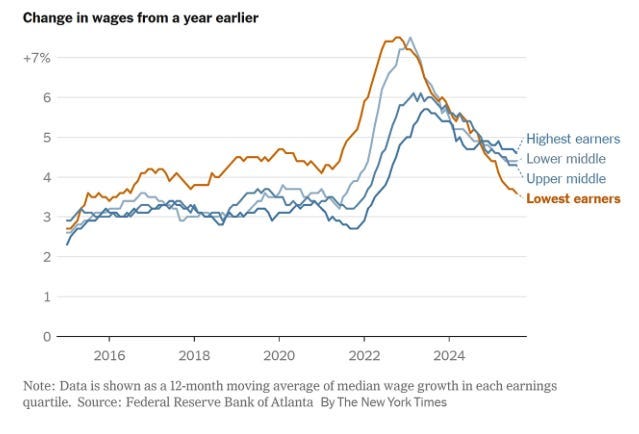
If Powell and the economists in the NABE survey really wanted true economic growth — that is, economic growth for everyone in the economy, not just the richest few at the top — they would be sounding the alarm about the slowing, stagnating labor market and encouraging wage growth for working Americans. Those paychecks are what matters in the economy — everything else is just chasing a temporary sugar rush that hurts more in the long run than it helps.
The Latest Economic News and Updates
The Shutdown Is Still Happening
After being delayed for a week due to the government shutdown, the Bureau of Labor Statistics will finally release the Consumer Price Index report for September on Friday. This CPI report is an important one because it helps determine the Cost of Living Adjustment for Social Security recipients next year, ensuring that seniors will be able to keep up with price increases in 2026.
As the shutdown continues, there are two important upcoming dates to keep in mind. First, many states will run out of federal funding for their Supplemental Nutrition Assistance Program (SNAP), which offers investments allowing Americans on the bottom end of the income scale to buy groceries, in November. An estimated 12.3% of the population uses SNAP benefits to purchase food, totaling some 42 million Americans.
If they do happen, these SNAP cuts might offer a preview of what is to come. When House Republicans passed their massive tax cuts for the rich and powerful this summer, some of those handouts to rich people and corporations were paid for with drastic cuts that will be made to the SNAP program in the year 2028.
Grocery prices have skyrocketed in the last few years, and 69% of Americans told Pew that those price increases havemade it difficult to buy and eat healthy food.

The second date to keep in mind is a little more nebulous: State by state, Americans around the country are receiving letters telling them how much their health insurance costs on the Affordable Care Act exchanges will increase. Remember, in order to pass those tax cuts for the rich, Republicans in Congress and President Trump eliminated a tax credit that helped people pay for their health insurance.
Now, the costs of eliminating that ACA subsidy are showing up in peoples’ mailboxes as ACA deadlines are triggered on a rolling basis in states around the country.
“Based on the newly posted information, a family of four making $130,000 in Maine would face an increase of $16,100 in annual premiums next year because they would no longer qualify for more generous subsidies,” reports the *New York Times*. Older Americans are also feeling the pinch: “In Kentucky, a 60-year-old couple making $85,000 per year could face an increase of $23,700 in annual premiums. In Nevada, a similar couple could pay an additional $18,100 in annual premiums, while in Minnesota, the cost might be $15,500 more and, in Maryland, an additional $13,700.”
Just as a reminder, this shutdown is happening because Republicans control all three branches of government, but they need Democratic votes to approve the budget and keep the government open. Democrats are refusing to hand over the votes Republicans need until Republicans agree to fully fund Medicaid and reinstate those Affordable Care Act tax credits, saving Americans on the ACA thousands of dollars next year.
As more Americans get the sharply increased bill for their upcoming year of health insurance, the pressure should rise on Republicans to come to the bargaining table and reinstate those tax credits that they slashed in their trickle-down tax bill. For elected officials in Congress, the contrast couldn’t be any sharper: Are you fighting to put even more money in the pockets of a small group of super-rich Americans, or are you fighting to protect affordable healthcare and groceries for tens of millions of Americans?
Could Decreased Seasonal Hiring Signal a Not-So-Merry Holiday Season?
The government shutdown has delayed the release of the September retail sales report, so we don’t have an official record of consumer spending for last month. But Bloomberg’s survey shows that sales likely slowed down in September, with just a .6% increase over last year’s retail sales.

Consumer spending in general seems to be showing a similar slowdown: “Bloomberg Second Measure, which analyzes credit and debit card data, showed less appetite last month for discretionary items such as furniture, electronics and appliances,” writes Mark Niquette at Bloomberg.
“Bank of America aggregated credit and debit card spending per household increased a modest 0.2% in September on a seasonally adjusted basis and was led by middle- and higher-income households,” Niquette writes.

Businesses aren’t demonstrating confidence that the holiday shopping season will be robust. Hiring for seasonal holiday help is down this year, even though there are more job-seekers on the market.
“A new Indeed report using data through September showed a disconnect between job seekers and employers. On the job seeker side, there are more searches for holiday work and indications that searches are starting earlier,” writes Madison Hoff at [Business Insider](https://www.businessinsider.com/holiday-seasonal-hiring-job-searching-competitive-less-urgent-demand-2025-10). “Meanwhile, employers have posted fewer urgent roles than in the red-hot labor market of 2021. The job-search platform also found that seasonal postings are relatively flat from last year, although down from earlier years.”

Consulting firm Challenger, Gray, and Christmas predicts that “With hiring slowing across the board, Retailers may hire fewer workers themselves, while many of their shoppers slow spending.” They also predict a decline in seasonal transportation and warehousing jobs.

If we start to see the K-shaped spending patterns impact holiday retail sales, with luxury items sales rising even as 90% of the economy pulls back on gifts and seasonal purchases, that could result in a negative feedback loop in the labor market in the year to come.
Farm Bankruptcies Are on the Rise Again
For the first time in five years, American farms are falling into bankruptcy. For *Fortune*, Jason Ma reports: “In the second quarter, there were 93 [Chapter 12 farm bankruptcy] filings, according to the Federal Reserve Bank of Minneapolis, up from 88 in the first quarter and nearly double the 47 at the end of 2024.”
Ma explains, “That’s still well below the recent high of 169 in early 2020, and filings nosedived in the two years that followed. But since 2022, farm bankruptcies have been trending higher.”

During the pandemic, crop prices rose considerably as more people cooked at home. That higher income helped farmers stave off bankruptcy for the next few years. But now we’re seeing the number of bankruptcies start to climb back to historic levels.
Even more troubling is the fact that President Trump’s tariffs have essentially wiped out the Chinese market for American soybeans, leaving a number of American soy farmers with an excess of crops and very little income.
And as I wrote last week, add to that the fact that the Trump Administration is sending anywhere from $20 to $40 billion in foreign aid to Argentina, at the same time that Argentinian farmers are stepping into the tariff void and selling their soy crops to China, and it seems as though the deck is stacked against American farmers.
Now, another American agrarian industry is getting sold out in order to bail out Argentina’s government: Cattle ranchers.
In recent months, thanks in part to high tariffs killing international demand and forced deportation policies wiping out large numbers of immigrant farm workers, cattle ranchers have been struggling to keep their farms in working order. As a result, beef prices have skyrocketed.
President Trump has suggested importing Argentinian beef in order to bring domestic beef prices down, even though, as *Newsweek* writer Hugh Cameron notes, “experts question whether Argentine imports — even at substantial levels — will be able to make a dent in the domestic shortfall.”
Naturally, American cattle ranchers are furious at the idea of another big bailout for Argentinian agriculture when American farmers are struggling to make ends meet.
Justin Tupper, president of the U.S. Cattlemen’s Association, told Cameron that, aside from benefitting the flailing Argentinian libertarian government, importing beef from Argentina will only benefit the four largest meat packers, who possess a monopoly on beef production in America. Tupper says those big four firms will then buy beef “way cheaper in those countries and bring it over here and sell it to our consumers for a lot more money.”
Tupper’s point is a good one. Not only would importing Argentinian beef support the flailing trickle-down regime of Argentina, but it would also enrich a handful of powerful monopolists on American soil. In other words, it’s trickle-down doing what trickle-down does best: enriching a few at the expense of the many.
This Week in Trickle-Down
- Here’s a reminder that even though we need to invest in ACA tax credits that cut health care costs for Americans, our whole employer-based health insurance system is very costly and inefficient. Health policy polling firm KFF reports that “Family premiums for employer-sponsored health insurance reached an average of $26,993 this year, KFF’s annual benchmark health benefits survey of large and smaller employers finds. On average, workers contribute $6,850 annually to the cost of family coverage, with employers paying the rest.”
- Heather Boushey reports that because of our trickle-down policies that prop up fossil fuels, the number of clean energy patents filed by American firms is falling far behind those of other nations. She writes, “The question we face now is, if we’re the first to innovate but choose to back out of the race, what other economic opportunities will we miss out on?”

This Week in Middle-Out
- New Jersey’s Department of Labor announced this week that the state’s minimum wage will climb to $15.92 per hour on January 1st, 2026.
- At the same time, Minnesota’s new paid family and medical leave program will officially go online. The plan, which passed into law in 2023, “creates a government-run insurance system where employers and employees will both contribute.”
This Week on the Pitchfork Economics Podcast
PItchfork Economics podcast producer Freddy Doss has a great conversation with Mexican economist Juan Carlos Moreno-Brid about free trade from the Mexican perspective. NAFTA may have enriched a few already-wealthy folks, but it turned out to be bad for Mexican workers, leading to wage stagnation and very little economic growth.
Closing Thoughts
I wanted to call your attention to this conversation in the New York Times with Ruben Gallego, the Democratic senator from the state of Arizona.
Gallego, who is one of the younger national leaders in the Democratic Party, talks about why he won in the state of Arizona in the same election that Kamala Harris wound up losing the state. Gallego says that he paid attention to voters. “What we were seeing on the ground in Arizona was that people were worried about being able to make the rent,” he explains.
“For a place like Arizona that was known to be affordable and had always been affordable,” Gallego continues, “for the first time in anybody’s memory, it became a very unaffordable place very quickly. And Democrats sounded extremely out of touch that we weren’t talking about that.”
Gallego says that he’d grown up poor and he was familiar with poverty, but what he was hearing from voters in 2024 was something different: “for the first time, I heard a desperation that I had never heard in my 45 years of being a Latino man,” Gallego explains. Voters “just felt they weren’t going to make it.”
We know why voters are feeling so desperate: It’s the end result of four decades of increasing economic inequality, in which rich people have sucked nearly $80 trillion out of the economy while paychecks of working people declined. But communicating that idea can be hard, and too many people talk about economics in broad, vague terms that don’t inspire voters.
“I’m surrounded by working-class Democrats, and the reason I speak the way I speak is because no one in my family’s involved in politics,” Gallego says. “Half of my family members are in unions; the other half are very working class. I have one sister who’s a doctor. I live in a working-class neighborhood in Phoenix. No one there talks about economic equity.”
He continues, “What they talk about is: I want to be able to buy a home. I am starting a business; I want to make money. I want my kids to do well. I want to be happy. And when we have these nebulous positions that people just can’t put their finger on, then Democrats are kind of losing an opportunity.”
Gallego says that if political parties can clearly explain that they’re “going to give you a real chance at the American dream, then buying a home, starting a business, being able to go on vacation, for God’s sake — the things that people used to be able to do — then people say: That’s the party that I want in there to fight for me.”
He concludes, “But when we’re just this nebulous blah group of people that is going to protect this idea but we don’t actually ever really do anything about it, voters are going to go off to something else shinier.”
It’s important in the spaces where policy is debated and formulated — in other words, in venues like this newsletter — to be clear and precise about the economic problems facing the American people. But Gallego is arguing that when we’re talking to non-policy nerds, it’s important to frame those conversations in the real-world impacts on things that matter most to people.
It’s important for our leaders to understand what the American Dream looks like to most people, and to talk about how to make that dream a reality. As always, it’s about meeting people where they are.
Be kind. Stay strong.
Zach
메타데이터
- post_id
- df0d8ed1d339
- slug
- a-strong-economy-for-everyone-but-working-americans-df0d8ed1d339
- url
- https://medium.com/civic-skunk-works/a-strong-economy-for-everyone-but-working-americans-df0d8ed1d339
- canonical_url
- https://medium.com/civic-skunk-works/a-strong-economy-for-everyone-but-working-americans-df0d8ed1d339
- author_url
- https://medium.com/@civicventures
- status
- ok
- fetched_at
- 2026-06-09 15:37:30