I Walked With My Baby Through an African Township
And felt safer than if I were alone
AFRICAN KINDNESS
I Walked With My Baby Through an African Township
And felt safer than if I were alone
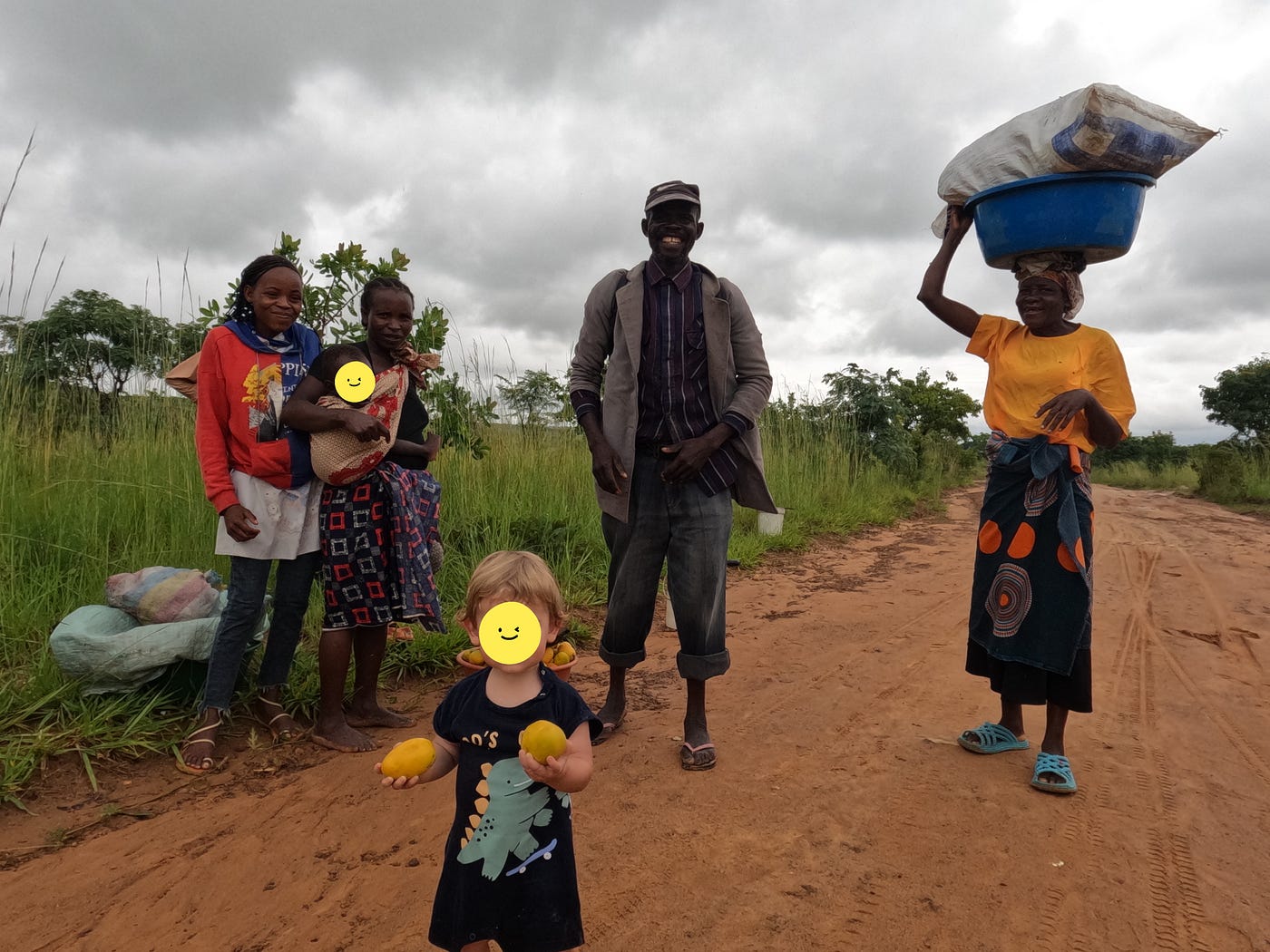
Eric receiving gifts from the locals walking into town. | Photo credit: Anne Bonfert
The sky is mostly cloud-covered and the temperature pleasant for a walk into town, but I’m sweating regardless, carrying Eric on my back. Every few meters I greet locals on the side of the road with "bom dia" and wave at kids running out of their homes.
Currently traveling through Angola with friends, we had been in the bush for almost a week when we arrived at Stefan's house on a property outside Menongue. We never met the guy, but we were given his number by a friend. After staying two nights in his game reserve way off the beaten track, we now needed some rest, and a caretaker opened his home for us.
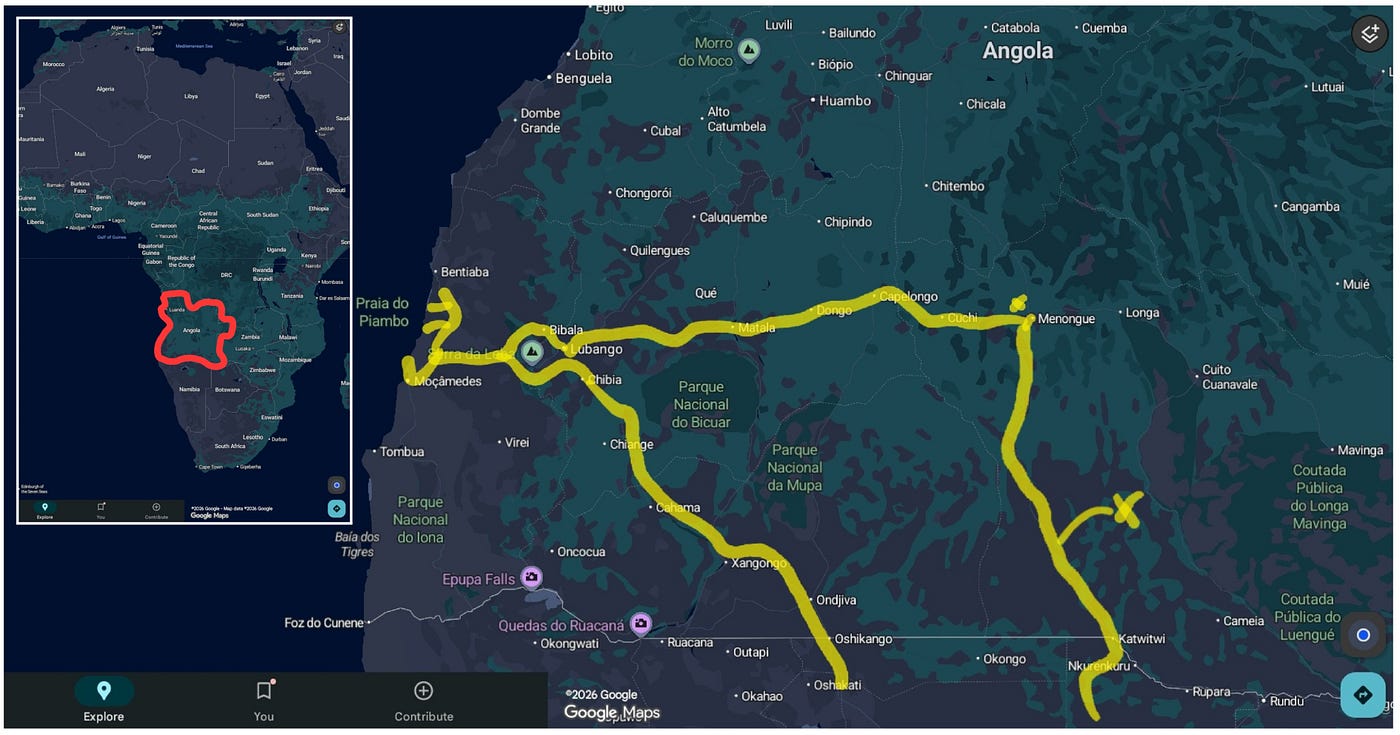
Location of the country and map of our road trip through Angola with markers for our first two stops. | © 2026 GoogleMaps, edited by author
It's Sunday morning and the day begins with a rain shower, but it stops by the time Eric and I finish our breakfast. The other couple is still asleep, and David (my husband) is reading in the rooftop tent, saying "get some tomatoes" when I wave goodbye.
Eric and I are heading into town. Or at least into that direction is the plan. The caretaker opens the gate of the farm and nods with a smile when I ask "é seguro andar" (is it safe to walk). I can't speak Portuguese but did two months’ worth of Duolingo lessons in preparation and practiced a few sentences I'd need. English doesn't help you in this African country.
We don't get far as Eric jumps into the first puddle in the road. He stops in his tracks and points at the mud behind him. It's where his shoe got stuck. I pull out that mud-covered shoe and take the other one off him. I usually let Eric walk barefoot, but David often says I need to make him wear shoes.
Well, not in this mud heaven.
When the last mud pond has been explored and splashed out, Eric spots a pile of dirt and climbs on top before I even notice he disappeared. He's such an active child and loves exploring the surroundings. I let him be, knowing he'll be tired soon.
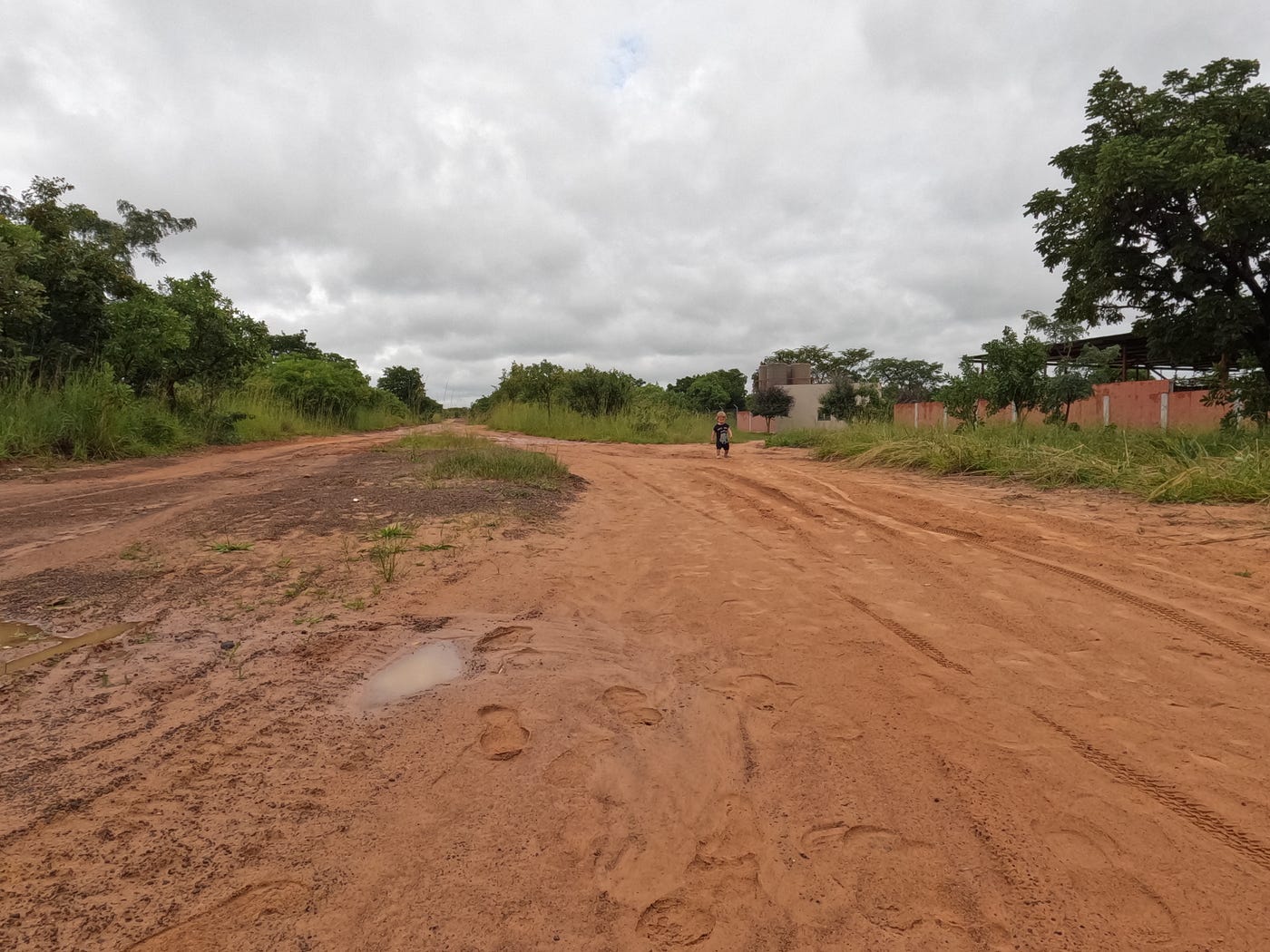
On the dirt trail just outside the property we were staying at. | Photo credit: Anne Bonfert
A group of locals catches up to us, seemingly living in the countryside, where they grow vegetables and fruit, which they now carry into the city of Menongue to sell. A man is walking with a group of women. "Bom dia, tudo bem?" I greet them with my practiced Portuguese and receive an enthusiastic response, “bom dia, muito bem," with smiles all around.
One of the women is carrying a small baby and says something incomprehensible while pointing at Eric. Her gesticulation lets me guess she’s trying to tell me I have to carry the baby, and so I nod while pointing at the carrier around my waist. The baby just needs to walk a bit more before I pick him up.
The man in the group now begins speaking to me in broken but clear English. The last thing I would have expected here in the rural part of southeastern Angola. He asks me whether I'm from Namibia and a few other questions. I then point at the bucket filled with mangoes and ask to buy some.
The man helps the lady take the heavy load off her head and gives me numbers in Portuguese, which I think is "3 for 1000". After calculating the conversion rate in my head, I decide it’s not cheap, but tell him I want six. While the lady picks six beautiful mangoes and places them into my shopping bag, I pull out a 2000 Kwanza note when the man shakes his head, saying "no change". I don't carry my wallet with me as I feel safer with just a few notes in a pouch stuffed in my bra, but then I pull out a 200 Kwanza note when the man grabs it. I guess I mixed up the word for “thousand” with the one for “hundred”.
That's all they wanted. I paid a fraction of a dollar for all those mangoes, and to top it off, when Eric reaches for the bowl, the lady gives him one in each hand. I hand her another 200 Kwanza note for the fact she was honest, not trying to rip me off and actually handing out free food to my child. As a goodbye, I say one big "obrigado".
I still take some photos of the group and show them the pictures on the tiny screen of the GoPro which causes smiles and laughter all around. This reminded me I should have taken a Polaroid on my travels. Then I could have handed them a printed picture. But being a nomad myself and a mom trying to live as minimally as possible, I did not carry that camera with me. Unfortunately.
Moving on, Eric and I fall behind the group and a few hundred meters after the tenth fall from my toddler, I pick him up and swing him into the carrier. He doesn't resist or complain and falls asleep almost instantly while I now near the first village on the outskirts of Menongue.
Since all my interactions with Angolans have been exclusively friendly up to this point, I feel safe enough to continue walking. Honestly, I am ashamed to say but I feel even safer than ten years ago when I traveled solo through Ghana and several southern African countries. And I feel safer because I'm carrying a child. As weird as it may sound, walking the same paths the locals do, carrying a child as they do, makes me somewhat closer to them.
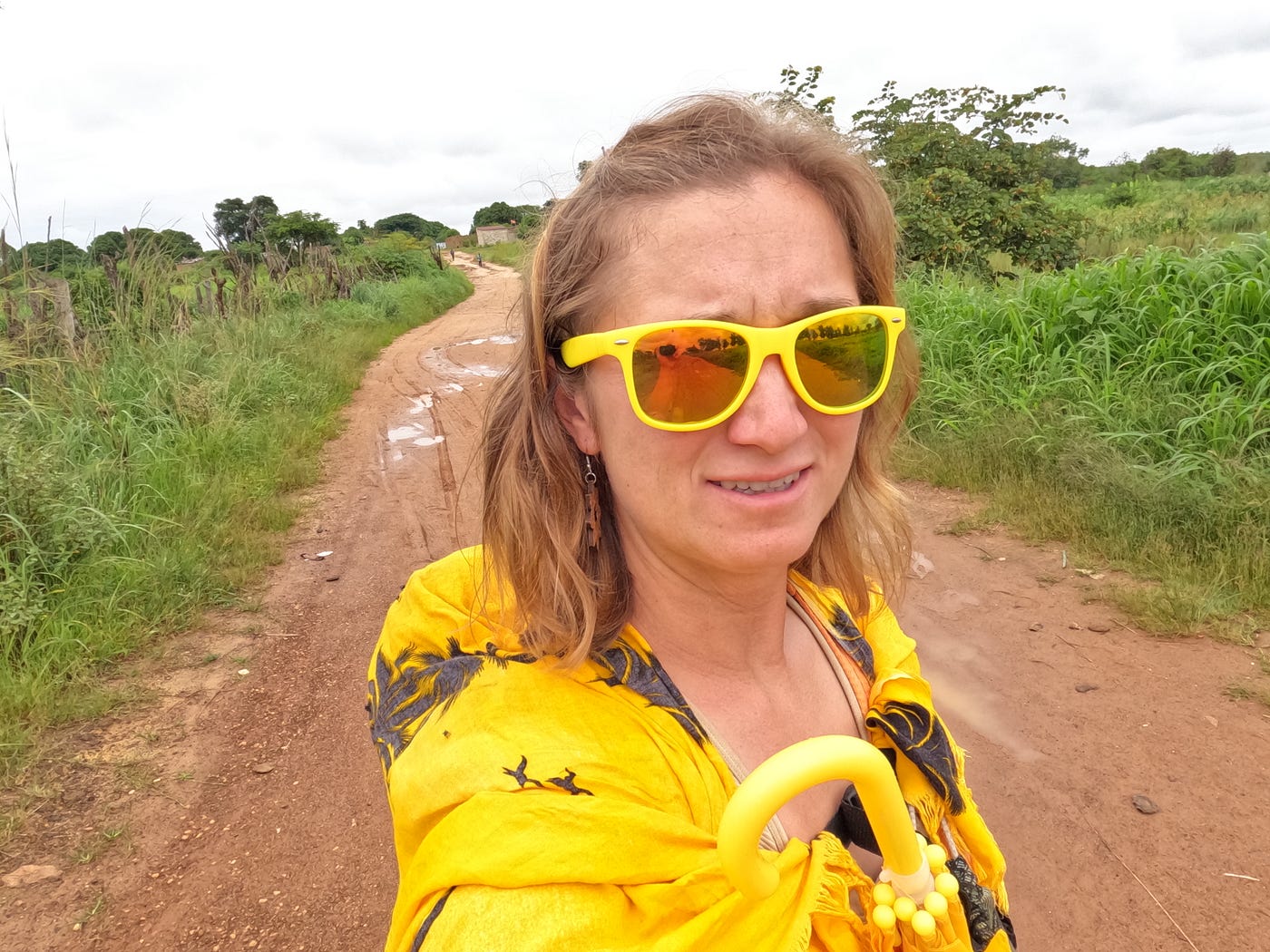
On my way into town with Eric asleep on my back. | Photo credit: Anne Bonfert
Reaching the tarred road, I now know I'm nearing the townships on the outskirts of the city but walk confidently behind the women I spoke to earlier. Yes, I caught up to them since I no longer walk at toddler pace and do not carry tens of kilos of groceries on my head. The woman points at my back where Eric sleeps and nods upon my explanation of "o filho a dormir". I got her approval now that I no longer make the baby walk. This makes me smile.
I greet a man passing by on a scooter who almost instantly slows down and comes to a halt, gesticulating that he offers me a ride into the city. I wave off and thank him for his generosity while remaining baffled by this incredible encounter.
A few houses appear and I begin to look out for piles of tomatoes stacked on the side of the road. Sights we had seen the previous days but sights which wouldn't appear today. Instead, I notice a child sitting on the side of the road with a box filled with what appears to be rolls. Bread, it's what we still need, I remember, and decide to cross the road, heading straight for the little girl, who lights up in a big smile upon my arrival and greeting.
Not knowing how much a roll would cost or what I'd get for a bill I decide this time to begin small and hand her a 200 Kwanza bill. The girl opens a plastic bag and places two rolls inside. I need more than that and decide to take back the bill out of her hand and give her a 1000 Kwanza bill instead. Now she picks more bread; I note that she hides her hand in a plastic paper, making sure she doesn't touch any of the rolls handed to me. Once the bag is full, I wave off and get a 200 bill as change.
This is how you can see if Westerners are common in any part of Africa or not. In most places where we've managed to present ourselves with shameless superiority, the locals will not hesitate to ask double or triple the local price from any white person, forcing us to haggle every time and still leaving us behind with a feeling of getting ripped off in the end.
Not here.
While tourism has slowly begun to spread across Angola, it is mostly centered on its capital, Luanda, and the coastline. Not many travelers make their way far off the beaten paths into the countryside or mountains in the East. And I am enjoying this. A lot.
Continuing my stroll with the sleepy baby on my back, I look out for more roadside sales but can't find the wanted tomatoes or avocados, which I'd also love to get. Thinking of entering one of the shops, I decide against the first one where five men are standing in front. They would probably not do anything, but I don’t want to force my luck, and so I keep walking.
Many locals now passing me are dressed in nice clothes and clean shoes, making me feel dirty. They are on their way to or from church, I guess. Girls are having their hair braided and decorated with beads, while my face is only carrying beads of sweat. Yes, despite the cloud cover, I feel the walk now. I lost track of time and carry no phone with me, but I know it's been a while and I've covered some miles.
The next shop looks promising, so I enter and ask for tomatoes after greeting the owner. He and another man inside try to understand what I want but don't know the word I use. I thought tomato is tomato in pretty much all the Latin languages but apparently not in Portuguese. The man then offers me “agua”, which makes me realize how thirsty I am, and so I decide to buy a bottle of water.
While gulping down the water, I re-enter the street and continue walking toward town. Looking far ahead, I see no more roadside stalls for a while. It's probably best if I turn around now. The city center is still far and that is probably where I will find tomatoes and avocados. But since I am on foot and still have to walk back all the way I came, I decide that this is as far as I will walk.
Asking some men at the next corner for tomatoes, I am sent into another shop that has nothing but canned foods and snacks. I look down the road leading deeper into the township and shake my head. I told David I would be staying on the main road. I felt safe walking here but I won't be pushing my luck.
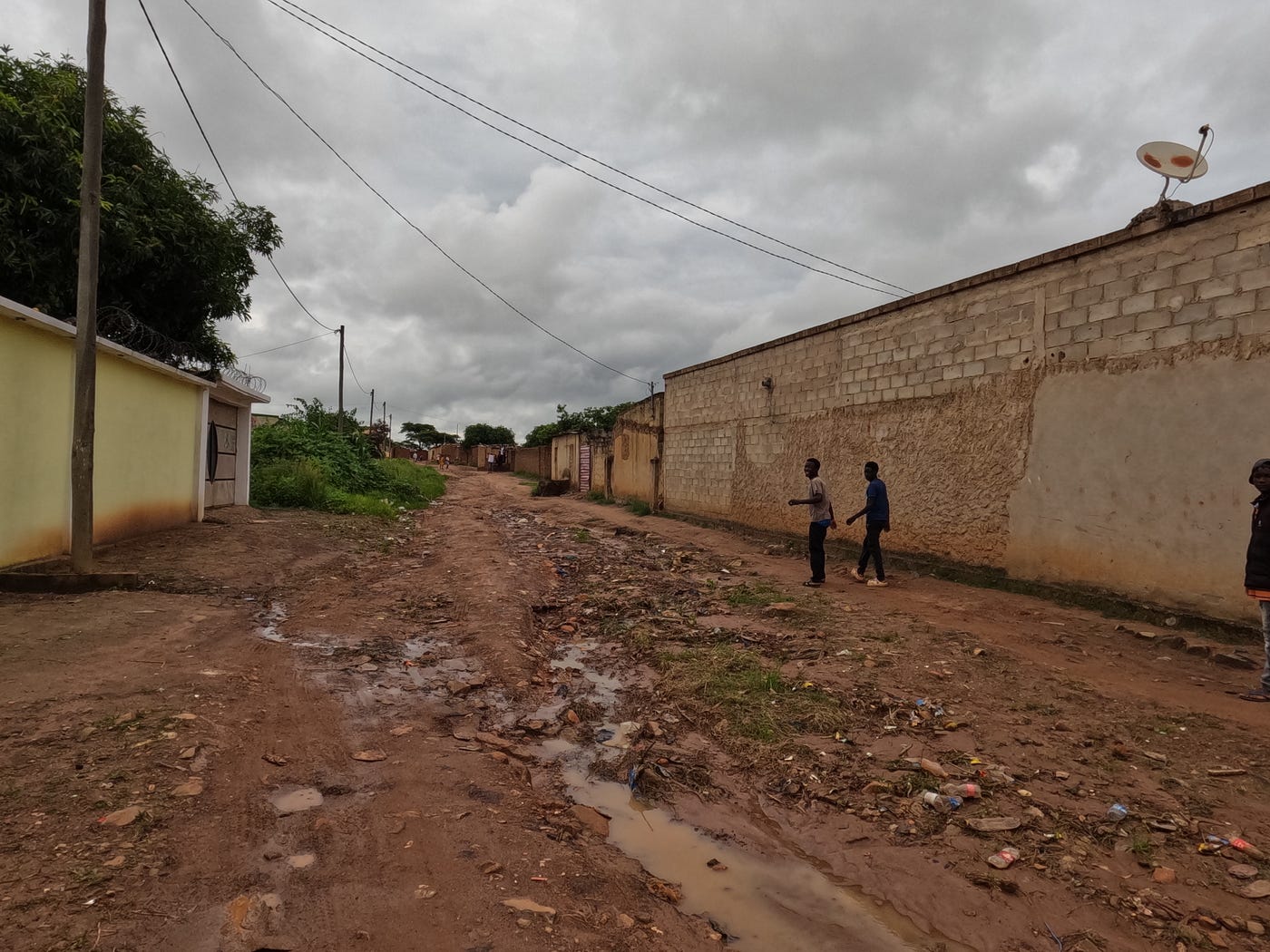
The road leading deeper into the township which I decided not to follow. | Photo credit: Anne Bonfert
It had been a joy coming this far and I still have one more stop ahead. Walking out here, I see two young girls sitting on a chair next to a box filled with dough balls. I've seen them in many parts of Africa before. They aren't super sweet nor filling but something to snack on. And so as I approach the girls, I greet them and point at their box, saying "dos". A whole group of children now appears and an older girl begins to tear off a piece of plastic attached to the box. I'm not getting the dough balls in a plastic bag, but in a piece of plastic just big enough that she doesn’t touch the product.
Not knowing the price and not getting an answer to my “quanto” question, I hand them the smallest bill, 200 Kwanza, and receive a nod. The girls are super happy, smiling all around and I decide to ask them if I may take a picture. Immediately, an even bigger crowd appears and poses in front of me. I put the GoPro back into my bag, wave to the children and move on.
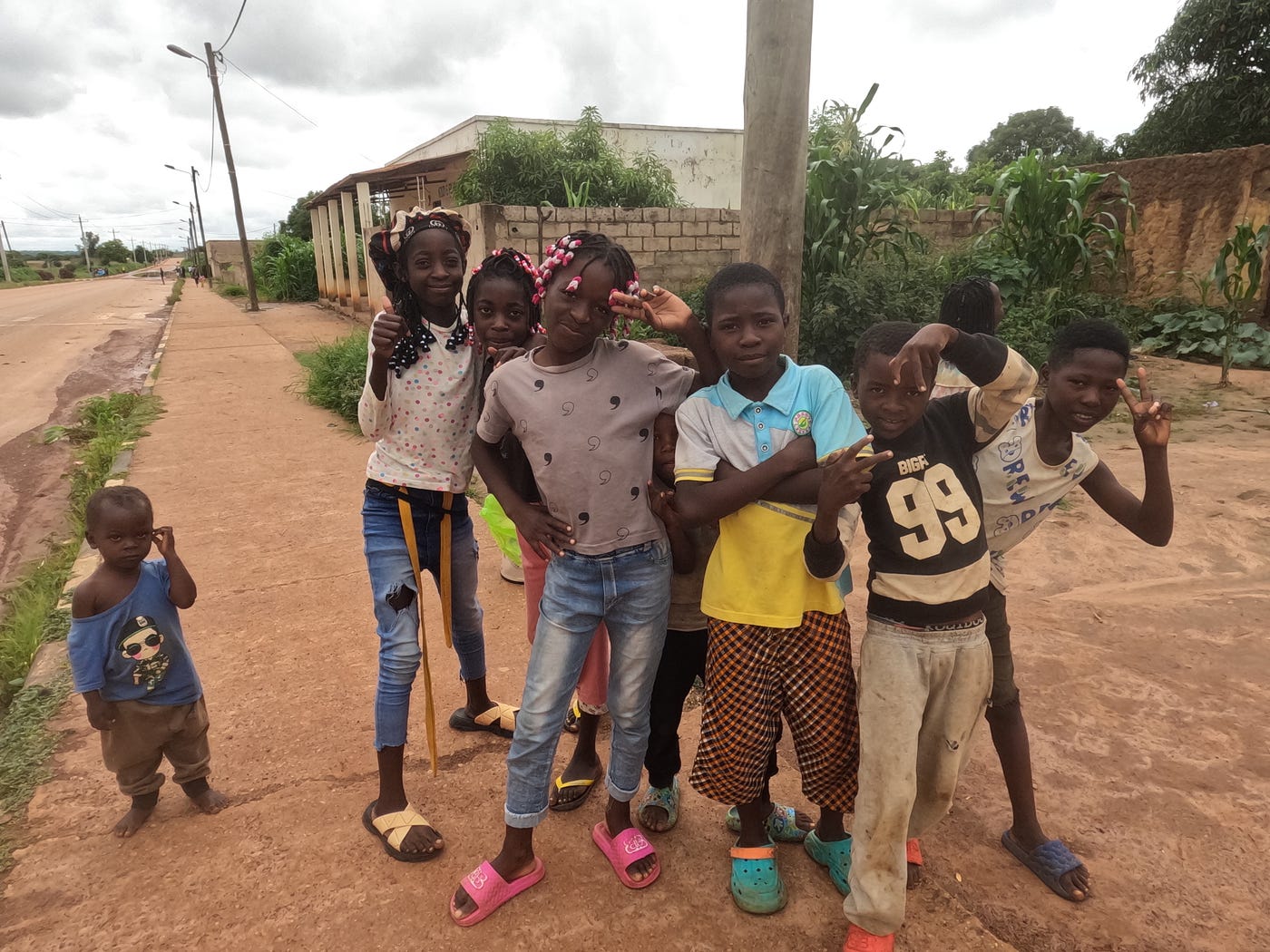
The girls selling me dough balls and some of their friends posing for a picture. | Photo credit: Anne Bonfert
A few hundred meters down the road, I hear some screaming and tiny feet clapping on the tarred road and turn around to see the girls chasing me. The oldest comes up to me and holds up two 50 Kwanza coins, my change. I am baffled. They probably had to go back to their parents to get the coins for my change. But neither they nor the parents came up with the idea just to "keep" my change. Honesty all the way. Meanwhile, those 100 Kwanza are worth less than 10 cents.
Looking at them while still trying to understand what is happening, I show the girl that the money is hers, which at first, she doesn’t even understand and keeps holding out her hands with the coins toward me. I try to tell her it's hers with the words "de vocés" while pointing at her and she shyly looks at her friends before bursting out with the happiest smile. She deserves that change.
Pointing at the baby on my back covered in a cloth, the kids hang on me and I decide to lift the sarong as Eric had slept for a while. He now smiles at those kids staring at him. The children are all smiling and waving at him, some tickling his toes. I look back, ensuring my little man isn’t placed into an uncomfortable situation right after waking up, but while hanging on his mommy, he's always the happiest and certainly up to interacting with local children.
The kids continue to walk with me as the first raindrops fall and we smile at each other without having a conversation. Some women from behind us catch up to me and tell me to use the umbrella I am carrying to protect the baby. It isn't raining hard yet, and the temperature is very pleasant, but since the woman makes a point, I decide to show her I was protecting my child and open up the umbrella, holding it above us both. This is also the moment when the paths of the crowd following me and mine separate as they turn off to go into the church and I continue on the road.
It rains a little harder now as I reach the end of the tarred road. The red dirt road ahead looks slippery when wet and I take off my flip-flops feeling more comfortable walking barefoot on this ground.
Reaching the village with nothing but clay huts, I stop next to a lady selling mangoes on the side of the road. Yes, I had bought some earlier but after knowing how cheap they are compared to the price I had been charged the previous day in the city, I decide to get some more. I ask for one pile of mangoes before noticing the large ones inside the lady's bag and point at those instead. She shakes her head, saying they are hers. She suddenly packs up all those mangoes into the bag while sending another woman to the back. She doesn't seem too keen on selling me fruits, which I don’t get why, but then I notice the other woman washing some mangoes in the water tank at the back and handing them to me.
While I'm handing over the money, Eric, whom I had placed on the ground, reaches out for the mangoes, and the lady, seemingly more friendly to my child than to me, gives him one nice-looking mango. While all this is happening, more and more people appear, including one police officer, watching the scene.
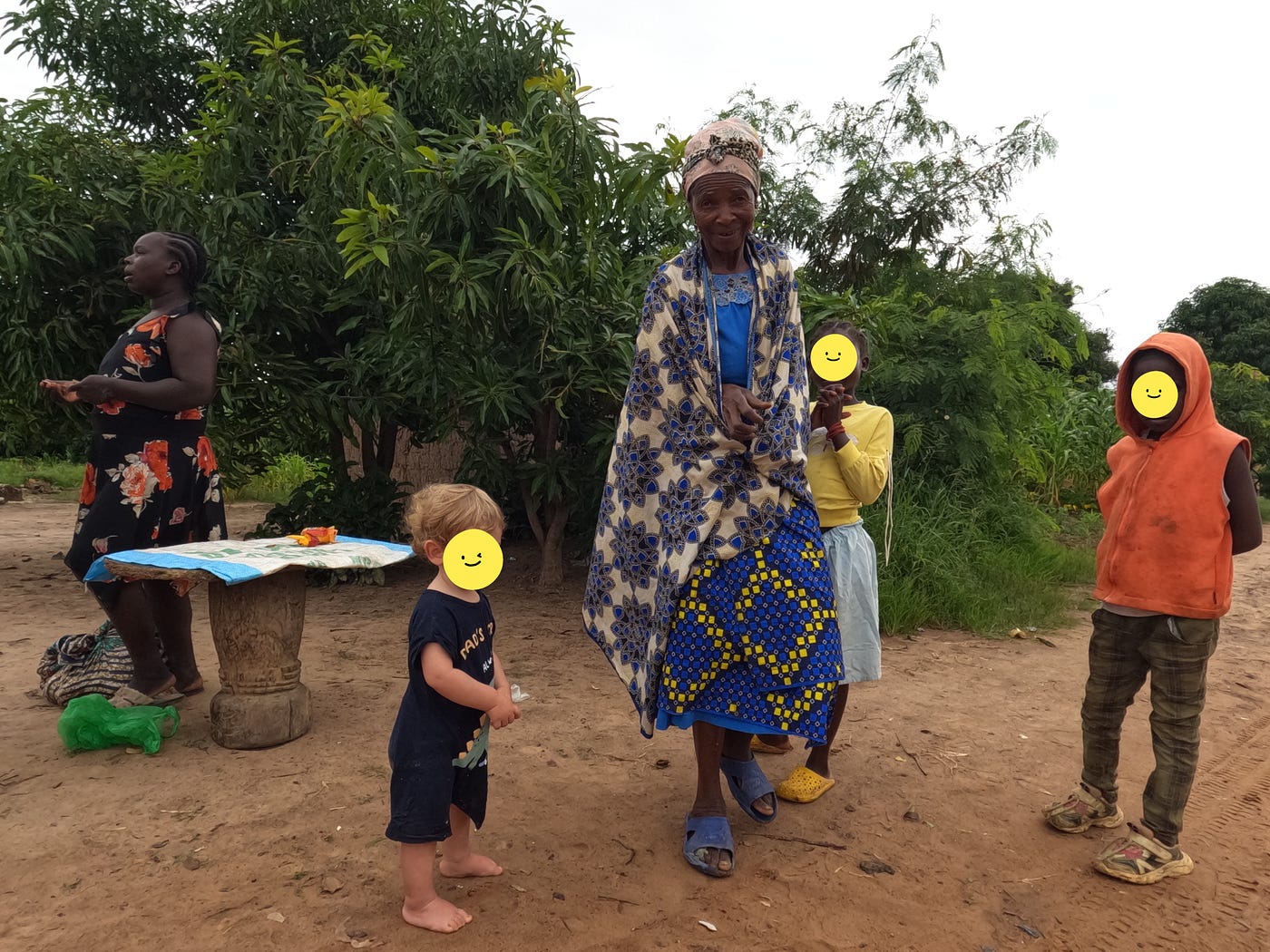
A roadside interaction. | Photo credit: Anne Bonfert
I remember I still have that annoying empty plastic bottle. No, there are no trash bins in this part of the country, but I also didn’t see much trash on the side of the road. I don't want to dump my trash onto these people but I know they'd reuse this bottle as they don't have money to ever buy bottled water. But how to communicate this?
When I first hold out the bottle, the lady shakes her head. Then they say something about agua and the other woman once again walks to the back with my bottle. They want to fill it with water for me. How generous of them, people who have barely enough for themselves, to share with a stranger. But I shake my head, saying "no agua" and showing once again it was a "gift". The police officer says something and then the woman smiles. They finally understand the gesture and seem to appreciate it.
A scooter is approaching on the dirt road and before I can get to Eric, one of the older girls picks him up against his will and as he complains, she looks at him saying "I know you don't want to be picked up but a motorbike is coming and I keep you safe" or something similar as I follow her words in Portuguese.
After a while of smiling at each other and laughing, we wave goodbye and I put Eric back into the carrier as my attempt of letting him walk failed. He wants to stay in the village. The kids and the dogs have caught his attention.
We walk behind two locals, a very chatty girl and her companion. Eventually I need a bathroom break but with all the foot traffic on this dirt track, I don't know where to hide. When I suddenly find a track leading down, I don't hesitate and follow it for a few meters before hiding in the bushes.
From here on I let Eric walk again who soon gets distracted by some kids. The boys are each holding either a machete or an axe and clearly on their way to the fields but also enjoy the stranger on foot here and sit down to watch Eric from a distance.
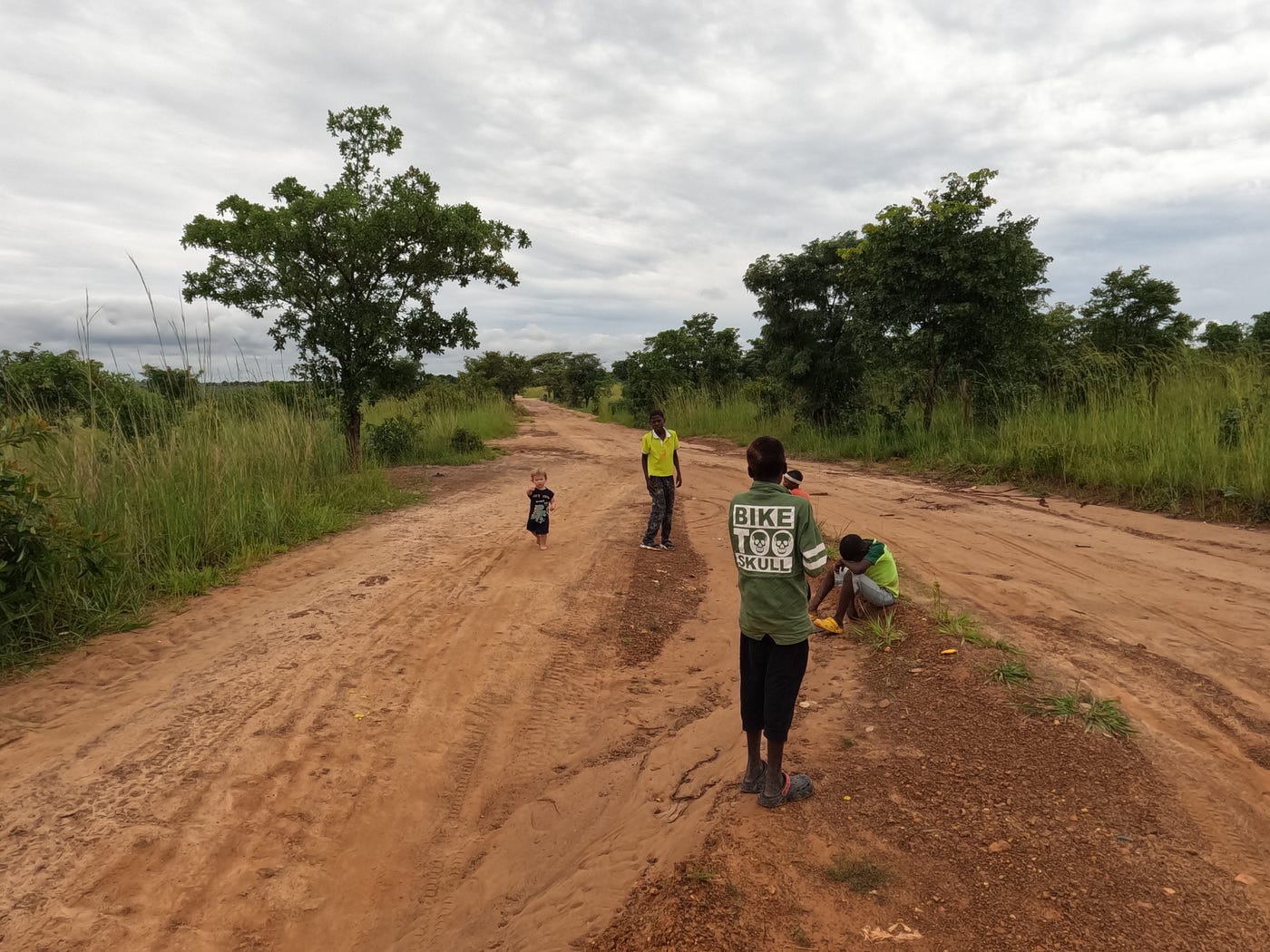
Eric and the local boys on their way to the fields. | Photo credit: Anne Bonfert
According to David, we made it back to our place over three hours after leaving. Exhausted but happy, I sit down and don't stop babbling as I want to share all we saw and experienced. I am fulfilled with some indescribable happiness. I had done nothing more but walked along a road and yet it was so much more.
All the interactions with locals, the smiles shared, and the respect I was given were so much more than I could have anticipated. Being treated as a basic human, not as a rich Westerner with money growing on trees, was such a refreshing and touching experience. I had many flashbacks to my time in Ghana over ten years ago, when I mostly traveled solo and was often helped along the way. For directions or access to food and water. The only difference now is that I have a child in tow, and the locals seem even more friendly and genuine than the “friendliest nation on Earth," as Ghanaians like to call themselves.
While I never considered stopping my travels after starting a family, I also didn’t think about how locals in the places we now travel to would react. With even more kindness, smiles, and genuine hospitality. Incredible.
This is part of Globetrotter’s June challenge “languages”.
Read more about this trip to Angola here or previous African adventures through southern Africa or Ghana. Thank you.
메타데이터
- post_id
- df10f6b380ae
- slug
- i-walked-with-my-baby-through-an-african-township-df10f6b380ae
- url
- https://medium.com/globetrotters/i-walked-with-my-baby-through-an-african-township-df10f6b380ae
- canonical_url
- https://medium.com/globetrotters/i-walked-with-my-baby-through-an-african-township-df10f6b380ae
- author_url
- https://medium.com/@anne.bonfert
- status
- ok
- fetched_at
- 2026-06-20 20:29:01