Why ‘Safe’ Is Dangerous: The CPF Dilemma Nobody Is Talking About for 2026
The trade-off between a guaranteed payout and the freedom to survive a crisis.
Why ‘Safe’ Is Dangerous: The CPF Dilemma Nobody Is Talking About for 2026
The trade-off between a guaranteed payout and the freedom to survive a crisis.
I’ve been scrolling through American financial news lately, and it’s a bloodbath. Retirees are furious because their Social Security “COLA” (Cost of Living Adjustment) is barely scratching the surface of real inflation.
It’s easy to sit back in Singapore, sip our kopi c, and feel smug. After all, our system is rock solid. We have the Triple-A credit rating. We have the CPF floor rates. We have stability.
But here is the uncomfortable truth that I’ve been discussing with my private clients: We have a silent crisis brewing for 2026, and the “standard” advice might be leading you into a trap.
The government is encouraging us to top up our CPF to the new Enhanced Retirement Sum (ERS). The narrative is simple: “It’s risk-free 4% interest! Where else can you find that?”
They aren’t wrong. It is safe.
But in the world of finance, safety always costs you something. In this case, the price isn’t risk — it’s freedom.
If you have a lump sum of cash sitting in the bank right now, here is why you need to think twice before locking it away.
AI Generated
1. The “Safety” Math Doesn’t Account for Medical Reality
Let’s get the numbers out of the way. Your CPF Special and Retirement Accounts are earning a floor rate of 4.0%.
That sounds great when bank deposits are hovering around 2.5% or 3%.
But you don’t live in an economy of “averages.” You live in a reality where your biggest future liability is healthcare. And medical inflation in Singapore is projected to hit 12% to 15% as we head into 2026.
Think about that delta.
Your “safe” money is growing at 4%. The cost of your knee replacement or cancer treatment is growing at 12%.
If you lock all your liquid cash into a fixed annuity (CPF LIFE) that pays a flat monthly sum, you are essentially betting that your expenses will remain flat. History tells us that is a losing bet.
You need an asset that doesn’t just survive inflation, but beats it.
2. The One-Way Bridge (The Liquidity Problem)
This is the part that usually gets me into trouble with the “CPF Maximalists,” but it needs to be said.
When you top up your CPF Retirement Account to the ERS limit, your money isn’t “gone.” It is still yours. It is still growing.
But it crosses a one-way bridge.
It transforms from Capital (a lump sum you control) into Income (a monthly allowance you receive).
Why does this matter?
Because life doesn’t happen in monthly instalments, life happens in lump sums.
- A sudden diagnosis that requires alternative treatment overseas.
- A child who needs help with a down payment.
- A leaky roof that costs $20,000 to fix.
If you are 65 and have locked in $400,000 in CPF LIFE, you might be receiving a nice $3,000/month payout. But if a $50,000 emergency hits on a Tuesday, you cannot call the CPF Board and ask for an advance. You are asset-rich, but cash-poor.
In retirement, cash flow keeps the lights on. But liquidity saves you from ruin.
3. The “Monthly Paycheck” Alternative
So, what’s the alternative? If you have the cash, do you just leave it in the bank to rot?
No. You build your own annuity.
I’m seeing more sophisticated retirees pivoting towards Monthly Dividend Funds or portfolios of high-yield REITs (Real Estate Investment Trusts).
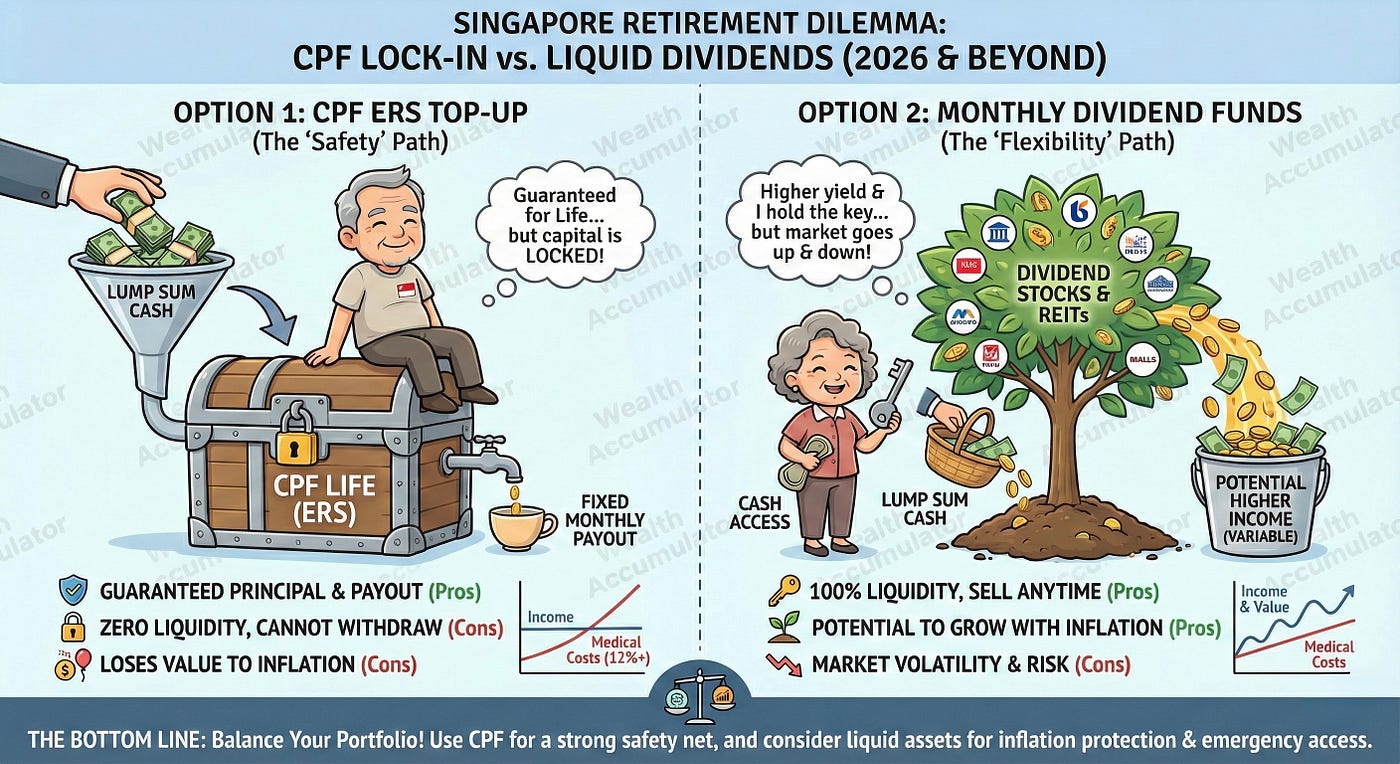
Here is the logic: Instead of handing your capital over for a promised payout, you buy assets that pay you a “salary” (dividends) while you keep the keys to the vault.
In the current 2025/2026 market, a solid income portfolio can target a 5.0% to 6.5% yield.
Let’s look at the trade-off:
- The CPF ERS Route: You get safety. You sleep well knowing the government guarantees your payout. But your capital is committed to the system.
- The Dividend Route: You get liquidity. You receive a monthly income (often higher than CPF yields), and crucially, you still own the principal.
If you need to sell $20,000 worth of stock next week for an emergency, you click a button, and the cash is in your bank account in three days.
The Verdict? Balance is the New Wealth.
I am not anti-CPF. In fact, I think hitting the Full Retirement Sum (FRS) is the bedrock of a Singaporean retirement. It’s your safety net.
But a safety net shouldn’t be your entire house.
If you have met the FRS, think carefully before you instinctively top up to the ERS.
- Use CPF to cover your survival needs (hawker food, utilities, basic bills).
- Use your Liquid Cash to build a dividend engine that covers your lifestyle (travel, gifts, upgrades) and acts as your emergency fund.
Don’t prioritise safety so much that you handcuff your own future. In 2026, the most valuable currency isn’t just interest — it’s flexibility.
Thanks for reading! If this perspective shifted your thinking on retirement planning, give it a few claps 👏 so others can find it. What’s your strategy for 2026? Are you Team ERS or Team Dividends? Let me know in the comments.
Disclaimer: This article is for informational and educational purposes only. It does not constitute financial, investment, or legal advice. The views expressed here are my own and do not represent the official views or positions of my company. Market investments carry risks, including the potential loss of principal. Always consult with a qualified financial advisor before making any decisions regarding your retirement planning or investments.
메타데이터
- post_id
- df22902a4883
- slug
- why-safe-is-dangerous-the-cpf-dilemma-nobody-is-talking-about-for-2026-df22902a4883
- url
- https://medium.com/@rogerchuakt/why-safe-is-dangerous-the-cpf-dilemma-nobody-is-talking-about-for-2026-df22902a4883
- canonical_url
- https://medium.com/@rogerchuakt/why-safe-is-dangerous-the-cpf-dilemma-nobody-is-talking-about-for-2026-df22902a4883
- author_url
- https://medium.com/@rogerchuakt
- status
- ok
- fetched_at
- 2026-06-10 18:44:10