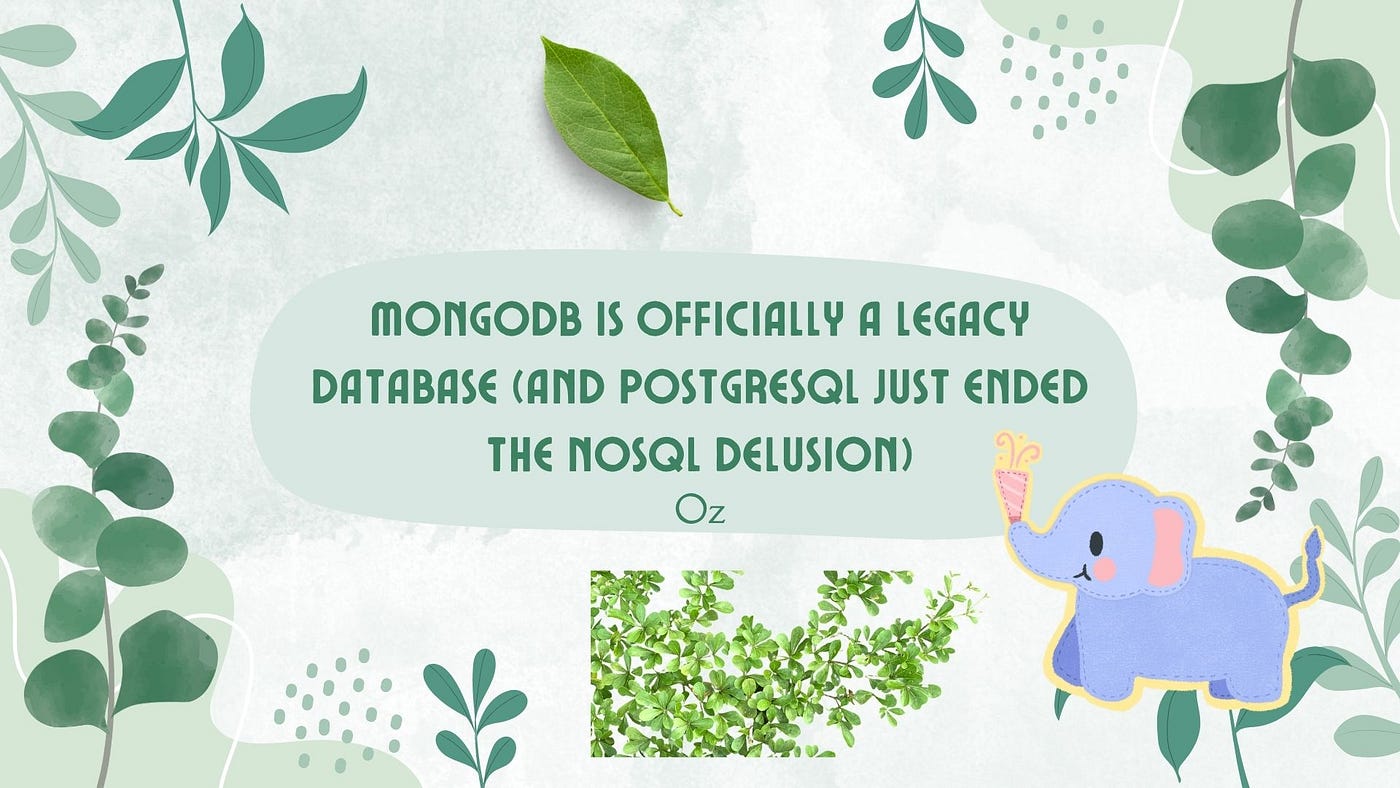
MongoDB is Officially a Legacy Database (And PostgreSQL Just Ended the NoSQL Delusion)
Why the database darling of the 2010s has been dethroned by the undisputed king of relational data, and why your next startup should…
MongoDB is Officially a Legacy Database (And PostgreSQL Just Ended the NoSQL Delusion)
Why the database darling of the 2010s has been dethroned by the undisputed king of relational data, and why your next startup should default to Postgres.
We chose NoSQL for the flexibility, but we stayed for the data inconsistency and the eventual realization that our data was relational all along. — The collective sigh of Senior Developers everywhere.
If you started coding anytime between 2012 and 2018, you were probably sold a very specific dream. The dream was called MEAN or MERN. You were told that SQL was a rigid, ancient artifact belonging to enterprise graybeards. You were told that schema-less was the future, and that if you wanted to achieve elusive web-scale, MongoDB was your only salvation.
Fast forward to today, and the dust has settled. The NoSQL hype train has officially derailed, and out of the smoke emerges a familiar, elephant-shaped silhouette. PostgreSQL didn’t just survive the NoSQL onslaught; it absorbed its best features, quietly rendering MongoDB into a legacy technology.
Here is why the NoSQL delusion is over, and why PostgreSQL has claimed the ultimate crown.
The False Promise of Schema-Less
The biggest selling point of MongoDB was that you didn’t need a schema. You could just dump raw JSON objects into a collection and figure it out later. For a two-week hackathon, this felt like magic. For a five-year-old production codebase, it was an absolute nightmare.
Developers quickly learned a harsh lesson: Your data always has a schema. If you don’t enforce it at the database level, you are forced to enforce it at the application level.
- The Nightmare of Data Integrity: Suddenly, you had records missing crucial fields, types changing dynamically, and validation logic scattered across thousands of lines of backend code.
- The Relational Reality: 95% of business applications are inherently relational. Users have posts, posts have comments, comments have likes. Trying to force relational data into a document model resulted in massive data duplication or horrendous application-level joins.
The PostgreSQL JSONB Revolution
While MongoDB was busy convincing developers that joins were bad, the PostgreSQL core team did something brilliant. They didn’t fight the JSON trend; they assimilated it.
With the introduction and continuous optimization of JSONB (Binary JSON), PostgreSQL essentially looked at MongoDB and said, Anything you can do, I can do better.
PostgreSQL is no longer just an RDBMS. With JSONB, GIN indexing, and its rock-solid ACID foundation, it is the ultimate multi-model data platform.
Here is why PostgreSQL’s JSONB officially ended the NoSQL argument:
- Hybrid Data Modeling: You can have strict, typed columns for your core relational data (Users, Payments) and a flexible JSONB column for unstructured data (User Preferences, API payloads) in the exact same table.
- Blazing Fast Indexing: Thanks to GIN (Generalized Inverted Index), querying deep within a JSON document in Postgres is incredibly fast. In many benchmarks, Postgres handles document querying faster than MongoDB itself.
- Uncompromising ACID Guarantees: You never have to lose sleep over partial transaction failures. PostgreSQL’s transactional integrity is battle-tested. You get the flexibility of NoSQL without sacrificing the reliability of SQL.
Why MongoDB is Now Legacy
Calling MongoDB a legacy database might rustle some feathers, but let’s define what legacy means in the modern stack. A technology becomes legacy when a newer, more robust standard makes its primary use case obsolete for new projects.
Are there companies still using MongoDB at a massive scale? Absolutely. Will it disappear tomorrow? No. But if you are a CTO or a Lead Engineer starting a brand new project today, choosing MongoDB over PostgreSQL is becoming increasingly difficult to justify.
You are actively choosing to:
- Give up strict data integrity.
- Make complex querying harder.
- Limit your future ability to easily write complex analytical queries.
The Verdict: Default to Postgres
The tech industry loves a pendulum swing. We swung all the way from strict relational databases to the absolute anarchy of schema-less NoSQL. Now, the pendulum has settled perfectly in the middle.
We realized we wanted the flexibility of documents, but we needed the strictness of relations. PostgreSQL gave us both.
The NoSQL delusion was a necessary phase in our evolution. It pushed the industry forward and forced relational databases to adapt. But the war is over. The undisputed champion of modern data storage is PostgreSQL.
Long live the Elephant.
메타데이터
- post_id
- df29e9a2833e
- slug
- mongodb-is-officially-a-legacy-database-and-postgresql-just-ended-the-nosql-delusion-df29e9a2833e
- url
- https://medium.com/postgresql-blogs/mongodb-is-officially-a-legacy-database-and-postgresql-just-ended-the-nosql-delusion-df29e9a2833e
- canonical_url
- https://medium.com/postgresql-blogs/mongodb-is-officially-a-legacy-database-and-postgresql-just-ended-the-nosql-delusion-df29e9a2833e
- author_url
- https://medium.com/@ozwizard
- status
- ok
- fetched_at
- 2026-07-09 03:40:04