How I Use Claude to Audit SEO?
(Better Than $500 Agency Audits)
How I Use Claude to Audit SEO?
(Better Than $500 Agency Audits)
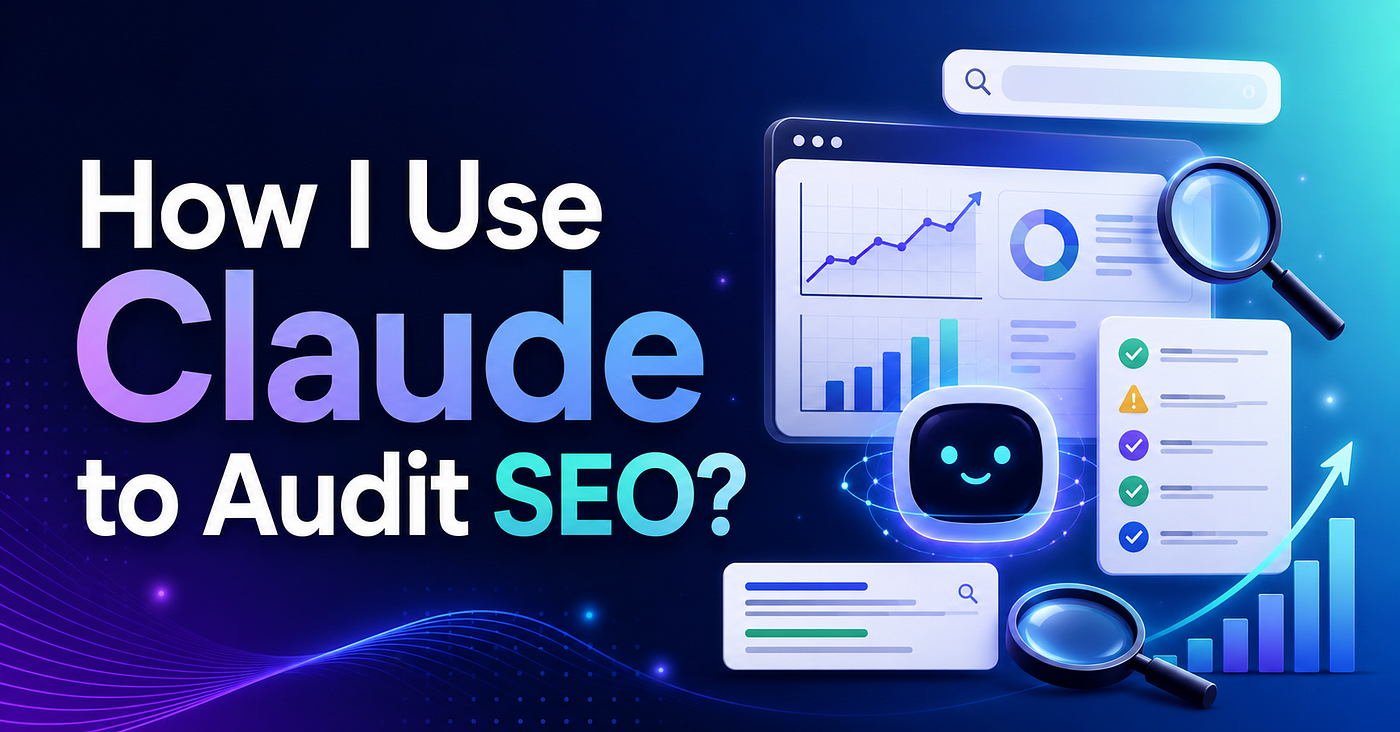
Source- ChatGPT
You can Checkout this site For Amazing Content. Click here!
I paid an SEO agency $500 for an audit last year.
They sent a 47-page PDF.
It had charts, competitor comparisons, keyword gaps, technical issues, and a priority matrix.
I read the whole thing.
Then I hired them for three more months to implement it.
Six months later, rankings had barely moved.
When I finally sat down and rebuilt the audit process myself using Claude, I found three issues the agency completely missed. Fixed them in two weeks. Rankings started moving within 30 days.
The $500 audit wasn’t bad. It was just built for the agency’s workflow, not mine.
This is the audit process I use now. It costs nothing except the time to run the prompts.
The Problem With Agency Audits
They’re not lying to you. They’re just optimizing for deliverables.
A 47-page PDF looks thorough. A one-page action list doesn’t. So you get the PDF.
The issues with most paid audits-
They’re templated. Same checklist for a food blog and a SaaS company.
They prioritize what’s measurable over what matters. Lots of technical fixes, light on content strategy.
They can’t account for your specific niche, audience, or business goals.
And the biggest one: they audit a snapshot. Your site in one moment. Then they leave.
Claude audits don’t work like that.
What I Audit (And What I Skip)
Most SEO audits try to fix everything.
That’s the wrong approach.
I audit in four areas. In this order.
- Content gaps vs. search intent
- On-page optimisation failures
- Internal linking structure
- Technical issues (last, not first)
Most agencies start with technical. Crawl errors, Core Web Vitals, redirect chains.
Fine. But if your content doesn’t match what people are searching for, fixing your crawl budget does nothing.
Content first. Technical last.
The Prompts I Actually Use For SEO Audits
Audit Prompt 1: Search Intent Mismatch Detection
This is where most sites bleed traffic without realizing it.
I’m going to give you a list of my top 20 pages by traffic, with their target keywords and current rankings.
For each page, tell me:
- Whether the content likely matches the search intent for that keyword
- What the actual search intent probably is (informational/commercial/transactional/navigational)
- Whether my current format matches what’s ranking on page one (guide, list, comparison, tool, etc.)
- A specific recommendation if there’s a mismatch
Pages: [paste your list: URL, target keyword, current ranking]
Be direct. Tell me which pages are fighting the wrong battle.
Audit Prompt 2: On-Page Optimization Score
Analyze this page for on-page SEO issues:
Target keyword: [keyword] Page content: [paste full content] Current ranking: [position] Current title tag: [your title] Current meta description: [your meta]
Check for:
- Title tag — keyword placement, length, CTR potential
- Meta description — character count, keyword inclusion, call to action
- H1, H2, H3 structure — logical hierarchy, keyword usage
- First 100 words — does the keyword appear? Is the intent clear immediately?
- Semantic keyword gaps — what related terms are missing?
- Internal links — how many, and are the anchor texts optimized?
- Content length vs. top-ranking competitors (estimate based on topic)
Give me a score out of 10 for each area. Then give me a prioritised fix list. Most impactful changes first.
The scoring matters more than the feedback.
When an agency says “your meta descriptions need work,” you don’t know if that’s a priority-one fix or a nice-to-have.
When Claude gives you 4/10 on semantic keywords and 9/10 on the title tag, you know exactly where to spend your next hour.
Audit Prompt 3: Internal Linking Gaps
This is the most underrated audit category.
Most sites have strong pages floating in isolation. No links pointing to them. No links flowing out.
Here’s a list of my top 15 pages by SEO value (or organic traffic):
[URL, topic, target keyword for each]
Tell me:
- Which pages should be linking to each other (and aren’t)
- What the anchor text should be for each suggested link
- Which pages look like “orphans” — strong content with no internal support
- What a logical topic cluster structure looks like for this content
- Which page should be my pillar page for each topic cluster
Assume I want to maximize topical authority, not just distribute PageRank.
My site had a pillar page on content marketing ranking at position 11.
Claude identified six supporting posts that never linked to it. I added the links with proper anchor text.
Position 11 became position 4. No new content. No backlinks. Just internal links.
Audit Prompt 4: Competitor Content Gap Analysis
I’m going to give you my main topic and three competitors.
My site focuses on: [your niche] My strongest content areas: [list your best topics]
Competitors: [competitor 1 URL] [competitor 2 URL] [competitor 3 URL]
Based on what you know about these sites and this niche, tell me:
- What content categories they likely cover that I probably don’t
- What keyword clusters I’m probably missing
- What content formats they use that I haven’t tried
- Where an newer site could realistically outrank them (lower competition angles)
- One content opportunity that could drive meaningful traffic within 90 days
Be specific. Not “write more long-form content.” Tell me exactly what to write.
The 90-day constraint matters.
Without it, Claude gives you a 12-month content strategy. Useful eventually. Not useful now.
With it, you get one specific opportunity you can act on this week.
Audit Prompt 5: Technical Issue Prioritization
I said technical comes last. I meant it.
But when you do get there-
Here is a list of technical SEO issues on my site:
[paste from Screaming Frog, Ahrefs, or Google Search Console]
I have approximately [X hours] per week for technical fixes.
Tell me:
- Which issues are actually hurting rankings (vs. which are just warnings)
- Which issues affect my most important pages vs. low-traffic pages
- A priority order based on impact vs. effort
- Which issues I can fix myself vs. which need a developer
- Which issues can be safely ignored for now
My site is [CMS: WordPress/Webflow/Shopify/etc.] if that affects the fix recommendations.
The difference between this and a standard audit?
Standard audit lists 140 issues.
This prompt tells you which 8 actually matter and in what order.
The Full Audit Workflow
Here’s how I run a full audit from scratch.
Week 1: Content layer
Run Prompt 1 on your top 20 pages. Fix the worst intent mismatches first. Run Prompt 2 on your five most important underperforming pages.
Week 2: Structure layer
Run Prompt 3 on your full content library. Add the missing internal links. This takes two to three hours and almost always moves rankings.
Week 3: Gaps and competition
Run Prompt 4. Pick one content opportunity from the output. Start that piece.
Week 4: Technical
Export your GSC issues and site crawl. Run Prompt 5. Fix the top 5 priority items.
Total time: Maybe 12–15 hours for a full site audit.
Agency equivalent: $500 to $1,500. Plus, waiting two weeks for the report.
What Claude Can’t Do (Be Honest About This)
Claude doesn’t crawl your site. It can’t see your actual page speed scores or find broken links on its own.
You still need-
- Google Search Console for real traffic and ranking data
- Screaming Frog (free version covers most sites) for technical crawl
- Google PageSpeed Insights for Core Web Vitals
But here’s the thing.
Those tools give you data. Claude tells you what to do with it.
That’s the gap agencies actually fill. And you can fill it yourself for free.
Why This Beats Paid Audits for Most Sites
The audit you’ll actually implement beats the perfect audit sitting in a PDF.
Every time.
I’ve done three full site audits this year using this process. Each one took me a weekend. Each one surfaces fixes the previous agency's mistake.
Not because agencies are bad at their jobs.
Because they don’t know your site the way you do. And they can’t iterate with you in real time.
Claude can.
Run a prompt. Get a result. Ask a follow-up. Adjust. Repeat.
That’s not an audit. That’s an ongoing SEO conversation with a system that never gets tired of your questions.
Way better than a PDF.
ALL THE BEST!
………………………………………………………………………………
Enjoyed this read? Show some love by giving it a few claps 👏 and sharing it around!
Follow Webjinnee For More!
More great content is coming soon, so feel free to follow me here on Medium to stay updated.
Let me know your thoughts and feedback in the comments below!
Cheers! 🥂
I’m Nitin (Founder of Webjinnee), and I’ll catch you on the next one! ✌️
………………………………………………………………………………
메타데이터
- post_id
- df2cb414a970
- slug
- how-i-use-claude-to-audit-seo-df2cb414a970
- url
- https://medium.com/marketing-matrix/how-i-use-claude-to-audit-seo-df2cb414a970
- canonical_url
- https://medium.com/marketing-matrix/how-i-use-claude-to-audit-seo-df2cb414a970
- author_url
- https://medium.com/@webjinneeofficial
- status
- ok
- fetched_at
- 2026-06-13 09:11:36