Assessing Startup Risk — A Methodology for Phi Measure of Risk
This articles describes a methodology for systematically assessing risks in a high technology startup and then presenting the results in a…
Assessing Startup Risk — A Methodology for a Phi Measure of Risk

Assessing Risk in Startups is Hard
This articles describes a methodology for systematically assessing risks in a high technology startup and then presenting the results in a simple risk contour profile and a single number, its Phi Risk.
The methodology described here is designed as adjunct to the Lean Canvas methodology. It extends that methodology by adding one further aspect — how to assess the risk side of the risk-reward tradeoff.
For anyone interested in a Phi Calculator that performs the calculations in this article and produces final graphs and risk numbers, you can download the calculator here.
There are 11 risk parameters to assess. Each parameter is graded on a profile of 0 to 10. Low risk is ranked as 0, medium risk as 5 and high risk as 10. Finally the result is shown in a simple “Risk Contour Profile”.

The Phi Risk Number for an Opportunity
Finally the resultant score is labelled as an opportunity’s Phi Risk Number — the average of the 11 scores, a number from 0 to 10.
Parameter 1: Technology Risk
“Technology Risk” is a measure of how risky it is to achieve the core technological breakthrough(s) that are necessary for an opportunity to be a success:
- An opportunity is “High Technology Risk” {Score 9–10} if it requires a significant set of breakthroughs (more than three), each one of which is necessary, and for which there is currently no proven and independently verified solution for any of them;
- An opportunity is “ High Technology Risk” {score 8–10} if it is predicated on a fundamental breakthrough in one of the sciences (chemistry, materials, physics, computing) and where that problem has been well understood for some time;
- An opportunity is “ Low Technology Risk” {score 0–4} if its technology solution has been demonstrated in reduced form already, and where it does not rely on simultaneously achieving multiple breakthroughs;
- An opportunity is “ Low Technology Risk” {score 0-4} if the technology breakthrough theory has been peer reviewed, through both patents and articles, and where the breakthrough is in creating additional small practical breakthroughs to commercialize the concept.
Parameter 2: MVP Edge Case Risk

Minimal Viable Product
Startups need to deliver a Minimal Viable Product (MVP) that reduces the scope of a product to one that is just sufficient to deliver a product that customers want and will purchase.
Then the startup can enter an iterative learning cycle to maximum effect.
However often the scope of an MVP is expanded drastically due to “edge cases” — all the little things that a customer wants in its MVP. Some products have few edge cases — they are easy to deliver as self-contained value propositions. They have low “Edge Case Risk”. Others have an enormous number of edge cases — very large numbers of little things that need to be delivered before a customer finds the product “acceptable”. Often in these latter cases customers become annoyed to the point of dismissal if any one of these “little things” are missing or don’t work. They have “High Edge Case Risk”:
- An opportunity has a “High Edge Case Risk” {score 9–10} if there are a large number of features { > 20 critical features} that must be delivered before the MVP can be accepted by the target initial customer base
- An opportunity has a “High Edge Case Risk” {score 8–10} if there are a large number of interfaces to 3rd party systems necessary (that are each subject to change outside of the control of the opportunity);
- An opportunity has a “High Edge Case Risk” {score 7–10}if there are a significant number of tools, accessories and associated products that must be delivered in parallel to make the product a success in the eyes of the user;
- An opportunity has a “ Medium to High Edge Case Risk” {score 5–8} if there are many different users with many different ways of interfacing to the device or the system under multiple use cases, each one of which must be perfected to make the product work;
- An opportunity has a “Low Edge Case Risk” {score 0–3} if there are few accessories or tools, there is a single well defined and well understood use case, and where the device or system stands independently (not reliant on 3rd party systems or interfaces);
Parameter 3: Market Timing Risk

Market Timing Risk
The Market Timing Risk is an assessment of the extent to which the success of the product is predicated on assumptions regarding the behaviour of the wider market and/or also on the trajectory of the economic market cycle.
- An opportunity has a “ High Market Timing Risk” {score 9–10} if it assumes that a major development will occur in the wider market (such as the adoption of a new technology) and that this opportunity will then service that new market — especially where the new technology or development is not on a proven and widely assessed commercialization or occurrence trajectory.
- An opportunity has a “ High Market Timing Risk” {score 7–10} if it depends for its marginal value proposition on a state of the market (such as a bull or growing market) or that a particular market condition will continue to exist (such as an arbitrage opportunity or the existence of some product shortage).
- An opportunity has a “ Low Market Timing Risk” {score 0–4} if it is not contingent on any particular cycle or state but is a result of some fundamental condition (human, environmental, physical) that is known with some certainty.
Parameter 4: Monolithic Customer Risk

Clustered Customers vs Diversified Customers
The Monolithic Customer Risk is an assessment of the extent to which the opportunity is contingent on supplying a small set of customers (or a group of customers that perform as if they were a cartel or a monopoly).
Single customers or small groups can act with some impunity in negotiating conditions of supply, including price and volume. The lack of diversity also exposes the opportunity to the problem of solving the MVP problem for one (potentially very demanding) customer. This can be linked to Platform Risk and Scale Risk.
- An opportunity has a “ High Monolithic Customer Risk” {score 7–10} if it is predicated on selling to a small set of customers (no matter how large those customers appear or how big their demand);
- An opportunity has a “Low Monolithic Customer Risk” {score 0–4} it can sell its product or service to a diverse and a large set of customers and so although it may be correlated to the space, it is not correlated to any one party in the space. It can then evolve an MVP to a subset and expand smoothly into the wider space.
Parameter 5: Scale Risk
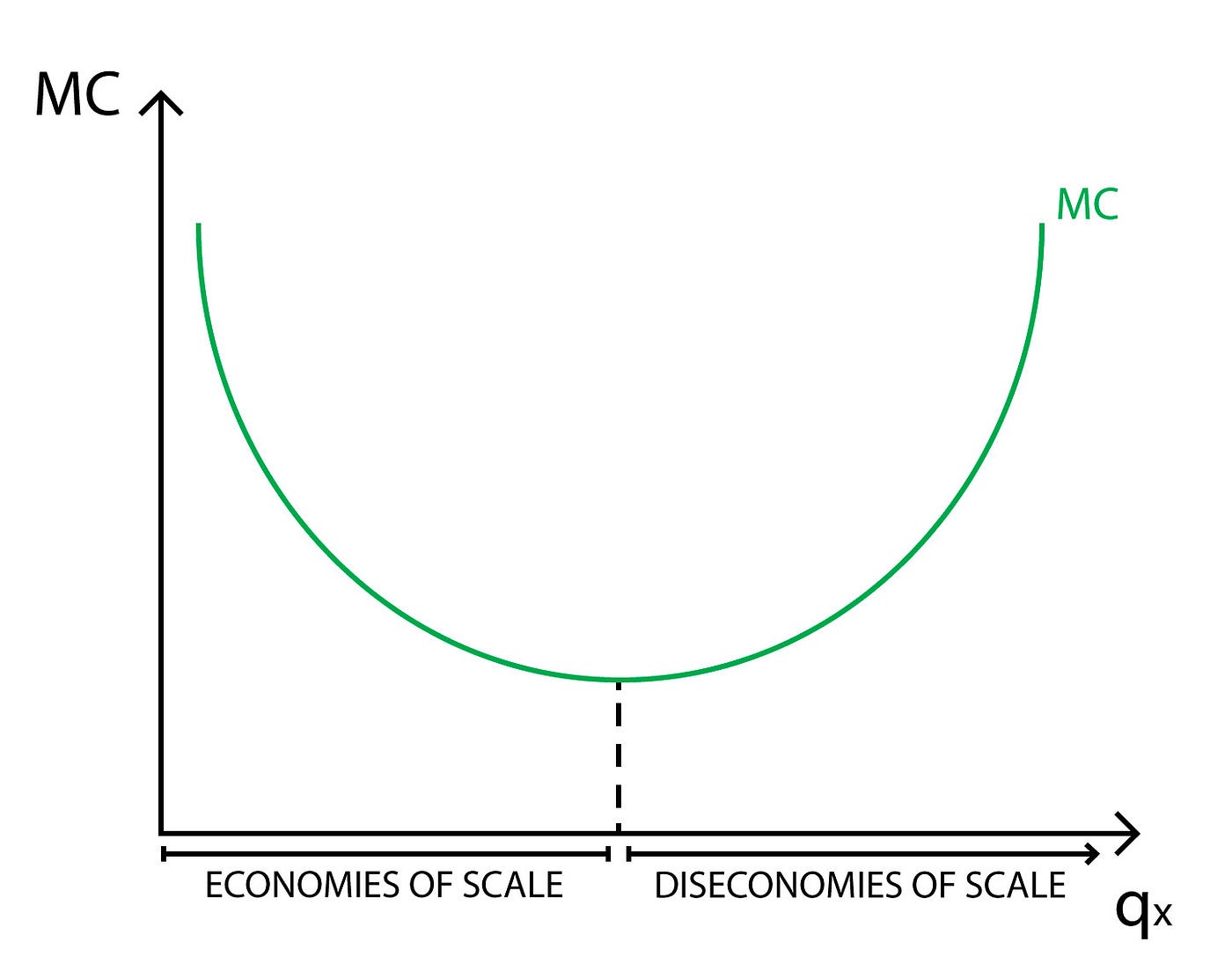
Economies of Scale
The Scale Risk is an assessment as to whether or not returns rise linearly (approximately) with scale, or whether the Opportunity requires a substantive threshold scale before it becomes viable. The larger this threshold the larger the capital required to get there.
Another form of Scale Risk is if there are increasing returns to scale. This implies that there will be a natural monopoly in the opportunity which in turn necessitates that the opportunity spend very heavily to ensure its dominant position in what is effectively a race.
- An opportunity is “ High Scale Risk” {score 7–10} if it only becomes viable after a threshold number of sales, users or installations and where that number is large (the larger the number the higher the risk). Effectively this means there is a step function in the value proposition and this occurs at scale. This can be linked to the Capital Intensity Risk parameter as such opportunities may need to subsidize marginal production costs until the scale effect eventuates.
- An opportunity is also a “ High Scale Risk” {score 9–10} if it exhibits increasing returns to scale, necessitating an arms race in adoption to outgun its competitors (this is also linked to the Capital Intensity Risk parameter (see below)).
- An opportunity is a “Low Scale Risk” if it delivers returns that are approximately linear, allowing a build-measure-learn-build cycle to be adopted early in the life cycle
Parameter 6: Execution Risk

Executing a sequence of steps can be risky
Execution Risk is an assessment as to how difficult the opportunity is to operationalize and execute. In particular if a large number of even slightly risky things have to all work in serial to make the opportunity function then the probability of failure escalates dramatically (the ‘line of ducks problem’).
- An opportunity has “ High Execution Risk” {score 7–10} if its method of manufacturing the product or its delivery of its service involves a sequence of many steps, each one of which has some risk or involves some significant and currently unquantified challenge
- An opportunity has a “ Low Execution Risk” {score 0–4} if its product or service can be achieved in a small number of steps, or if the steps are in parallel, or if there is little or no risk in each step
Parameter 7: Gorilla Incumbent Risk

Gorilla Incumbents Pose Risk
Gorilla Incumbent Risk is an assessment as to the size of a direct competitor who is occupying the same segment or a materially close segment, even if they could change to being a customer or potentially being a great trade sale candidate.
- An opportunity has a “ High Gorilla Incumbent Risk” {score 7–10} if it involves either competing with, or modifying the behaviour of (such as replacing some component), a very large and successful incumbent operating in a long standing and well explored segment. Such competitors can have a stranglehold over the distribution chain, they can bundle services to obscure competitive supply positions and they can overwhelm the domain with engagement and marketing activity;
- An opportunity has a “ Low Gorilla Incumbent Risk” {score 0–4} if it involves a diverse set of modest competitors who are competing in a rapidly growing new segment.
Parameter 8: Legal Risk

Legal Risks
Legal Risk is an assessment as to the extent to which the opportunity may encroach on either patent or intellectual property areas of a large existing company, or butt up against legally defined jurisdictional restrictions.
- An opportunity has a “ High Legal Risk” {score 7–10} if it is operating within known deep intellectual property territory of an existing incumbent and where there are hints that they are secretly exploring similar areas;
- An opportunity has a “High Legal Risk” {score 8–10} if its success is predicated on exploiting a legal or jurisdictional loophole (such as arbitraging existing rent seeking activity, or avoiding certain taxes or charges by redefining the service)
- An opportunity has a “Low Legal Risk” if it is operating in an area of intellectual property where it already has a substantive patent or intellectual property portfolio or is aware that it is pursuing materially different lines of inquiry to existing incumbents or it is knowingly not seeking to arbitrage existing legal definitions and taxes.
Parameter 9: Capital Intensity Risk

Capital Intensity
Capital Intensity Risk is an assessment of the downside case of how much capital it will take to achieve a cashflow positive status and how long this process will take. Some opportunities require several iterations where each iteration requires a large capital injection. This can be linked to other parameter risks (such as scale risks).
- An opportunity has a “High Capital Risk” {score 7–10} if it requires very significant amounts of capital ( > $100m) and or time to reach a point where it can engage in a deploy-measure-learn-deploy cycle that generates marginal positive net income.
- An opportunity has a “Low Capital Risk” {score 0–4} if it is possible to quickly move into a deploy-measure-learn-deploy cycle that generates a positive marginal cashflow without committing large volumes of cash or time.
Parameter 10: Platform Risk

Platform Risk
Platform Risk is an assessment of two issues. The first is an assessment of how reliant the opportunity is on the continuing behaviour of a very large company via its platform or its services. Complete reliance runs the risk that a shift in direction by that company can eliminate the opportunity. The second assessment is how reliant the opportunity is on being a part of an existing structure, partially removed from the value proposition to the end customer. For example being in the middle of a long OEM supply chain. In such cases any high profitability in one part of the segment can be commoditized or squeezed from either side of the segment. This is related to, but subtly different from issues of Monolithic Customer Risk and Gorilla Incumbent Risk.
- An opportunity is a “ High Platform Risk” {score 7–10} if its product or service is completely reliant on one very large company and its policies or services or products;
- An opportunity is also a “High Platform Risk” {score 7–10} if its product or service is just one segment in a chain of supply of a larger offering, with reliance above and below it in the chain sequence, together with the whole sequence delivering value not any one particular segment delivering value to a final customer group;
- An opportunity is a “ Low Platform Risk” if its product or service relies on multiple parties who have diverse interests and so is resilient to sudden shifts in any one strategy;
- An opportunity is also a “ Low Platform Risk” if its product or service delivers a self contained value proposition to a customer (rather than being buried inside a supply chain) thereby allowing the opportunity to engage in a rapid feedback cycle of deploy-learn-deploy.
Parameter 11: Personnel Risk

Personnel Risk
A successful company needs a great company culture and a smoothly integrated team — a group of skilled individuals who work well together under stress to achieve a goal.
Personnel Risk can occur through a mismatch in the initial group (an indication that there is not a natural synergy amongst the core founders or specific skills are missing).
Risk can also occur if the skills and personalities that are necessary to form a team are hard to source (or very expensive to source) — either because of regional issues in recruitment or because there is a general shortage of such skills in the market.
- An opportunity has a “High Personnel Risk” {score 6–9} if its team has important members whose skills are inappropriate (either now or in the near future) to the task at hand or where the existing team displays some form of interaction dysfunction (poorly defined roles or processes, inappropriate matching of skills to tasks) or where skill gaps are highly specialized and difficult to source;
- An opportunity has a “Low Personnel Risk” {score 0–4} if its team is functioning smoothly, there is a good match between skills and responsibilities, and where any gaps can be readily sourced (given sufficient time).
The Phi Risk Measures and the Risk Contour Profile
Phi Risk Measure
To achieve a quick snapshot view of the risk profile we can plot the measures as shown in the diagram examples below.
After viewing these profiles certain patterns emerge (which will be discussed in a later article).
We can also generate the two core Phi measures of risk — the Phi and the Max Phi.
The basic Phi measure is simply the average of the Risk Parameters and is a number between 0 and 10.
Most opportunities will have medium Phi numbers as they will have a mix of risks.
Opportunities that have a high Phi are indicative of a very risky opportunity.
The second Phi risk measure is the Max Phi — this is the sum of any parameter above a score of 7.5. It is essentially a measure of the size of the risk outliers.
Example 1 — Modest Risk

The example at the left shows a Phi value of 5 (a medium overall risk) and a max Phi of 9 (indicating only one outlier).
The big picture is an opportunity of modest risk with one area of concern. If this one area of risk can be mitigated, the general picture is an opportunity of medium risk.
Example Two — High Outlier Risk

The example at the left also shows an opportunity with a medium general risk with a Phi value of 4.7.
However the Max Phi is 25, indicating that there is significant outlier risk.
To achieve an overall risk commensurate with the medium Phi requires mitigation across three critical areas, indicating a much higher risk profile than the first example.
Example 3: High Risk

The example profile at left is a high risk profile with a Phi of 7 and a Max Phi of 61.
It is indicative of an opportunity with broad systemic risk that would need to have commensurately very high potential returns to offset its risk profile.
메타데이터
- post_id
- df38cffe6a84
- slug
- assessing-startup-risk-a-methodology-for-phi-measure-of-risk-df38cffe6a84
- url
- https://medium.com/@gary_28206/assessing-startup-risk-a-methodology-for-phi-measure-of-risk-df38cffe6a84
- canonical_url
- https://medium.com/@gary_28206/assessing-startup-risk-a-methodology-for-phi-measure-of-risk-df38cffe6a84
- author_url
- https://medium.com/@gary_28206
- status
- ok
- fetched_at
- 2026-06-21 07:44:09