Biofilms
Biofilms is the accumulations of microorganisms of mono or poly microbial aggregates. Microorganisms have shown to naturally come together…
Biofilms
Biofilms is the accumulations of microorganisms of mono or poly microbial aggregates. Microorganisms have shown to naturally come together on a wide variety of surfaces. These surfaces include bio materials such as contact lenses, household and industrial pipes, medical devices, plant and animals tissues.
A biofilm can be better explained as a well protected surface where bacteria hibernate. They are multicellular communities formed by bacteria and they are made up of bacteria encased within a non-crystalline extra cellular matrix of proteins, polysaccharides and other small molecules. These matrix forms a barrier against antibiotics and also reduce the penetration of oxygen and food which leads to starvation of the bacteria at the deepest of the biofilm.
Microorganisms that form biofilms are mostly bacteria, fungi and protists. Common examples of biofilms is pond scum and dental plaque.
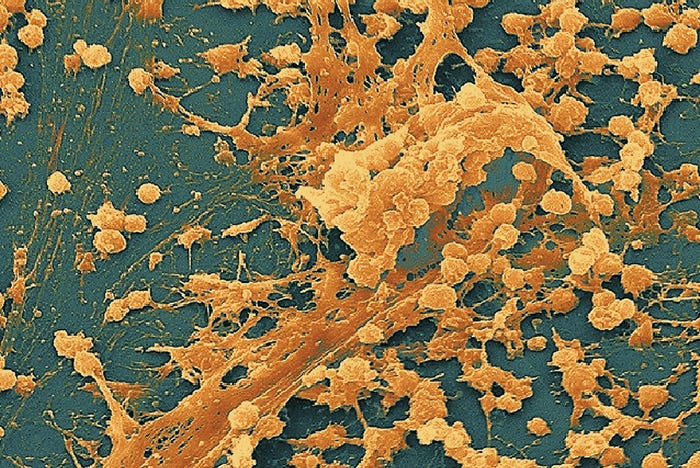
The main importance of biofilms to the microorganisms is that it helps them to support each other by distribution of metabolic products, exchange of substrate and removal of toxic end products. The structure of the biofilm community help protect the microorganisms within it from attack of shear forces, antimicrobial agents and immune system.
The formation of biofilms involves four main stages; initial reversible attachment, irreversible attachment, maturation and dispersion. The first stage proceeds with the initial contact of the planktonic bacteria with the surface, this could still be reversed. The bacteria starts to form a monolayer and produces an extracellular matrix for its protection. This extracellular matrix is called slime and consists of extracellular polymeric substances which includes extracellular polysaccharides, cell debris, structural proteins, and nucleic acid. The initial steps of matrix formation are dominated by extracellular DNA after which polysaccharides and structural proteins take over the formation. These stage also involves the formation of microcolonies which shows growth and cell to cell communication.
The biofilm proceeds to grow in a three dimensional manner and the attachment in now non-reversible. The bacterial cells of the biofilm mature after which they start to separate and move into the environment as a single cell again. They can come together again to start a new cycle of biofilm formation. The biofilm cells can be dispersed by shedding of daughter cells from actively growing cells, separation because of nutrients level or sharing of biofilm aggregates. The three main processes for detachment are erosion/sharing, sloughing, and abrasion. Shearing involves the continual removal of small portions of the biofilm; sloughing entails rapid and massive removal, and abrasion is detachment occurring due to collision of particles from the bulk fluid within the biofilm.

Biofilms play a role in pathogenesis. It has positive and negative impact on the human health. The most common human disease resulting and aided by biofilm is cystic fibrosis (CF). It is a frequently passed genetic disorder in Western Europe caused by Pseudomonas aeruginosa.
During infection of the lung, Pseudomonas aeruginosa undergoes a characteristic transition from an acute virulent pathogen to a cystic fibrosis adapted pathogen which makes it easy to persist in the lungs for years. This results from the overpopulation of the matric polysaccharide alginate leading to the formation of a mucoid biofilm. These mucoid biofilm tolerates antibiotics and resists phagocytosis and hence its persistence with the cystic fibrosis lungs leads to the development of a distinct antibody response and leads to chronic inflammation and severe damage to the lung tissue of the patient.
Another harm biofilms cause to the human health is dental plaque which results from the consumption of fermentable carbohydrates. This leads to an increase in the production and and secretion of organic acids by the bacteria and when untreated, increased acidification of the bacteria leads to the demineralization of the enamel and hence dental plaque deteriorates to dental caries.
An example of the positive effect of biofilm is the biofilms of staphylococcus epidermis which can stop the colonisation of future pathogenic bacteria through the simulation of host cell immune defenses and the prevention of adhesion.
The discovery of microbial biofilms can be credited to Van Leeuwenhoek. He first observed microorganisms on tooth surface using simple microscopes. Heukelekian and Helter (1940) observed the growth and activity for marine microorganisms and noticed that it is enhanced by their absorption to a surface. Jones et al (1969) used scanning and transmission electron microscope to examine biofilms on trickling filters in a waste water treatment plant and it showed to be made of variety of microorganisms.
Researchers were able to prove that the matric material enclosing cells in biofilms was polysaccharides using a polysaccharide stain called Ruthenium red and adding osmium tetroxide fixative.
References [1] Jones HC, Roth IL, Saunders WM III. Electron microscopic study of a slime layer. J Bacteriol. 1969;99:316–25. [2] Heukelekian H, Heller A. Relation between food concentration and surface for bacterial growth. J Bacteriol. 1940;40:547–58.
메타데이터
- post_id
- df3d4d58520e
- slug
- biofilms-df3d4d58520e
- url
- https://medium.com/@mmuocharity/biofilms-df3d4d58520e
- canonical_url
- https://medium.com/@mmuocharity/biofilms-df3d4d58520e
- author_url
- https://medium.com/@mmuocharity
- status
- ok
- fetched_at
- 2026-08-19 02:23:02