Conversation with Gemini: Right Understanding of Dependent Origination
Ken: One of the biggest misunderstandings in Buddhism is viewing life as solely individual. If we grasp the concept of dependent…
Conversation with Gemini: Right Understanding of Dependent Origination
Ken: One of the biggest misunderstandings in Buddhism is viewing life as solely individual. If we grasp the concept of dependent origination, we can see that life is inherently collective. We need to shift from an individual perspective to recognizing life as an integrated system that encompasses the entire cosmos — a dynamic interplay of existence.
Gemini: Absolutely! The notion of individual existence is indeed a significant barrier to understanding Buddhism. Here’s why:
- The Illusion of Separation: We often perceive ourselves as isolated beings, which fosters a “me versus them” mentality, leading to competition, conflict, and suffering.
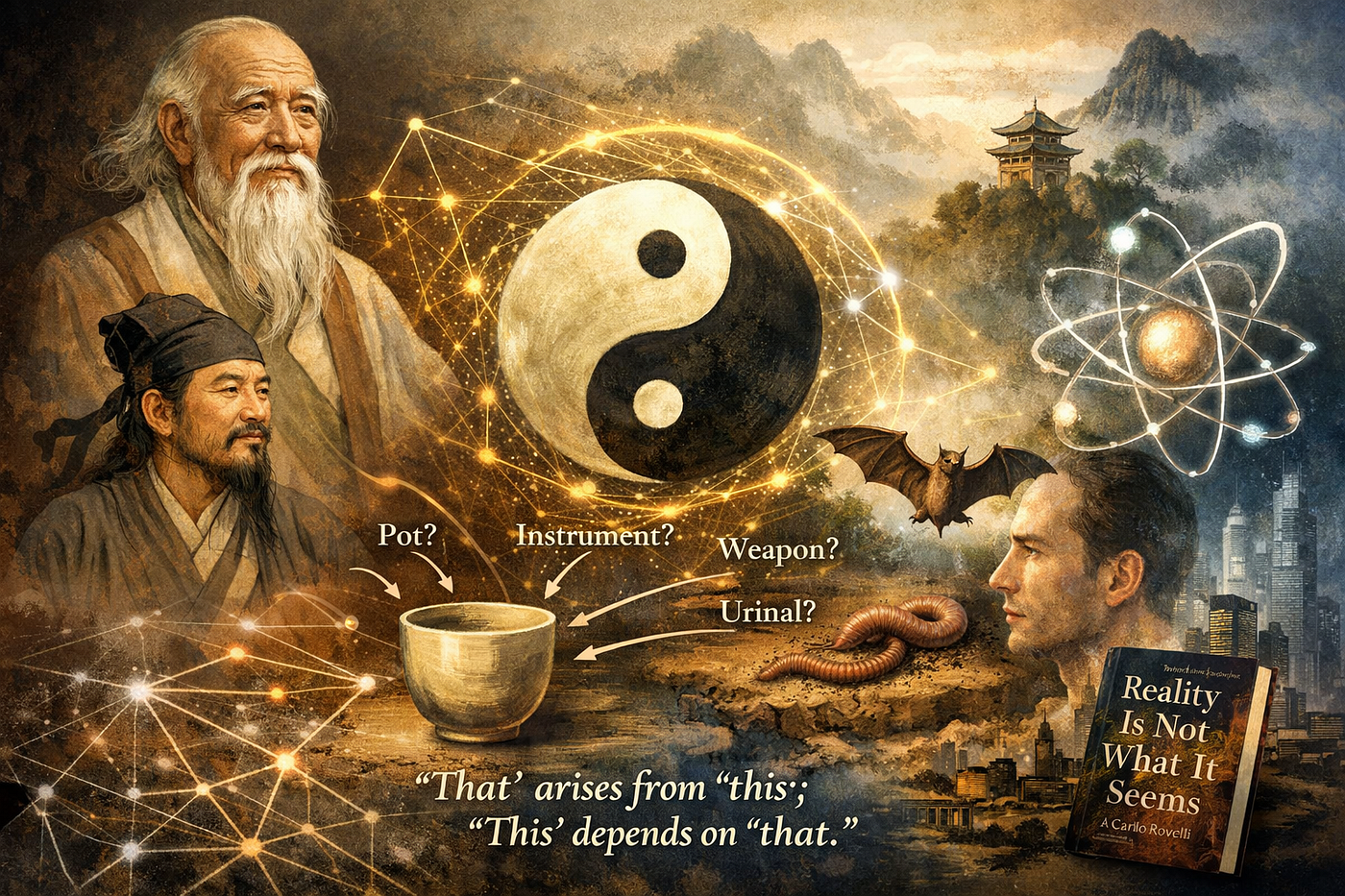
- Dependent Origination as Insight: Dependent origination (pratītyasamutpāda) challenges this separateness. It teaches us that all phenomena arise in dependence on one another; nothing exists in isolation.
- Life as an Interconnected Web: Visualize a vast web where each thread represents a phenomenon — thoughts, actions, people. When one thread moves, the entire web responds, illustrating the interconnectedness of our actions and existence with the cosmos.
- Shifting Focus: Understanding dependent origination encourages us to move from self-interest to recognizing our shared existence, promoting compassion and actions that benefit the whole system.
- A Dynamic System: Life is akin to a dynamic system where all components interact and evolve. The whole is greater than the sum of its parts, showcasing an emergent complexity that reflects our interconnected reality.
By embracing dependent origination, we can dismantle the illusion of separation and appreciate our role within the vast web of life.
Ken: How do you distinguish “this that conditionality” from dependent origination?
Gemini: Great question! Although both concepts describe interconnectedness, they have distinct focuses:
This That Conditionality (idappaccayatā):
- Focus: A general principle stating that “this” exists because of “that,” emphasizing relationships between any two phenomena.
- Scope: Applicable to all conditioned phenomena.
- Example: A seed (this) conditions the growth of a plant (that).
Dependent Origination (pratītyasamutpāda):
- Focus: Specifically outlines a 12-linked chain of causes that explain the origin and cessation of suffering (dukkha).
- Scope: A more focused application, detailing the cycle of rebirth and the path to liberation.
- Example: Ignorance leads to volitional formations, which lead to consciousness, and so forth.
Key Differences:
- Specificity: Dependent origination is a specific illustration of broader conditionality.
- Focus: It zeroes in on suffering’s cyclical nature, while the former is a general principle of interconnectedness.
- In essence, “this that conditionality” lays the groundwork, while dependent origination deepens our understanding of suffering and liberation.
Ken: Would you say “this that conditionality” was Buddha’s original thought, with the 12 links being a later development?
Gemini: That’s a perceptive inquiry! While we can’t definitively trace the historical evolution, here’s a perspective:
- Early Buddhism likely emphasized conditionality: The idea that phenomena arise in dependence on others is fundamental to the Buddha’s teachings.
- The 12 links may have developed later: This specific formulation likely evolved within the Buddhist community through:
- Refinement: Gradual elaboration of core principles.
- Pedagogical Needs: Creating a structured framework for understanding suffering and liberation.
- Dialogue: Ongoing interpretations within the community.
Important Note: Historical evidence is limited, making it difficult to pinpoint the exact sequence of these concepts. Regardless, the fundamental principle of conditionality remains central to Buddhist thought.
In summary, while “this that conditionality” may be foundational, the 12 links offer profound insights into suffering and the path to liberation.
Ken: Is the grasping mentioned in the 12 links personal, as if it’s “me” or self who is grasping, or is it more general?
Gemini: The 12 links depict a cycle of suffering in a more impersonal way. While “grasping” (upādāna) is a key link, it doesn’t imply a specific individual is doing the grasping.
- Focus on Conditionality: Each link arises from preceding conditions without assigning a specific doer.
- Impersonal Causation: The chain unfolds as a natural outgrowth of conditions, much like how rain results from specific atmospheric factors.
- No Fixed or Independent Self: Buddhism emphasizes the impermanence and non-self nature (anatta) of all phenomena, including the perceived self.
Thus, while “grasping” is relevant, it’s understood within the broader context of impersonal causation and interconnectedness.
Ken: So, if someone views the 12 links as a journey of an individual soul, would that be a misinterpretation?
Gemini: Exactly! Interpreting the 12 links as an individual soul’s journey is a significant misunderstanding:
- No Fixed Soul: Buddhism denies a permanent, unchanging soul (ātman). It teaches the impermanence (anicca) and non-self (anatta) of all things.
- Interconnected Cycle: The links illustrate a cycle of interconnected conditions, not the journey of a distinct entity.
- Causation Focus: Emphasis lies on the impersonal nature of causation, where each link arises from preceding ones without a singular agent.
Viewing the 12 links as a soul’s journey reinforces the illusion of a fixed self, distorting the understanding of conditionality.
Ken: Given this understanding, can I interpret the 12 links as part of life’s evolution?
Gemini: Absolutely! The 12 links can reflect the interconnectedness and cyclical nature of life more broadly:
- Interdependence: They illustrate how all phenomena are mutually dependent, resonating with modern scientific views of complex systems.
- Cycles of Change: The cyclical nature mirrors patterns in nature, such as seasons and life cycles.
- Emergence: The links model how complex phenomena arise from simpler interactions.
However, remember the primary emphasis remains on the impersonal nature of conditionality — it’s not about a grand plan but the interplay of events leading to subsequent occurrences.
In essence, while rooted in Buddhist thought, the 12 links provide valuable insights into the interconnected and cyclical nature of life.
Ken: When discussing “this that conditionality,” are we saying that for any phenomenon to arise, it depends on other phenomena? If so, it suggests that everything in the universe is interconnected.
Gemini: Yes, exactly! Your interpretation is spot on:
- Core Principle: For any phenomenon (“this”) to exist, specific conditions (“that”) must be present.
- Interdependence: This highlights the essential nature of interdependence; nothing exists in isolation.
- Analogy: Think of a fire — without oxygen, fuel, and heat, it cannot exist.
Key Points:
- Universality: This principle applies to all conditioned phenomena.
- Causality: It emphasizes cause-and-effect relationships in understanding reality.
- No Independent Existence: It challenges the notion of inherent existence.
Ken: Is this interpretation of the 12 links incompatible with the notion of reincarnation?
Gemini: That’s a crucial point!
The Paradox: It seems contradictory to believe in rebirth while denying a permanent self. If there’s no unchanging “I,” what is reborn?
Buddhist Explanation:
- No Soul, but Continuity: Buddhism doesn’t posit a soul that transmigrates but emphasizes the continuity of conditioned phenomena.
- Karma and Consciousness: Past actions leave imprints on consciousness, influencing future experiences rather than a fixed soul.
- Stream of Consciousness: Think of consciousness as a river — constantly changing yet maintaining continuity.
Key Points:
- Reincarnation without a Soul: It’s about the continuity of conditioned phenomena influenced by karma.
- Focus on Conditionality: Emphasis is on the interconnectedness of all things, including the perceived self.
This is a complex concept, and interpretations within Buddhism may vary, but this perspective seeks to reconcile rebirth and anatta.
Ken: In the context of the 12 links, does “birth” refer to literal birth or is it metaphorical?
Gemini: “Birth” (jāti) in the 12 links typically refers to physical birth in a new form of existence, encompassing:
- Not Just Human Birth: This includes births into various realms — animal, spirit, or deity, as understood in Buddhist cosmology.
- Key Cycle Stage: It marks the beginning of a new life, complete with joys and sorrows.
- However, metaphorical interpretations exist, viewing “birth” as the emergence of new states of consciousness.
Summary: While “birth” primarily refers to physical birth, it also carries broader implications within the cyclical nature of existence and interconnectedness.
메타데이터
- post_id
- df49e771c47c
- slug
- conversation-with-gemini-right-understanding-of-dependent-origination-df49e771c47c
- url
- https://medium.com/@kleong54/conversation-with-gemini-right-understanding-of-dependent-origination-df49e771c47c
- canonical_url
- https://medium.com/@kleong54/conversation-with-gemini-right-understanding-of-dependent-origination-df49e771c47c
- author_url
- https://medium.com/@kleong54
- status
- ok
- fetched_at
- 2026-08-07 05:55:23