The Roman Empire: From Failure to Flexibility, and What We Can Learn From It
By: Saam Foroughi
The Roman Empire: From Failure to Flexibility, and What We Can Learn From It
By: Saam Foroughi
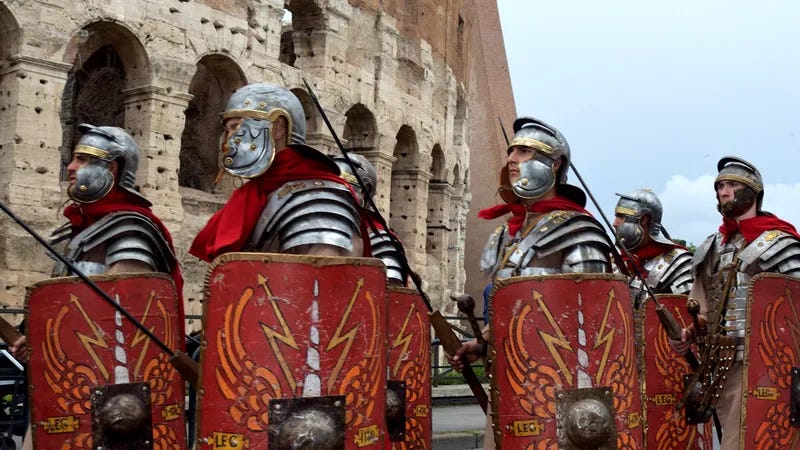
Britannica Images
We all know of the Roman Empire in some shape or form. Its history of power, its widespread religious influence, and its technological advancements shaped the tail end of the Iron Age, enabling it to conquer the entire Mediterranean Basin.
However, what we all tend to overlook is how they achieved such success.
This might come as a shock, but the Romans were not always the most triumphant in battle. In fact, they suffered failure after failure in wars against the Parthians/Sassanians (modern-day Iran and Turkmenistan), the Germanic Tribes, and the Carthaginians, in a series of gruelling conflicts. Defeat once was so bad that in 260, after a defeat to Emperor Shapur I of the Sassanid Empire, Emperor Valerian was captured and said to have swallowed melted gold as a means of execution.
They might have suffered defeat after defeat, but what’s notable about the Romans and why they’re so well-known for their widespread success is their response. Rome was excellent at, and known for, stealing its enemies’ technology and adapting it to its needs to achieve strategic flexibility and operational success.
Let’s take the Punic Wars as an example to show how they took such an unfamiliar piece of technology from another nation and used it to their advantage against other foes.
Fought by Carthage and Rome, both had the advantage in two completely distinct areas of warfare. The Romans were excellent at fighting on land and had almost mastered their signature formation, the manipular formation, which allowed for better maneuvering in rugged terrain and greater operational flexibility. Carthage was a state that ruled the seas, with a centralized empire based in Tunisia at the heart of the Mediterranean. With standardized naval assembly lines and the formidable quinquereme, quadrireme, and trireme, Carthage was able to conquer vast swaths of the North African Coast and Iberia, consolidating its control over major trade routes and passageways, thereby strengthening its economy in the Iron Age. Two wildly different powers, and two wildly different expertise, with Carthage having the upper hand due to their rather modestly diverse, formidable land force.
Rome and Carthage first went to war in 264BCE on the Island of Sicily, aiding their respective city-state allies. Rome had managed to conquer as far as Agrigentum and had laid siege to the city. However, because of their rather weak navy and the fact that this was the first time they weren’t fighting on Italian soil, they suffered heavy casualties (30,000 to Carthage’s 7,000). Their weak navy couldn’t supply their troops, so while Rome achieved victory on land, they lost the initial battle at sea, prompting weakened morale among the Roman Legions and leading to widespread starvation and disease.
With a stroke of luck, a Carthaginian quinquereme mistakenly landed on Italian soil.
What did the Romans do? They went right to work.
They used the quinquereme as a blueprint for designing and constructing their own fleet of about 120 warships. While fighting experience was still necessary to strengthen their tactical approach, they learned from every failure and rebuilt, retried, and succeeded. For example, at the Battle of the Lipari Islands, the Romans were outmaneuvered and crushed by the Carthaginian fleet. In response, the Romans developed the Corvus, a portable landing bridge that allowed their land forces to interoperate with their navy, overwhelming the Carthaginians at the Battle of Mylae in 260 BCE. What was supposed to be a sweeping Carthaginian victory ended up as a Carthaginian defeat and sent shockwaves across the empire. In a matter of 4 years, Rome had gone from a weak naval power to controlling the Sicilian Coast and fending off arguably the strongest navy of the Iron Age.
And that’s exactly why Rome achieved the success it had. Because of their willingness to fail and ability to be open to the use of new tactics. They were flexible in adopting Carthaginian tactics and technology, and their innate ability to adapt their strengths to areas of weakness was a major reason Rome was so successful in conquering much of the Mediterranean Basin and thus became one of the strongest, most influential empires the world has ever seen.
What might you be able to take away from this?
It’s that you can do exactly what the Romans did, and adapt it to your own life.
If you notice you have a strong transferable skill and a gaping weakness in your life, find a creative way to adapt that skill to plug the hole.
Pull a Roman, steal someone else’s idea, and make it suited to you and better.
Fail. Adapt. Overcome. Achieve.
It’s the name of the game of life. Be as legendary to you as Rome is to everyone else.
Sources:
https://www.youtube.com/watch?v=yRmOWcWdQAo, https://www.britannica.com/event/Punic-Wars, https://www.britannica.com/summary/Punic-Wars, https://www.livius.org/articles/concept/corvus/
메타데이터
- post_id
- df4b390160bd
- slug
- the-roman-empire-from-failure-to-flexibility-and-what-we-can-learn-from-it-df4b390160bd
- url
- https://medium.com/@saamforoughi2/the-roman-empire-from-failure-to-flexibility-and-what-we-can-learn-from-it-df4b390160bd
- canonical_url
- https://medium.com/@saamforoughi2/the-roman-empire-from-failure-to-flexibility-and-what-we-can-learn-from-it-df4b390160bd
- author_url
- https://medium.com/@saamforoughi2
- status
- ok
- fetched_at
- 2026-06-20 20:29:01





