Why Big Companies’ Bad Service is Your Greatest Opportunity
While big companies are surviving on friction, not loyalty, their customers are yours for the taking.
Why Big Companies’ Bad Service is Your Greatest Opportunity
While big companies are surviving on friction, not loyalty, their customers are yours for the taking.
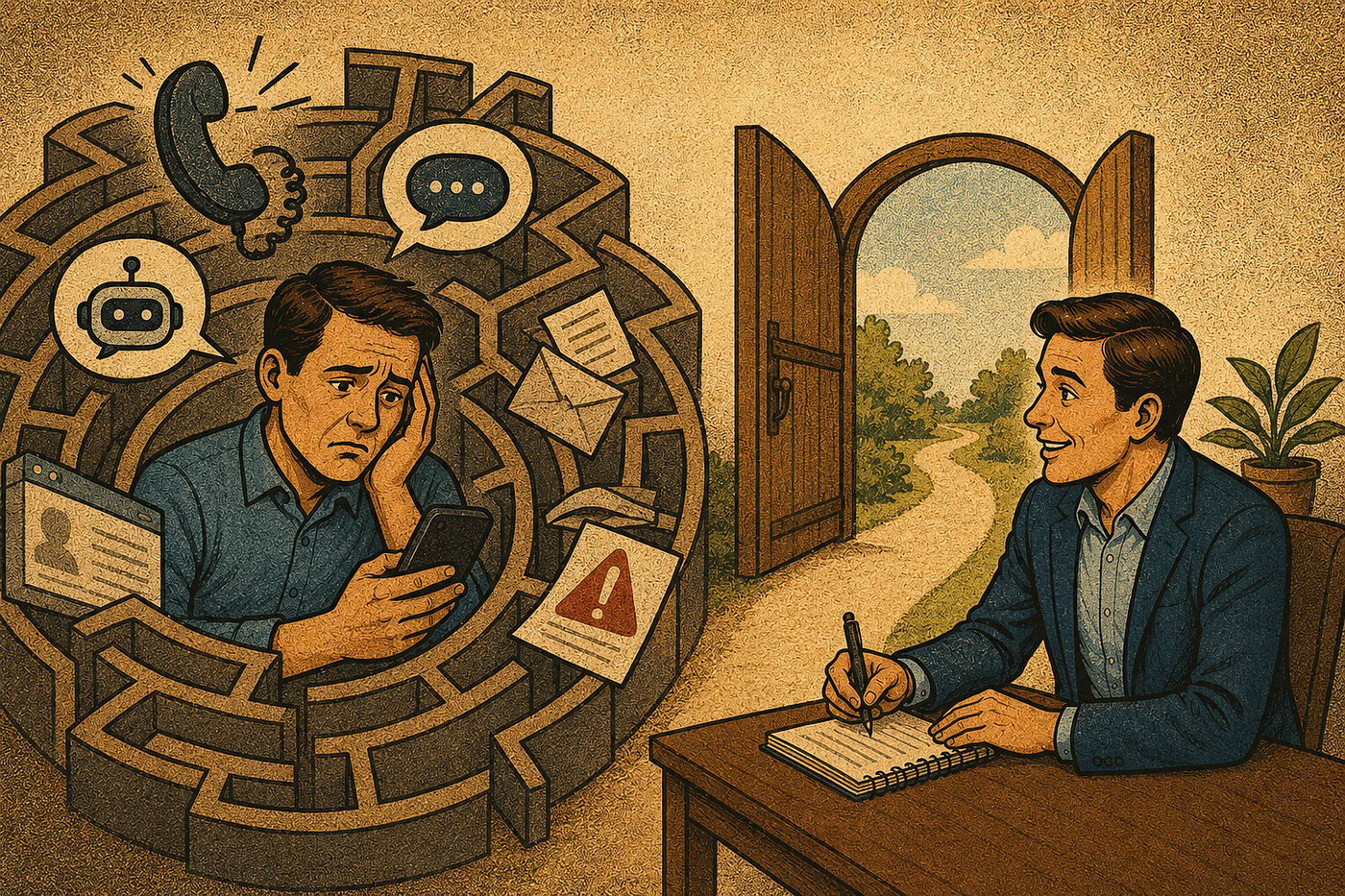
Image courtesy of ChatGPT
I saw “new phone contract” flash up in my diary and felt myself wince. Renewals are always such a performance.
I opted for the easy option. Keep my phone and number, but swap providers. Simple enough.
The SIM arrived with a new number.
Having put things off to the last minute, I cancelled and renewed with my existing provider instead. Annoying but easier still. No cancellation letter arrived from the other provider, but their customer service assured me it was all done.
Fine till I got the bill.
A bill for the SIM I never ordered and the line I never used, both cancelled within 24 hours, well inside my legal right. Nor was it an invoice-type bill. This was a highly aggressive 7-day reminder, or they would apply it as a default to my overall credit rating.
Swearing silently, I rang them. Several times.
Each customer service person told me they couldn’t take payment because the account was cancelled. Unbelievable.
To protect my credit rating, I had to drive to my nearest store and pay a bill I don’t owe. They say I’ll get a refund. I won’t hold my breath.
How do these big companies survive, giving customers that level of service?
…
When poor service becomes the norm
The mobile phone company was by no means the only one that delivered outstanding levels of low service.
In the same week, a shoe company, when told I wanted to return some shoes I bought online, replied telling me to go to their in-person stores in future. Highly diverse-friendly.
Or the broadband supplier who, every time I write to them, responds with an automatic “As we haven’t heard back from you, we are closing your complaint”. For months.
Good for the blood pressure, that one.
Catastrophically bad service — but not remotely unusual.
During the decades I ran small businesses, I always made customer service central to what we did. And we used very simple principles.
A customer database.
Without fail, details were entered by everyone for all to read and see. So when anyone spoke to a customer, they — shock horror — knew the facts.
Not rocket science.
Yet, very important because people remember when you’ve listened, and they notice immediately when you haven’t.
Somewhere along the line, within the major players, efficiency became more important than service. Systems were designed to process customers rather than understand them.
Using AI and automation isn’t wrong. Customers of all sizes need to. But how those companies are using it is very definitely, entirely wrong.
…
An open Goal
These giant companies have created open goals.
They know customers like me see the word “renewal” crop up in their diaries and feel desperate.
They know how long switching can take, how exhausting it is. And how, because of this, more often than not, customers stay put.
Depressingly, even if a customer escapes for a year, they will discover the grass is by no means greener.
Large companies with just the vaguest understanding of the concept of customer service are rarer than lions in the Arctic.
Once a customer has discovered that they are going to be abused, whoever they go to, the incentive for moving drops even further.
They are trapped. And with trapped customers, the silence isn’t even indifference; it’s exhaustion.
But in the dark recesses of customers’ minds still lingers a dream of escape, of being … listened to.
Looked after even.
…
The Opportunity
Startups need to systemise, too. They won’t grow otherwise.
But startups have the advantage. Unlike the unwieldy corporations, startups can get things right from the start. No new systems, no re-training.
Setting up right doesn’t take too much thought. You founders are, after all, a consumer and know how you want to be treated.
Making it standard for all contacts to be recorded and all contacts to be read before responding is a simple game-changer.
Automation is great, but never automate emails to the customer to tell them you are closing the complaint, or at least not without a human having checked it actually is fully closed.
Set up a system that keeps complaints with the same person throughout.
There is nothing more frustrating than having to start again with yet another new person every time you want an update.
Remember the shoe sellers who told me to go to a shop? Beware any message that could spark a major diversity affront. The shoe shop, for example, had no idea if they were writing to a fully able person or one unable to visit shops.
That ancient adage of having two ears and one mouth and using them in equal proportion should apply to everyone customer facing.
None of it is complicated.
Customers just want to feel safe. Right now, most big companies can’t even manage that.
Might it be fractionally slower?
Yes and no.
When compared to the time of replacing customers, these things can be done at the speed of light. Customers are crying out for them.
And right now, customers aren’t staying with the big companies because they love them. They stay because moving is exhausting.
…
The hub of opportunity
The big brands think that friction will protect them. They see their customers staying and believe they have loyal customers.
Friction isn’t loyalty.
Friction creates customers who are desperate for a change.
Here is the opportunity.
For a startup that delivers first-rate customer service, the big companies are opening the door wide to customers desperate to move.
Every frustrating call centre interaction, every ignored complaint and every automated brush-off creates another customer looking for a better option.
The big brands see trapped customers. Smart startups see future customers.
메타데이터
- post_id
- df4dcf255a7d
- slug
- why-big-companies-bad-service-is-your-greatest-opportunity-df4dcf255a7d
- url
- https://blog.startupstash.com/why-big-companies-bad-service-is-your-greatest-opportunity-df4dcf255a7d
- canonical_url
- https://blog.startupstash.com/why-big-companies-bad-service-is-your-greatest-opportunity-df4dcf255a7d
- author_url
- https://medium.com/@jancavelle
- status
- ok
- fetched_at
- 2026-07-13 18:04:26