Three: The Number That Shapes Hindu Dharma
Three times over :or three in one?
Three: The Number That Shapes Hindu Dharma
Three times over :or three in one?
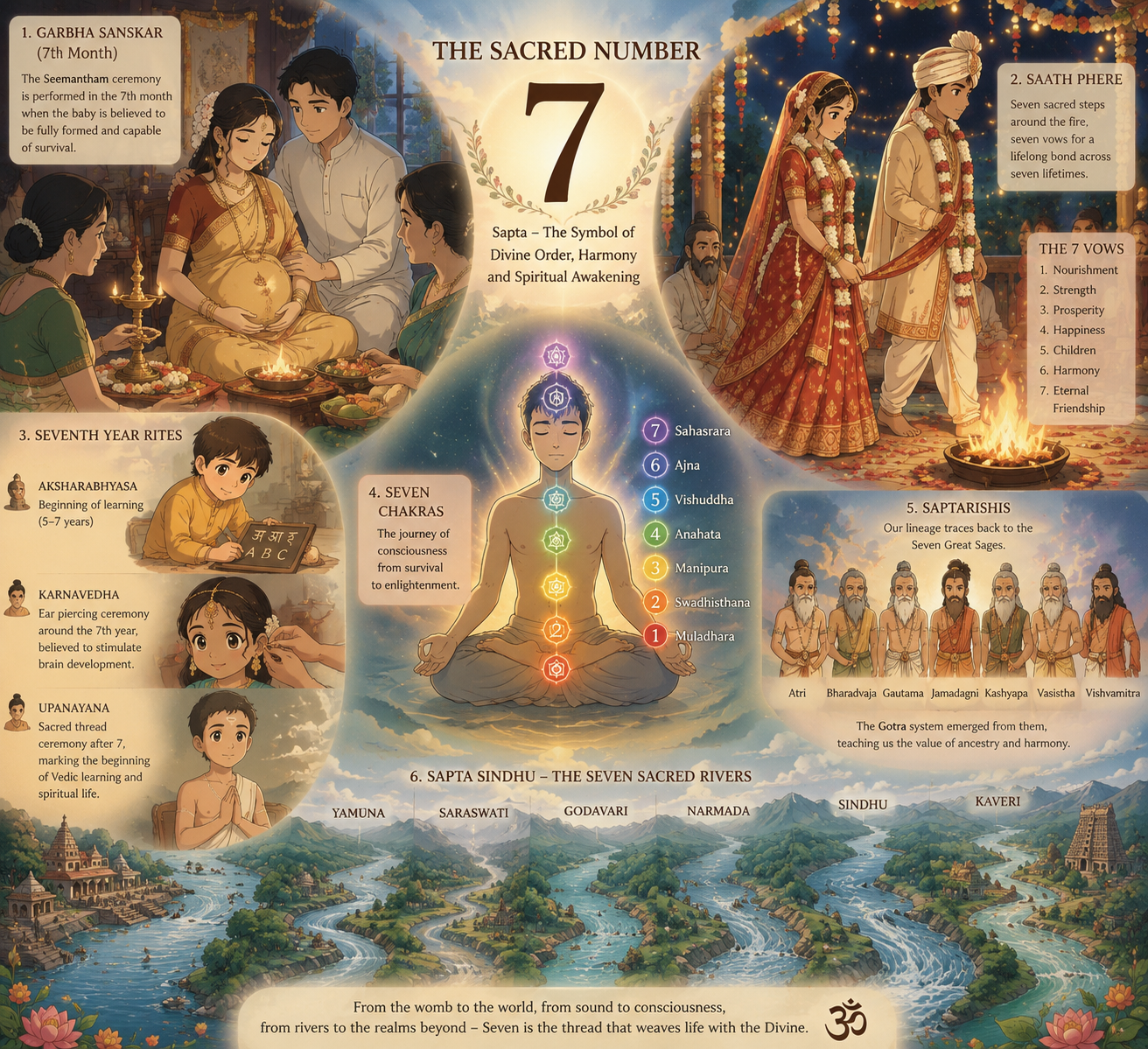
Earlier, we explored why the number seven occupies such a sacred place in Hindu Dharma. We journeyed through the Sapta Matrikas, the seven sages, the seven sacred rivers, and many other sevens that appear throughout our scriptures.
Today, let us look at another number that quietly shapes Hindu philosophy, spirituality, and everyday life.
Three.
At first glance, it seems like an ordinary number. Yet, the deeper we look, the more we discover that Hindu Dharma repeatedly uses three to explain the universe ,from the creation of the cosmos to the workings of the human mind.
Perhaps this is because life itself unfolds in threes: a beginning, a middle, and an end.
The Divine Trinity
The best-known example is the Trimurti, the three principal deities of the Hindu pantheon.
- Brahma :the Creator, who brings the universe into existence.
- Vishnu :the Preserver, who sustains and protects creation.
- Shiva :the Transformer, who dissolves what has fulfilled its purpose, making way for new beginnings.
These are not three competing gods but three expressions of one continuous cosmic process.
Creation cannot exist without preservation, and preservation eventually gives way to transformation.
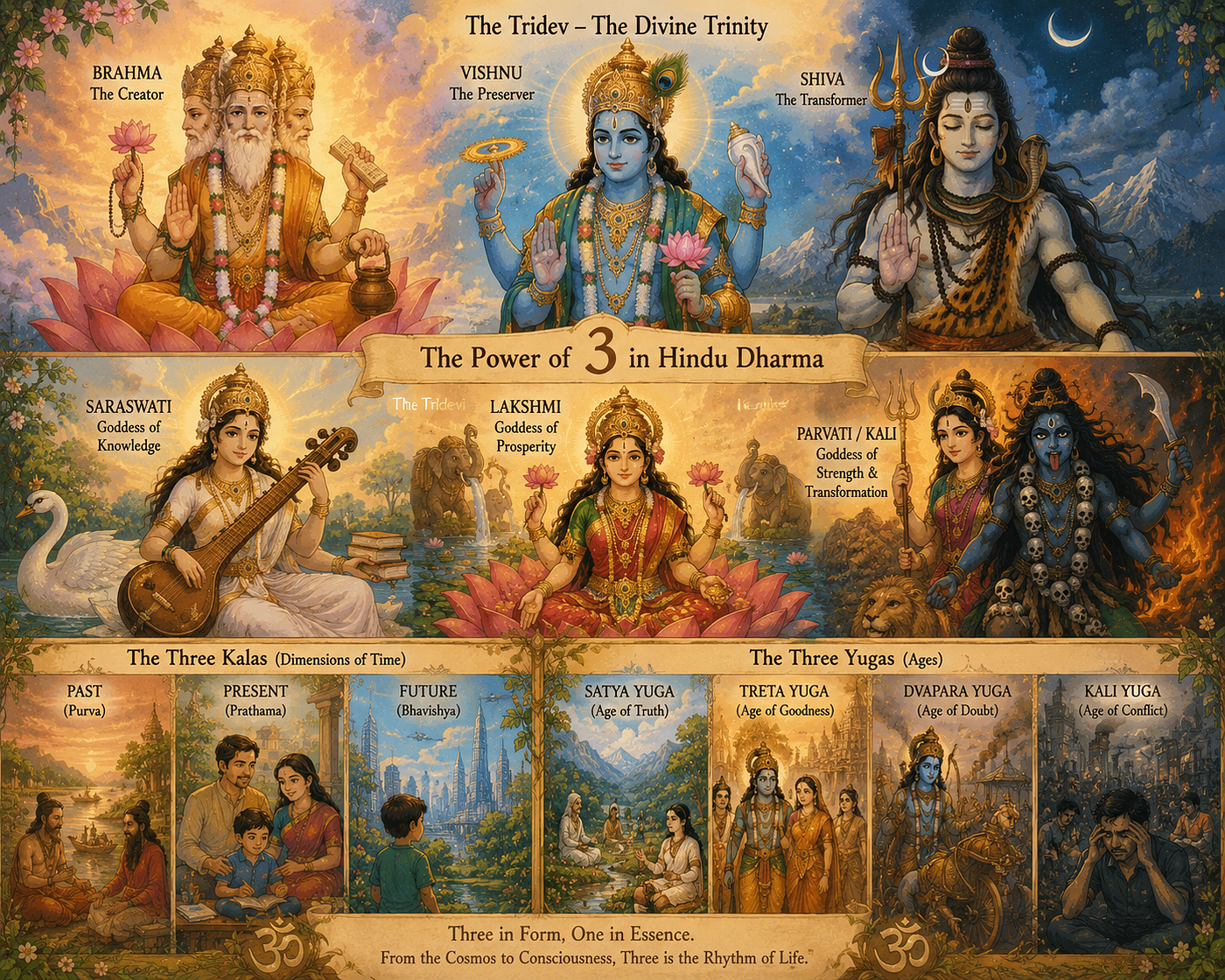
Three In Hindu Dharma-Created By Author Using Chatgpt
The Divine Feminine
Complementing the Trimurti is the Tridevi, the three great goddesses.
- Saraswati: the consort of Brahma, is the goddess of wisdom, learning, music, and the arts.
- Lakshmi: the consort of Vishnu, blesses the world with prosperity, abundance, and good fortune.
- Parvati:whose fierce manifestations include Durga and Kali, represents strength, compassion, transformation, and the power to destroy ignorance.
Together, they embody the feminine energies that sustain creation.
Time Comes in Three
Human life unfolds through three dimensions of time. A cyclical passage ,not a linear one.
- Past-Ateet
- Present-Vartaman
- Future-Bhavishya
We learn from the past, live in the present, and prepare for the future. Yet Hindu philosophy constantly reminds us that only the present moment can truly be experienced.
The Three Gunas
According to the Samkhya philosophy and the Bhagavad Gita, everything in nature is governed by three fundamental qualities called the Gunas.
- Sattva — purity, wisdom, harmony, and clarity.
- Rajas — passion, action, ambition, and movement.
- Tamas — inertia, darkness, rest, and stability.
Every person possesses all three. Our thoughts, actions, and personalities simply reflect which guna is dominant at a given moment.
The Three Doshas
Ayurveda also understands the human body through a triad.
- Vata — governs movement, breathing, and communication.
- Pitta — governs digestion, metabolism, and transformation.
- Kapha — provides structure, nourishment, lubrication, and stability.
Health, according to Ayurveda, is achieved not by eliminating one dosha but by maintaining harmony among all three.
The Sacred Sound of Om
Perhaps the most profound triad in Hindu Dharma is A-U-M, the sacred syllable Om.
Each sound carries its own meaning.
- A represents creation.
- U represents preservation.
- M represents dissolution.
When these three merge, they become Om, the primordial vibration from which the universe itself is believed to emerge.
The Three Worlds
The scriptures often describe the Triloka, the three worlds.
- Bhuloka — the earthly realm.
- Bhuvarloka — the intermediate realm.
- Swargaloka — the heavenly realm.
These are not merely physical locations but different planes of existence and consciousness.
The Three States of Consciousness
The Mandukya Upanishad describes three ordinary states of consciousness.
- Jagrat — the waking state.
- Svapna — the dreaming state.
- Sushupti — deep, dreamless sleep.
Beyond these lies Turiya, the transcendent state of pure consciousness that cannot be described in words.
The Three Sacred Fires
Ancient Vedic householders traditionally maintained three sacred fires.
- Garhapatya — the domestic fire.
- Ahavaniya — the sacrificial fire offered to the gods.
- Dakshinagni — the southern fire associated with ancestral rites.
These fires symbolized the spiritual duties of family life.
Shiva’s Trident
One of Lord Shiva’s most recognizable symbols is the Trishula, or trident.
Its three prongs have been interpreted in many ways.
They represent:
- Creation, preservation, and transformation.
- Past, present, and future.
- Sattva, Rajas, and Tamas.
The trident reminds us that while life appears divided into many parts, all are ultimately held together by one divine reality.
Shiva’s Three Eyes
Lord Shiva is also known as Tryambaka:the three-eyed one.
His two eyes perceive the physical world.
His third eye symbolizes wisdom, intuition, and spiritual awakening. It burns away ignorance, allowing one to see beyond appearances.
The Three Debts of Life
Hindu tradition teaches that every person is born with three sacred debts (Ṛṇa).
- Deva Ṛṇa — the debt to the gods, repaid through gratitude and worship.
- Rishi Ṛṇa — the debt to the sages, repaid by acquiring, preserving, and sharing knowledge.
- Pitṛ Ṛṇa — the debt to our ancestors, repaid by caring for family and continuing noble traditions.
Life, therefore, is not only about receiving but also about giving back.
The Three Paths of Yoga
The Bhagavad Gita describes three major paths leading toward spiritual realization.
- Karma Yoga — the path of selfless action.
- Bhakti Yoga — the path of devotion.
- Jnana Yoga — the path of knowledge and wisdom.
Though different in practice, all three ultimately lead to the same destination.
Why Three?
As we step back, a beautiful pattern begins to emerge.
The number three appears in our gods, our goddesses, our scriptures, our philosophy, our medicine, our rituals, our yoga, and even our understanding of consciousness.
It teaches us that reality is rarely made of simple opposites.
Instead, life unfolds through balance.
Creation. Preservation. Transformation.
Body➡️Mind ➡️Spirit.
Past➡️Present ➡️Future.
Knowledge➡️Prosperity ➡️Strength.
Perhaps that is why three is revered in Hindu Dharma. It is not merely a number but a way of understanding existence itself. Every ending prepares for a new beginning. Every transformation is part of a larger cycle. Every aspect of life finds meaning only when seen as part of the whole.
The next time you notice the number three in a temple, a mantra, a ritual, or a scripture, remember ;it is not a coincidence.
It is one of the many ways Hindu Dharma reminds us that the universe is beautifully balanced.
Thanks for kind reading.
If you wish to read the other articles in this series:
메타데이터
- post_id
- df4ee12b963d
- slug
- three-the-number-that-shapes-hindu-dharma-df4ee12b963d
- url
- https://medium.com/the-pillionaire-diaries/three-the-number-that-shapes-hindu-dharma-df4ee12b963d
- canonical_url
- https://medium.com/the-pillionaire-diaries/three-the-number-that-shapes-hindu-dharma-df4ee12b963d
- author_url
- https://medium.com/@radhanarayanan_85248
- status
- ok
- fetched_at
- 2026-07-13 06:23:13