I Checked the Country of Origin on Every Wet Wipe at Five Australian Retailers.
Between April and August 2026, I walked the wipes aisle at Woolworths, Coles, Chemist Warehouse, Foodland and ALDI, and read the back of…
I Checked the Country of Origin on Every Wet Wipe at Five Australian Retailers. Here’s What the Shelves Actually Say.
Between April and August 2026, I walked the wipes aisle at Woolworths, Coles, Chemist Warehouse, Foodland and ALDI, and read the back of every pack. Imported products held between 74% and 100% of the visible shelf space at every store. One retailer carried zero Australian-made wipes. At another, every single pack said Made in China.
I run Kine, an Australian company that makes wipes in South Australia. That is my disclosure, up front, because what follows is primary data anyone can check, and I want you to know exactly who collected it and why.
It started with a moment in a supermarket aisle. I had been buying the same wet wipes for years, the same brand my family used every day. One day I actually read the back of the pack. Imported. The product had travelled across the world before it ever reached my Adelaide kitchen drawer.
I looked across the rest of the shelf. Most of it was the same story. But I could not find anyone who had actually measured it. So I did.
The method
Simple and repeatable. Walk the baby wipes aisle. Read the country of origin statement printed on every pack. Photograph everything. Map the result as visible shelf space, which is what a shopper actually sees when standing in the aisle.
One store per chain, one visit, one point in time. Not a market share analysis. Not sales data. Just the shelf, as it faced the shopper that day. I flagged every caveat in the original posts and I will repeat the main one here: ranges change, stock moves, and one store does not speak for a whole chain. But after six audits at five retailers, the pattern is consistent enough to be worth your attention.
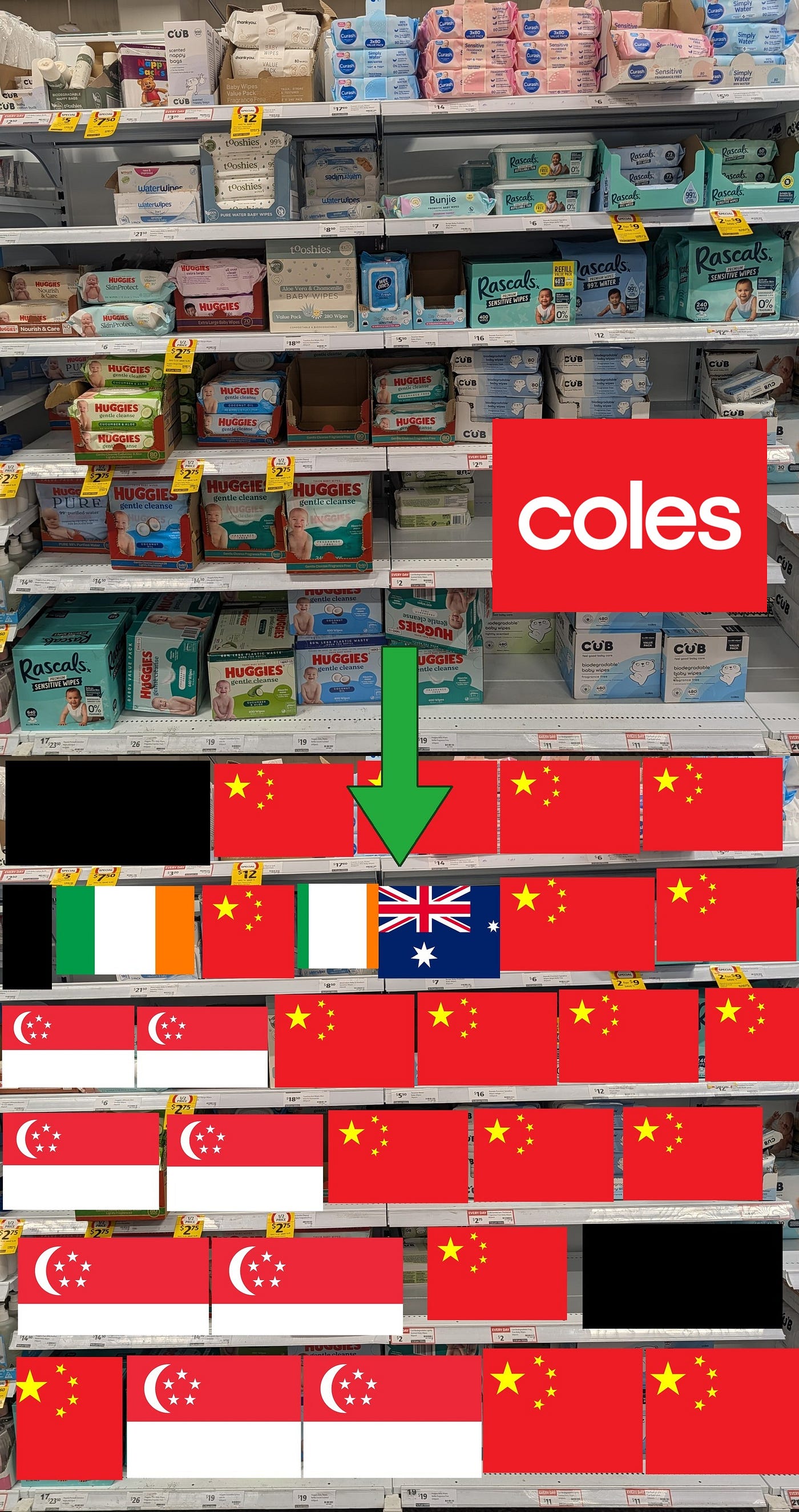
What the shelves said
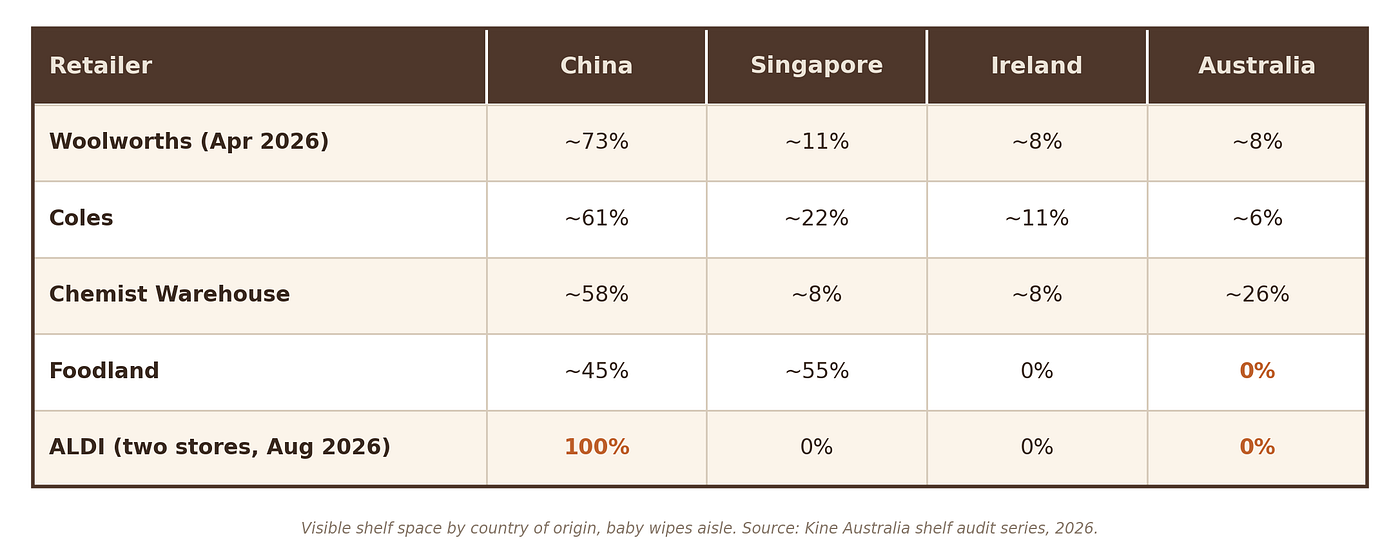
Three findings stood out.
China dominates everywhere, but the degree varies. At Woolworths, Chinese-made products took nearly three quarters of the shelf. At Coles and Chemist Warehouse, around 58 to 61%. Singapore was a bigger secondary source than most shoppers would guess, and at Foodland it was actually the dominant origin.
The brands Australians know best are almost all imported. Huggies, Curash, Tooshies, Mamia. All manufactured overseas, primarily in China and Singapore. We also found that Huggies sources from different countries depending on the product variant. The same brand can say Made in China at one retailer and Made in Singapore at another.
Australian-made wipes exist, but you have to know where to shop. Chemist Warehouse gave locally made products roughly a quarter of its shelf, the best result in the series. Foodland, a proudly South Australian retailer whose own website commits to prioritising SA and Australian manufacturers, had zero Australian-made baby wipes on the shelf the day we visited. The local brands (GAIA, Bunjie, and ourselves) are out there. Their shelf presence depends entirely on individual ranging decisions.
The ALDI aisle
ALDI was the audit I had promised and not yet done, and it turned out to be the most interesting one.
ALDI runs an almost entirely private-label range, so the wipes aisle is essentially one brand: Mamia. On 5 August 2026 I visited two Adelaide stores, Mawson Lakes and Norwood, and checked the origin statement on every Mamia wipe product on the shelf. Every box, every variant, no sampling.
Every single pack, at both stores, carried the same three words: Made in China.
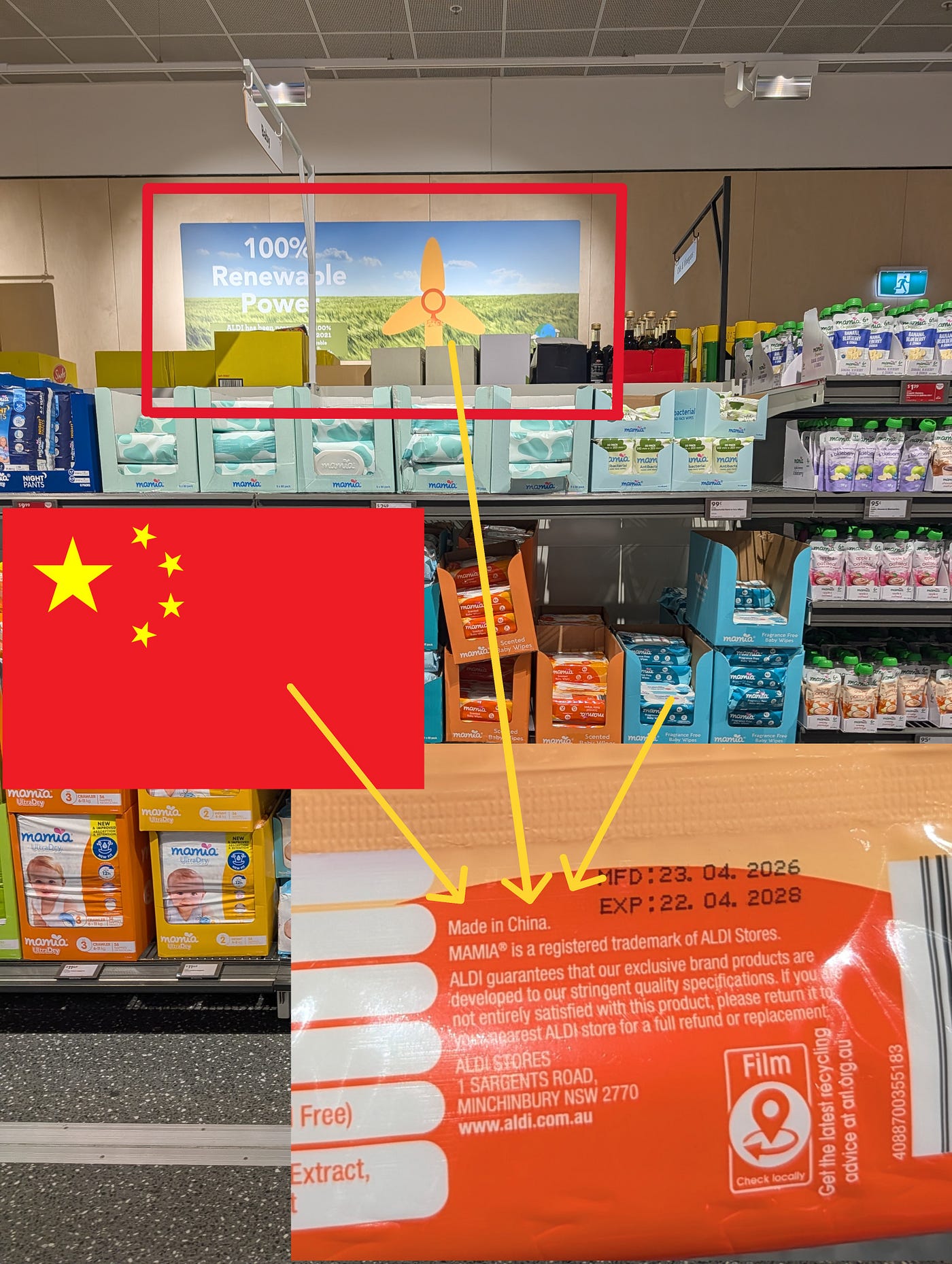
Here is where it gets more interesting. Some of the product photography on ALDI’s own Australian website shows Mamia packaging marked Made in Australia. We archived those pages the same day we photographed the shelves. The website’s standard product disclaimer resolves the gap: product information may differ from the product in store, please read product labels before purchasing.
Nothing about that is unlawful, and I am not suggesting it is. The disclaimer was written by people who are very good at their jobs. My point is smaller and, I think, more uncomfortable. For a product parents wipe on newborn skin, “technically accurate once you have read the fine print” is a remarkably low bar. Shoppers deserve the country of origin story straight, printed on the front, no homework required.
One more detail from that aisle. At Mawson Lakes, a large sign hangs directly above the Mamia bay: 100% Renewable Power. The claim is real. ALDI’s Australian stores have run on certified renewable electricity since 2021, and that is a genuine achievement. But the sign describes the store’s electricity, not the products beneath it, every one of which was manufactured roughly 10,000 kilometres away and shipped here on vessels burning heavy fuel oil. The electricity is renewable. The supply chain is not. Only one of those facts gets a billboard.
What the label will not tell you
Reading a hundred or so wipe packs teaches you as much from what is missing as from what is printed.
Most packs do not say what the cloth is made from. Many conventional wipes are made wholly or partly from plastic fibres, which is why they persist in landfill and waterways for years. Around 90% of conventional wipes contain plastic. Yet fibre content is rarely printed anywhere on the pack. An FSC label tells you the wood fibre was responsibly sourced. It does not tell you whether the cloth also contains polyester.
Who actually makes the product is often invisible. Private-label wipes name only the retailer. The contract manufacturer is not disclosed. The honest answer to “who makes these wipes” is frequently: the pack will not tell you.
Flushability claims are mostly absent, which is the right call. To ALDI’s credit, the Mamia pack states plainly: never flush these wipes down the toilet. That single sentence is worth more than most marketing in this category. Wipes that cannot break down are a leading cause of sewer blockages, which cost Australian water utilities millions of dollars every year. None of the imported packs we checked carried certification to AS/NZS 5328, the Australian and New Zealand standard for flushable products, which remains rare on Australian shelves.
How to check a wipe pack in 30 seconds
Three things to look for before the pack goes in your trolley:
- Country of origin. It is on the back, usually in small print. If the front says nothing about where it is made, that is usually the answer.
- Fibre content. Look for “plant-based”, “cellulose” or “viscose” stated explicitly. If the pack does not say what the cloth is made from, assume it may contain plastic.
- Flushability certification. If a pack claims to be flushable, look for AS/NZS 5328. A bare “flushable” claim without the standard behind it has caused enough sewer damage that the ACCC has pursued brands over it.
Where I land
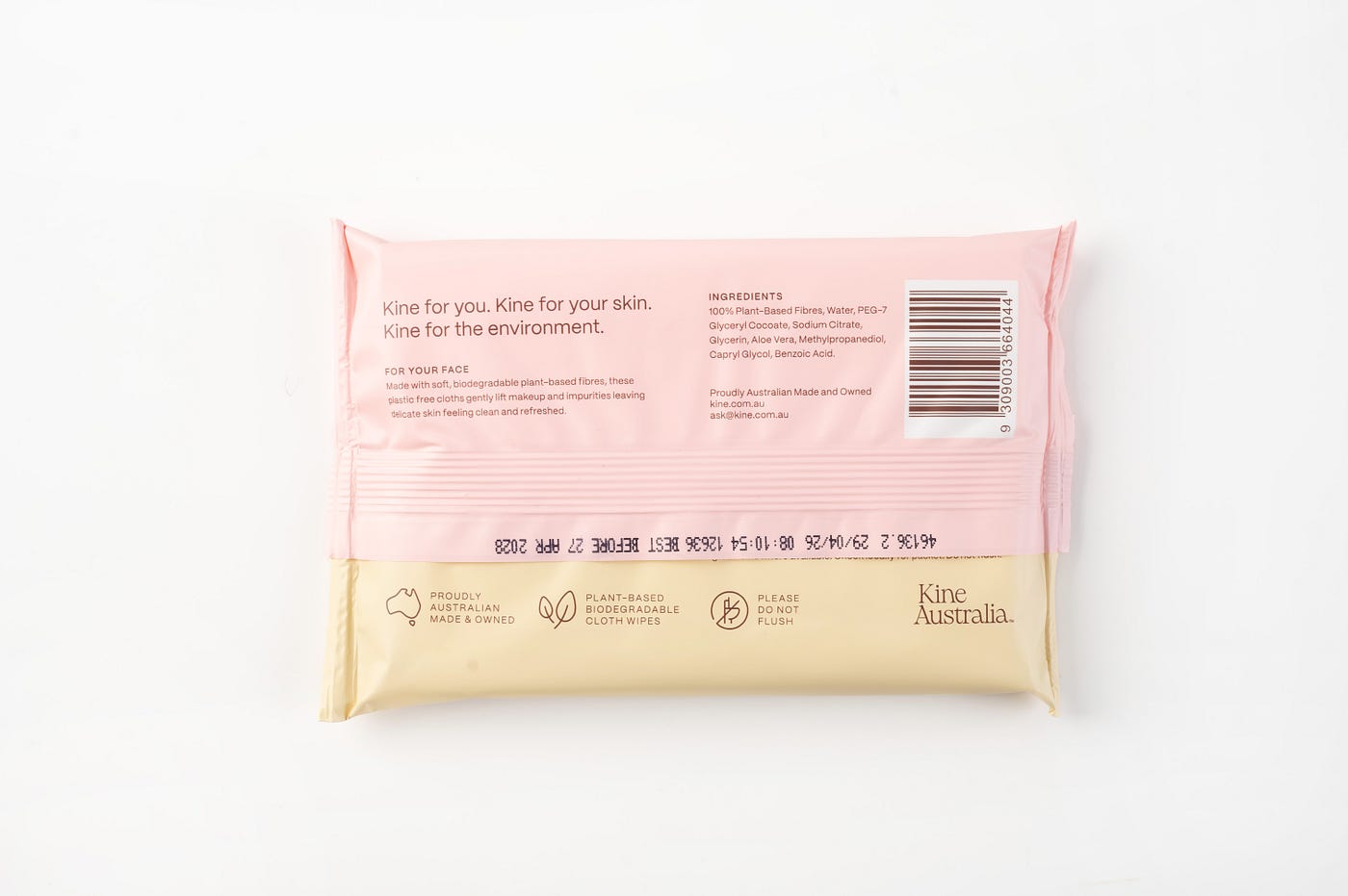
I have an obvious commercial interest here, and I have not hidden it. Kine makes wipes in Australia from 100% plant-based fibres, and we print both facts on the front of the pack, along with AS/NZS 5328 certification on the two products where flushability is independently tested. We manufacture locally because it cuts the transport emissions of every pack by more than half compared with an imported equivalent, and because quality control we own end to end matters in a category people use on their skin every day.
But you do not have to buy anything from me for this series to be useful. The point of the audits is simpler: the information is on the shelf, it has been there the whole time, and almost nobody looks. Six audits in, the pattern is clear. Where your wipes come from is not a mystery. It is just printed in very small letters, on the back, below the barcode.
Turn the pack over. That is the whole method.
The full shelf audit series, with every photograph and retailer breakdown, is at kine.com.au/blogs/news. Kine makes plant-based, plastic-free wipes in South Australia. If you’ve run your own audit at a local store, I’d like to hear from you: ask@kine.com.au.
메타데이터
- post_id
- df6bfc6e5de2
- slug
- i-checked-the-country-of-origin-on-every-wet-wipe-at-five-australian-retailers-df6bfc6e5de2
- url
- https://medium.com/@markpyates/i-checked-the-country-of-origin-on-every-wet-wipe-at-five-australian-retailers-df6bfc6e5de2
- canonical_url
- https://medium.com/@markpyates/i-checked-the-country-of-origin-on-every-wet-wipe-at-five-australian-retailers-df6bfc6e5de2
- author_url
- https://medium.com/@markpyates
- status
- ok
- fetched_at
- 2026-08-19 16:49:35




