How the NVIDIA EGX Stack Is Shaping AI-Driven Edge Infrastructure in 2025
Explore how the NVIDIA EGX stack revolutionizes AI deployment at the edge with Kubernetes-native orchestration, GPU-accelerated inference…
AI at the edge isn’t a future promise — it’s happening now with NVIDIA EGX.
How the NVIDIA EGX Stack Is Shaping AI-Driven Edge Infrastructure in 2025
Explore how the NVIDIA EGX stack revolutionizes AI deployment at the edge with Kubernetes-native orchestration, GPU-accelerated inference, and real-time data processing.
As we enter 2025, artificial intelligence (AI) is no longer confined to the data center. AI workloads — especially those involving real-time inference — are increasingly moving toward the edge, where data is generated. The challenge lies in delivering the compute power, orchestration, and reliability needed for these distributed AI workloads.
This is where NVIDIA EGX emerges as a game-changer. EGX is a cloud-native, Kubernetes-integrated edge computing platform designed for GPU-powered AI processing at the edge. It combines the strength of NVIDIA GPUs, Triton Inference Server, TensorRT, and Fleet Command, creating a streamlined stack optimized for scalable AI infrastructure.
In this blog, we’ll explore:
1.The architecture of the EGX platform
2.Its integration with Kubernetes
3.Real-world deployment models
4.Programming implications for AI developers
5.How it compares to traditional edge AI deployments
Understanding the Need for AI at the Edge
Edge AI refers to running AI workloads locally at the edge of the network — closer to the source of data. This is essential for applications like:
- Autonomous vehicles
- Smart surveillance
- Industrial robotics
- Real-time medical diagnostics
- Retail analytics
However, edge computing introduces unique constraints:
- Low latency
- Bandwidth optimization
- Offline capability
- Security and data locality
Traditional infrastructure often fails to meet these demands. That’s where EGX brings its value.
What Is NVIDIA EGX?
NVIDIA EGX is a full-stack edge AI platform built for real-time inference. It includes:
- NVIDIA GPU (T4, A100, L4) for accelerated computation
- CUDA and TensorRT for model optimization
- Triton Inference Server for model serving
- Fleet Command for remote orchestration and lifecycle management
- Kubernetes-native deployment for containerized workloads

Unlike generic edge platforms, EGX is designed with AI inference as its core function.
Architecture of EGX Stack
Here’s how the EGX architecture looks under the hood:
+---------------------------+
|       Fleet Command       |
|  (SaaS-based edge ops)    |
+---------------------------+
|   Kubernetes Orchestration|
| + Helm + GPU Operator    |
+---------------------------+
|  Triton + TensorRT + CUDA |
| (Model Optimization Layer)|
+---------------------------+
|  NVIDIA GPU + DPU Layer   |
+---------------------------+
|       EGX Edge Node       |
+---------------------------+
This layered stack ensures full control over:
- Model serving
- Scaling
- Monitoring
- GPU utilization
- Multi-site deployment
Deep Kubernetes Integration
The EGX platform integrates seamlessly with Kubernetes, enabling developers and DevOps teams to:
- Schedule GPU resources using
nvidia.com/gpu - Use GPU Operator to install drivers, plugins, and monitoring agents
- Manage model inference using Helm charts and ConfigMaps
- Deploy Triton Inference Server as a sidecar or standalone pod
Sample Kubernetes spec:
resources:
  limits:
    nvidia.com/gpu: 1
This allows teams to treat GPU resources just like CPU/RAM within Kubernetes-native workloads.
Accelerating Inference with Triton and TensorRT
One of EGX’s strongest components is its inference engine:
Triton Inference Server
- Supports multiple frameworks (TensorFlow, PyTorch, ONNX)
- Ensemble models (multi-model chaining)
- Concurrent execution
- REST/gRPC APIs
TensorRT
- Reduces model size using FP16 and INT8 quantization
- Layer fusion and pruning for minimal latency
- Generates serialized
.planfiles for GPU-optimized execution
Example Workflow:
trtexec --onnx=model.onnx --saveEngine=model.planThis dramatically cuts inference times — crucial for real-time AI at the edge.
Fleet Command: Centralized Edge AI Management
NVIDIA’s Fleet Command is a SaaS orchestration platform that enables:
- Secure remote deployment
- Device provisioning
- Model updates
- Performance monitoring
- Secure tunneling and rollback
All edge devices can be managed from a single web dashboard — ideal for managing 100s of EGX-enabled sites globally.
Use Cases of EGX in 2025
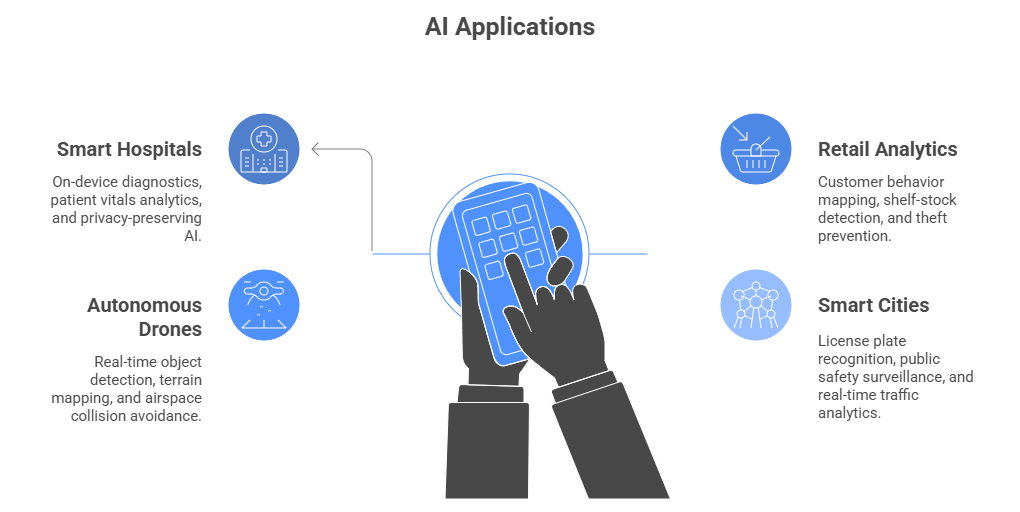
Smart Hospitals
- On-device diagnostics with GPU-powered CT/MRI processing
- Patient vitals analytics
- Privacy-preserving on-prem AI
Retail Analytics
- Customer behavior mapping
- Shelf-stock detection
- Theft prevention via real-time inference
Autonomous Drones
- Real-time object detection
- Terrain mapping
- Airspace collision avoidance
Smart Cities
- License plate recognition
- Public safety surveillance
- Real-time traffic analytics
Developer Stack and Tools
For ML/AI engineers, EGX provides:
- Pre-trained models via NVIDIA NGC
- Model conversion tools:
tf2onnx,torch.onnx,trtexec - Docker containers: GPU-enabled and Triton-ready
- Kubernetes plugins: Helm charts, GPU operator
Sample developer flow:
# Step 1: Convert PyTorch model
python export.py --model my_model.pt --onnx model.onnx
# Step 2: Optimize with TensorRT
trtexec --onnx=model.onnx --saveEngine=model.plan
# Step 3: Deploy with Helm
helm install my-inference ./triton-chart/
This entire process is containerized and reproducible across edge nodes.
EGX vs Traditional Edge Platforms
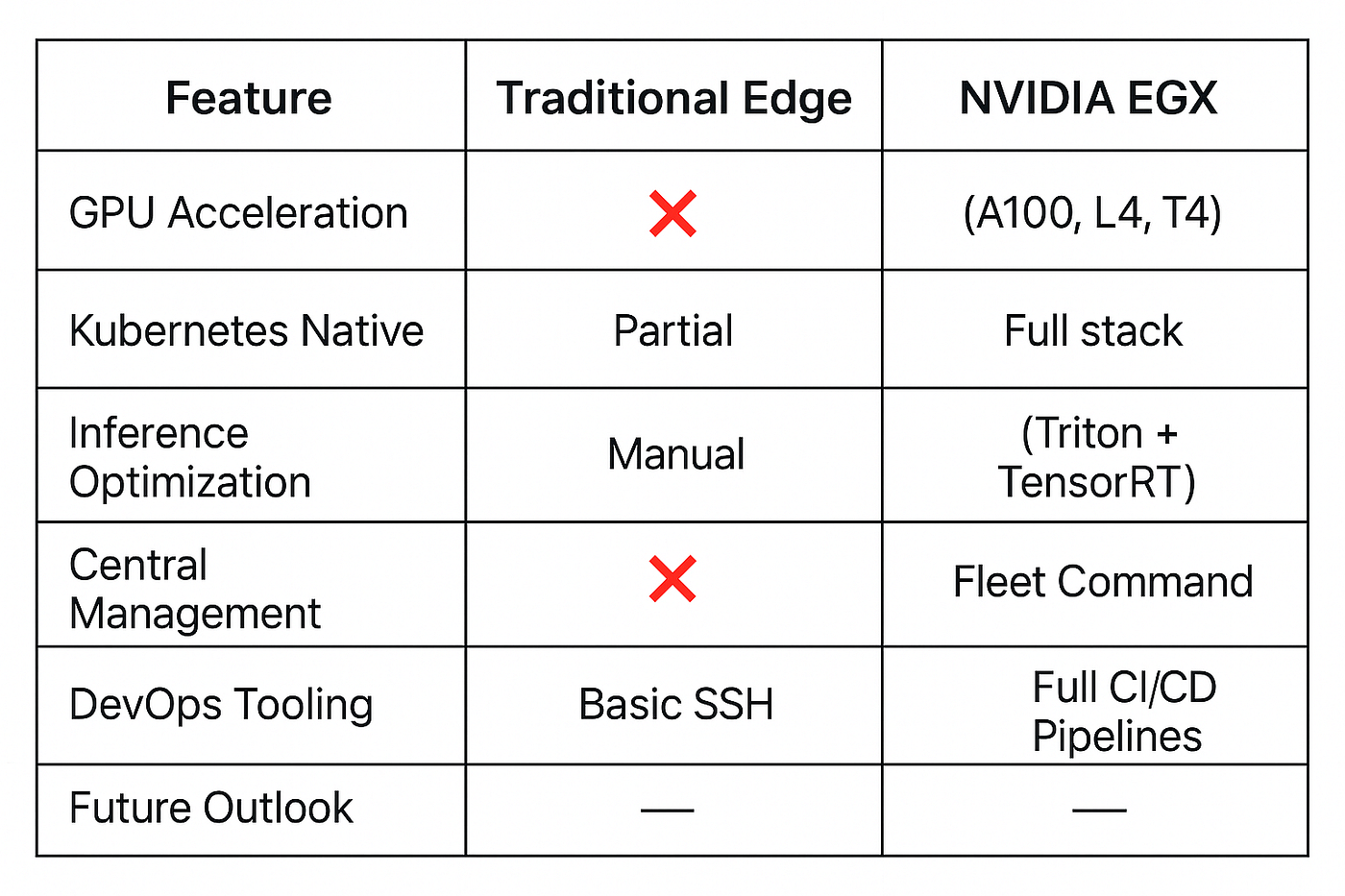
With Future Outlook
support for LLMs at the edge, multi-modal inference, and 5G/6G edge deployments, EGX is not just an edge AI platform — it’s becoming a complete AI infrastructure fabric for globally distributed applications.
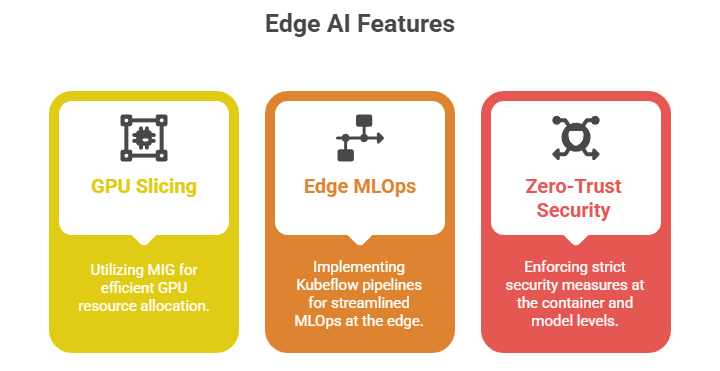
As Kubernetes and AI continue to converge, we can expect future enhancements like:
- GPU slicing using MIG (Multi-Instance GPU)
- Edge MLOps with Kubeflow pipelines
- Zero-trust security enforcement at the container and model level
Conclusion
The NVIDIA EGX stack represents a significant leap in the way we deploy and scale AI workloads at the edge. With native Kubernetes support, GPU-powered inference, and SaaS-based fleet orchestration, EGX delivers data center-level performance with edge-level proximity.
For developers, it simplifies MLOps. For infrastructure teams, it unifies edge management. For businesses, it unlocks powerful real-time insights at the very edge of their operations.
메타데이터
- post_id
- df6d9e45084e
- slug
- how-the-nvidia-egx-stack-is-shaping-ai-driven-edge-infrastructure-in-2025-df6d9e45084e
- url
- https://medium.com/@StackGpu/how-the-nvidia-egx-stack-is-shaping-ai-driven-edge-infrastructure-in-2025-df6d9e45084e
- canonical_url
- https://medium.com/@StackGpu/how-the-nvidia-egx-stack-is-shaping-ai-driven-edge-infrastructure-in-2025-df6d9e45084e
- author_url
- https://medium.com/@StackGpu
- status
- ok
- fetched_at
- 2026-06-12 18:14:10