Your Inventory Count Is Already Wrong — Here Is Why RFID Changes That
The warehouse team just finished the quarterly count. Three days of work, two temporary staff, and a paused receiving dock. Two weeks…
Your Inventory Count Is Already Wrong — Here Is Why RFID Changes That
The warehouse team just finished the quarterly count. Three days of work, two temporary staff, and a paused receiving dock. Two weeks later, the system is showing the same discrepancies it always does. A pallet of components the count confirmed as present has not moved, but it cannot be found on the floor. A set of tools last signed out three months ago is nowhere in the records.
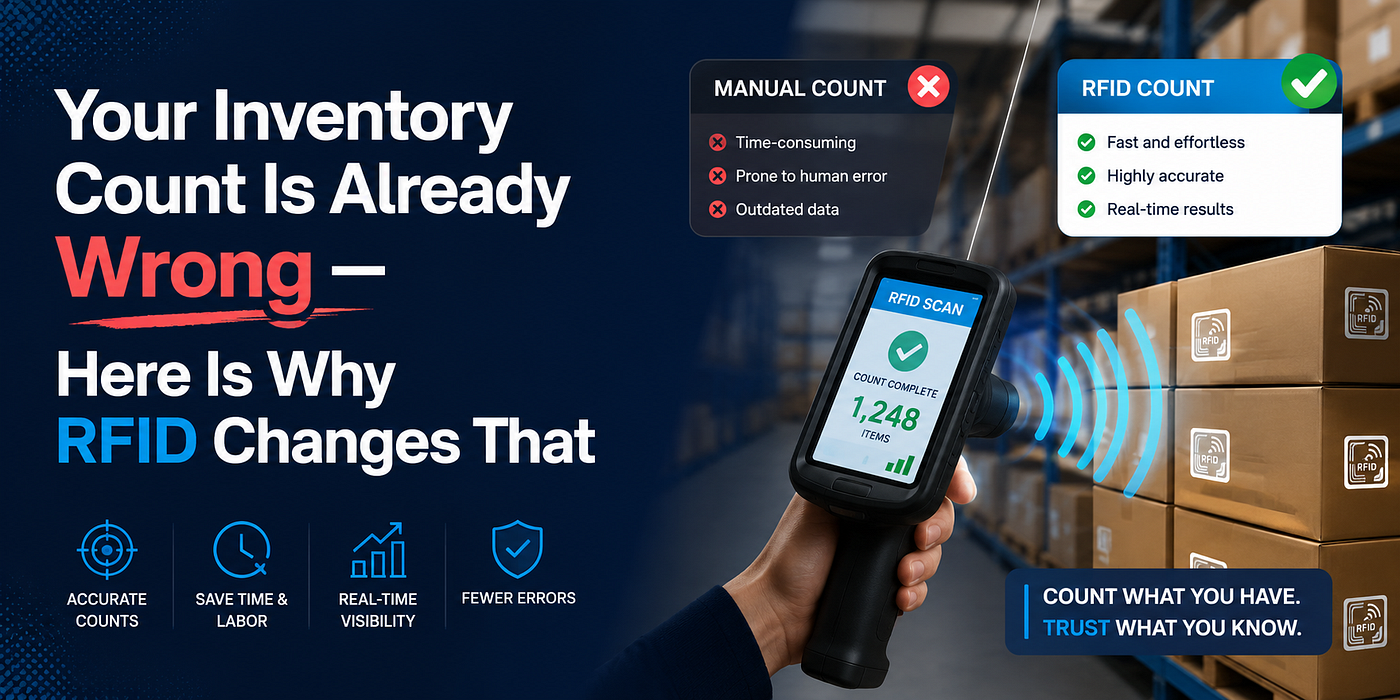
This is not a process failure. It is a technology ceiling. Manual barcode-based inventory tracking is accurate at the moment of scan and nowhere else. The moment goods move, tools are borrowed, or assets are relocated, the record drifts. By the time the next scheduled count rolls around, the gap between what the system believes and what is physically there has grown into something that takes days to close. This is one reason why many organizations are adopting **RFID tags for inventory** to maintain accurate, real-time inventory records.
What RFID Does That Barcodes Cannot
RFID uses radio waves to identify tagged assets without requiring line-of-sight scanning or individual handling. **Fixed readers** positioned at doorways, storage zones, and transit points capture movement automatically. Handheld readers let staff sweep an entire room in minutes — not hours. Multiple tags are read simultaneously regardless of orientation or packaging.
The practical consequence is that inventory records stay current without dedicated count cycles. A team can run a fast RFID sweep at the start of each shift and catch discrepancies the same day they occur, not six weeks later. Assets that move between departments leave a trail. Items that leave a facility without authorization trigger an alert at the exit reader rather than appearing as a variance in next quarter’s count.
The system components that make this work are straightforward: tags on each asset storing a unique ID, readers that capture those IDs, middleware that processes the data, and application software that connects it to whatever WMS or ERP the operation already uses. The integration step is where most deployments require planning, but it is also where the payoff comes from — RFID data flowing directly into operational systems eliminates the manual data entry that introduces errors in the first place.
Choosing the Right Tag for the Environment
Not all **RFID tags** perform the same way in every environment. Metal surfaces interfere with standard passive tags, so assets stored on metal shelving or attached to metal equipment require on-metal tag variants. Liquids absorb the frequencies that standard tags use, so applications near fluids need tags engineered for that condition. Temperature extremes in cold storage or outdoor environments call for ruggedized enclosures.
Read range is another variable that gets underestimated in planning. Short-range tags work for close-proximity tasks like check-in and check-out at a service counter. Long-range tags are needed for automated capture at dock doors or across large storage areas. Getting this wrong does not cause the system to fail catastrophically — it causes inconsistent reads that erode confidence in the data, which is almost worse.
Passive tags, which draw power from the reader’s signal, cover the majority of inventory applications. Active tags carry their own power source and can broadcast their location continuously, which is useful for high-value assets that need to be locatable at all times rather than just readable when a reader is nearby.
Where the ROI Actually Comes From
The financial case for RFID tags for inventory management has three components that appear consistently across industries. The first is labor. Cycle counts that previously required dedicated staff time at scheduled intervals become fast, frequent sweeps that can happen without disrupting operations. The saved hours compound quickly across a year.
The second is loss prevention. When every asset has a tracked identity and movement events are recorded automatically, the point of loss becomes identifiable. Assets do not simply disappear from the system — they leave a trail that shows where they were last read, who checked them out, and whether they returned. That visibility deters misplacement and makes recovery faster when items go missing.
The third is decision quality. Inventory decisions made on accurate, current data produce different outcomes than decisions made on records from the last physical count. Reorder timing improves, overstocking falls, and capital tied up in excess inventory is freed. For operations managing hundreds or thousands of assets, that difference adds up.
RFID does not suit every operation. For small, stable inventories where barcodes work reliably, the additional cost and setup complexity may not be justified. But for operations where assets move frequently, where losses are a recurring problem, or where audit requirements demand current and traceable records, RFID closes a gap that process improvements alone cannot.
Source: AssetPulse — RFID Tags for Inventory: Improve Visibility & Accuracy
메타데이터
- post_id
- df6feef2dee2
- slug
- your-inventory-count-is-already-wrong-here-is-why-rfid-changes-that-df6feef2dee2
- url
- https://medium.com/@aemuthu/your-inventory-count-is-already-wrong-here-is-why-rfid-changes-that-df6feef2dee2
- canonical_url
- https://medium.com/@aemuthu/your-inventory-count-is-already-wrong-here-is-why-rfid-changes-that-df6feef2dee2
- author_url
- https://medium.com/@aemuthu
- status
- ok
- fetched_at
- 2026-06-12 18:14:10