The Machine That Knows Everything
Certainty vs. Uncertainty
The Machine That Knows Everything
Certainty vs. Uncertainty

I keep two “answer machines” on my desk. One is a book: the I Ching, or Book of Changes, a Chinese text roughly three thousand years old. The other is a phone with a chatbot on it, a few years old. Over time, I have asked both the same kinds of questions — should I take a job, is this the right time to begin something, should I forgive someone? The two machines never answer the same way.
The chatbot answers immediately, in complete sentences. It summarizes the situation, weighs the options, and gives me something I can act on. When it finishes, I have an answer.
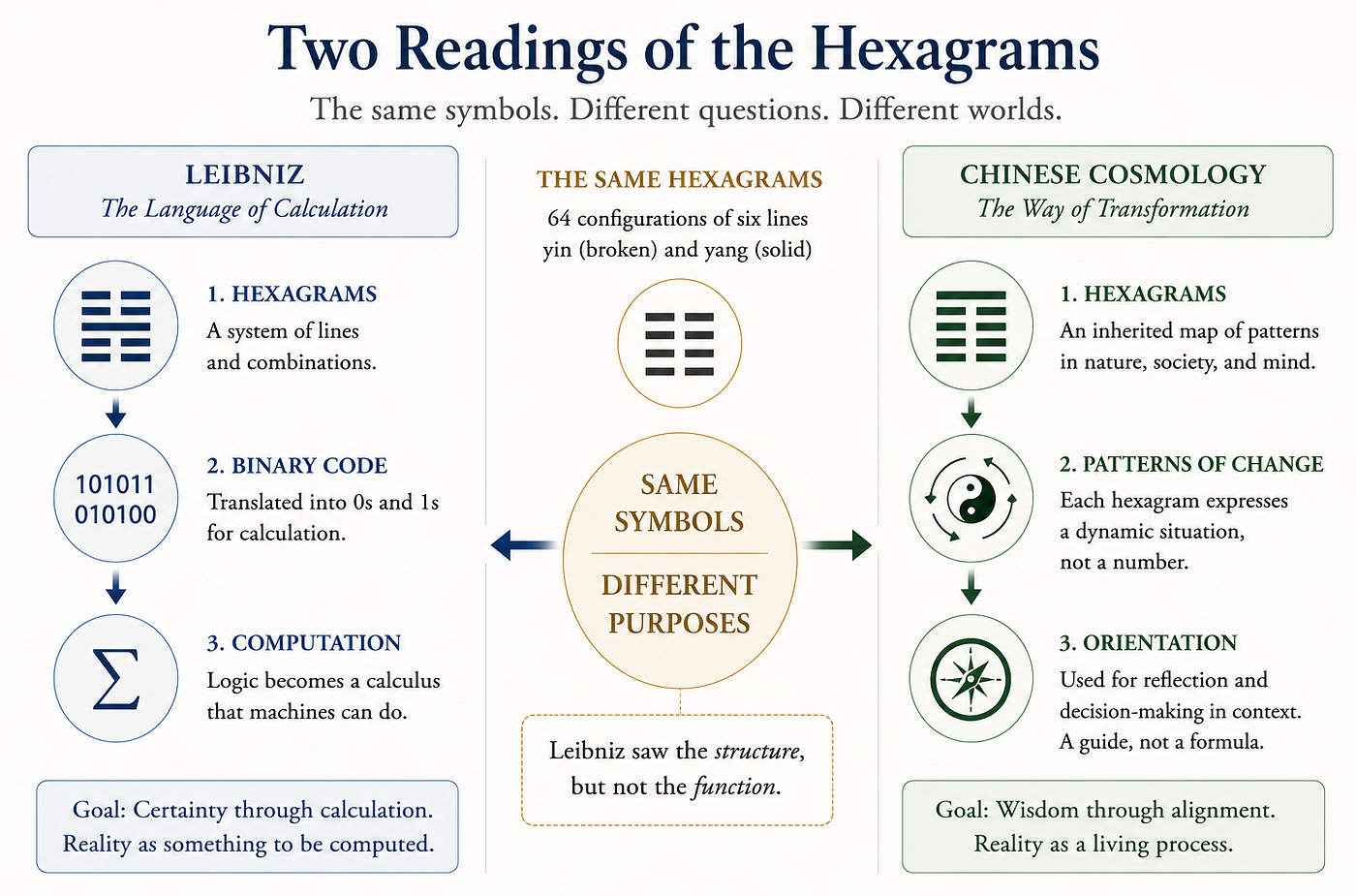
The I Ching works differently. I cast a hexagram — a figure made of six broken or unbroken lines, generated by tossing coins or counting yarrow stalks — and receive a short, often cryptic passage: a name like “Gradual Advance” or “Before Completion,” and an image such as wind on a mountain.
The text does not tell me what to do. And yet, a day or two later, I often notice that I have made a decision. The book has not answered my question; it has handed the question back to me in a form I can finally think through.
The Chatbot: Fluent, but Whose Voice?
Consider what happens if you ask a chatbot to name history’s most influential philosophers. To simplify a real pattern for the sake of illustration: a chatbot trained mainly on English-language, Western sources will typically answer with a caveat — it is difficult to name just one — and then list figures like Socrates, Plato, Aristotle, Kant, and Nietzsche.
A chatbot trained primarily on Chinese-language sources would more likely name Confucius, Laozi, and Zhuangzi. One trained mainly on Indian sources might name Shankara and Radhakrishnan.
In practice, most major systems are trained on very large amounts of multilingual data and are further shaped by fine-tuning, product policy, and the specific way a question is worded, so real answers tend to be considerably more mixed than this simplified example suggests. The underlying pattern still holds, though: whatever a system’s training and design happen to emphasize will show up in its answers.
None of these answers is false, and none of the systems is lying. Each is accurately reflecting the intellectual tradition it was trained on.
The philosopher Edmund Husserl used the term “intersubjectivity” to describe the shared, taken-for-granted background assumptions that members of a culture hold in common, assumptions so basic they usually go unstated.
A chatbot, in effect, absorbs this shared background from its training data so thoroughly that it can generate new, fluent sentences that are consistent with that background indefinitely.
This is a genuinely impressive technical achievement. It is also the source of a problem we may call the intelligence trap.
Throughout human history, fluent speech has been strong evidence of a mind behind it. For roughly a hundred thousand years, if something could hold a conversation, take a joke, or correct its own mistake, we could safely assume “someone” was there. This is not a naive assumption. It has been one of our most reliable tools for navigating the social world.
The chatbot is the first thing in human history to trigger that instinct at full strength without it being clear that anyone, in any meaningful sense, is “home.” We do not currently know whether a large language model has any form of inner experience. What can be said more confidently is narrower: fluency by itself no longer proves understanding. The two have come apart.
An analogy: sweetness and fruit. For most of human history, a sweet taste reliably signaled fruit — and therefore ripeness and nourishment. The tongue could trust sweetness because only real fruit could produce it.
Once food science learned to manufacture sweetness artificially, the signal separated from what it used to indicate. The tongue still responds the same way; the nourishment is no longer guaranteed. In the same way, fluent language is used to reliably indicate a mind behind it. Machines have now made fluency cheap to produce, but our instinct to trust fluent speech has not caught up.
The I Ching: A Different Kind of Machine
The I Ching is often dismissed in the West as a form of fortune-telling, and its long history of use for that purpose supports the dismissal. But looking closely at how it actually functions reveals something different.
To consult the I Ching, a person first formulates a question and then generates six lines, traditionally by sorting yarrow stalks or, more commonly today, by tossing three coins six times. Each result produces either a broken or unbroken line, sometimes marked as changing. Together, the six lines form one of sixty-four hexagrams. The reader then consults the corresponding passages in the book, including any changing lines.
Suppose someone asks, “Should I accept this new job?” and receives Hexagram 53, “Gradual Development,” traditionally represented by a tree growing slowly on a mountain. The image does not say yes or no. Instead, it may prompt the person to ask whether the opportunity represents sustainable growth, whether the transition should be made in stages, and whether impatience is influencing the decision. The I Ching has not predicted the future or made the choice. It has placed the question within a pattern of change that helps the reader see the situation differently.
The accompanying text is intentionally ambiguous. It does not instruct you. Instead, it places your uncertainty in relation to these paired opposites and leaves you to work out the resolution yourself.
Several scholars have commented on this mechanism. The psychologist Carl Jung, who wrote an influential foreword to the widely read English translation, was interested in its psychological function; Marysol Sterling Gonzalez, in her book The I Ching and Transpersonal Psychology, called it a “psychological computer.” The sharpest name, though, comes from the philosopher Will Buckingham, who called it an “uncertainty machine.”
The distinction is useful: a chatbot is a certainty machine. You bring it a question, and it removes your uncertainty by supplying an answer. The I Ching is an uncertainty machine. It does not remove your uncertainty; it organizes it and requires you to resolve it yourself. Its underlying assumption is that you already have the material needed to answer your own question, and what you lack is a structured way to access it.
The reflective use of the I Ching described here does not depend on any factual prediction about the external world. It does not need to tell you anything about traffic, markets, or weather to do the work described above.
Historically, the I Ching has also been used for divination in a more literal sense, but the claim that matters here concerns only us: that our uncertainty already contains the seed of its own resolution.
A Thought Experiment: Two Future AI Systems
Now consider a deliberately simplified hypothetical, useful for isolating a single point rather than describing how any real national AI industry currently behaves. Imagine two advanced, general-purpose AI systems, each trained overwhelmingly on the digital record of a different civilization. One draws mainly on American sources; the other, mainly on Chinese sources. Suppose we ask each the same question: what is the shortest path to world peace?
Both systems answer fluently. Both answers are internally consistent and well-supported by evidence. And yet the two answers differ — not on basic facts, but on more fundamental questions: what “peace” means, what a “world” is, and what should count as “short.”
In this simplified case, one system’s answer might lean toward emphasizing individual rights; the other might lean toward emphasizing social relationships and collective order.
As with the chatbot example, real systems are considerably messier than these scenarios. But to isolate the underlying point, both hypothetical answers are intelligent, and neither hypothetical system is deliberately biased. Each has inherited a particular conception of what matters, along with the data it was trained on.
This is not a design flaw that better engineering would eliminate. It is a basic feature of how these systems work: any answer to a question about what matters reflects the values embedded in the system’s training.
The chatbot in the earlier example reflects the shared assumptions of its designers; a large-scale AI system of this kind would reflect the assumptions of an entire civilization; the I Ching, unlike either, reflects the person asking the question.
Who Chose the Goal?
This scenario raises a clear question: who chose the goal? A powerful AI system can pursue almost any objective with remarkable effectiveness, but it can only optimize toward a goal that has already been set. Wisdom is required to ask where that goal came from and whose values are embedded in it.
As far as we currently know, an AI system cannot generate its own sense of what matters from nothing. Its knowledge may be vast, but its values are inherited, not chosen.
It’s possible that future AI systems could develop the ability to set their own goals. Even then, it would remain reasonable to ask where such a choice originated — from what history, what body, what stake in the world. A choice that comes from nowhere in particular is not the same as freedom; it is closer to randomness.
This gives us three points of comparison.
The chatbot reflects its training data. A hypothetical advanced AI would reflect the record of an entire civilization. The I Ching reflects the individual asking the question. Two of these systems supply an answer from outside; only one, the I Ching, returns the question to the person who asked it, treating that person as the one who must ultimately supply the judgment.
It would be all too simple to regard the I Ching as a relic of an earlier, less sophisticated stage of human thought, now superseded by data and modern AI. But the I Ching’s underlying assumption is worth taking seriously: that some questions are actually about your inner world, and no amount of information can answer them for you. The answer, in these cases, has to be produced by the person asking. There are, in short, two different kinds of questions, and only one kind can be outsourced to a machine.
Modern AI systems do not draw this distinction. By design, they are built to treat every question as the first kind — the kind they can answer. This is a genuine strength, but it creates a risk: the more capably these systems answer, the easier it becomes to forget that the second kind of question exists at all.
And so I keep both machines on my desk. The phone is indispensable for navigating the external world: it retrieves information, compares possibilities, and supplies answers with remarkable speed. The I Ching serves a different purpose. It returns the question to the person who asked it.
Not every uncertainty represents a shortage of data; some questions concern not the world, but the asker. In an age of thinking machines, the danger is not simply that machines will know too much. We may forget which decisions must remain our responsibility. A machine can help map the possible routes. Wisdom begins by deciding where — and whether — we should go.
This article was adapted from my forthcoming book, Beyond Intelligence: Wisdom in the Age of Thinking Machines.
메타데이터
- post_id
- df71faaecd3b
- slug
- the-machine-that-knows-everything-df71faaecd3b
- url
- https://medium.com/@jankrikke2020/the-machine-that-knows-everything-df71faaecd3b
- canonical_url
- https://medium.com/@jankrikke2020/the-machine-that-knows-everything-df71faaecd3b
- author_url
- https://medium.com/@jankrikke2020
- status
- ok
- fetched_at
- 2026-08-11 22:07:34