Genocide is a Process, Not an Event
What the nineteenth century destruction of the Circassian people reveals about how genocide unfolds
Genocide is a Process, Not an Event
What the destruction of the Circassian people tells us about how genocides happen
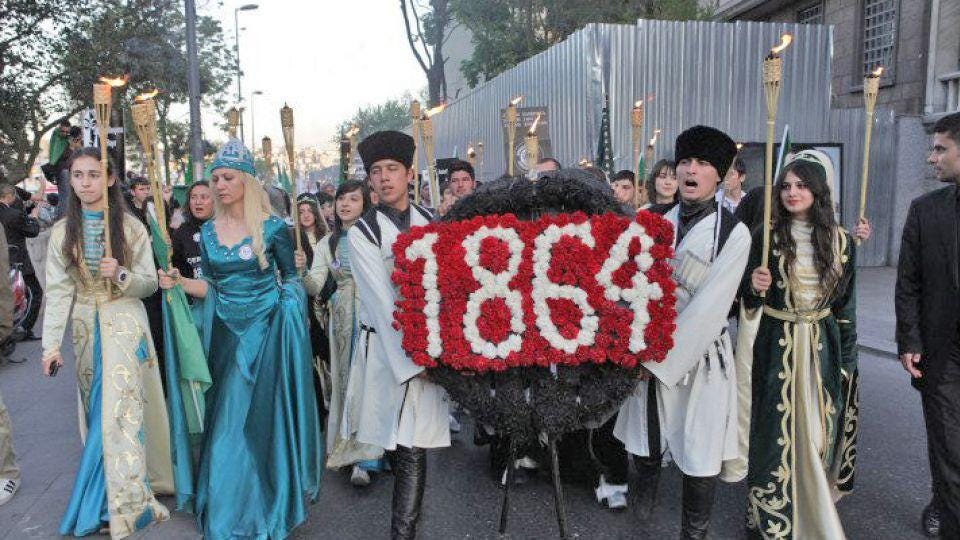
Circassians in Istanbul, Turkey, commemorate the banishment of their ancestors from their homeland by Russia on May 21, 2011. (TRT World and Agencies)
Circassian history is known only in the broadest of outlines to regional specialists and not at all to most outside observers.
The destruction of the Shapsug, Abkhaz, Adyghe, Ubykh, and Kabardian peoples — collectively called Circassian and resident for millennia along the northeastern shore of the Black Sea— did not occur in a single historical moment. Nor was it ever wholly complete.
In her 2024 report *Anatomy of a Genocide*, UN Special Rapporteur on the occupied Palestinian territory Francesca Albanese wrote, “Genocide is a process, not an act.” The following year she she sharpened the point: “Genocide is a process, not a single act,” Albanese added. “A collective act. A criminal venture. To end it, we must first be willing to see it.” Her formulation belongs to a wider body of scholarship that understands genocide as cumulative and settler colonialism as an enduring structure of elimination. Patrick Wolfe’s influential 2006 essay, “Settler Colonialism and the Elimination of the Native,” offers one of the clearest accounts of that structure.
Although these scholars do not reference the destruction of the Circassian peoples, their history fully substantiates their points. The annihilation of the Indigenous peoples of the North Caucasus extended over generations and traversed the vast territories of the Russian and Ottoman empires.
Given its multi-ethnic character and transregional geography, the Circassian genocide poses a particular challenge to historical narration. Walter Richmond’s *The Circassian Genocide* is one of the fullest English-language attempts to meet that challenge. How do you tell the story of a process that unfolded across generations and across the territories of two empires?
The answer cannot take the form of a simple chronology. The Circassian genocide involved imperial conquest, prolonged war, mass killing, expulsion, resettlement, and renewed displacement. Telling this history therefore requires interweaving several narratives and thinking about genocide over the *longue durée*.
The Circassians’ encounter with colonial expansion began with tsarist incursions into the northwest Caucasus in the early nineteenth century. General Aleksey Yermolov’s campaigns devastated Kabardia. Russian conquest culminated in the deportation of hundreds of thousands of Circassians to Ottoman territories during the 1860s and the final defeat of organised resistance on 21 May 1864. Many of those already displaced were expelled again from the Balkans by Russian troops during the 1870s. Russian conquest joined the removal of an Indigenous population with the colonisation of its land, bringing the Circassian case into the history of settler colonialism as well as genocide.
The expulsions created a global Circassian diaspora extending across the Ottoman Balkans, Anatolia, and the Levant. Those who remained in the homeland faced other forms of dispossession and repression. The genocide must therefore be understood spatially as well as chronologically, through a geography extending from the northwest Caucasus to the Ottoman Balkans, Anatolia, and the Levant. This geography encompasses both the destruction of Circassian life in the northwest Caucasus and the conditions imposed on survivors wherever they attempted to rebuild their communities.
Understanding genocide as a process poses a challenge to conventional historical narration because genocidal processes such as those that shaped Circassian history are often dispersed across time and territory.
The Circassian narrative
The expulsions did not end when Circassians crossed into Ottoman territory. After 1864, survivors were resettled across the Balkans, Anatolia, and the Levant. Many who had first been settled in the Balkans were uprooted again during and after the Russo-Ottoman War of 1877–78. The geography of Circassian survival was therefore shaped by repeated displacement rather than by a single passage from homeland to refuge.
Across the late Ottoman Levant, Circassian refugees founded villages and rebuilt communal life under new political conditions. In Transjordan, they helped establish modern Amman as a refugee settlement, along with other agricultural communities connected to Syrian and Palestinian commercial networks. Circassian communities in Jordan later attained a degree of political security unavailable to many parts of the diaspora, although survival within a host state could not substitute for the recovery of a lost homeland.
In Palestine, Circassian refugees founded communities including Kfar Kama and Rehaniya. Their settlement there placed the descendants of one displaced people within a land that, in the following century, would become the site of the Nakba and the mass displacement of the Palestinian people.
The Golan Heights became another site of Circassian displacement. Quneitra, a city built in significant part by Circassian settlers in the Golan Heights, was occupied by Israel in 1967. The city changed hands during the 1973 war and Israeli forces massively and deliberately destroyed it during the occupation before withdrawing in 1974. The descendants of refugees from Russian conquest were thus drawn into another history of occupation, destruction, and displacement in the same region where their ancestors had sought refuge.
The Circassian case therefore expands the temporal frame of genocide studies. The destruction did not end with military defeat in 1864. It continued through repeated expulsion and through the conditions imposed on communities rebuilding beyond their homeland.

The Mountaineers Leave the Aul, by Pyotr Nikolayevich Gruzinsky, 1872. Wikipedia (public domain).
The pan-Caucasus narrative
While Circassian communities rebuilt their lives across the Middle East, the Soviet state subjected neighbouring Caucasus peoples to new campaigns of deportation.
Richmond situates the Circassian genocide within the history of the North Caucasus, but his regional framework leaves its wider imperial and global implications underdeveloped. Vladimir Hamed-Troyansky’s Empire of Refugees: North Caucasian Muslims and the Late Ottoman State provides the transimperial framework that Richmond’s account lacks. By following roughly one million North Caucasus Muslim refugees across the Ottoman Balkans, Anatolia, and the Levant, Hamed-Troyansky shows how their displacement reshaped the modern Middle East. His organising framework is refugee history rather than genocide, but his geography makes the connection between the Caucasus and Palestine more evident.
Richmond’s pan-Caucasus perspective nevertheless reveals important connections among the deportations inflicted on the region’s peoples. He details the traumatic deportations experienced by the Turkic Karachays who lived peacefully alongside the Circassians for centuries until the Soviet period. His observation that, due to their own brutal expulsion, the Karachays “have little sympathy for the Circassians’ plight” complicates his account of the Circassian catastrophe with intimations of the parallel genocides that darkened the pasts of many Caucasian peoples.
A pan-Caucasus perspective is surely necessary. Acts of genocide were inflicted on many peoples of the Caucasus and neighbouring regions, including during the Soviet deportations of 1943–44, which targeted the Karachays, Balkars, Crimean Tatars, Meskhetian Turks, Kalmyks, Chechens, and Ingush. Richmond uses these intertwining histories to elucidate how Soviet social engineering prevented the formation of cross-ethnic solidarity among Caucasian peoples and to explain why conflict in this region so frequently transpires along artificially fabricated ethnic lines.
We need a global framework
But the pan-Caucasus perspective can also be limiting when it does not help us think beyond this particular world region and apply the lessons that the peoples of the Caucasus know so well to genocidal processes unfolding today in Palestine, Sudan, eastern Congo, and against the Rohingya.
How can we best honor these long histories of systematic and systemic abuse? Can the lessons of Circassian annihilation yield new understanding, actionable policies, or redress for victims? Will the Circassians, now scattered across the Middle East, Europe, and North America, ever attain their political demands to return to the land they once called their own?
Palestine clarifies what is at stake in describing genocide as a process. The Nakba did not become a closed historical episode because its first generation of refugees aged and died. The denial of their right of return made dispossession intergenerational. Circassian and Palestinian histories remain distinct, but both expose how settler colonial regimes use the passage of time to transform dispossession into a permanent condition.
Circassian and Palestinian experience require us to link past, present, and future, and to ask how nineteenth-century genocides continue to shape twenty-first-century practices of imperial annihilation.
Beyond Russian sources
As with many Caucasus peoples, the Circassians are plagued by a crisis of global representation. Nearly everything that is known about them by the general public within and outside Russia is mediated by Russian (or other foreign) sources. The preponderance of imperial perspectives on Circassian history carries with it a mandate to look beyond such frameworks.
In this work as well as in his earlier study, The Northwest Caucasus: Past, Present, Future (2008), Richmond draws on local and little-used sources that complicate Russian imperial narratives. He also introduces colonial-era Circassian intellectuals such as Sultan Khan-Girey, Shora Nogmov, Dmitry Kodzokov, and Adil-Girey Keshev, who dedicated themselves to preserving Circassian culture as Russian imperial power gradually eroded it.
For the later Soviet period, Richmond’s canvas of local sources is more limited. Major Circassian voices such as the Kabardin writer Tembot Kerashev and Abkhaz novelist Bagrat Shinkuba are left out. Particularly regrettable is the absence of Shinkuba, whose harrowing portrait of the extermination of the Ubykh in his historical novel The Last of the Departed (1974) should be required reading for everyone interested in the Circassian genocide.
Richmond also understates the contribution made by Soviet scholarship to keeping certain forms of local culture, especially local languages and literature, alive in the northwest Caucasus. His assertion that “the peoples of the North Caucasus would find their languages under assault for the rest of the Soviet period” may be accurate for the northwest, but scholarship on the languages of Daghestan and Chechnya-Ingushetia, in the northeast Caucasus, was substantially advanced during the Soviet period. These omissions matter because an account of colonial destruction remains constrained when the voices of those subjected to that destruction occupy the margins.
Remember the past, live in the present, and think of the future
When displacement becomes the lens through which genocide is understood, the relationship between past and present in the genocidal process becomes visible.
Studies by political scientist Georgi Derluguian, anthropologist Paul Manning, and historian Austin Jersild similarly emphasize vernacular forms of intellectual life over purely Russian narratives. Read alongside them, Richmond’s account forms part of a broader effort to develop postcolonial and post-genocidal ways of writing about the pasts, presents, and futures of the Caucasus. But we still have a long way to go.
Richmond’s wide geography is valuable because it follows the Circassian diaspora beyond the Russian Empire. Geography alone, however, does not produce a global history. A global account must ask how Circassian dispossession became entangled with later histories of refuge, occupation, and return in the Levant.
Genocide persists after armies withdraw. It survives in the prohibition of return, the destruction of collective life, and the authority claimed by states to decide when a displaced people’s history has ended. Circassian history makes this long duration visible. Palestine makes its contemporary stakes impossible to evade.
The trajectory of the Circassian people calls for a transnational approach to understanding genocide. When displacement becomes the lens through which genocide is understood, the relationship between past and present in the genocidal process becomes visible.
The Adyghe memorial injunction to “remember the past, live in the present, and think of the future” carries political force. Memory prevents the passage of time from converting dispossession into legitimacy. It also keeps alive the possibility of return.
Even as Circassians and Palestinians mourn the dead, they use cultural memory, archives, and history to make possible another future.
Further reading
Francesca Albanese, Anatomy of a Genocide: Report of the Special Rapporteur on the Situation of Human Rights in the Palestinian Territories Occupied since 1967, A/HRC/55/73 (United Nations Human Rights Council, 2024).
Georgi Derluguian, *Bourdieu’s Secret Admirer in the Caucasus: A World-System Biography *(University of Chicago Press, 2005).
Vladimir Hamed-Troyansky, Empire of Refugees: North Caucasian Muslims and the Late Ottoman State (Stanford University Press, 2024).
Austin Jersild, Orientalism and Empire: North Caucasus Mountain Peoples and the Georgian Frontier, 1845–1917 (McGill-Queen’s University Press, 2002).
Walter Richmond, *The Circassian Genocide *(Rutgers University Press, 2013).
Bagrat Shinkuba, The *Last of the Departed,* translated by Paula Garb (Moscow: Raduga Publishers, 1986). Also available online here.
Patrick Wolfe, “Settler Colonialism and the Elimination of the Native,” Journal of Genocide Research 8, no. 4 (2006): 387–409.
This essay began as a short review for Transitions of Walter Richmond’s The Circassian Genocide. It has been substantially revised and updated. For more stories of genocide and resistance to genocide see this list
메타데이터
- post_id
- df72c8d85b30
- slug
- the-19th-century-genocide-of-the-circassian-people-df72c8d85b30
- url
- https://medium.com/global-literary-theory/the-19th-century-genocide-of-the-circassian-people-df72c8d85b30
- canonical_url
- https://medium.com/global-literary-theory/the-19th-century-genocide-of-the-circassian-people-df72c8d85b30
- author_url
- https://medium.com/@rrgould
- status
- ok
- fetched_at
- 2026-07-14 16:46:30