Slaying Dragons… 2025 Style
When I was growing up in Mississippi as a kid in elementary school — and even later — I believed in, basically, everything. Ghosts, UFOs…
Slaying Dragons… 2025 Style
When I was growing up in Mississippi as a kid in elementary school — and even later — I believed in, basically, everything. Ghosts, UFOs, Bigfoot, the Loch Ness Monster… you name it, I probably believed in it at some point. The reason I believed in those things is quite simple: I had an active imagination combined with a somewhat lonely childhood, and I wanted to believe in them because they made the world a more interesting and fun place. But as I got older and my interest in science matured from looking at Mars through a reflecting telescope for signs of aliens to actually understanding the scientific method and skeptical thought processes, those beliefs began to crumble in my adult life.
One by one, pieces of evidence began to fall by the wayside. It seemed that the more carefully I examined any given piece of evidence, the more it began to fall apart. As I got older and read more of the scientific and skeptical literature, I learned how easily aerial phenomena could look like flying discs, how standing wave formations could look like monsters, how the “electromagnetic sensors” used by ghost hunters was complete nonsense, and how black bears can move like ape men under the right conditions. It was painful to have to discard pieces of evidence that I had previously hung my hat on, but I had no choice in the face of the evidence.
One of the earliest influences on my thinking as it related to monsters, and particularly lake monsters, was a 1976 book called The Monsters of Loch Ness by Roy Mackal. I knew of Mackal from a television special about monsters that aired in 1980 and was hosted by Bill Kurtis of CBS news. As the host of the CBS Morning News, Kurtis was a heavyweight of television news in those days, and he would go on to host and/or produce investigative shows like Investigative Reports, American Justice, and Cold Case Files. Having him as the host of the program lent it the seriousness and gravitas of real news, and among other things, Mackal was interviewed about his then-current pursuit of dinosaurs in the Congo. Mackal had a Ph.D. in biology and lectured at the University of Chicago, and so that made him an expert in my young mind. What I didn’t know, however, was that his field of expertise was biochemistry, not marine zoology. This was an example of “credential mongering,” where people’s academic credentials are touted as expertise, even though the person’s field of study is not really relevant to the question at hand, an all-too-common occurrence in this area.
Mackal was, nevertheless, an intellectual and a serious investigator. Well, a lot more serious than most of his cryptozoological contemporaries, anyway. His book was one of the first attempts to approach the subject of Nessie with some real academic rigor, and even today, it’s one of the few to really even try. Mackal framed the book as the “first complete scientific study” of the Loch Ness phenomenon, recounting his efforts to gather evidence through systematic fieldwork, although he frequently undercut this position by slipping into wildly adventurous speculation and creature building. At over 400 pages, it was thick, well-sourced, and somewhat turgid reading material for a high school kid. Not really what I would call a fun book, but fascinating nevertheless. But I admired Mackal’s work so much that I told the school librarian I had lost the book and paid the fine, and I still have that school copy today.
Most books on the subject in those days — at least the ones available to me — just towed the “there’s a plesiosaur in Loch Ness” party line and approached every photo and every sighting with complete credulity, so I was a bit surprised that a small high school library in Mississippi — not generally known for its intellectual rigor — had a tome as thick and academic as Mackal’s book on its shelves. What set Mackal apart from his contemporaries, in my view, was that he was willing to critically assess and reject several key pieces of evidence that were widely regarded as sacred by cryptozoologists. The famous “surgeon’s photograph,” which was almost universally held up as the gold standard in monster evidence in those days (it would be another two decades before it was finally exposed as a hoax), was the biggest piece to fall. Based on his personal observation of birds at Loch Ness, he — quite reasonably, but incorrectly — noted problems with the scale of the object in the photo (or photos, as there is a lesser-known second one) and identified it as a bird sitting on the surface of the loch. Mackal also exposed the Peter McNabb photo from 1955 as a hoax, partially on the grounds that it was impossibly large, but also based on discrepancies he discovered between the negative and the published print. And while he accepted the photos themselves as positive evidence, he was one of the first to publicly document deficiencies in the methodology used by Robert Rines and the Academy of Applied Science in their acquisition of several sensational underwater photos in the early 1970s. Those deficiencies would later be the undoing of the Rines photographs.
Mackal’s willingness to skewer sacred cows influenced my own thought process, and I became determined to evaluate evidence critically and reject things that didn’t pass muster. As the years went by and more information became available, partcularly with the advent of the modern Internet in the early 90s, I slowly began to reassess a great deal of the evidence I had previously accepted. The Tim Dinsdale film turned out to be a boat, and if you see a clean enough enlargement, you can even make out the form of its pilot. The surgeon’s photo and the Lachlan Stuart photo were hoaxes. The Rines underwater photos were photos of the bottom of the loch caused by sloppy methodology, and in the case of the “flipper” photos, they were outright fakes. The “gargoyle head” photo turned out to be a rotting tree stump at the bottom, which has since been located and recovered and can be seen at the Loch Ness Center at Drumnadrochit.
Eventually, I arrived at a point where there was simply nothing left, and I had no choice but to reject the idea of large unknown animals in Loch Ness unless some new and better evidence turned up. And to date, it hasn’t. I’m not alone in my view — longtime researchers and one-time true believers Adrian Shine and Dick Raynor, among others, have come to the same conclusion. There is simply no good evidence that you can hang your hat on and say, “Well, what about THAT?” I mean NONE. Zero. At this stage, as far as I’m concerned, we can pretty firmly slam the door on Nessie.
Which brings me to the subject of this piece. There is one researcher who steadfastly and very publicly clings to the conviction that there are real unknown animals in Loch Ness. His name is Roland Watson, and he writes a quite good and very entertaining blog on the subject that can be found here. I read it regularly, and I enjoy his work. Watson has done an outstanding job of researching and documenting old sightings and photos, turning up previously unseen news clippings, letters, interviews, unpublished manuscripts, and other gems from the distant past. I think it’s fair to venture a guess that he probably has the largest and most comprehensive library of Loch Ness documents in the world at this stage, and his research is first-rate.
However, that’s where my praise for Watson will end, because while I find his research laudable, I find his analysis and conclusions regarding said evidence to be lacking. My first issue is his misuse of the term “skeptic” (or sceptic, using his preferred British spelling). Those pesky people who bring logic into the discussion and stubbornly insist on, you know… evidence. Skepticism is not a belief system, as he would have you assume. It’s an analytical thought process that forms the very basis of science itself, and it has no loyalties to any eventual conclusions. Skepticism is a process, not a conclusion, and I consider myself a proud skeptic because I go where the data takes me. But in Watson’s view, anyone who questions the evidence or the existence of the beast is simply a stubborn contrarian determined to conceal the monster’s reality from the world, and anyone who challenges a sighting on the very legitimate grounds that the witness has a clear motive to lie or has made contradictory statements is just engaging in character assassination. If that’s the case, lawyers have assassinated quite a few characters in the courtroom with a lot less evidence.
I’ve never been to Loch Ness and I’m not an expert on marine zoology. But what I am an expert in is assessing the credibility of evidence. I know from my legal training how to weigh evidence, assess its credibility, and determine which evidence is good and which is bad. I understand why the rules of evidence are what they are, and I understand that those reasons extend well beyond the courtroom to the very basics of human nature. For Watson, the null hypothesis is that there are definitely large unknown animals in the loch, every witness is presumed sincere and accurate, and every photo is presumed to show a real monster until proven otherwise. Well, sorry mate, but that’s not how any of this works. Extraordinary claims require extraordinary evidence, and the burden is not on skeptics to disprove the evidence. The burden is on believers to produce evidence that can’t be refuted. Once a reasonable explanation has been offered up, the burden is on Watson to prove that the evidence cannot possibly be anything except a monster, and that’s a high bar to clear. The problem is that for Watson, no explanation short of a monster is ever reasonable.
If you want to know how determined he is to see a monster in every photo, take this example from his blog. I don’t have the rights to reproduce the photo and I don’t think I’m likely to get it, so I’ll let you look at it on his blog and then I’ll draw a diagram to make my point. This is very clearly a wave to anyone who isn’t absolutely determined to see a monster.
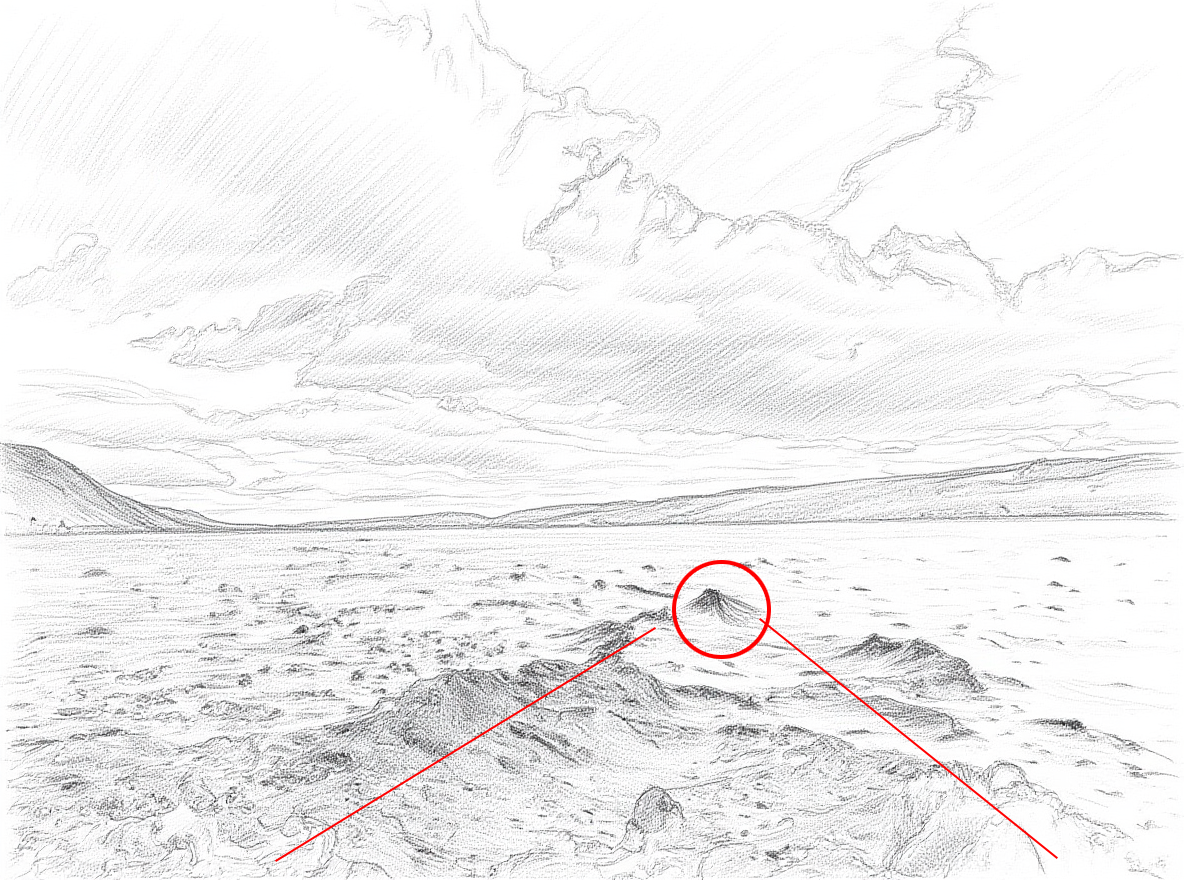
Sketch of the Jonathan Bright photo
It’s a textbook case of pareidolia — the human tendency to see meaningful shapes in random patterns that simply aren’t there. I’ve spent a lot of time on boats and I’m familiar with the peculiar mechanics of boat wakes. The wave in question appears at exactly the cusp of the two divergent waves, so it’s completely unsurprising that the crest would be a bit higher there. It has a sharp ridge at the top with water spilling down the sides, which is typical of a wave just past its peak and not a solid object. If it were an animal’s head or neck, you’d expect smoother contours, symmetry, and perhaps breaks in the water where the body emerges. Instead, the feature blends seamlessly with the surrounding water patterns and looks exactly like the other waves except for its size and position. So no, I’m sorry, it’s a wave, and not even a particularly unusual one at that. I’ve seen hundreds of similar wave formations on my boating excursions up and down Pickwick Lake and the Tennessee River, and if I really wanted to, I could see a monster in every one of them.
Then there is the matter of the Hugh Gray photo from November 1933. This is another photo which shows nothing more than a blurry mess that even the staunchest monster hunters of decades past were reluctant to say much about, but Watson hangs his hat on it as a definitive piece of evidence because he sees something that no one has ever seen before, in yet another case of pareidolia. You can read his analysis of the photo here. In short, he believes that what everyone has always presumed to be the backside is actually the head of a fish-like creature. This is an example of where Watson’s research once again is solid, in that he turned up a much better quality version of the photo than what had been previously circulating, but his conclusions are sorely lacking. I’m going to reproduce it here because I believe it to be in the public domain since 1984 under the pre-1957 UK copyright laws. If anyone disagrees, contact me.
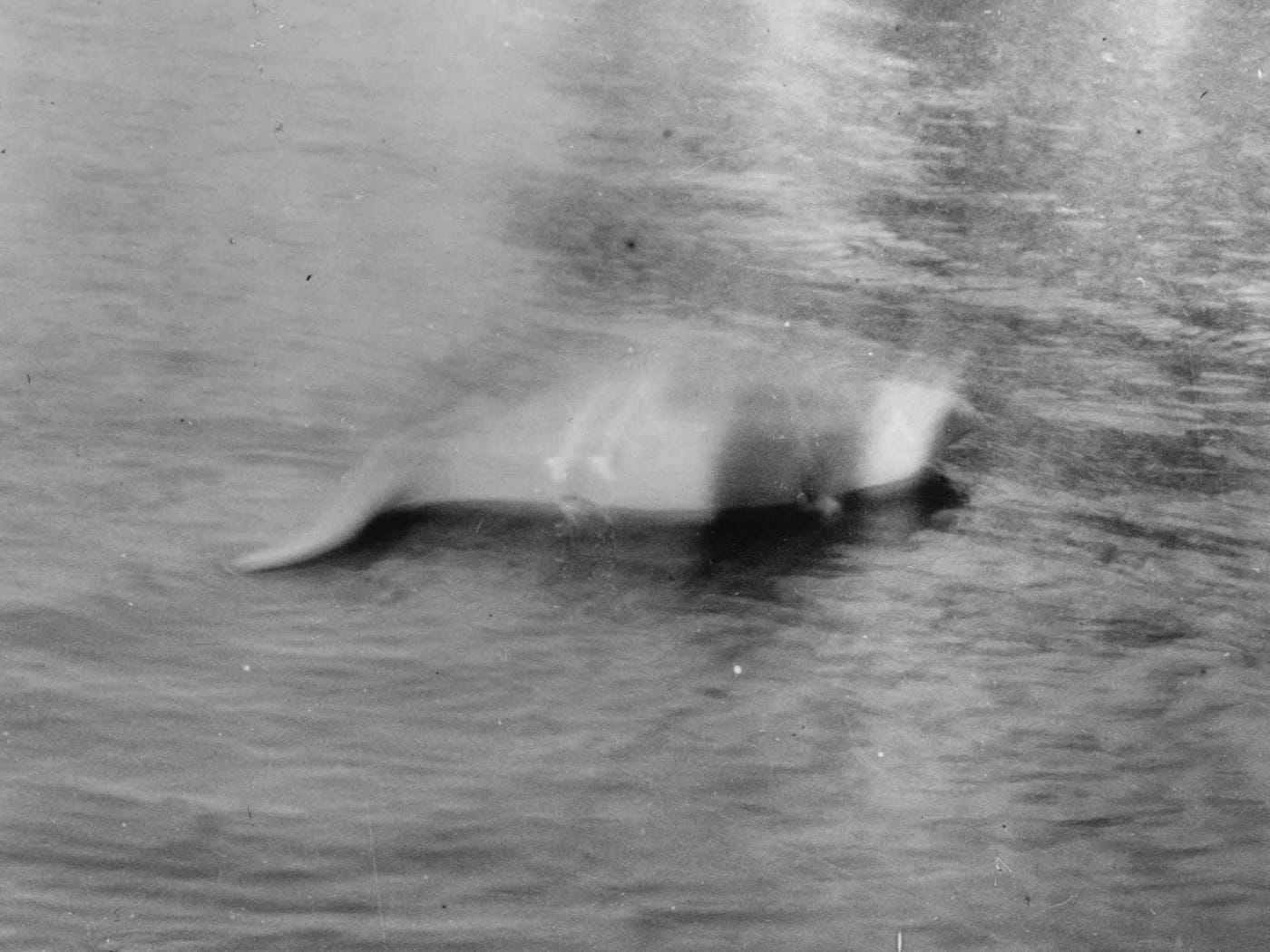
The problem with finding a better quality print is that it becomes even clearer what this actually is, and it’s not a monster. Credit goes to Darren Naish of tetzoo.com for figuring this out (or at least being first to publish it), and I think there can be little doubt about it.
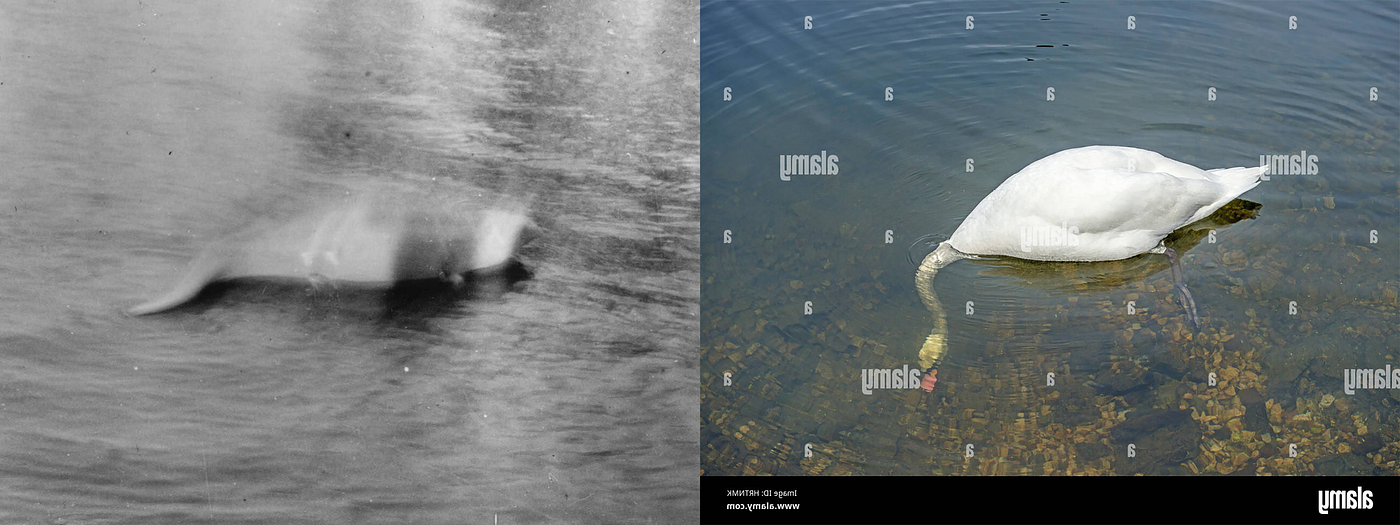
I’ve reversed the stock image (with apologies to Alamy), but I think it’s quite clear what this is. It’s a double exposure (either intentional or accidental) of a swan with its head in the water. There are several species of swan that are commonly found in Scotland: Mute Swans are found year-round, while Whooper Swans migrate from Iceland for the winter — consistent with a November photo. There are also other species occasionally found in Scotland. The swan in the stock photo is a Mute Swan.
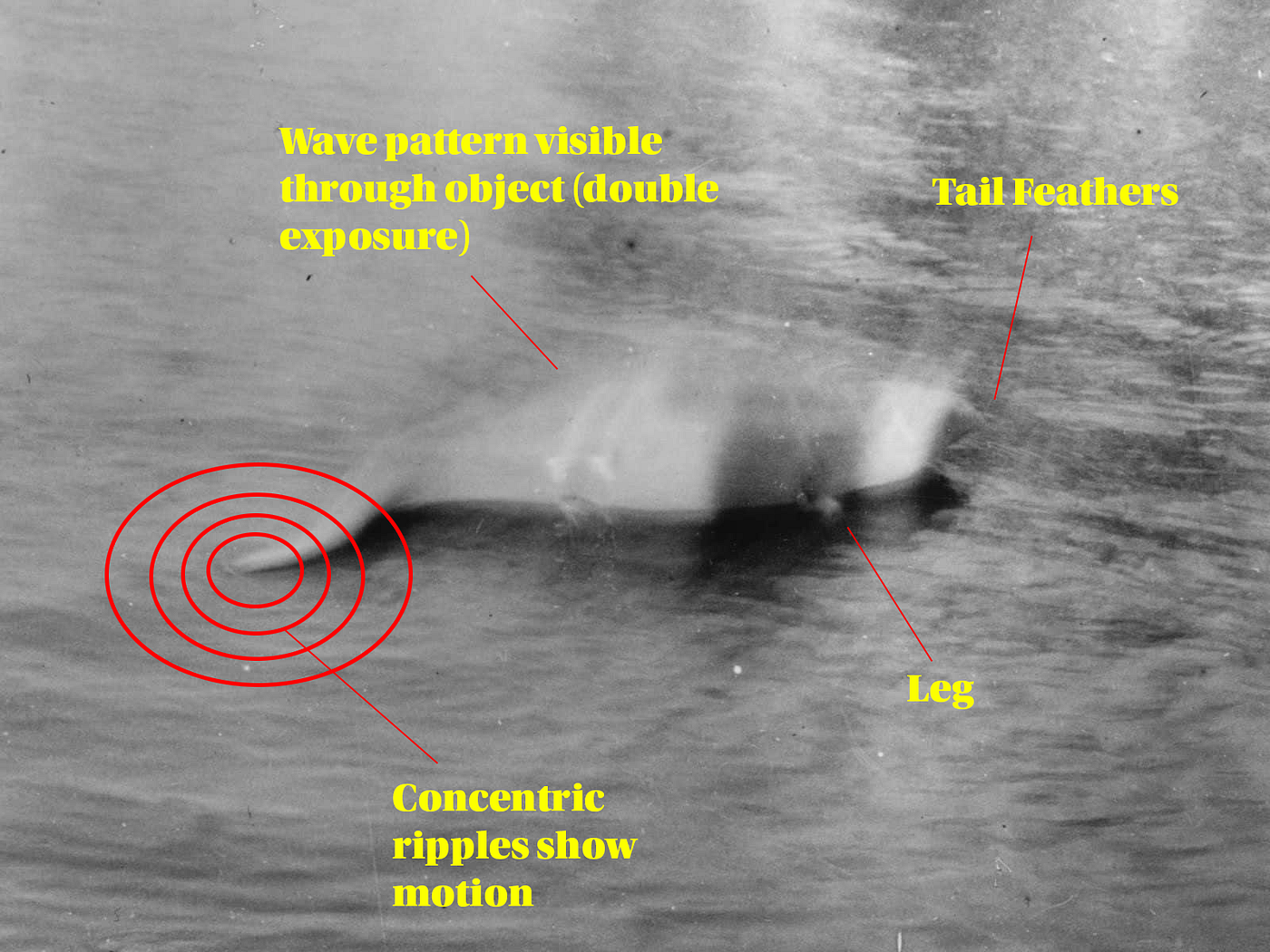
Watson asserts that the camera negative was examined by Kodak and they found no manipulation. I’ll not challenge that because he probably knows more about that history than I do, but no manipulation does not equal a monster. Whatever they said doesn’t change the fact that it’s still a double exposure, as evidenced by the visibility of wave patterns through the object. The concentric ripples around the neck cement it for me.
In caracteristic fashion, Watson rejects this analysis out of hand and labels it a “fast crumbling theory” — without saying why — because nothing short of a monster will do as far as he is concerned. He says of this analysis, “Too often, one will encounter more of the psychology, sleight of hand, straw men and ad hominems when dissecting sceptical arguments.” Sorry mate, that would be you, not us. It’s called projection.
The primary grounds upon which he dismisses this view are that Naish used the older, lower quality version of the photo that was in wide circulation instead of the better quality version. He alleges a conspiracy because using the better version “would destroy the swan argument.” On the contrary, I think the better image makes it even more obvious. He goes on to note, “someone is going to suggest (or rather tell us) that this is a double exposure and that opens a wonderful vista for sceptics as it allows them to tack on almost anything in their agenda against this picture.” Yes, because it is a double exposure, and it’s really not that hard to show using a Sobel edge map.
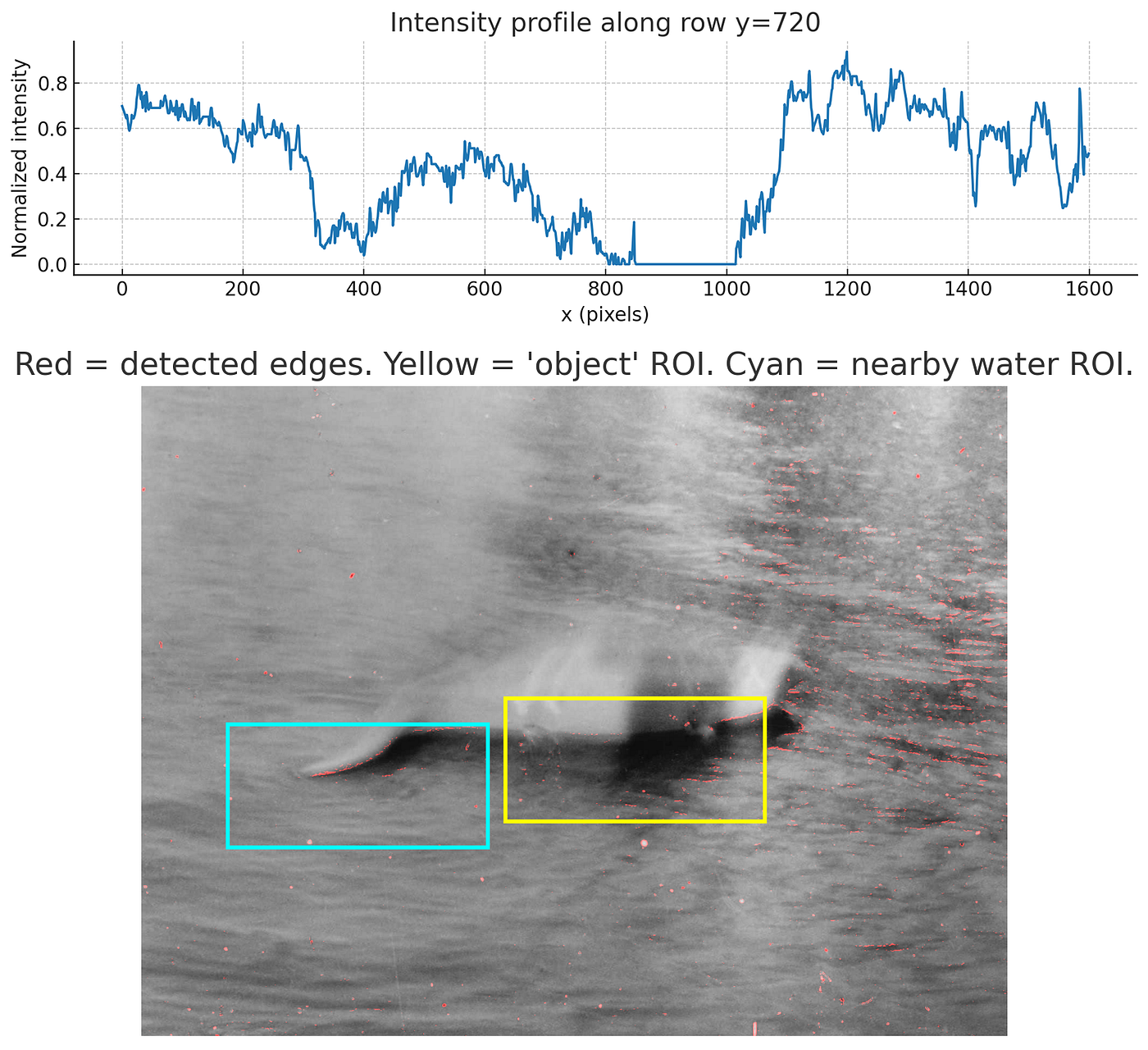
The red lines trace places where brightness changes quickly — ripples, outlines, scratches, etc. In calm areas you’ll see little or no red; in highly textured or overlapping areas you’ll see more red. In the “object” box, the fraction of pixels flagged as edges is about 1.07%. In a nearby water-only box, it was 0.69%. That extra edge activity inside the bright area means we’re seeing two textures stacked (the water pattern plus a blurred overlay), which is exactly what you’d expect from a double exposure or superimposition, not a solid, opaque body displacing water.
Throught the entirety of his blog, Watson alleges conspiracy after conspiracy to suppress the reality of the beast, although he never states what the underlying motivations for such conspiracies might be, considering the amount of money that Nessie brings into Scottish coffers annually. I’m sure he would probably say something along the lines of, “they want to sell books,” despite the fact that the same charge could be leveled against the legions of true believers who have written books proclaiming the reality of the beast, including Watson himself, who has written no less than three books on the subject. I haven’t written any books, so what’s my motivation? And at any rate, stating the obvious that someone wants to sell a book doesn’t negate the validity of the argument. The only thing that refutes an argument is a better argument, and making special pleadings to avoid addressing the elephant in the room doesn’t cut it.
To be clear, I have nothing against Roland Watson personally, and he seems like a perfectly nice guy most of the time that he’s not accusing people of baseless conspiracies. I enjoy reading his blog, and I’ll continue to do so because I find a great deal of the historical information he writes about fascinating. I just read it with my eyes open to his analytical sleight of hand. He once wrote in his blog that no one would ever change his mind about the reality of the monster, and that should tell you all you need to know because that’s just the mark of a fool. Any serious researcher is always open to new opinions in light of new evidence.
I hear some people saying, “Let him have his fun. What’s the harm?” Well, there’s actually a great deal of harm in letting this stuff go unchallenged. In the words of Sheldon Cooper:
“If we poison the critical thinking faculties of children by telling them that rabbits come out of hats, then we create adults who believe in astrology and homeopathy and that Ryan Reynolds was a better choice for Green Lantern than lovable rogue Nathan Fillion.”
To put a finer point on it, we live in a world where disinformation has been fully weaponized, and the ability to distinguish reality from fantasy is now a critical life skill. During the Covid-19 pandemic, we saw fully grown adults ingesting livestock dewormers to treat viral infections because they lacked the ability to tell real science from junk science. Scientific literacy and critical thinking are more important now that at any other point in modern human history, and nowhere is this need more visible or the skill more accessible than in the fields of cryptozoology and other paranormal research.
I totally understand why believers like Watson want to cling to their beliefs. A world full of monsters is fun and exciting. It’s the same reason I believed in them as a child, and it’s painful to let go of those long-cherished beliefs. But unfortunately, it’s time to grow up and let reality take hold. I’ve slain my dragon. It’s time for Roland to do the same, because if we can’t move past this kind of junk science and learn to distinguish reality from fantasy, a very real species — humans — may not survive on this planet in the long term.
메타데이터
- post_id
- df985ce3983d
- slug
- slaying-dragons-2025-style-df985ce3983d
- url
- https://medium.com/@heyburns2/slaying-dragons-2025-style-df985ce3983d
- canonical_url
- https://medium.com/@heyburns2/slaying-dragons-2025-style-df985ce3983d
- author_url
- https://medium.com/@heyburns2
- status
- ok
- fetched_at
- 2026-06-09 15:37:30



