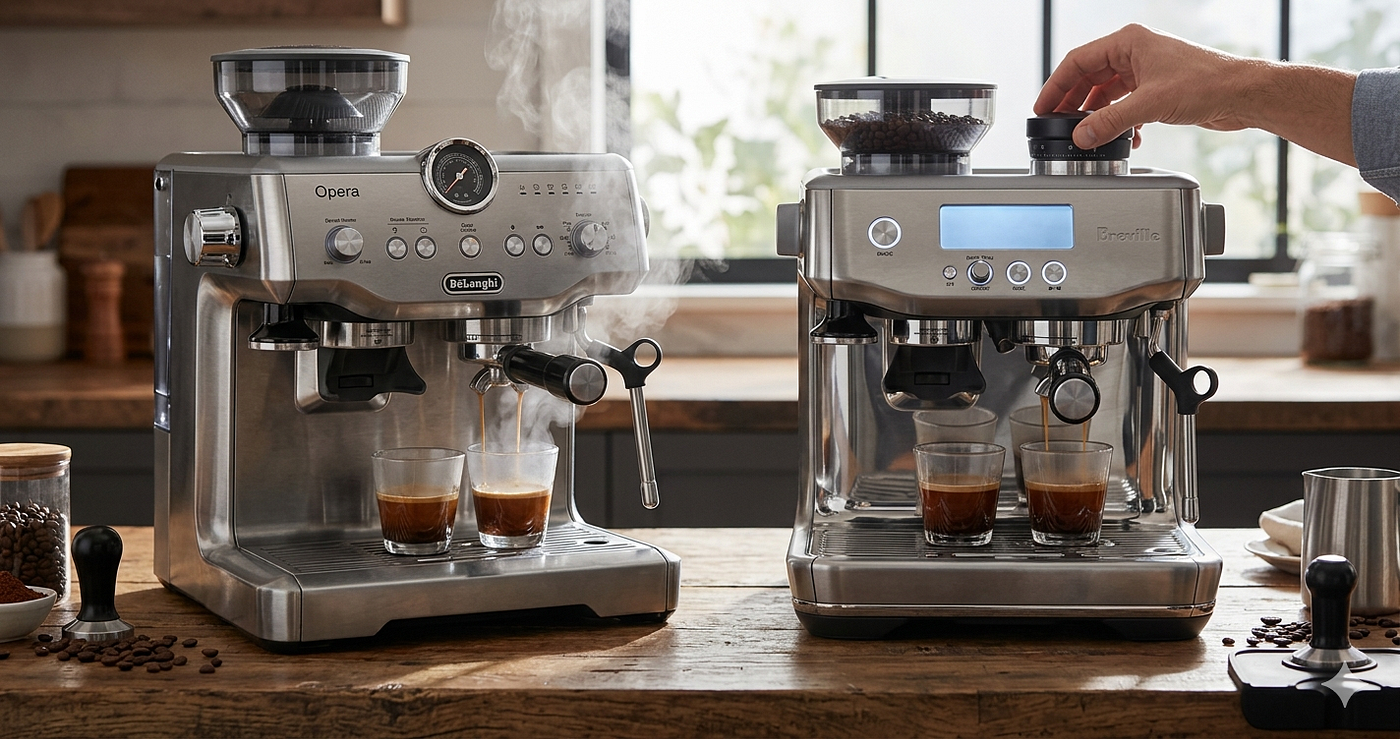
The Espresso Machine Decision That Nobody Explains Honestly (And Why It Cost Me More Than I’d Like…
Your machine’s heating system determines every shot you’ll ever pull. Here’s what the buyer guides leave out.
The Espresso Machine Decision That Nobody Explains Honestly (And Why It Cost Me More Than I’d Like to Admit)
Your machine’s heating system determines every shot you’ll ever pull. Here’s what the buyer guides leave out.

I have bought two espresso machines in five years.
The first one — a compact thermoblock with a 30-second heat-up time and a gleaming chrome finish — felt like exactly the right decision on paper. Fast. Manageable. Took up roughly the same counter space as a large book. I made myself coffee with it every morning for about a year before I started noticing something that I couldn’t quite name. The shots were fine. Most mornings, fine. Some mornings, oddly thin. Others, unpleasantly sharp. I kept adjusting the grind. I changed my tamping pressure. I bought a better scale.
The machine kept doing what it was always going to do: produce shots that were slightly, unpredictably different from each other, because the underlying system that managed the water temperature — the part I’d never once looked at when I was comparing price tags and reading spec sheets — was doing its job inconsistently.
This is the thing about espresso equipment that buyer guides tend to treat as a footnote, when it’s actually the whole story.
The Number That Changes Everything
Espresso is extracted within a narrow thermal window: 90°C to 96°C. Go above that and you’re pulling bitter, harsh coffee. Drop below it and the result is sour, thin, under-extracted — the kind that makes you wonder if you’ve done something wrong with the beans.
The boundary that separates a good shot from a bad one is roughly ±1.5°C of deviation during extraction.
Not across the whole morning. During a single pull. That’s how precise the margin is.
Most home espresso machines are sold on aesthetics, brand, and heat-up speed. The question of how the machine manages temperature while you’re actually pulling a shot — how it holds that narrow window under real conditions, back-to-back shots, after the boiler has been stressed — that question tends to get a paragraph or two, usually written in a way that makes both systems sound roughly equivalent.
They aren’t.
What a Single-Boiler Machine Actually Does
A single-boiler machine maintains a dedicated reservoir of heated water at brew temperature. Think of it less like a kettle and more like a thermal battery. When you pull a shot, that large body of heated water resists temperature fluctuation in a way that on-demand systems cannot replicate. The physics of it — thermal mass — means the machine is inherently buffered against the small temperature swings that would otherwise drift into your extraction.
The trade-off is real and worth acknowledging upfront. These machines take 5–10 minutes to warm up properly. When you want to move from brewing to steaming milk, you wait — usually somewhere between 30 seconds and two minutes — for the boiler to climb from brew temperature to steaming temperature (around 120°C). Some machines with PID controllers manage this more predictably than others, but the sequential nature of the workflow is intrinsic to the design.
And there’s a technique associated with single-boiler machines called temperature surfing — timing your pull to coincide with the machine’s optimal thermal moment in its heating cycle. It sounds fussy, because it is fussy, and also because it genuinely works once you understand it. Experienced home baristas talk about it the way guitarists talk about learning to tune by ear. A bit awkward at first. Second nature eventually.
The temperature variations you’ll see in a well-managed single-boiler machine during the switch between brew and steam modes tend to run around ±4°C to ±6°C, and sometimes wider without PID control. But during the extraction itself — the actual shot — the thermal mass that creates those steaming delays is the same mass that’s keeping your brew temperature anchored. This matters more than people give it credit for.
What a Thermoblock Machine Actually Does
A thermoblock heats water on-demand as it flows through heated metal channels. There’s no large reservoir to warm up. Hence the 30–60 second startup times that appear prominently in every thermoblock marketing sheet.
The speed is genuine. I’m not dismissing it. For someone pulling one shot on a Tuesday morning before a meeting, the difference between a 45-second startup and an 8-minute one isn’t trivial.
But here’s what that speed costs: thermoblock systems commonly show temperature variations of ±3°C to ±5°C across shots, and these variations compound when you’re pulling multiple drinks in a session. The rapid heating and cooling cycles required to deliver hot water on-demand create moments of overshoot and undershoot that a large boiler simply doesn’t experience. Higher-end thermoblocks with sophisticated temperature management close the gap somewhat, but they’re working against a fundamental design constraint rather than with one.
The steam performance gap is the part that surprised me most when I started paying attention. Single-boiler machines, once the boiler has climbed to steaming temperature, generate powerful, dry steam — the kind that heats milk quickly while developing fine microfoam. Thermoblock steam tends to be wetter, weaker, and harder to control. You end up with larger bubbles, less stable foam, milk that gets overheated before the texture is right. For anyone who mostly pulls black espresso, this is manageable. For anyone who makes a lot of flat whites or lattes, this is a persistent source of frustration.
I know because I spent several months making lattes with a thermoblock and wondering why my microfoam never quite looked like the tutorials.
The Durability Question Nobody Asks Early Enough
Five years into owning espresso equipment, I’ve started thinking much more carefully about what happens when something breaks.
Single-boiler machines have a simpler internal architecture. Heating elements, thermostats, pressure switches — standardised parts that technicians can identify and replace without extraordinary effort. Brass and stainless steel boilers in quality machines are built for long service. When something goes wrong, you’re usually dealing with a known, replaceable component.
Thermoblock systems are compact and integrated by design — the same qualities that make them light and fast also make them harder to service when something fails. The compact structure that houses the heating element means there’s less physical separation between components, which creates complications when a repair is needed. Overheating under heavy consecutive use is a recurring issue that shows up in long-term ownership conversations, not in first-week reviews.
This isn’t a condemnation of thermoblocks. It’s a reminder that the purchase price is the beginning of the cost calculation, not the end of it.
Matching the Machine to the Person You Actually Are
The thing that buyer guides get wrong — and I include my early self in this — is they tend to evaluate machines against an idealised version of the buyer. Someone who has unlimited morning time, is deeply patient, and will enthusiastically maintain a complex workflow.
Most people aren’t that person every day.
If you’re making espresso occasionally, moving through your kitchen quickly most mornings, and treating coffee as fuel rather than ritual — a thermoblock is a perfectly rational choice. The speed and simplicity are real advantages. The temperature inconsistency is a trade-off that won’t bother you much if you’re not pulling shots back-to-back and you’re not trying to dial in microfoam.
If you’re someone who finds themselves reading comparison guides at length, thinking about grind variables, watching extraction videos, and caring about the difference between a mediocre shot and a good one — you probably already know which way this goes. A single-boiler machine’s workflow demands are not a burden for someone who enjoys the process. They’re part of it. The five-minute warm-up becomes part of a morning routine. The temperature surfing becomes something you do without thinking.
The deeper point is that the machine that rewards your particular kind of attention is the one that will serve you well for years. Not the one that sounds impressive at a dinner party, and not the one with the fastest startup time, and not the one that looked best in the photo.
What I eventually concluded — after one machine that frustrated me in ways I couldn’t initially name and one that doesn’t — is that understanding the heating system before you buy is the conversation worth having. Everything else is just furniture.
*Brew Precision covers espresso equipment in depth — testing, comparing, and explaining the variables that actually affect what ends up in your cup.*
메타데이터
- post_id
- dfa43b79fab5
- slug
- the-espresso-machine-decision-that-nobody-explains-honestly-and-why-it-cost-me-more-than-id-like-dfa43b79fab5
- url
- https://medium.com/@brewprecision/the-espresso-machine-decision-that-nobody-explains-honestly-and-why-it-cost-me-more-than-id-like-dfa43b79fab5
- canonical_url
- https://medium.com/@brewprecision/the-espresso-machine-decision-that-nobody-explains-honestly-and-why-it-cost-me-more-than-id-like-dfa43b79fab5
- author_url
- https://medium.com/@brewprecision
- status
- ok
- fetched_at
- 2026-06-09 15:37:30