Why StarRocks Is Better Than DuckDB for Gaming and Player Behavior Analytics
Modern games are analytics engines wearing a fun costume. Every match, session, login, purchase, crafting action, and social interaction —…
Why StarRocks Is Better Than DuckDB for Gaming and Player Behavior Analytics
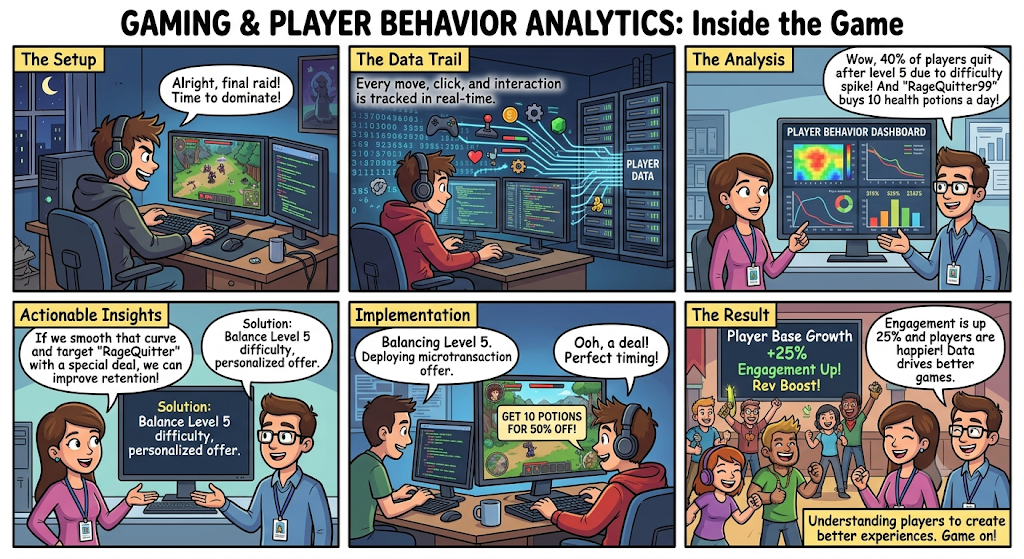
Modern games are analytics engines wearing a fun costume. Every match, session, login, purchase, crafting action, and social interaction — an upvote on a piece of user-generated content, a downvote, a share — emits telemetry, and a live-service title generates that telemetry continuously, around the clock, from players in every time zone. The people who consume this data are not only analysts writing a quarterly retention deck. They are LiveOps teams tuning an in-game event this afternoon, designers watching how a balance patch lands, anti-cheat systems scoring behavior in near real time, and — increasingly — the players themselves, who see leaderboards, “trending content,” and “most-downloaded” rankings rendered directly inside the game client.
DuckDB has earned a genuine reputation as the fastest way to analyze data on a single machine, and it shows up all over game data teams. But an in-game leaderboard served to millions of concurrent players is a fundamentally different animal from a laptop analysis of a telemetry extract. This post walks through where DuckDB legitimately shines in gaming work, where its single-node, single-writer architecture runs out of road, and why StarRocks is the better foundation once analytics has to run the live game rather than just describe it after the fact.
Where DuckDB fits in a game data workflow
DuckDB is an in-process (embedded) analytical database. It runs inside your Python, R, or Node process, reads Parquet and CSV directly, and delivers excellent columnar performance with zero servers to stand up. For a large class of gaming analysis tasks, that is exactly what you want:
- Ad-hoc telemetry analysis on extracts. A designer pulls a week of match records into Parquet and asks DuckDB to compute win rates by hero, session length distributions, or drop-off in a new-player funnel. It’s fast, local, and requires no infrastructure — the classic “query your Parquet files directly” pattern DuckDB is famous for.
- Notebook analytics and modeling. DuckDB pairs naturally with pandas/Polars for churn modeling, cohort studies, and feature engineering for matchmaking or recommendation models. It’s an excellent workbench for the data scientist exploring player behavior.
- Prototyping a streaming pipeline. There are good public write-ups of streaming game telemetry into DuckDB for exploration — for example, a widely shared tutorial that pipes Counter-Strike: Global Offensive telemetry from a Kafka topic into DuckDB using Quix Streams to detect cheaters and study in-game events. It’s a great way to prototype what the metrics should be.
- Lightweight internal dashboards. DuckDB embedded inside tools like Rill, Evidence, and Mode makes it easy to ship a fast, self-contained dashboard over a snapshot for a single analyst or a small LiveOps pod.
If your question is “let me analyze this dataset,” DuckDB is a great answer. The trouble starts when the question becomes “let me serve this to the game and the whole studio, live,” because that flips almost every requirement at once.
Where the DuckDB model breaks down for live gaming analytics
1. Continuous, high-velocity telemetry ingestion
A live-service game doesn’t produce data in tidy daily Parquet drops; it produces a firehose of events off game servers and clients, usually landing on Kafka. In one anonymized evaluation we’re familiar with, a large global video game publisher was designing a cross-title content-engagement system fed by game telemetry through Kafka, with near-real-time aggregation targets on the order of a few minutes and a data-lake (Apache Iceberg) history layer alongside it. DuckDB is a single-writer, embedded engine that analyzes data at rest; it has no native, always-on streaming ingestion path from Kafka/Flink and no concept of many concurrent writers continuously appending fresh events. You end up bolting on an external micro-batch pipeline, and the “freshness” of your leaderboard becomes the latency of that batch job.
StarRocks was built for this. It ingests continuously from Kafka via Routine Load, from Flink via its connector, and through the high-throughput Stream Load API, and it can query Iceberg and Parquet in the lake directly — so the same platform blends fresh streaming events with historical batch data without copying it through extra hops. Data lands and is queryable within seconds, which is precisely why the publisher above was drawn to StarRocks: it could combine historical and fresh data without duplicating it, and ingest Kafka with far less pipeline engineering.
2. Mutable state: leaderboards and engagement counters change constantly
This is the requirement that quietly kills naive OLAP designs. In gaming, an enormous share of the interesting data is not an immutable fact. Upvotes and downvotes accumulate, content moves in and out of “trending,” a player’s rank shifts, an item’s popularity rises and falls. These are counters and rankings that must reflect the current state, updated continuously. DuckDB technically supports UPDATE/DELETE, but it is not architected as a high-frequency upsert engine serving live queries; heavy mutation against a file-based store that is simultaneously being read is exactly the workload it was not designed for. Its single-writer model means one writer at a time per database — a hard ceiling for continuously mutating live state.
StarRocks offers a Primary Key table model built precisely for this: real-time upserts and deletes that keep only the current version of each key, while queries stay fast and consistent. This is not theoretical. Tencent Games, in its publicly published StarRocks case study, credits exactly this feature — StarRocks’ primary key tables for real-time mutable data let it “transition most offline metrics to real-time,” giving up-to-the-minute insight into player behavior instead of yesterday’s snapshot.
3. High concurrency: serving the game client and the whole studio
A live game’s analytics layer is a shared, high-concurrency serving system. When rankings and “top content” panels are rendered inside the game, every player session is effectively a query source, on top of the LiveOps analysts and BI users hitting the same data. The anonymized publisher above projected on the order of 500–600+ QPS per title, served 24/7 to a global player base, across many titles at once. DuckDB runs in a single process on a single machine and executes one analytical query at a time per connection; it has no notion of serving hundreds of concurrent interactive users behind a shared endpoint. To get there you would build and operate your own fleet of DuckDB instances, a load balancer, a data-distribution scheme, and a cache-invalidation strategy — in other words, reinvent a distributed database.
StarRocks is a distributed MPP database designed for exactly this profile. It scales out across nodes, and asynchronous materialized views let predictable, heavy leaderboard and metric queries be pre-aggregated so thousands of users hit sub-second responses; its cost-based optimizer can even transparently rewrite a query against the base table to use a materialized view. StarRocks’ user-facing and gaming case studies routinely cite hundreds to thousands of QPS at sub-second latency — the exact regime an in-game leaderboard lives in.
4. Joins and complex metrics across the game data model
Answering real questions — “which players in this cohort engaged with which content, in which title, and how does that correlate with retention?” — means joining players to sessions, to items, to titles, and computing metrics that go well beyond SUM: ranking windows, lifetime-to-date values, funnels, and cohort math. The publisher above explicitly needed window functions and multi-flavored metrics (5-minute, hourly, daily, lifetime) served from one engine, and wanted to avoid pre-joining and denormalizing everything upstream.
This is a StarRocks strength and a first-generation-OLAP weakness. StarRocks has a cost-based optimizer and a distributed join engine built for large multi-table queries, so you can keep a normalized model and join on the fly. Tencent Games reported that StarRocks’ on-the-fly JOIN capability let it “sidestep denormalization” and realize a 50% boost in development efficiency. YooZoo Games, in its public case study, moved off a ClickHouse-based architecture specifically because StarRocks delivered strong multi-table join performance and supported real-time updates. Pushing that same live, concurrent, window-function-heavy join workload through a single embedded engine is not what DuckDB was built to do.
5. Multi-tenancy and cost isolation across many titles
A publisher rarely runs one game. It runs a portfolio, and it needs to attribute analytics cost and isolate load per title so a hit title’s traffic spike doesn’t starve everyone else — and so costs can be charged back to each studio. The anonymized publisher wanted exactly this: logical separation (per-title databases, access rules) plus the option of physical separation (dedicated compute per title) for clean chargeback. DuckDB, as a single embedded process, has no multi-tenancy story at all; you would stand up and manage entirely separate deployments.
StarRocks supports both levels natively: logical isolation via databases, role-based access control, row-level security, and column masking, and physical isolation via separate compute (warehouses/resource groups) whose usage can be metered independently. One platform serves many titles with per-title guardrails and cost visibility.
6. Always-on reliability for a game that never sleeps
Live-service games run 24/7 across the globe; someone is always playing, so there is no maintenance window and the analytics layer is load-bearing. DuckDB, as an in-process library, has no built-in replication, failover, or high-availability story — that is simply not its job. StarRocks provides replicated storage, front-end failover (production deployments typically run three FE nodes for exactly this reason), and tooling for rolling upgrades without downtime, so leaderboards and LiveOps dashboards stay up even while you patch the cluster.
The pattern: DuckDB for the analyst’s desk, StarRocks for the live game
None of this is a knock on DuckDB. It is arguably the best tool in existence for single-node analytical work, and on a game data team it’s a fantastic companion for exploration, prototyping, churn modeling, and analyst-driven studies. The mistake is trying to promote a laptop-scale, single-writer engine into the always-on serving layer of a live game with millions of concurrent players.
The public record on the StarRocks side is consistent. Tencent Games — whose franchises include League of Legends with its ~200 million players — unified gaming analytics across studios on StarRocks, using primary key tables to move most metrics from offline to real-time and on-the-fly joins to avoid denormalization and boost development efficiency by 50%. YooZoo Games replaced a ClickHouse-based OLAP platform with StarRocks for its combination of fast multi-table joins and real-time updates. Both tell the same story: when analytics has to run the live game — fresh, mutable, joined, and served to many consumers at once — the workload outgrows a single-node engine.
Decision guide
Choose DuckDB when the work is local and bounded: ad-hoc analysis of telemetry extracts, notebook-based cohort and balance studies, feature engineering for matchmaking or churn models, prototyping a streaming pipeline, and quick single-user or small-team dashboards over a snapshot. It will be faster to start and delightfully simple.
Choose StarRocks when the analytics is operational: continuous streaming ingestion of game telemetry from Kafka/Flink blended with an Iceberg history layer; real-time upserts of mutable leaderboards, rankings, and engagement counters via the Primary Key model; sub-second queries for hundreds or thousands of concurrent players and staff; large multi-table joins and window-function metrics served from one platform; multi-tenant isolation and cost chargeback across a portfolio of titles; and 24/7 availability for a global player base. That’s a live game — and it’s the workload StarRocks was built for.
메타데이터
- post_id
- dfa5d924118b
- slug
- why-starrocks-is-better-than-duckdb-for-gaming-and-player-behavior-analytics-dfa5d924118b
- url
- https://medium.com/@indomitability/why-starrocks-is-better-than-duckdb-for-gaming-and-player-behavior-analytics-dfa5d924118b
- canonical_url
- https://medium.com/@indomitability/why-starrocks-is-better-than-duckdb-for-gaming-and-player-behavior-analytics-dfa5d924118b
- author_url
- https://medium.com/@indomitability
- status
- ok
- fetched_at
- 2026-07-31 08:56:44