Metafigurative Cognitivism
Metafigurative Cognitivism is a theoretical and artistic framework that explores the interrelation between figuration and cognition in…
Metafigurative Cognitivism

Metafigurative Cognitivism is a theoretical and artistic framework that explores the interrelation between figuration and cognition in contemporary art. The term designates a mode of visual practice in which the formation of the image and the activity of thinking are understood as mutually reflective processes.
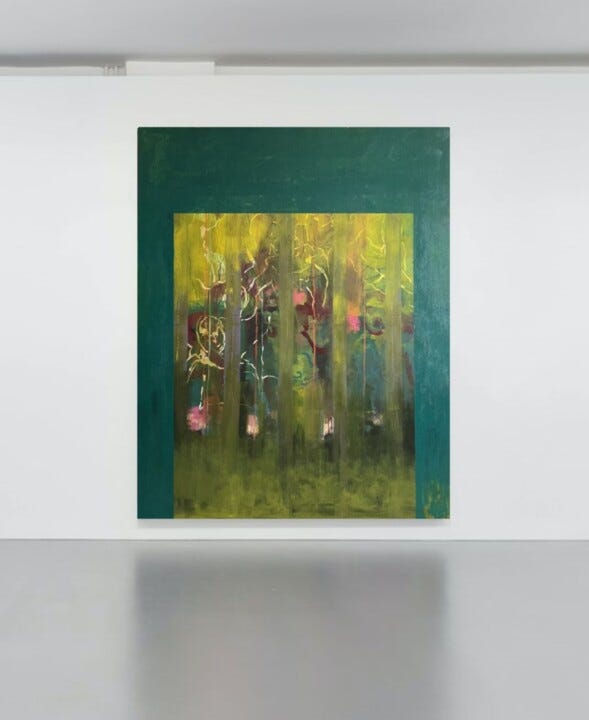
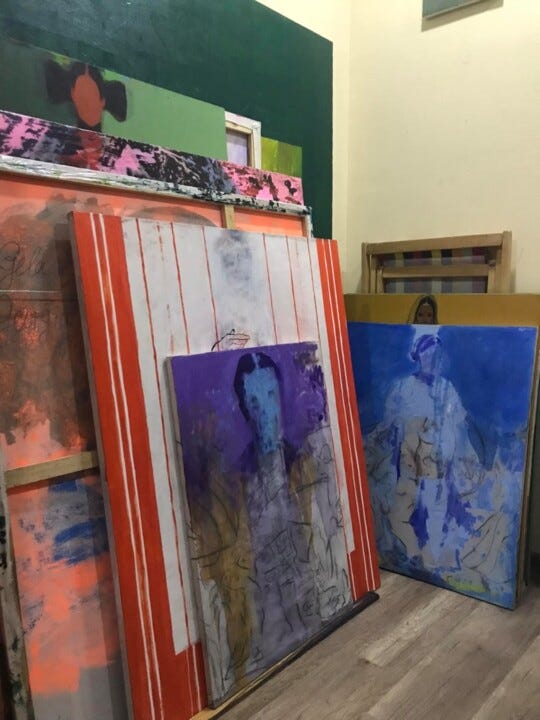
The concept was formulated and articulated through the practice of Gela Mikava, a Georgian contemporary artist whose work combines text, abstraction, and figuration within layered pictorial structures. In Mikava’s paintings, linguistic fragments, inverted inscriptions, and overlapping color fields are employed as cognitive instruments rather than decorative elements. These strategies invite the viewer to reconstruct meaning through perception itself, transforming the act of seeing into an act of thinking.
Metafigurative Cognitivism situates itself within the broader discourse of cognitive aesthetics and post-structuralist art theory. It proposes that the artwork is not merely a representation of external reality but a cognitive environment — a materialized form of thought. Figuration is treated as an operative sign within this environment, capable of revealing the processes of memory, association, and mental reconstruction.
According to this framework, meaning is not fixed within the image but arises through interaction between artwork and observer. The visible surface becomes an index of consciousness: a site where perception, reflection, and abstraction intersect. By inverting textual orientation, fragmenting bodily forms, and eroding traditional compositional hierarchies, Mikava’s works illustrate how cognition can be visualized as an evolving structure rather than a static interpretation.
Philosophically, Metafigurative Cognitivism draws on the legacy of cognitive constructivism, semiotics, and phenomenology. It regards perception as a generative act and art as a method of inquiry into the mechanisms of consciousness. The theory emphasizes that visual form can operate as a language of cognition — one that functions beyond verbal expression and allows the mind to observe its own architecture through material composition.
In this sense, Metafigurative Cognitivism extends the boundaries of both figurative and conceptual art. It reframes painting as a cognitive experiment, where form and idea, matter and mind, are inseparable. The movement underscores a shift in contemporary aesthetics toward the investigation of consciousness itself as the ultimate subject and medium of artistic practice.
메타데이터
- post_id
- dfaabdc8be72
- slug
- metafigurative-cognitivism-dfaabdc8be72
- url
- https://medium.com/@conceptualart/metafigurative-cognitivism-dfaabdc8be72
- canonical_url
- https://medium.com/@conceptualart/metafigurative-cognitivism-dfaabdc8be72
- author_url
- https://medium.com/@conceptualart
- status
- ok
- fetched_at
- 2026-06-26 03:39:16