Paired Practice in Traditional Martial Arts: Mutual Development
From objective to exercise
Paired Practice in Traditional Martial Arts: Mutual Development
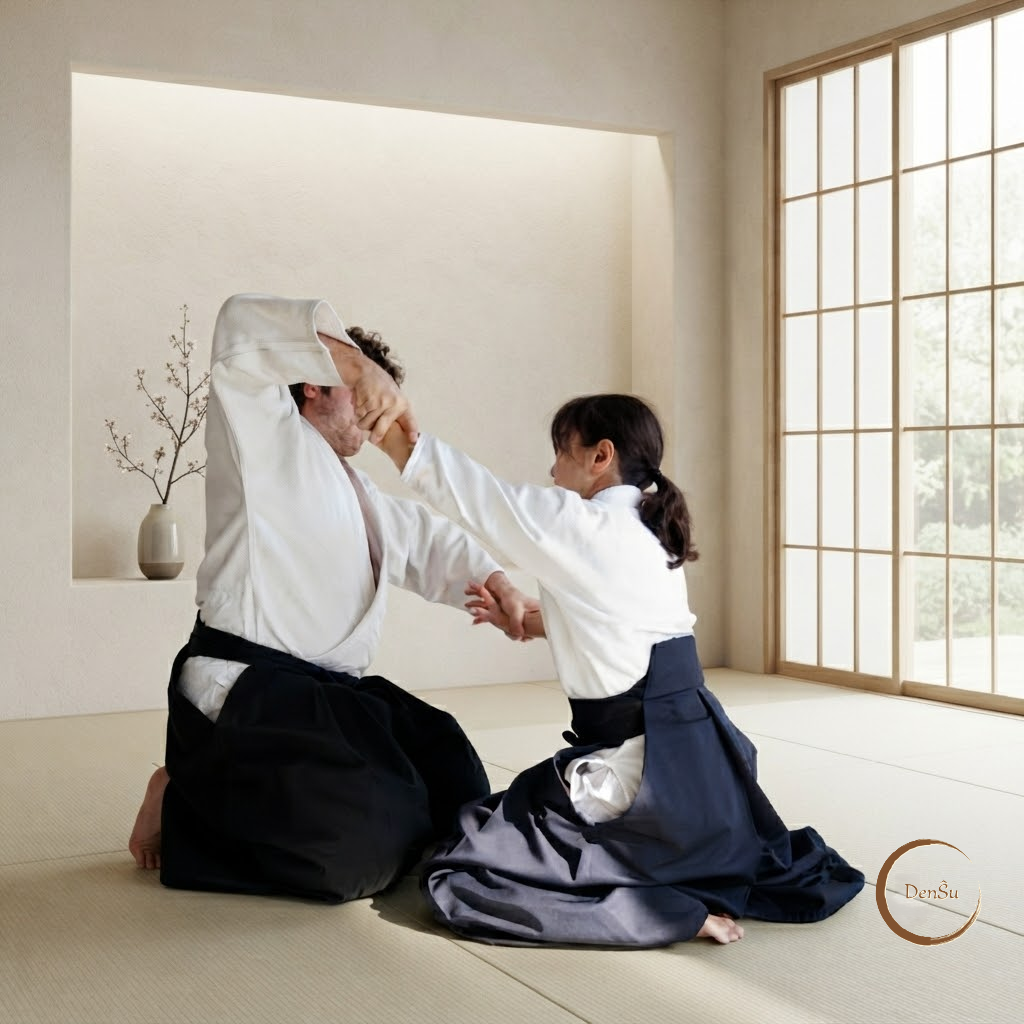
Suwari kokyōhō
From objective to exercise
In the traditional martial arts of China and Japan — and in the systems that later evolved from them throughout East Asia — paired practice has always been the cornerstone of training. Yet while it represents the ultimate destination of martial education, it is not its starting point.
This apparent contradiction concerns only the sequence of training methods. Before a student can train effectively with a partner, they must first develop fundamental skills through individual practice. From the very beginning, however, the ultimate objective remains unchanged: successful application against a real opponent. In other words, although paired practice comes later in the curriculum, it defines the purpose of training from the very first day.
Traditional training process
Historically, the curriculum of traditional schools followed a broadly similar pattern. Students first learned and refined a set of fixed solo forms — taolu in Chinese systems and kata in Japanese traditions. These were followed by paired drills based on the same movements, alongside specialized conditioning methods designed to cultivate strength, stability, mobility, coordination, reaction speed, and other essential qualities. Perhaps the best-known example of those conditioning methods is the Shaolin tradition of the famous “72 training methods,” which collectively preserve centuries of accumulated practical experience.
Many of these conditioning methods, in one form or another, became common throughout traditional Chinese martial arts. Later, they found their way into the Ryukyu Kingdom, where they eventually formed the foundation of Hojo Undo, the supplementary conditioning system of tōde — the art that would later become known as karate.
The Japanese samurai traditions often approached training somewhat differently.
In many schools, kata were taught from the outset as paired exercises — a practice that also existed in certain Chinese lineages. Yet the underlying objective remained the same. Whether practiced individually or with a partner, kata were never intended merely as collections of techniques. Their primary purpose was to shape the practitioner’s body, cultivate structural integrity, coordination, stability, and other essential physical qualities, develop an efficient culture of movement — not aesthetic choreography, but movement optimized for combat — and foster focused awareness together with a practical repertoire of responses to attacks from different directions and under different circumstances.
Importantly, the order of these priorities matters. Unless body development, structural organization, and mental cultivation become the practitioner’s primary concern, technical application inevitably suffers. Combat methods become crude, mechanical, or, in the worst cases, little more than choreographed demonstrations. This is precisely what often happens when traditional weapon arts are reduced to purely utilitarian techniques, divorced from the broader concept of the Way — a lifelong process of continuous self-improvement.
Traditional martial arts are therefore not static historical relics, despite attempts by some historical reconstruction enthusiasts to present them as such. For those practitioners, details such as the correct sword lacing or historically accurate methods of folding training garments may become matters of paramount importance. Yet the martial traditions themselves have always been living systems, continually adapting and evolving. Many of the rigid formal rules that are now considered “traditional” are, in fact, relatively recent developments.
This evolutionary process explains why many schools gradually introduced a preliminary stage of “basic techniques” before formal kata or taolu. Practitioners discovered that isolating and repeatedly refining relatively simple movements produced superior long-term results, significantly improving the quality of later paired practice.
For the same reason, solo kata and taolu continued to evolve as independent training methods. They proved exceptionally effective for developing structural integrity in motion and for integrating individual techniques into a unified, energy-efficient flow of movement.
Likewise, treating paired practice as a more advanced stage of continuous training brought significant methodological advantages. Once students have developed sound body mechanics and movement skills individually, they are free to devote far more attention to the subtleties of interacting with an opponent — the technical, tactical, and psychological dimensions of combat. A solid foundation in solo practice also substantially reduces the risk of unnecessary injuries during partner training.
By the time students begin paired practice, they should already possess well-developed control over both their body and the force it generates. This is worth emphasizing, because such mastery is often dismissed as something that “simply comes with training.” It does not. If it did, genuine masters would be everywhere. In reality, they remain remarkably rare.
Perhaps this is the greatest inconvenience of traditional martial arts for the modern consumer mindset. Developing the body, the mind, and the qualities that unite them is a slow, demanding, and often difficult process. Contemporary expectations, by contrast, frequently revolve around achieving disproportionately large results immediately, without undergoing meaningful personal transformation. This disconnect is one of the principal reasons why many traditional schools continue to decline.
Contrary to popular belief, paired practice in traditional martial arts is not primarily about memorizing techniques. Its true purpose is to test and apply the qualities cultivated during solo practice under the dynamic conditions of combat. Techniques merely provide the framework through which those qualities are expressed — and, in turn, further refined.
The knowledge and experience gained through such training extend far beyond the martial arts themselves. Truly life-and-death confrontations are, fortunately, rare. Far more common are the countless challenges that everyday life presents — some of them no less demanding than physical combat. In this respect, traditional martial arts cultivate resilience and adaptability that prove just as valuable outside the dojo as they do in a fight.
Another major focus of paired practice is learning to manage and redirect an opponent’s force, ultimately turning it against its source. As practitioners gain experience, they begin to uncover increasingly subtle aspects of this interaction. These discoveries often send them back to solo practice with a clearer understanding of what must be corrected in their own body and what qualities still require development. Over time, greater mastery of the opponent’s structure and force naturally leads to the ability to perceive intention itself — the mental impulse that precedes physical action.
Typical structure of the paired work
From a methodological perspective, paired practice can be divided into several interconnected stages.
The first consists of relatively simple attack-and-defense drills: defending against a single attack, practicing blocks and controlling actions with the hands and feet, escaping from grabs, and responding appropriately to weapon attacks. Although these exercises are technically straightforward, they reveal a surprising depth of subtlety. Success depends on maintaining control over one’s own center — both physically and psychologically — while simultaneously gaining control over the opponent’s balance. It also requires effective management of distance, timing, angles of entry, and the coordination of the entire body into a unified action.
The next stage introduces more sophisticated attack–defense–counterattack sequences, encompassing both the technical and psychological dimensions of achieving decisive control over an opponent and preventing any possibility of a follow-up attack. In both spirit and execution, this stage closely resembles an actual full-scale confrontation.
Because this stage involves the sophisticated techniques characteristic of a particular martial tradition, outside observers often assume that students are simply memorizing “techniques.” In reality, something much deeper is taking place. Practitioners are learning to synchronize their body mechanics, mental focus, timing, spatial awareness, and the opponent’s movements into a single integrated process. Under these conditions, paired practice becomes the natural arena in which the qualities cultivated through solo training are tested and refined under realistic combat conditions.
Within a traditional training methodology, free sparring is not regarded as the ultimate expression of combat itself. It is one of several training modalities, designed to provide a relatively safe environment in which practitioners can develop and refine many of the technical, tactical, physical, and psychological dimensions of fighting before confronting the unpredictability of a real encounter.
Even when sparring is constrained by specific rules or training objectives, it offers valuable opportunities to study rhythm, timing, coordination, speed, the transmission of force, and many other dimensions of combat from a different perspective. Equally important is the ability to observe one’s own actions almost from the outside — a quality reminiscent of the Zen practice of detached awareness. Such observation allows practitioners to recognize which aspects of their performance are functioning effectively and which require further refinement through earlier stages of training.
Training sparring also requires practitioners to remain constantly aware of their partner’s capabilities. Both participants should work at an intensity that is demanding yet safe, allowing each other to develop without unnecessary risk. Once sparring becomes a contest of ego or a competition to prove superiority, its educational value rapidly diminishes. Instead of engaging openly, practitioners become guarded and hesitant. Their movements grow tense and fragmented, while opportunities to explore timing, rhythm, distancing, movement, and adaptive responses are replaced by a narrow desire to dominate.
For sparring to fulfill its purpose, both partners must consciously create conditions that allow one another to work effectively, gradually increasing the complexity and intensity of the interaction as their skills evolve. When approached in this way, free practice becomes an exceptionally productive method of mutual development.
It is quite possible that the most demanding form of paired practice found in traditional schools is a training method in which the attacker launches spontaneous attacks using any available means until the defender successfully neutralizes and controls the assault. Even at this advanced stage, however, certain minimal restrictions are usually maintained to prevent injuries that serve no educational purpose.
At this point, advocates of the modern competitive MMA paradigm often raise a familiar objection. They argue that traditional martial arts lack genuine pressure-testing because they do not rely on full-contact competition or minimally restricted sparring as the ultimate measure of effectiveness.
In one sense, they are correct. Traditional martial arts pursue a different objective. Yet passing a “real test” under the rules of a combat sport is no guarantee that the same skills will prove equally effective in an unpredictable street confrontation. There is no shortage of examples demonstrating precisely this fact. Nor is there any shortage of evidence showing that uncontrolled hard sparring can damage a practitioner’s health almost as effectively as actual combat.
This stands in sharp contrast to one of the most enduring principles of the Shaolin tradition: martial arts should, above all else, strengthen and preserve health. Unfortunately, even instructors who consider themselves representatives of traditional schools sometimes neglect this principle, treating accumulated training injuries as badges of honor rather than signs of methodological failure.
The methodological difficulty of paired practice
This brings us to one of the central methodological questions: how can paired practice prepare students for uncompromising combat while simultaneously minimizing unnecessary injury?
The answer lies largely in the role of the attacker, who effectively determines the character of the training session. A skilled attacker must become genuinely dangerous. Attacks should be fast, powerful, and delivered with complete commitment, creating the psychological and technical pressure that many schools attempt to achieve simply through exhausting physical conditioning or continuous full-contact sparring. Such pressure is not merely physical. Internally, the attacker must generate a genuine intention to reach the target, forcing the defender to respond as though facing a real assault.
At the same time, the attacker must avoid overwhelming the defender. The challenge is to recognize the defender’s current level of ability and to work precisely at the edge of those capabilities, gradually extending the limits of speed, timing, and intensity. This is exactly what often occurs when an experienced sword instructor practices paired kata with a student while assuming the role of the attacker — a level of individualized guidance that is often difficult to reproduce in large group classes.
For this reason, partner training is generally most productive when practitioners of comparable ability train together. The defender learns to deal with increasingly sophisticated attacks, while the attacker continually refines the quality, precision, and realism of those attacks. Both partners therefore move in the same direction, progressively approaching the dynamics of genuine combat without sacrificing safety or educational value.
As should already be evident, the attacker’s growth is inseparable from the defender’s. This principle echoes one of the fundamental ideas underlying East Asian natural philosophy: the dynamic unity of opposites. In practical terms, the stronger the defender becomes, the more the attacker must evolve in response.
If this training balance is consistently violated — for example, if the attacker uses overwhelming force that leaves the defender with no meaningful opportunity to respond — in the end both practitioners stagnate. The defender cannot develop effective solutions, while the attacker has no incentive to refine the sophistication of the attack itself. The training ceases to produce meaningful adaptation.
By contrast, when the defender is challenged at the very limit of their current abilities, an interesting transformation begins to occur. As the defender improves, the attacker soon discovers that previous “pressure” methods are no longer sufficient. To remain effective, the attacker must cultivate greater decisiveness, more refined body mechanics, and a deeper command of power generation.
This initiates a continuous cycle of reciprocal growth, in which the effectiveness of each practitioner is directly conditioned by the development of the other. While this process is intuitively obvious from the defender’s perspective — which is why many students naturally prefer that role — it is no less significant for the attacker. Indeed, certain dimensions of martial interaction become even more apparent from the attacking side of the exchange.
An example of mutual cultivation in aiki-systems
Aikido offers an excellent illustration of this principle in the exercise known as suwari kokyōhō, inherited from the older tradition of Daitō-ryū aikijūjutsu and performed from a kneeling position. Although deceptively simple, it vividly demonstrates that the attacker’s role extends far beyond merely providing an opponent for the defender to practice against.
The exercise requires the defender to project the attacker by relying on two interconnected sources of power. The first is the defender’s own structural integrity and efficient whole-body power. The second is the body structure established by the attacker as they firmly grip both of the defender’s wrists and hold them in front of the defender’s abdomen.
If the attacker simply overtightens the grip at the beginning, the exercise immediately loses its educational value. In a hard-style aikijūjutsu environment, it quickly degenerates into little more than a wrestling match. Under those conditions, there is no longer any incentive to search for efficient vectors of force, minimize muscular tension, generate power from the body’s center, maintain rootedness, or preserve structural integrity — all of the qualities the exercise is specifically designed to cultivate.
When the objective is to develop precisely these attributes, the attacker must deliberately allow the defender to work at the edge of their current capabilities. In this role, the attacker becomes a silent instructor, carefully regulating the level of resistance so that meaningful adaptation can occur. This educational function is relatively easy to recognize. What is less obvious is how profoundly the exercise also develops the attacker.
At the beginning, it is usually rather simple for the attacker to hold the defender in place. As the defender’s skill grows, however, the attacker is forced into a difficult choice. To avoid being projected, they can either sacrifice the integrity of their own posture or break contact by releasing the defender’s wrists — yet both options violate the conditions of the exercise. The only remaining solution is to refine the way force is generated and transmitted throughout the body, shifting the primary source of power from muscular effort to the coordinated action of the body’s center (tanden). This turns out to be a surprisingly demanding task.
Seen from this perspective, suwari kokyōhō becomes far more than a technical drill. It illustrates a fundamental principle of traditional martial training: the simultaneous development of both practitioners. The attacker is not merely creating conditions for the defender’s progress; they are engaged in an equally demanding process of self-improvement.
Clarity of purpose
At this point, another methodological principle deserves attention: clarity of purpose. Effective training requires a precise understanding of the goal being pursued, together with a consistent selection of methods capable of achieving that goal. Without such clarity, practitioners become vulnerable to attractive but ultimately unproductive concepts that are often presented as profound martial wisdom.
One frequently encounters sayings such as, “A samurai has no goal — only the Way.” While poetic, such statements are often used to excuse the absence of methodological clarity. They provide convenient cover for practitioners who cannot clearly explain what they are training, why they are training it, or what tangible results their methods are intended to produce. Even more importantly, they allow people to ignore the growing gap between the capabilities their school claims to develop and those it actually demonstrates in practice.
When this attitude becomes widespread, traditional martial arts gradually lose their original function. Instead of remaining living systems of continuous self-cultivation, they drift toward either semi-mystical speculation or historical reenactment — both of which bear only superficial resemblance to the traditional ideal of following the Warrior’s Way through constant personal development.
The methodology of paired practice points in the opposite direction. Every stage of training should be guided by clearly defined objectives, an understanding of the mechanisms that produce results, and the deliberate selection of appropriate methods. When these conditions are met, progress naturally follows.
Does that mean one has reached the end of the Way?
Of course not.
Traditional concept of victory without fighting
Returning to the attacker’s role in paired practice, we arrive at a particularly intriguing aspect of traditional martial arts — one that often escapes the attention of practitioners, yet points toward one of the highest levels of martial development.
Throughout the martial traditions of East Asia, one repeatedly encounters the ideal of victory without fighting. This concept is far more demanding than it first appears, for meaningful discussion of it requires a thorough understanding of the far more practical question of how victory is achieved through combat itself. Too often, ideas associated with genuine mastery are reduced to abstract philosophical slogans, stripped of the practical experience from which they originally emerged.
Popular interpretations are usually illustrated by stories of a master who simply walks away from an aggressive challenger, having sensed hostile intent before violence begins. Such accounts certainly convey part of the idea. Yet there is another, considerably deeper dimension — one that is far more difficult for most practitioners to comprehend.
This second interpretation concerns the development of the mind through years of paired practice to the point where one’s presence alone can undermine an opponent’s will before physical conflict even begins. Viewed from this perspective, the training methodology described throughout this article leads quite naturally toward concepts that otherwise appear vague, mystical, or purely symbolic.
A classic illustration may be the well-known story of Matsumura Sōkon and the engraver Uehara, who challenged the Okinawan master to a duel. According to the traditional account, Uehara was an experienced and capable fighter. Yet when the moment of confrontation arrived, he found himself unable to initiate the attack in the fight that he himself had demanded. His determination simply dissolved in the presence of his opponent.
An even more striking story tells of an unnamed samurai who was walking alone through a forest while piecefully playing a bamboo flute. A notorious bandit, seeing what appeared to be an easy victim, attempted to approach from behind. But as he drew closer, he found himself losing not only the resolve to attack but even the physical strength to continue his advance.
Readers interested in these accounts will have little difficulty finding them. It would also be fascinating to identify comparable stories within the Chinese martial tradition — examples that, while writing this article, did not immediately come to mind.
Whether these narratives are interpreted as literal history, carefully preserved teaching stories, or expressions of an enduring martial ideal is ultimately of secondary importance. Their value lies in the principle they embody. Together with the personal experience accumulated by many practitioners, they suggest that it is indeed possible to cultivate the ability to weaken an opponent’s aggressive intent and disrupt their psychological balance before physical techniques become necessary.
If such a possibility exists, then the attacker’s role in paired practice acquires an even deeper significance. It is no longer concerned solely with delivering technically effective attacks or helping a partner refine defensive skills. It also becomes the laboratory in which both practitioners gradually learn to understand, influence, and ultimately master the psychological dimension of combat itself.
In this sense, paired practice is not simply preparation for fighting. It is a process of mutual cultivation in which body, technique, intention, and awareness evolve together. The defender learns to receive and transform force; the attacker learns to generate, regulate, and eventually transcend it. Through this continuous cycle of reciprocal development, both move incrementally toward the traditional ideal of martial mastery — not through domination of one another, but through the disciplined refinement of themselves.
메타데이터
- post_id
- dfba199c32ad
- slug
- paired-practice-in-traditional-martial-arts-mutual-development-dfba199c32ad
- url
- https://medium.com/@invest00dima/paired-practice-in-traditional-martial-arts-mutual-development-dfba199c32ad
- canonical_url
- https://medium.com/@invest00dima/paired-practice-in-traditional-martial-arts-mutual-development-dfba199c32ad
- author_url
- https://medium.com/@invest00dima
- status
- ok
- fetched_at
- 2026-08-02 11:52:24