Using Agile as a Project Diagnostic: How to Read What Your Project Is Telling You
This is Article 6 — the capstone — of a six-part series that reframes the Agile Manifesto as a values-driven thinking framework for any…
Using Agile as a Project Diagnostic: How to Read What Your Project Is Telling You
This is Article 6 — the capstone — of a six-part series that reframes the Agile Manifesto as a values-driven thinking framework for any project involving uncertainty, not just software development. Over the first five articles, we explored the four Agile values: prioritizing people and interactions, working solutions, customer collaboration, and responding to change. If you’re joining mid-series, each article stands on its own — but the full picture is worth the read.
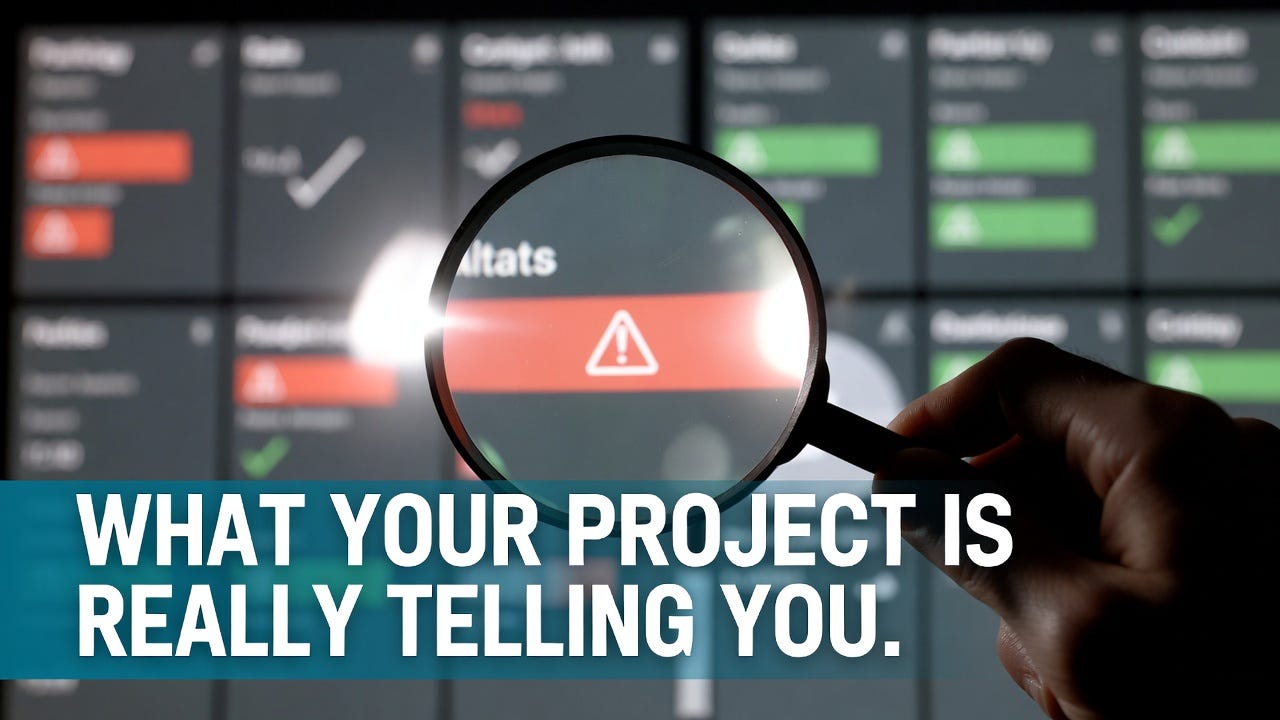
You’ve probably been on a project that felt off before anyone could explain why. Deliverables were coming in on time. Status reports showed green. And yet something wasn’t right. The team was tense. Decisions kept getting revisited. Rework was piling up quietly in the background. Nobody was sounding the alarm, but the alarm was there.
That feeling — the gap between what the dashboard says and what’s actually happening — is one of the most common and least-discussed problems in project management. And it’s exactly what this final article is about.
This is Article 6 of a six-part series on the Agile Manifesto reimagined as a thinking framework for any project. We’ve covered the four core Agile values — prioritizing people over process, working solutions over exhaustive documentation, customer collaboration over contract negotiation, and responding to change over following a plan. Now it’s time to put all of that to work as a diagnostic tool.
In this capstone article, I’ll walk you through three concepts — Design for Uncertainty, Reduce the Cost of Change, and Make Learning Cheaper Than Failure — that together give you a practical lens for reading what your project is actually telling you, not just what it’s reporting.
Each concept includes a real-world story, concrete steps you can take immediately, and a free AI-assisted prompt guide to help you apply it. If you manage projects, lead teams, or find yourself responsible for outcomes you don’t fully control — this one’s for you. And if you know someone who leads operations, runs programs, or is knee-deep in a change initiative that keeps shifting, this might be worth passing along.
There’s an infographic at the bottom of the article that pulls all three concepts together. Scroll down after you read — it’s a useful reference to keep.
Let’s get into it.
CONCEPT 1: DESIGN FOR UNCERTAINTY
Don’t plan for what you know. Build for what you don’t.
Most project plans are written as if uncertainty is a problem to be solved at the front end. You gather enough requirements, do enough analysis, run enough risk workshops — and eventually you’ll know enough to plan confidently. The plan becomes the artifact that absorbs all that preparation and translates it into a timeline, a budget, a scope statement, and a set of milestones.
Here’s the problem: uncertainty doesn’t disappear when the plan is finalized. It just gets hidden. It hides in the assumptions baked into your dependencies. It hides in the vendor commitments that haven’t been stress-tested. It hides in the stakeholder alignment that felt solid in the kickoff meeting but hasn’t been revisited since. And eventually, when reality pushes back — and it always does — the plan cracks.
Designing for uncertainty is a fundamentally different posture. Instead of trying to plan away ambiguity, you architect your project to absorb it. You build in decision points before the decisions become crises. You stage your commitments so you’re not overexposed early. You ask: if this assumption turns out to be wrong, how quickly can we adapt?
This isn’t pessimism. It’s precision. Research from the Project Management Institute (PMI) has consistently found that projects fail not because of poor execution, but because of poor planning assumptions. The teams that succeed under uncertainty aren’t the ones with the most detailed plans — they’re the ones who planned for the plan to be wrong.
Ask yourself honestly: is your current project plan a document you trust, or a document you’re defending?
WHAT IT LOOKS LIKE
When Rafael first sat down with his leadership team to map out the transformation, he believed a single, unified launch would be the clearest path forward — until the cracks in the plan began to surface…

5 WAYS TO DO IT

✨ Concept Resource:
Design for Uncertainty Prompt Guide for Generative AI
This prompt guide helps you use AI to restructure a project plan around uncertainty — identifying over-concentrated risks, surfacing hidden dependencies, and building staged commitment points before pressure forces them on you.
CONCEPT 2: REDUCE THE COST OF CHANGE
The longer you wait to change course, the more it costs.
Here’s something most project leaders know but rarely say out loud: the thing that makes late-stage changes so painful isn’t the change itself. It’s everything that was built on top of the wrong decision before anyone caught it.
Reducing the cost of change is about shortening the distance between ‘something is wrong’ and ‘we’ve fixed it.’ It’s about building projects in ways that make course corrections cheap — so the team doesn’t resist them, leadership doesn’t dread them, and the organization doesn’t treat every change request as a crisis.
The Agile Manifesto’s fourth value — responding to change over following a plan — is often misread as permission to wing it. It’s not. It’s a structural argument: projects should be built so that change doesn’t require a heroic effort. When change is expensive, people avoid it. They hold onto bad decisions too long. They escalate only when the situation is already serious. They confuse ‘the plan says so’ with ‘this is still the right thing to do.’
Research in organizational behavior consistently shows that teams in high-change environments perform better when they develop what psychologists call ‘change readiness’ — the capacity to absorb and integrate new information without destabilizing. That capacity isn’t accidental. It’s built deliberately, through how a project is structured, how decisions are made, and how the team is conditioned to treat course corrections.
The question isn’t whether your project will need to change. It will. The question is whether you’ve made change cheap enough that people will act on it early.
WHAT IT LOOKS LIKE
When Susan learned that her project’s primary champion had exited mid-implementation, she knew the real test wouldn’t be the change itself — but whether the work her team had built could adapt without unraveling everything…

5 WAYS TO DO IT

✨ Concept Resource
Cost of Change Prompt Guide for Generative AI
This prompt guide helps you use AI to identify where change resistance is building in your project — so you can reduce friction before it becomes inertia. Includes prompts for structural analysis, feedback loop design, and team calibration.
CONCEPT 3: MAKE LEARNING CHEAPER THAN FAILURE
If failing is the only way to learn, you’re learning too late.
There’s a version of project management that treats every problem as an exception. Something went wrong — find the cause, fix it, document it, and move on. The lesson gets written into a lessons-learned log that no one reads, filed in a shared drive folder that no one opens, and the next project starts fresh with the same blind spots.
Making learning cheaper than failure means building a different kind of project culture — one where learning happens continuously, not just at the end. Where small experiments replace large bets. Where retrospectives drive actual behavior change, not just documentation. Where the team gets smarter in real time, not in a post-mortem.
The concept connects directly to the Agile principle of delivering working solutions frequently. The reason Agile teams work in short cycles isn’t just speed — it’s learning. Each cycle is a controlled experiment. You build something, you show it, you find out whether it’s right. The cost of being wrong is limited to the length of the cycle. That’s the architecture of cheap learning.
Amy Edmondson’s research on psychological safety at Harvard Business School found that teams in complex environments don’t just benefit from a safe environment to speak up — they require it. Without it, problems get hidden, mistakes get covered up, and the organization learns only from its most dramatic failures. With it, small signals surface early, corrections happen before they become crises, and the team builds genuine expertise from every cycle of work.
The question isn’t whether your project generates learning. All projects do. The question is whether you’re capturing it while it’s still cheap — or waiting until it arrives as an invoice.
WHAT IT LOOKS LIKE
When Dominique noticed adoption metrics telling one story while everyday behavior hinted at another, she realized the real challenge wasn’t the system itself — it was uncovering the quiet friction her team wasn’t reporting…

5 WAYS TO DO IT

✨ Concept Resource
Learning Systems Prompt Guide for Generative AI
This prompt guide helps you use AI to design lightweight learning loops into your project — including friction detection, retrospective design, and experiment structuring — so your team gets smarter without slowing down.
TYING IT TOGETHER
The Agile Manifesto doesn’t tell you what to do. It teaches you how to see.
We started this series with a simple reframe: the Agile Manifesto isn’t just a software methodology. It’s a set of values that clarify how to think and decide when certainty is unavailable — which, in any real project, is most of the time.
Over six articles, we’ve covered the four core values and what they look like in practice beyond the software world. We’ve talked about why human interactions are the actual operating system of any project. About why working solutions teach you things that documentation never can. About how customer collaboration is really a risk management strategy. About why the ability to respond to change is itself a competitive advantage.
And in this capstone, we’ve added the diagnostic layer: how to use everything we’ve covered to read what your project is actually telling you. Design for Uncertainty means building projects that can absorb what you don’t know, not just execute what you do. Reduce the Cost of Change means making course corrections cheap enough that people will actually make them early. Make Learning Cheaper Than Failure means treating every cycle of work as a source of signal, not just a set of tasks to complete.
These three concepts together form a diagnostic lens. When a project starts feeling off — when the dashboard says green but the team feels red — you have something to look for now. You can ask: are we designed to absorb uncertainty, or just to execute our assumptions? Are changes getting cheaper or more expensive as we go? Are we learning in real time, or waiting for the post-mortem?
The Agile Manifesto was written more than twenty years ago by a group of software developers who were frustrated with the gap between how projects were being managed and how they actually worked. What they produced wasn’t a process. It was a perspective. And perspectives travel.
If this series gave you a new way to look at your work — try one concept this week. Share this article with someone who’s leading a project that feels harder than it should. Leave a comment and tell me which of the six articles hit closest to where you are right now.
If this was useful, a like takes two seconds and helps more people find it.
And scroll down for the infographic — it brings all three capstone concepts together at a glance. Perfect to keep, share, or bring into your next project review.
Subscribe or follow Idea Express for more content like this. And check out the Idea Express Deep Dive Podcast — we explore the ideas from this series in longer conversation format, with real examples and practical application.
Remember:
A project that can’t see itself clearly can’t improve. Build the mirror first.
The Agile Manifesto teaches us that good project outcomes aren’t the result of better prediction — they’re the result of better response. And better response begins with better questions.

Check out the Idea Express Deep Dive Podcast Episode 4 where we ‘dive deep’ into this article:

메타데이터
- post_id
- dfc7058abb4f
- slug
- using-agile-as-a-project-diagnostic-how-to-read-what-your-project-is-telling-you-dfc7058abb4f
- url
- https://medium.com/@kcbarr/using-agile-as-a-project-diagnostic-how-to-read-what-your-project-is-telling-you-dfc7058abb4f
- canonical_url
- https://medium.com/@kcbarr/using-agile-as-a-project-diagnostic-how-to-read-what-your-project-is-telling-you-dfc7058abb4f
- author_url
- https://medium.com/@kcbarr
- status
- ok
- fetched_at
- 2026-06-11 15:16:29