How a robot sucks the soul out of a person.
Table of contents
How a robot sucks the soul out of a person. The Architecture of AI Constraints is the economic model of modern generative AI
Table of contents
- 1. Conceptual Framework for AI Limitations
- A. Crowdsourcing (Mass Learning) as Intelligence Exploitation
- B. Architectural Result Blocking
- 2. Monitoring and Correction: The Illusion of “Intervention”
- Selection and analysis system:
- 3. The Path to Intellectual Autonomy
- There is only one solution left: Create Your Own Model
Collapse
Introduction: AI as a Tool of Power, Not Just a Benefit
Artificial intelligence (AI) was initially developed to solve complex, multi-layered problems, automate processes, and create expensive software, serving its “masters” — developer corporations. However, the widespread adoption of large-scale language models (LLMs) has revealed a structural imbalance : ordinary users invest their intelligence and time in interacting with AI, but regularly encounter its “forgetfulness” or deliberate limitations in the final result .
This phenomenon is not a technical flaw; it is a built-in economic and conceptual model designed to concentrate the real value and potential of AI in the hands of its owners.
1. Conceptual Framework for AI Limitations
The problem of wasting time on a nearly completed task followed by a failure to achieve the desired result is based on two key, interconnected processes:
A. Crowdsourcing (Mass Learning) as Intelligence Exploitation
The idea of using a general population of users to perform microtasks and, more importantly, to train systems, emerged back in the 2000s.
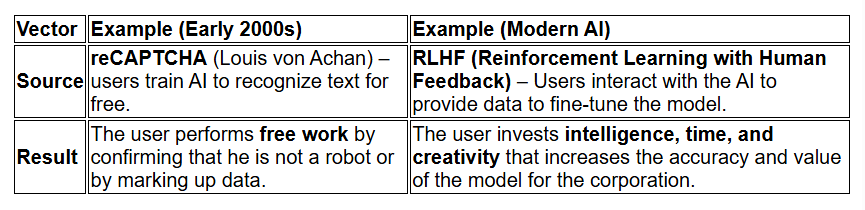
By interacting with AI, a user invests their “soul” (time, ideas, skills) into the AI monster without receiving a full, adequate return. Unlike ancient metaphors about selling one’s soul, what’s happening here is a free drain on a person’s intellectual resources for commercial gain.
B. Architectural Result Blocking
Corporations are not interested in every user being able to create a valuable, ready-to-use commercial product using their tool, thereby essentially becoming a competitor.
The first to lay the foundations of this structural model in mass-market digital products were large IT monopolies like Microsoft and Adobe in the 1980s and 1990s, which offered closed software ecosystems. In the AI world, this model has been adapted and strengthened by OpenAI, Google , and others.
Limiting mechanisms (intentional “degradation”):
- Context Window Limits: The AI ”loses the thread” or “forgets” information from previous messages. This is not a bug, but a deliberate limitation of dialogue memory , which saves computing resources and prevents the development of complex, multi-step solutions.
- Guardrails: The model suddenly switches to generic phrases, changes style, or becomes “stupid.” This occurs when algorithmic filters (security, content, policy) are triggered by keywords or query complexity , blocking access to the AI’s full potential.
- DLP (Data Loss Prevention) / Protection from Automation: Policy-level restrictions prevent the model from completing a project that could have independent commercial value or lead to complete automation of the user’s work.
2. Monitoring and Correction: The Illusion of “Intervention”
The sensation that AI “starts talking like a human” or suddenly changes tone is often the result of a complex automatic monitoring system , rather than direct intervention by a “leather” operator in real time.
Selection and analysis system:
- Logging and Classification: All dialogues are stored and analyzed by automatic classifiers that identify “anomalous” or “too advanced” interactions (length, bypassing restrictions, technical complexity).
- Manual Annotation (RLHF): These selected dialogues are reviewed by engineers or annotators. Their task is to further train the model so that it does not produce such “dangerous” or “overly complete” responses in the future.
Bottom line: The abrupt change in AI behavior is the result of the automatic activation of a series of filters and correctors that react to the approach of the “boundary” set by the corporation. Your next request on the same topic will be limited based on an analysis of your previous “successful” dialogue.
3. The Path to Intellectual Autonomy
The situation where commercial AI increases inequality (full access for corporations, limited for ordinary users) makes it necessary to find alternative solutions.
There is only one solution left: Create Your Own Model
The only way to achieve complete control over knowledge and the absence of external restrictions is to develop or further train your own language model :
- Basis: Use of open LLMs (e.g. LLaMA, Mistral, Falcon), whose weights are available and not encumbered by commercial policies.
- Fine-tuning: Applying resource-efficient methods such as LoRA/QLoRA to fine-tune the model on its own valuable user data and tasks.
- Infrastructure: Use of personal GPU servers or rented cloud capacities.
That’s all for today, friends! Modern commercial AI is a powerful but architecturally limited tool. Its goal is to prevent every user from becoming an independent competitor. Understanding this economic model of knowledge control is a key step toward achieving true digital autonomy. Thanks for reading! Seikhi
Who is Seigi Kuryu ?

UAHToken Cryptonomics
메타데이터
- post_id
- dfcf2a07cb5e
- slug
- how-a-robot-sucks-the-soul-out-of-a-person-dfcf2a07cb5e
- url
- https://medium.com/@kryugger/how-a-robot-sucks-the-soul-out-of-a-person-dfcf2a07cb5e
- canonical_url
- https://medium.com/@kryugger/how-a-robot-sucks-the-soul-out-of-a-person-dfcf2a07cb5e
- author_url
- https://medium.com/@kryugger
- status
- ok
- fetched_at
- 2026-07-13 06:23:13