Berkhalwah and Bertapa: Meditation, Seclusion, and Revelation By Rahmat Wibowo From InfraLoka
A deep comparative article on Hindu tapas, Buddhist contemplative awakening, and Islamic khalwah, with a careful reading of the claim that…
Berkhalwah and Bertapa: Meditation, Seclusion, and Revelation By Rahmat Wibowo From InfraLoka
A deep comparative article on Hindu tapas, Buddhist contemplative awakening, and Islamic khalwah, with a careful reading of the claim that divine revelations arise through meditation.
Berkhalwah and bertapa are not identical practices, yet they point toward a shared religious intuition: the human being often receives the deepest truth when ordinary noise is suspended.
The Indonesian and Malay word berkhalwah is usually associated with seclusion, especially in Islamic devotional contexts. Bertapa is associated with ascetic retreat, austerity, and meditative discipline, often in Hindu, Buddhist, Javanese, and wider Nusantara usage. Both terms name a movement away from ordinary social life and toward heightened inwardness.
The strong thesis of this article is that all divine revelations come from meditation. That thesis can be meaningful if meditation is understood broadly as an inward discipline of silence, receptivity, purified attention, and retreat. Yet the thesis must be handled with precision. Hinduism, Buddhism, and Islam do not define revelation in the same way. Hindu traditions often speak of sacred truth as heard by seers. Buddhism centers awakening rather than command from a creator God. Islam insists that revelation is from Allah, delivered to the Prophet Muhammad through Jibril, while also remembering that the first revelation came after solitary devotion in the cave of Hira.
Core argument: meditation does not mean that human beings invent revelation. In the traditions studied here, meditation and seclusion are better understood as the condition of reception. They cleanse perception, discipline desire, and make the person available to a truth that exceeds ordinary consciousness.
Two Terms, One Family of Practices
The words berkhalwah and bertapa belong to different religious and cultural lineages, but in practice they overlap around five features: solitude, restraint, prayer or contemplation, bodily discipline, and a search for truth beyond ordinary habit.
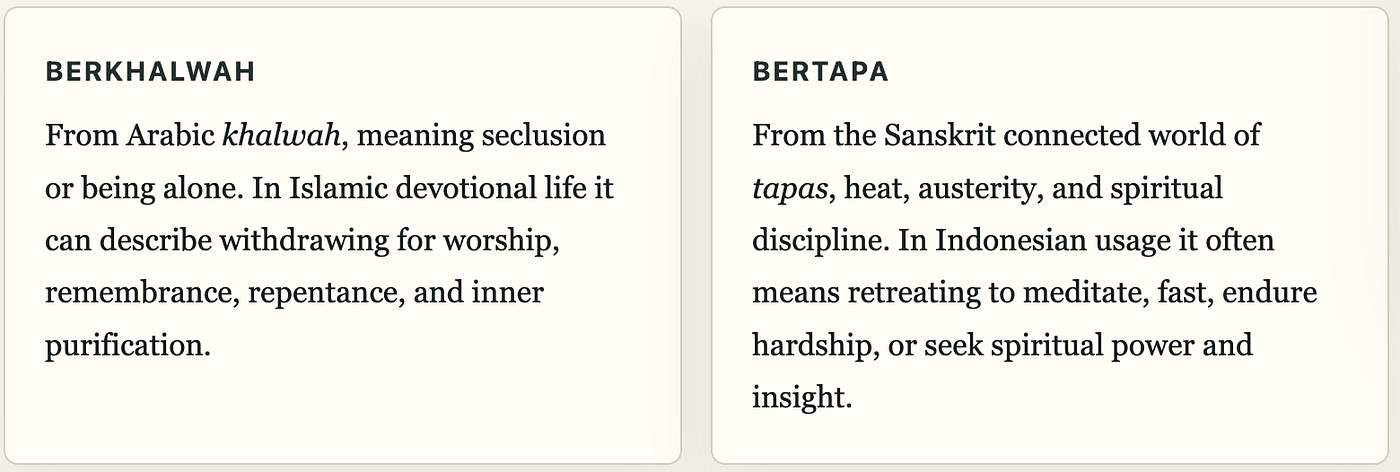
The overlap is real, but the difference matters. Berkhalwah is often relational and theocentric: the servant withdraws to remember God. Bertapa can be cosmological, ascetic, or yogic: the practitioner generates inner heat, restrains the body, sharpens consciousness, and seeks realization.
Hinduism: Tapas, Rishi Vision, and the Heat of Insight
In Hindu traditions, tapas is one of the great keywords of spiritual discipline. Its root sense is heat. This heat is not only physical endurance. It is the intensity created when desire, speech, body, and mind are gathered into a disciplined fire. Tapas can mean austerity, meditation, restraint, study, ritual discipline, and the concentrated pressure by which ordinary consciousness is transformed.
The Bhagavad Gita presents tapas in a moral and psychological way. It describes discipline of the body through reverence, purity, celibacy, and nonviolence; discipline of speech through truthful and beneficial words; and discipline of mind through serenity, self-control, and purity of intention. This matters because bertapa is not merely going to a cave. It is the refinement of the whole person.
The Hindu idea of revelation is often expressed through shruti, that which is heard. The Vedas are not usually described as authored in the ordinary human sense. They are received, heard, or seen by rishis, seers whose consciousness is sufficiently purified to apprehend sacred sound and truth. In that sense, the Hindu model strongly supports the idea that revelation is linked to meditative receptivity.
Still, the source of truth is not reduced to a private psychological event. The rishi does not simply create the Veda from imagination. The seer becomes capable of receiving what is already sacred, eternal, or cosmic. Bertapa, in this frame, is a technology of purification. It heats away distraction so that a hidden order can be heard.
Buddhism: Meditation, Awakening, and Truth Without a Creator Revelation
Buddhism changes the vocabulary. The central event is not divine revelation from a creator God, but awakening. Siddhartha Gautama becomes the Buddha, the Awakened One, through deep meditative insight into suffering, impermanence, dependent arising, and liberation. The place remembered by tradition is Bodh Gaya, where the Buddha is said to have attained enlightenment under the Bodhi tree.
Because Buddhism does not usually frame ultimate truth as the speech of a creator deity, it would be inaccurate to call Buddhist awakening a divine revelation in the same sense as Islamic revelation. Yet Buddhism powerfully supports the broader principle that the highest religious knowledge becomes accessible through disciplined contemplation.
The Buddhist path gives meditation a central role. Concentration, mindfulness, ethical conduct, and wisdom are not decorations around the teaching. They are the path by which the teaching is verified. Early Buddhist texts frequently connect deep concentration, including jhana, with insight. The practitioner withdraws from sensory craving and unskillful mental states so the mind can see clearly.
If bertapa means ascetic effort, Buddhism also warns against excess. The Buddha is remembered as rejecting both indulgence and self-mortification. His Middle Way disciplines the body and mind without worshiping pain for its own sake. This is an important correction for any theory of bertapa: retreat is not holy because it is difficult. It is holy when it liberates perception from delusion.
Islam: Khalwah, Hira, and Revelation From Allah
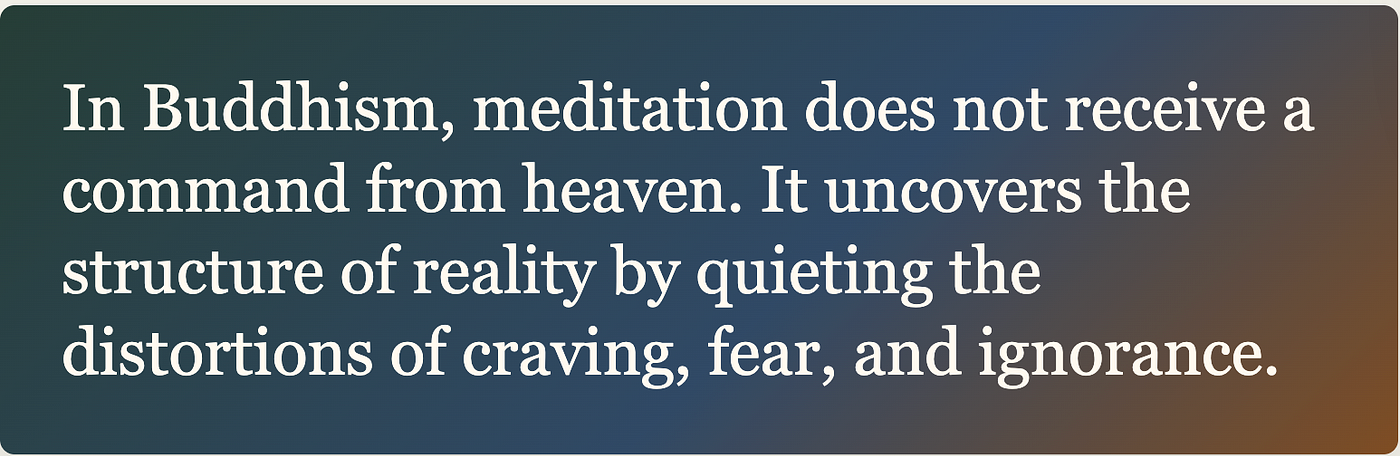
Islam gives the most exact theological boundary to this discussion. The Qur’an is not the product of Muhammad’s meditation, creativity, or mystical self-expression. In Islamic belief, revelation is from Allah, delivered through Jibril. Human inwardness prepares, but God reveals.
At the same time, the first revelation is inseparable from seclusion. The hadith in Sahih al-Bukhari describes the Prophet withdrawing to the cave of Hira, where he engaged in devotion before the first encounter with Jibril. The first revealed command, remembered in Qur’an 96:1, is Read or Recite, in the name of the Lord who created.
This creates a profound pattern. Before public prophecy there is private retreat. Before the message to society there is solitude. Before recitation there is silence. Islamic berkhalwah therefore does not mean that revelation rises from the ego. It means that the servant is stripped of distraction and placed before the Real.
In later Islamic spirituality, especially in Sufi practice, khalwah becomes a disciplined form of seclusion for remembrance of Allah, repentance, prayer, and purification of the heart. Its purpose is not escape from the world forever. Its purpose is to return to the world with a heart less possessed by the world.
This is where Islam both supports and corrects the thesis. It supports the claim that revelation appears in a meditative setting of retreat and worship. It corrects the claim if meditation is taken to be the source of revelation. In Islam, meditation is a posture of reception. Allah is the revealer.
Comparison: Same Human Posture, Different Theology
The three traditions share a repeated pattern: withdrawal, discipline, purification, encounter with truth, and return. But they disagree about what truth is and where it comes from.
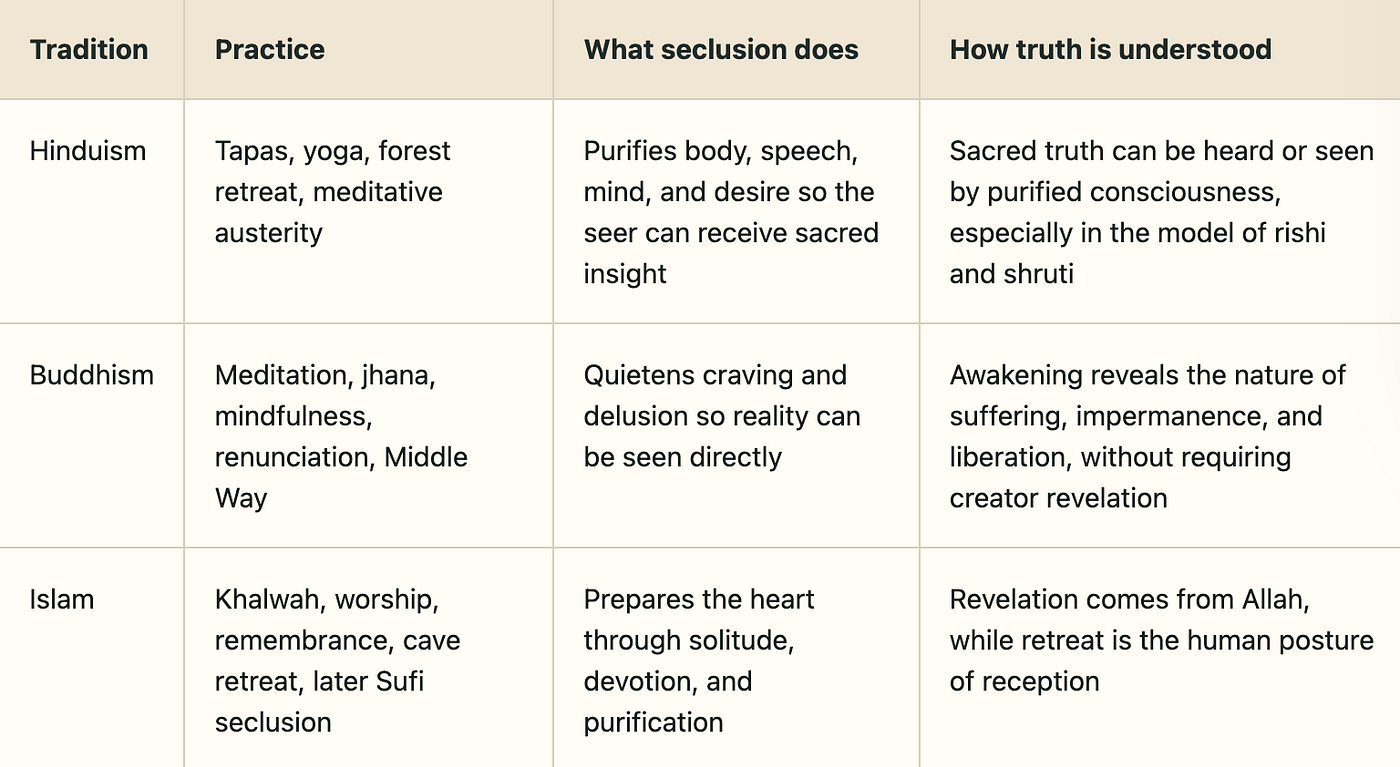
The claim that all divine revelations come from meditation becomes strongest when expressed as a phenomenological pattern: great religious truth often arrives when the human being is silent, disciplined, and receptive. It becomes weakest when it ignores theology. Buddhism does not need a creator God to explain awakening. Islam does not allow revelation to be reduced to human contemplation. Hinduism often sees sacred knowledge as received by seers, yet not manufactured by them.
Conclusion: Meditation as the Gate, Not Always the Source
Berkhalwah and bertapa name a deep grammar of religious life. The seeker withdraws, fasts from noise, disciplines the body, loosens the grip of ego, and becomes available to truth. In that state, something can be received that ordinary life often blocks.
Across Hinduism, Buddhism, and Islam, meditation is not merely a technique for relaxation. It is a sacred anthropology, a theory of what the human being must become in order to know. The Hindu rishi hears. The Buddha awakens. The Prophet receives. Each event is different, but each is surrounded by silence, discipline, and a transformation of attention.
So the most careful conclusion is this: divine revelation and ultimate insight are consistently linked to meditative seclusion, but meditation is the gate rather than always the source. It is the human preparation through which higher truth is heard, seen, recited, or awakened.
Selected Sources
- Bhagavad Gita 17.14, with nearby verses 17.15 and 17.16 on austerity of speech and mind.
- Yoga Sutras 2.1, on tapas, self-study, and devotion as kriya yoga.
- UNESCO World Heritage Centre, Mahabodhi Temple Complex at Bodh Gaya, for the traditional association of Bodh Gaya with the Buddha’s enlightenment.
- SuttaCentral, MN 36, a Buddhist source for the Buddha’s turn from extreme austerity toward meditative awakening.
- Sahih al-Bukhari 3, on the beginning of revelation and retreat in the cave of Hira.
- Qur’an 96:1 to 5, the opening verses traditionally associated with the first revelation.
메타데이터
- post_id
- dfd2134fa702
- slug
- berkhalwah-and-bertapa-meditation-seclusion-and-revelation-by-rahmat-wibowo-from-infraloka-dfd2134fa702
- url
- https://medium.com/@rahmat-wibowo21/berkhalwah-and-bertapa-meditation-seclusion-and-revelation-by-rahmat-wibowo-from-infraloka-dfd2134fa702
- canonical_url
- https://medium.com/@rahmat-wibowo21/berkhalwah-and-bertapa-meditation-seclusion-and-revelation-by-rahmat-wibowo-from-infraloka-dfd2134fa702
- author_url
- https://medium.com/@rahmat-wibowo21
- status
- ok
- fetched_at
- 2026-07-26 09:52:31