The Hidden Fragility of AI Valuations: When Governance Becomes a Core Financial Variable
Earlier in my career as a credit officer from Crédit Lyonnais to Deutsche Bank, valuation and risk analysis were inseparable. Whether…
The Hidden Fragility of AI Valuations: When Governance Becomes a Core Financial Variable

Institutions appear stable; valuation depends on how their underlying systems are modelled and interpreted
Earlier in my career as a credit officer from Crédit Lyonnais to Deutsche Bank, valuation and risk analysis were inseparable. Whether assessing structured finance transactions, commercial real estate, infrastructure assets, or corporate debt, the exercise involved understanding how fragile the assumptions behind the cash flows might become under stress or uncertainty.
Over time, I came to appreciate that valuation models are often less constrained by mathematics than by the quality of the due diligence supporting them. It is more subtle than the obvious “Garbage in, garbage out.” Two companies can produce similar projections while carrying radically different exposure to business volatility, financial resilience, concentration risks, or governance weaknesses.
Long before artificial intelligence became a board-level topic, I was already interested in that broader question of modeling ambiguity and instability. In 1990, as part of my MBA at Paris Dauphine University, I completed a thesis titled Justification and Development of a Multi-Criteria Decision-Making Method under Uncertainty. At the time, the subject was largely academic. It has proven to be very practical and an enduring source of curiosity.
Over the past few years, while working on governance and risk questions, I began noticing a disconnect surrounding AI systems that is becoming harder to ignore. On one hand, organizations are becoming increasingly sophisticated at identifying and categorizing AI-related risks. On the other hand, markets and analysts still lack a structured way to integrate AI-related economics into valuation assumptions.
The next challenge is to connect those insights to valuation frameworks in a disciplined way, integrating both the upside potential and the structural fragility introduced by AI-driven systems. Doing so may improve how investors compare businesses whose economics increasingly depend on opaque models, adaptive algorithms, and evolving data ecosystems.
Valuation Was Always About Translating Uncertainty
Throughout my years in risk management, I relied on valuation frameworks to assess companies, assets and cashflows under uncertain conditions. The objective is simple: estimate what a business is worth and how much debt it could realistically sustain across different future states.
There are primarily three broad valuation approaches, each with strengths and limitations depending on the maturity of the industry or company.
The cost-basis (or replacement cost) approach is particularly well suited to value startup companies or divisions that have yet to generate steady revenues and margins. The costs required to build a manufacturing plant, develop technology, or acquire customers may provide a rough approximation of enterprise value. While it may partially capture technology or dataset investments, the book value provides limited information into how AI may alter the future economic value of those assets.
The market-comparable approach may offer greater insight for companies already operating at scale with AI-enabled business models, where public markets have begun incorporating AI expectations into pricing multiples. However, because markets are still learning how to price AI-related durability, fragility, and scalability, comparable analysis may currently contain limited genuine pricing wisdom.
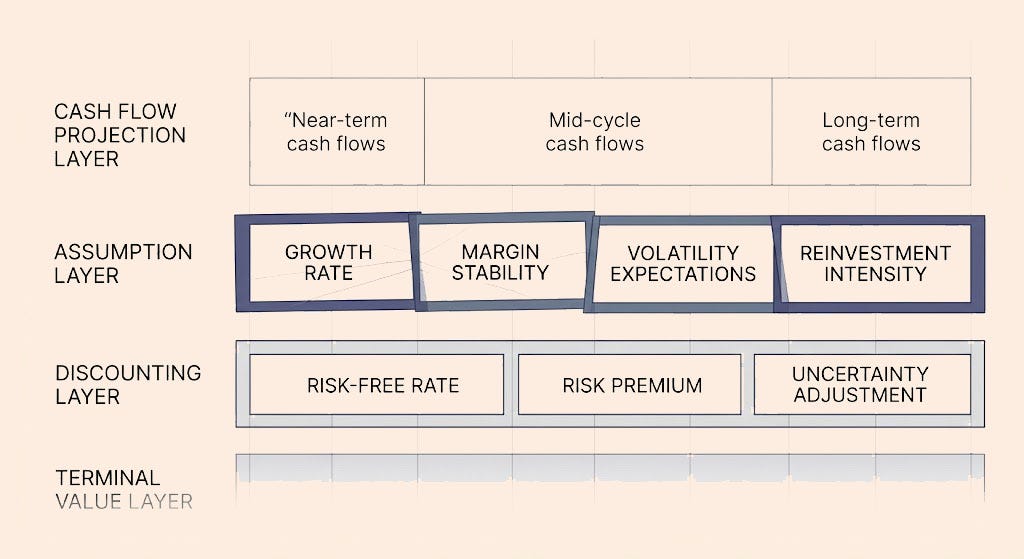
Discounted cash flow models are sensitive not only to inputs, but to the structural stability of assumptions.
The discounted cash flow (DCF) approach is more analytical and requires a fair amount of due diligence to estimate the present value of future cash flows. The mathematics are usually the easy part. The real challenge lies in understanding how resilient assumptions about growth, profitability, capital intensity, financing conditions, and risk will remain once conditions begin to diverge under the influence of AI systems.
These three approaches share the same implicit assumption that the underlying systems behave in relatively stable, observable, and continuous ways. AI is beginning to destabilize those underlying assumptions.
With AI, the Nature of Uncertainty Began to Change
For decades, valuation frameworks evolved around businesses whose operating dynamics were broadly understandable, even when outcomes remained uncertain. Analysts could debate assumptions, disagree on scenarios, or misjudge market cycles, but the underlying economic engines were still relatively observable.
As AI-driven systems move closer to the core of companies, from customer strategy and operations to human resources and executive decision-making, the nature of uncertainty itself is evolving. Increasingly, companies are relying on models whose internal logic may not always be fully explainable, whose behavior can shift under changing data conditions, and whose outputs can influence the very environments from which future data will be generated.
When I was a student in Paris, I attended a modeling course taught by a professor from École Polytechnique. Long before the emergence of modern AI systems, he insisted on a principle that stayed with me throughout my career: every model eventually loses predictive power because the environment around it changes. The real challenge was designing the indicators capable of signaling when its assumptions no longer matched reality.
The lesson feels remarkably relevant today. An AI model may perform extremely well for long periods before degrading abruptly when exposed to new operating conditions. Feedback loops may amplify errors rather than dampen them. Small changes in data quality, user behavior, or adversarial manipulation can produce disproportionately large operational consequences. Systems may behave one way under normal conditions and another once certain thresholds are crossed. In some situations, management itself may not fully understand the causes of deteriorating performance until after meaningful damage has occurred.
Traditional valuation methodologies may therefore need to evolve. Among the three traditional approaches, DCF is likely the most flexible framework for integrating AI-related risks and opportunities because it forces analysts to articulate the assumptions underlying long-term value creation. The challenge is no longer whether AI matters economically, but how to translate model robustness, data dependency, governance quality, and operational resilience into those assumptions in a rigorous manner.
AI Governance Became a Way to Map Economic Fragility
As AI systems became increasingly embedded into critical business functions, organizations developed AI governance frameworks, often inspired by the NIST AI Risk Management Framework, to identify, assess, monitor, and manage AI-related risks.
In a recent LinkedIn post, I proposed a simplified framework to help boards and leadership focus their attention around four core dimensions:
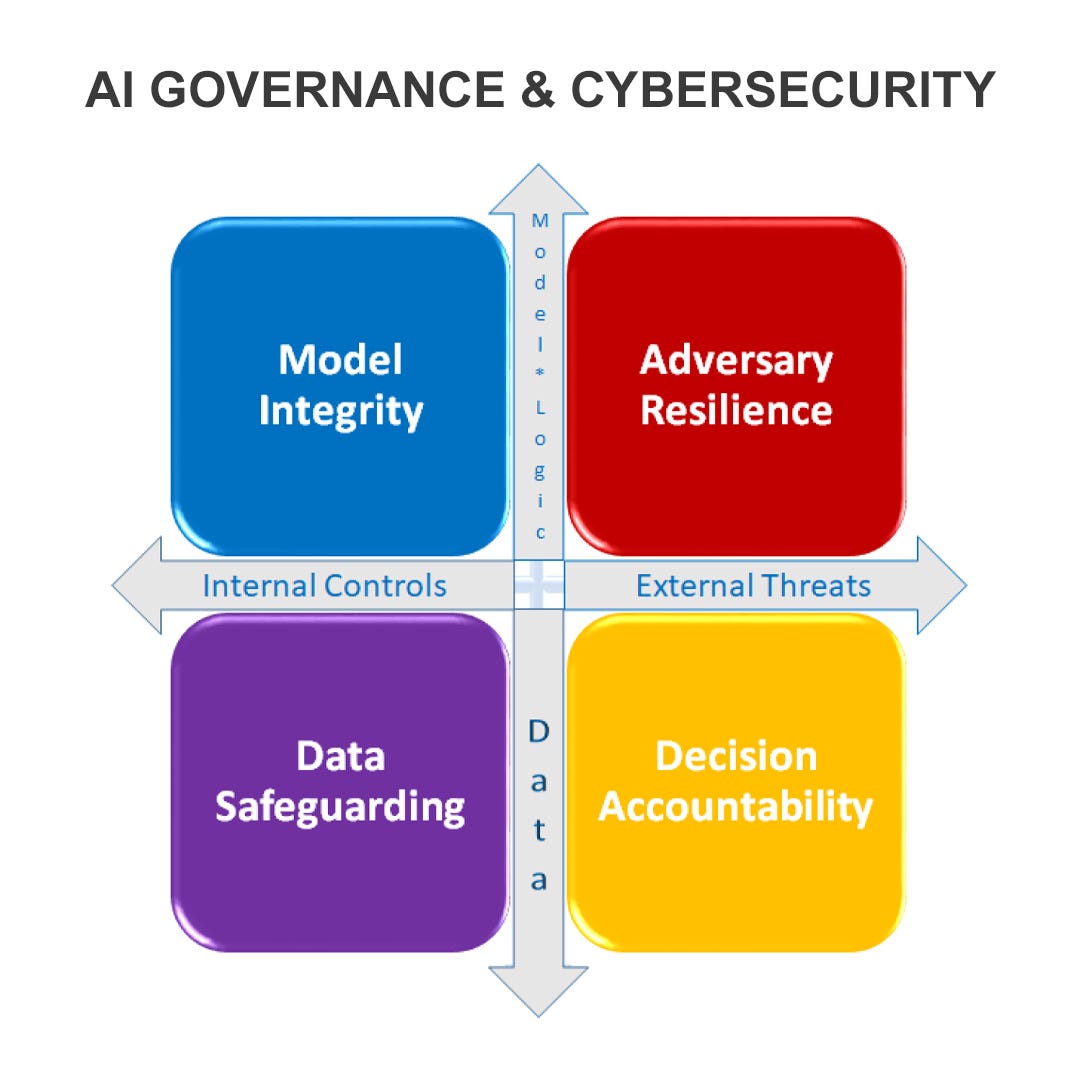
Governance quality increasingly shapes the reliability of financial outputs, not just compliance outcomes.
· Integrity focuses on whether AI systems continue to behave as intended over time, including risks such as drift, bias, or corrupted training inputs.
· Resilience addresses the ability of systems to withstand adversarial attacks, malicious prompts, or model exploitation.
· Safeguarding concerns the protection of sensitive data throughout the AI lifecycle, while
· Accountability emphasizes transparency, auditability, explainability, and governance oversight.
The objective is not simply to determine whether a model works, but to understand under which conditions it may fail, drift, become manipulated, or generate cascading operational consequences. However, the more I worked through these dimensions, the more they appeared connected to valuation itself.
Integrity influences the reliability of future cash flows. Resilience affects the severity of downside scenarios. Safeguarding impacts legal exposure, reputational stability, and customer trust. Accountability increasingly shapes regulatory sustainability and long-term franchise value.
Although the terminology differs, these governance assessments increasingly resemble forms of economic stress testing. Once governance frameworks identify where AI systems may become fragile, the next challenge is translating those findings into valuation inputs.
Towards a Fragility-Adjusted Valuation (FAV)
Unlike market comparables or replacement-cost approaches, discounted cash flow analysis forces analysts to articulate explicitly the assumptions driving long-term value creation. In traditional DCF, AI-dependent growth and risks are often absorbed into generic upside or downside scenarios, diluted through broad discount-rate adjustments, or obscured by highly subjective probabilities. As a result, materially different forms of AI-system fragility may ultimately produce similar valuation outputs.
This is where a Fragility-Adjusted Valuation framework could begin to emerge.
Step 1 — Standardize AI Governance Diagnostics
The first challenge is organizational rather than mathematical. AI audit reports, governance reviews, validation assessments, cybersecurity findings, and operational monitoring outputs are often highly fragmented. Different teams use different vocabularies, methodologies, and reporting structures.
A specialized LLM could potentially act as a translation layer by extracting relevant governance findings into a standardized analytical table inspired by frameworks such as the NIST AI Risk Management Framework. This would require standardized taxonomies, reliable governance documentation, and careful human oversight.
For example, a governance review of a fictional AI-driven insurer might produce the following simplified output:
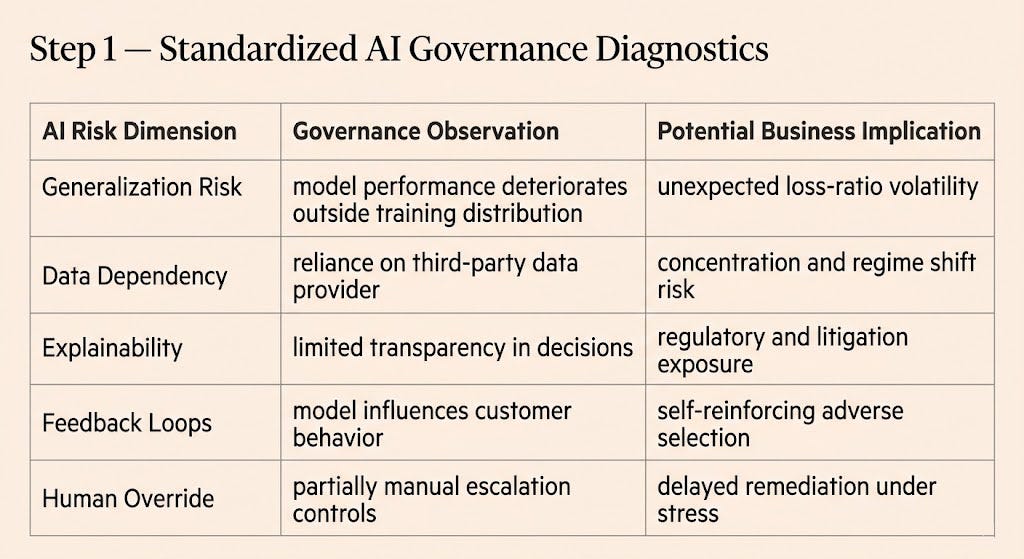
Governance signals become valuation indicators.
The goal is not only to structure uncertainty consistently enough to support comparative analysis across businesses and sectors, but also to identify companies whose governance quality may allow AI systems to scale more reliably than competitors.
Step 2 — Turn Governance Findings into Risk Assessments
The second step is to transform these technical diagnostics into economically meaningful risk drivers, using structured indicators such as High / Medium / Low risk classifications. For instance:
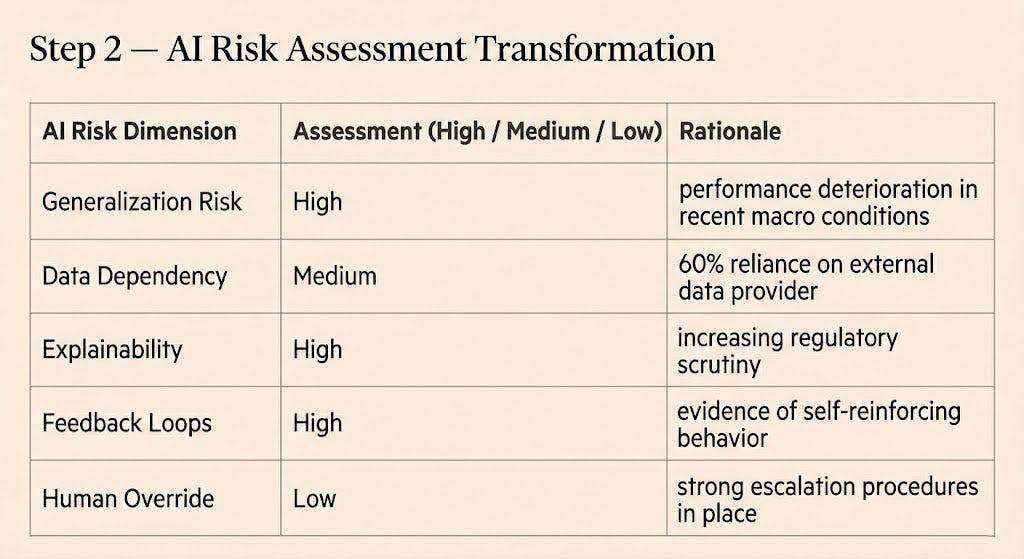
AI-driven fragility can be translated into structured risk signals and incorporated into valuation assumptions.
Taken together, Steps 1 and 2 resemble the logic of Enterprise Risk Management heat maps, where identified risks are systematically assessed according to their potential likelihood and severity. The difference is that the underlying drivers here increasingly originate from AI model behavior, data dependencies, governance quality, and adaptive system dynamics.
Step 3 — Translate AI Fragility into Valuation Inputs
The final step is where governance and valuation begin to converge directly. Traditional valuation frameworks, like DCF, primarily model variability around assumptions. Fragility-oriented approaches attempt to identify conditions under which the assumptions themselves may cease to remain valid.
Returning to the fictional insurer example:
· Generalization risk may affect the probability distribution of future cash flows by increasing the likelihood of abrupt operational deterioration under changing conditions. Instead of modestly reducing expected growth, analysts may assign greater probability to extreme downside outcomes.
· Data dependency may reduce the durability of competitive advantages and shorten the expected life of excess returns, directly affecting terminal value assumptions.
· Weak explainability may justify explicit regulatory disruption scenarios rather than vague “risk premiums.” For example, a valuation model could incorporate a defined probability that regulators force underwriting modifications or restrict deployment of certain AI models.
· Feedback-loop risks may introduce path dependency into cash flows. A model failure may trigger self-reinforcing deterioration through customer behavior, pricing errors, or reputational damage.
· Human oversight and override mechanisms may affect downside severity rather than probability. Strong controls may contain losses early. Weak controls may allow localized failures to become systemic events.
Scenario probabilities become partially linked to observable characteristics of the AI system itself. Instead of a traditional static bear case “Margins decline by 20%,” the new approach proposes a trigger-based scenario: “If claims ratios exceed a defined threshold for multiple quarters, it activates a higher-probability tail-risk scenario in underwriting performance.”
Fragility-Adjusted Valuation represents a step toward more dynamic valuation frameworks capable of incorporating model fragility, adaptive behavior, and state-dependent outcomes.
Valuation Will Still Require Judgment
Artificial intelligence will not eliminate uncertainty from valuation models. In many ways, it may increase it. What AI changes is the nature of the questions boards, investors, and risk professionals must ask when assessing long-term value creation:
· How dependent is the business on opaque or fragile AI-driven decision systems?
· How quickly would management detect deteriorating model behavior?
· Are governance and oversight mechanisms mature enough to contain failures before they become systemic?
· Do valuation assumptions adequately reflect both the upside and fragility introduced by AI?
For investors, Fragility-Adjusted Valuation may improve the ability to distinguish between companies merely deploying AI and those genuinely building resilient, governable, and economically durable AI capabilities. For boards, it creates a more direct bridge between technology oversight, enterprise risk management, strategy, and valuation itself.
Ultimately, valuation models will remain only as reliable as the assumptions embedded within them. As AI systems become increasingly adaptive, interconnected, and autonomous, the importance of human judgment may actually increase rather than diminish.
I often think back to the modeling lesson I learned as a student in Paris decades ago: the most important part of a model may be the indicators capable of signaling when its assumptions no longer reflect reality. That principle may become even more important in the age of AI.
메타데이터
- post_id
- dfd2e0e7a67e
- slug
- the-hidden-fragility-of-ai-valuations-when-governance-becomes-a-core-financial-variable-dfd2e0e7a67e
- url
- https://medium.com/@andre.louis.clemot/the-hidden-fragility-of-ai-valuations-when-governance-becomes-a-core-financial-variable-dfd2e0e7a67e
- canonical_url
- https://medium.com/@andre.louis.clemot/the-hidden-fragility-of-ai-valuations-when-governance-becomes-a-core-financial-variable-dfd2e0e7a67e
- author_url
- https://medium.com/@andre.louis.clemot
- status
- ok
- fetched_at
- 2026-06-22 12:55:45