The Psychology of Intrinsic vs. Extrinsic Motivation: Why What Drives You Matters More
Why knowing what truly fuels you can transform not just your success, but your sense of purpose.
The Psychology of Intrinsic vs. Extrinsic Motivation: Why What Drives You Matters More Than You Think 💡
I once asked a room full of ambitious professionals a simple question: “Why do you do what you do?” The answers ranged from “for the promotion” to “to make a difference,” but what struck me wasn’t the diversity of answers – it was how deeply they revealed the unseen forces shaping our lives. Motivation isn’t just a buzzword; it’s the lens through which we experience purpose, effort, and fulfillment. And understanding the difference between intrinsic and extrinsic motivation could change not just how we work, but how we live.
Intrinsic Motivation: Doing It for the Joy of It
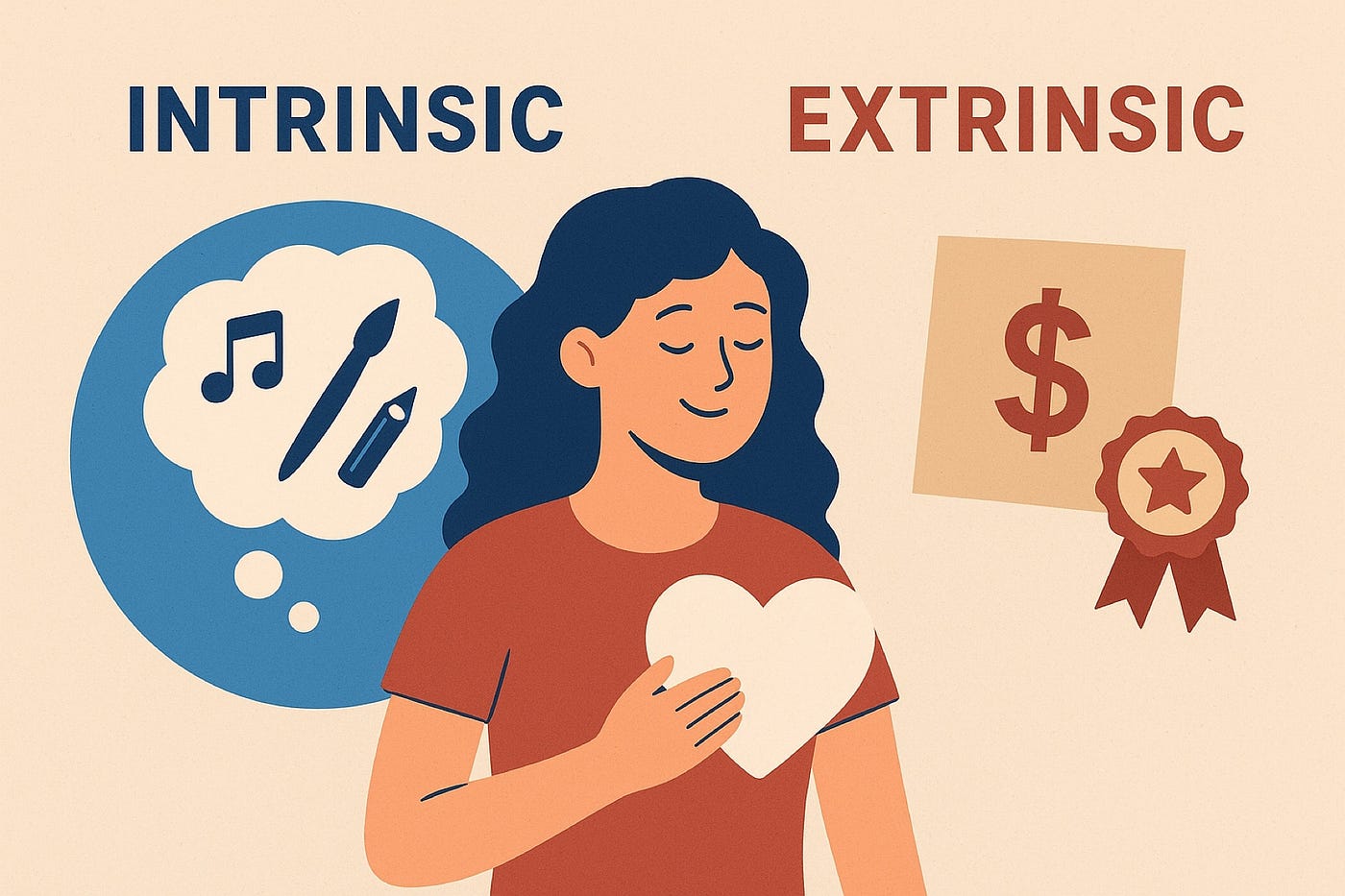
Intrinsic motivation is subtle, almost invisible, but powerful. It’s the drive that comes from within – the passion that makes you stay up late writing, coding, painting, or learning, not because someone told you to, but because you genuinely love it. Psychologists describe it as doing an activity for its inherent satisfaction, rather than for some separable outcome.
Think about the last time you lost track of time while reading a book, solving a problem, or playing music. That absorption, that flow state, is intrinsic motivation at work. It’s what fuels creativity, perseverance, and a deep sense of fulfillment. And studies consistently show that people who are intrinsically motivated are more likely to stick with challenges, experience less burnout, and feel more satisfied with their lives.
Extrinsic Motivation: The Push from Outside
Extrinsic motivation, on the other hand, comes from outside ourselves. Bonuses, grades, praise, recognition – these are all extrinsic motivators. They can be powerful. They can get you moving, get you through tasks you might otherwise avoid, and help you achieve measurable results.
But here’s the catch: extrinsic motivation can be a double-edged sword. While it can spark action, it rarely sustains deep engagement or long-term fulfillment. In fact, research shows that over-reliance on external rewards can sometimes reduce intrinsic motivation, a phenomenon psychologists call the overjustification effect. When every action is tied to a reward, the joy of the activity itself can diminish. You end up doing things for the reward, not the experience.
Why the Balance Matters
This isn’t to say extrinsic motivation is bad. On the contrary, it’s essential in many areas of life. Deadlines, accountability, recognition – these external forces often provide the structure that helps us turn goals into reality. But when extrinsic motivation dominates, we risk losing touch with our internal compass. Work becomes a series of checkpoints; learning becomes a means to a grade; passion becomes just a side hustle.
Intrinsic motivation, meanwhile, aligns our efforts with our values, interests, and sense of purpose. It’s what makes us wake up excited on Monday mornings – not because we have to, but because we want to. And the most sustainable, rewarding achievements often come from that alignment.
How to Cultivate Intrinsic Motivation
-
Connect with your “why.” Ask yourself: Why do I really want this? What about it excites me?
-
Focus on growth, not outcome. Celebrate effort, curiosity, and progress, not just results.
-
Give yourself autonomy. When you have the freedom to make choices, intrinsic motivation flourishes.
-
Make the work meaningful. Align tasks with your values or personal goals to enhance engagement.
A Final Thought
Motivation is not a one-size-fits-all concept, and life rarely gives us the luxury of doing only what we love. But understanding the subtle tug-of-war between intrinsic and extrinsic drives allows us to navigate life with more awareness. It reminds us that true fulfillment rarely comes from external rewards alone – it comes from finding the joy, purpose, and meaning in the very act of doing.
So, the next time you find yourself chasing a bonus, a promotion, or a pat on the back, pause and ask: Am I doing this because I truly love it, or because I’m chasing someone else’s measure of success?
The answer could change not just how you work – but how you live.
메타데이터
- post_id
- dfd2eac5e0ea
- slug
- the-psychology-of-intrinsic-vs-extrinsic-motivation-why-what-drives-you-matters-more-dfd2eac5e0ea
- url
- https://medium.com/across-horizons/the-psychology-of-intrinsic-vs-extrinsic-motivation-why-what-drives-you-matters-more-dfd2eac5e0ea
- canonical_url
- https://medium.com/across-horizons/the-psychology-of-intrinsic-vs-extrinsic-motivation-why-what-drives-you-matters-more-dfd2eac5e0ea
- author_url
- https://medium.com/@sejuti_sarker
- status
- ok
- fetched_at
- 2026-06-12 22:02:08