Money Does Not Make More Money
A widely held belief in modern economies and the way economists model economies is that money can make more money. But money does not…
Money Does Not Make More Money

A widely held belief in modern economies and the way economists model economies is that money can make more money. But money does not create more money. If you put it under your bed, the number of money tokens under the bed will not increase.
Money lets us exchange goods and services, and if we keep it under the bed or buy an asset we can later sell, it becomes a store of value. If we own an asset, it might produce goods or services that make a profit and increase our wealth, but it has not made any more money. Money has transferred. Some people have more, and some have less. If the asset we buy decreases in value, then a store of money has decreased. The only way money tokens can increase is for the issuer of the currency to allow its creation.
We call stores of money capital, and when we use it to exchange goods and services, we call it money. There is a very interesting online model you can try to see how wealth is distributed with simple trading. Go to https://ccl.northwestern.edu/netlogo/models/SimpleEconomy
“This model is a very simple model of economic exchange. It is a thought experiment of a world where, in every time step, each person gives one dollar to one other person (at random) if they have any money to give. If they have no money, then they do not give out any money.” From the description.
I ran the model and obtained the following result.

With random transactions where everyone started with an equal number of money tokens, the top 10% of the population obtained more than the bottom 50% after running the algorithm many times.
This result, where the rich get richer but stay in the game, and the poor get poorer and stop playing when they have no money and start again when a wealthier person gives them a token, intuitively would not change the distribution. However, it does change the distribution because when a person gets to zero, they participate in fewer transactions, so it takes them longer to accumulate; hence, more people will accumulate fewer tokens, while a few “lucky ones” will accumulate more, and the distribution will continue to shift to the right.
In today’s economies, taxation or other redistribution mechanisms will not change the maldistribution of wealth. We have to change the way we introduce new money into society and the way we distribute profits. Everyone should be able to participate in the “economic game”.
Cellular Economics provides one way for any modern economy to adjust itself continuously and prevent the maldistribution of wealth and inevitable over-consumption of natural resources, along with the social and global conflicts we see today.
The following model compares two ways of buying a home. The first way is a regular 6% home loan over 20 years to pay off the loan, and it is compared to a home loan where the government sells the money over 20 years through a bank, where the bank takes a 2% commission on the money still outstanding but takes no risk on the money.

The buyer pays about $520,000 less for the money, and the government receives about $560,000 in funds that could replace taxes. The bank receives 2% on the money outstanding, or about $460,000 less than with a loan, but it has no risk and does not have to hold reserves to cover the $700,000 it sells.
If all houses in the ACT were purchased this way, the amount collected for the government would cover at least 25% of the ACT government's total yearly expenditure. The ACT government could use a similar approach to remove all its debt and put its finances in a very strong position.
The message is that the rules matter, and only giving loans to people who already have wealth will rapidly lead to a few wealthy people and many very poor people. A solution is not to take money from the wealthy through taxation but to allow everyone to access new money at the same price through local economic cells, no matter the individual’s wealth.
Cellular Economics allows this to happen within an economic cell like an affordable housing cell, and in doing so, it keeps the distribution of wealth within the cell as a normal distribution with a small standard deviation.
In the general economy, we can do the same by sharing increases in wealth (profits) between the buyer and the seller. When we do this, participants in a cell will require much less capital to participate. This leads to a productive economy by increasing the productivity of capital. Typically, this will be seen as less capital to purchase assets and higher returns to investors.
Financial Flows in a Housing Cell
A Housing Cell does not create additional houses or increase the value of existing houses. The housing stock is the same under both systems. The difference lies entirely in the way money flows through the economy.
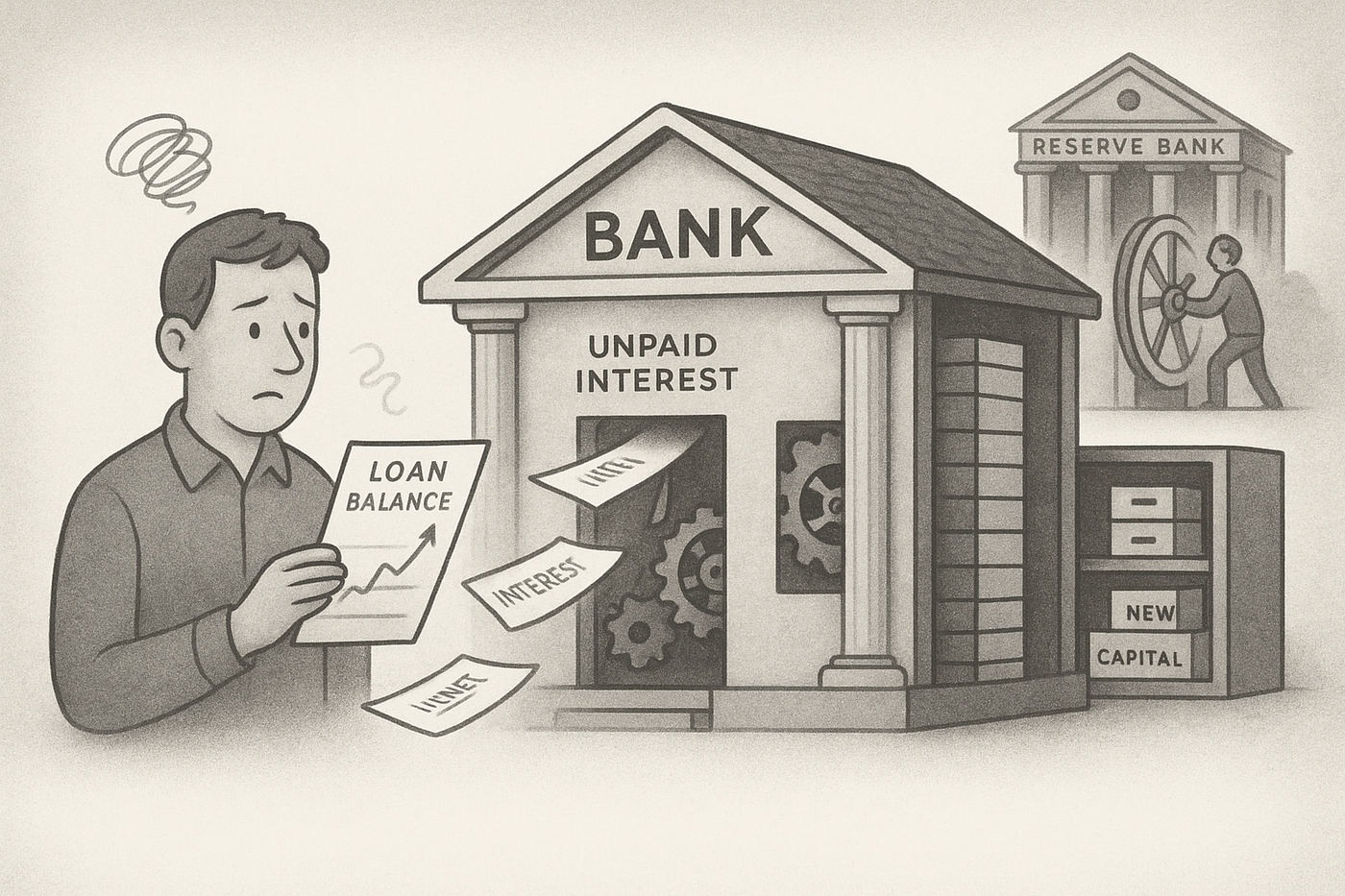
Under conventional finance, members make regular mortgage payments to a bank. Each payment consists of repayment of the original loan together with interest. The loan repayment reduces the outstanding debt, but the interest becomes income to the banking sector and leaves the cell permanently. Over time, this represents a substantial transfer of wealth from the community to external financial institutions.
Under the Cellular Economics model, members also make regular payments. The bank receives only a transparent service fee for administering the transaction. The remainder of each payment is returned to the government, which created the money. The government can then retire that money from circulation or issue it again to finance new productive activity.
The important difference is therefore not how much members pay, but where the money goes. Under conventional lending, interest continually leaves the cell. Under Cellular Economics, only the bank’s service fee leaves the cell, while repayments return to government. The financial value created by the community is therefore retained far more effectively within society instead of accumulating in the financial sector.
The difference is illustrated by financing an existing $700,000 property over twenty years.

These figures show that the Housing Cell exports far less money. Banking services are still paid for, but a transparent service fee replaces interest. Most of the money therefore remains available for public purposes rather than becoming private financial income.
This difference has important consequences for the long-term distribution of wealth. Conventional lending transfers a significant share of community income to those who already own financial capital. Because households with less wealth generally need to borrow a larger proportion of the value of their homes and they can only pay it off slowly, they also pay proportionally more interest over their lifetimes. The result is a gradual concentration of wealth.
The Housing Cell changes these financial flows. Contributions that would otherwise be absorbed as interest instead become ownership within the community. Wealth therefore accumulates within the cell instead of being transferred to external owners of financial assets.
All occupiers contribute money to the cell and members who own their homes or who vacate a home receive their money back with extra by selling the money to those who have not yet purchased their home. The longer the money is left in the cell and the slower it is taken out results in a return on investment. Its effect is the same as interest but it is “earned” as it is not taken out until earned and the earning rate is determined by how long it remains in the cell.
The simulation above demonstrates the effect. Without changing house prices or constructing any additional dwellings, the wealth Gini coefficient falls from 0.428 to 0.206, while the share of housing wealth owned by the bottom half of participants rises from 14.1 per cent to 35.0 per cent. At the same time most of the original public funding is returned to the government, while banking costs are limited and received as income not capital gains.
The significance of these results is that the houses have not become more valuable and the economy has not produced more housing. The improvement comes entirely from changing the financial rules governing the circulation of money. Less income leaks away as interest, more ownership remains within the community, and wealth becomes progressively more evenly distributed.
Cellular Economics therefore does not increase production. It changes the destination of financial flows. Instead of continuously exporting wealth through interest, it retains ownership within the community, returns the value of money creation to government, and substantially reduces wealth inequality while leaving the existing economy unchanged.
메타데이터
- post_id
- dfd85efc5c21
- slug
- money-does-not-make-more-money-dfd85efc5c21
- url
- https://medium.com/@kevin-34708/money-does-not-make-more-money-dfd85efc5c21
- canonical_url
- https://medium.com/@kevin-34708/money-does-not-make-more-money-dfd85efc5c21
- author_url
- https://medium.com/@kevin-34708
- status
- ok
- fetched_at
- 2026-08-10 20:44:44