Thailand’s 2026 Property Policies — What Foreign Buyers Actually Get
A friend in Singapore forwarded me a WeChat article last week. The headline promised a “2026 gift package” for Thailand property buyers —…
Thailand’s 2026 Property Policies — What Foreign Buyers Actually Get
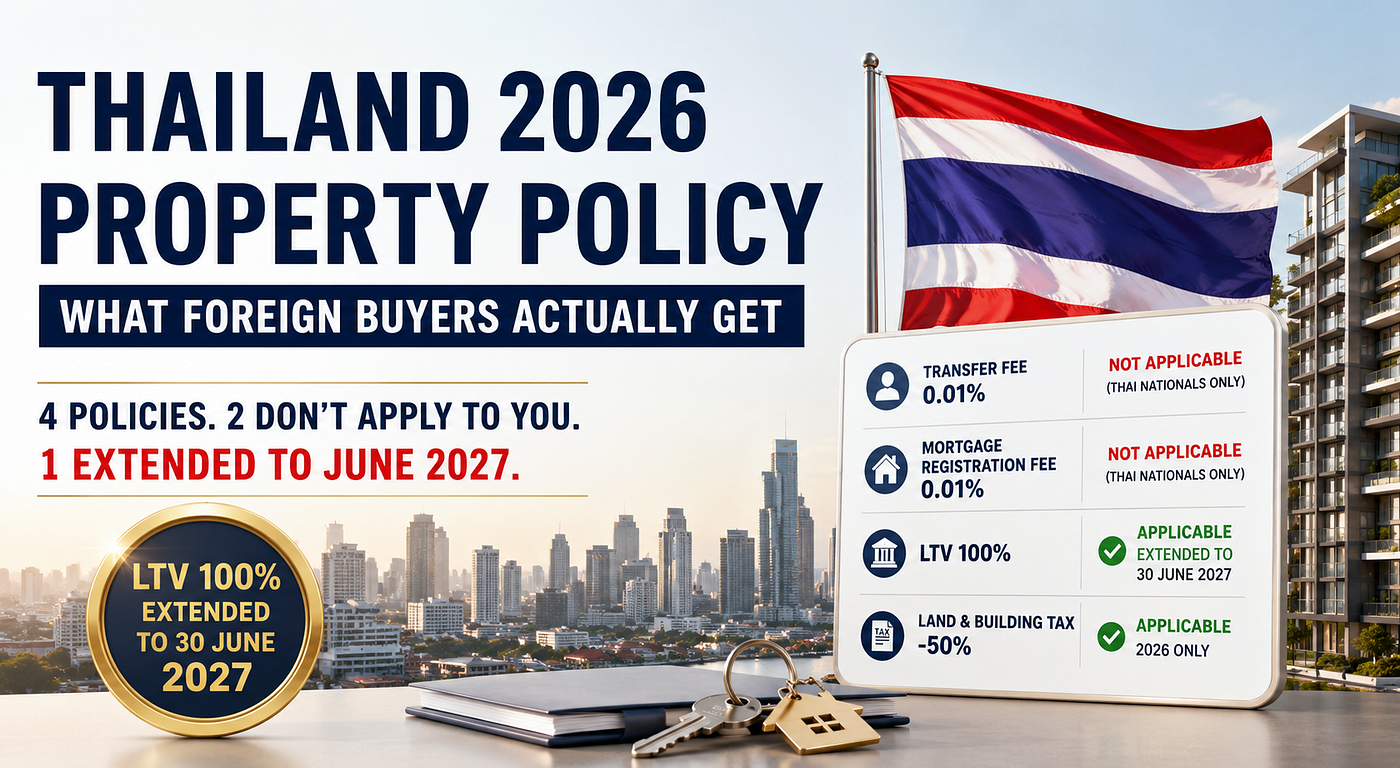
A friend in Singapore forwarded me a WeChat article last week. The headline promised a “2026 gift package” for Thailand property buyers — four stimulus measures rolled into one summary. He asked whether he should rush a Bangkok condo transfer before June 2026.
The answer surprised him. Two of the four measures don’t apply to him at all.
This piece walks through what’s actually in the policy stack, what foreign buyers are eligible for, and the one piece of news from late April that most English-language coverage hasn’t picked up yet.
The four-measure stack
The package commonly bundled together in regional press:
- Transfer fee cut from 2% to 0.01%
- Mortgage registration fee cut from 1% to 0.01%
- Bank of Thailand raising the LTV ceiling to 100%
- 50% reduction in land and building tax for 2026
The framing problem: measures 1 and 2 carry a nationality restriction that didn’t make it into most summaries. Measures 3 and 4 are open to foreign buyers but have practical nuances that affect how usable they really are.
Measure 1 and 2: Thai-nationals-only
The Thai cabinet approved both measures on 8 April 2025 and they took effect via Royal Gazette on 22 April 2025. The reduced rates apply to detached houses, semi-detached homes, townhouses, commercial buildings, accompanying land, and condominium units, capped at THB 7 million purchase price, official appraisal, and mortgage amount.
Per the legal interpretation issued by both Tilleke & Gibbins and Nishimura & Asahi when the measures landed, the reduced rate is available only to Thai nationals. Thai companies — even those with Thai majority ownership — and foreign nationals acquiring property are not eligible.
The expiration is 30 June 2026. Three industry associations (Housing Business Association, Thai Condominium Association, Thai Real Estate Association) have formally lobbied for a one-to-two-year extension. As of late May 2026, no official extension has been confirmed.
A workaround occasionally suggested in informal channels — purchasing under a Thai spouse’s name — runs into Land Code nominee-holding provisions. The Land Department escalated enforcement after 2006 and continues to investigate corporate structures suspected of being formed to circumvent foreign ownership rules. It’s not a clean cost optimization; it’s a legal question that deserves proper review.
Measure 3: The LTV extension that just changed
This is the underreported headline.
On 24 April 2026, Bank of Thailand Governor Vitai Ratanakorn announced the 100% LTV easing, originally set to expire on 30 June 2026, has been extended to 30 June 2027. BOT’s stated rationale: the property sector continues to show no clear recovery signal, and credit-side support remains warranted.
The mechanics:
- BOT permits banks to issue housing loans up to 100% of collateral value
- Originally launched 1 May 2025
- Applies to all price tiers (the original measure carved out specific rules for first vs. second homes; the relaxation covers both)
- No nationality restriction on the policy itself
The practical ceiling-vs-floor distinction:
100% is what BOT allows; it’s not what banks deliver. Foreign borrowers without Thai-sourced income face structural barriers — most domestic banks don’t extend mortgages to non-residents. The handful of foreign-friendly products (notably UOB and certain ICBC offshore offerings) come with terms that typically require evidence of Thai income, an LTR Visa, or Thailand Privilege Card.
In practice, foreign-buyer LTV outcomes I’ve seen for cross-border applicants tend to sit between 50% and 70%, with the higher end reserved for buyers with verifiable Thai income. The policy extension matters, but it improves a ceiling that most foreign buyers don’t actually hit.
Measure 4: The quiet land tax cut
The 50% reduction in land and building tax for 2026 applies to property owners regardless of nationality. For a Bangkok mid-range condo with an assessed value of THB 6 million, annual land and building tax typically ranges from THB 1,500 to 3,000 depending on use classification. Cutting that in half delivers a few hundred to a thousand baht in savings.
The absolute numbers are modest, but the principle is real: this is a holding-cost reduction available to foreign owners who often miss it in their cost projections. Worth checking with your management company that 2026 invoicing reflects the reduced rate.
What this means in practice
If you’re a foreign buyer considering Thai property right now:
The “rush a transfer before 30 June 2026” framing some Chinese-language and Southeast Asian press is pushing — disregard it. You weren’t going to benefit from the 0.01% rate anyway. Your transfer fee remains 2%, your mortgage registration fee remains 1%, and the timing pressure is artificial.
What does have a real timeline:
- LTV 100% policy window extended to mid-2027 (no immediate pressure)
- Land and building tax 50% cut covers 2026 only (check your management billing)
- The transfer fee extension lobbying is happening; if it succeeds and includes foreign buyers (unlikely based on past patterns), that becomes a 2026-H2 story
A useful mental reframe: the 2026 Thai property policy stack is real, but the timing pressure marketed in regional media is largely synthetic for foreign buyers. The policies aimed at you don’t carry a June 2026 deadline.
About BigHousekeeper
BigHousekeeper (泰国大管家) has been operating in Bangkok and Pattaya since 2020, providing trilingual end-to-end services for international property buyers — selection, legal review, mortgage facilitation, transfer support, and rental management. We work primarily with Chinese-speaking clients but the policy reality outlined here applies across foreign-buyer profiles.
Sources: Nation Thailand (24 April 2026), Bangkok Post (8 April 2025), Tilleke & Gibbins (24 April 2025), Nishimura & Asahi (April 2025), Chiang Rai Times (January 2026), Forbes & Partners (January 2026).
메타데이터
- post_id
- dfe64a474df5
- slug
- thailands-2026-property-policies-what-foreign-buyers-actually-get-dfe64a474df5
- url
- https://medium.com/@xingelucky0719/thailands-2026-property-policies-what-foreign-buyers-actually-get-dfe64a474df5
- canonical_url
- https://medium.com/@xingelucky0719/thailands-2026-property-policies-what-foreign-buyers-actually-get-dfe64a474df5
- author_url
- https://medium.com/@xingelucky0719
- status
- ok
- fetched_at
- 2026-07-22 05:12:34