Covert Narcissism in the Neurology of Selective Blindness
They don’t lie to you. Their brain edits the footage before it ever reaches their conscious mind — and neuroscience finally knows why.
Covert Narcissism in the Neurology of Selective Blindness
They don’t lie to you. Their brain edits the footage before it ever reaches their conscious mind — and neuroscience finally knows why.
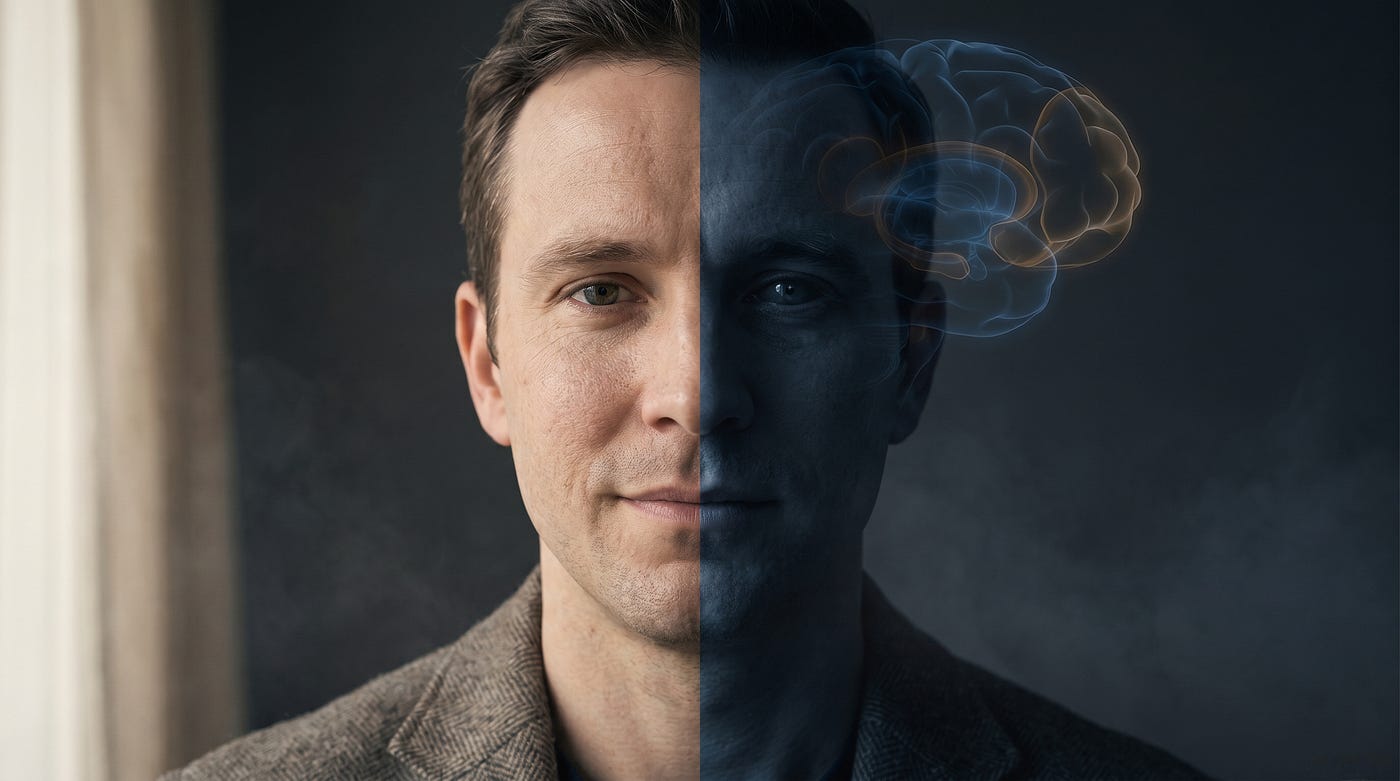
Image is generated via Nano Banana Pro.
The Moment You Realize You’re Not Crazy
There is a very specific kind of exhaustion that only certain people know.
It’s not the exhaustion of a hard day at work. It’s not grief. It’s not even the ordinary friction of a difficult relationship. It’s the exhaustion of standing in front of someone you love — a partner, a parent, a sibling, a boss — and describing something they did to you, something you both know happened, something you have text messages and witnesses and photographs to prove happened, and watching their face while they blink at you, slowly, with the quiet confidence of a person who has never once in their life done anything wrong.
They don’t argue. They don’t get defensive. They just… don’t see it.
Not the way a liar doesn’t see it. Liars know. Liars flinch. Liars have a little tell around the mouth, a micro-flicker in the eyes when the story gets close to the bone. What you are looking at is different. There is no flinch. There is no micro-flicker. There is a smoothness to their denial that feels almost architectural, as if the memory of what they did was never filed in the first place. As if the projector in their head simply skipped that reel.
And when you leave that conversation, you don’t feel angry. You feel unmoored. You feel the specific vertigo of a person whose grip on reality is being gently, methodically, lovingly loosened, one polite dismissal at a time.
For decades, the language we used to describe this experience was moral. He’s lying. She’s cruel. He’s a manipulator. She’s evil. And sometimes that language is accurate. But it misses something crucial — something that anyone who has actually lived with a covert narcissist will tell you if you ask them the right question. Which is: the scariest part isn’t that they’re lying. The scariest part is that, on some level, they really believe themselves.
That belief is not a moral failure. Not entirely.
That belief has a neurology.
This is an article about that neurology. About what actually happens inside the skull of a covertly narcissistic person when reality collides with a self-image the brain refuses to update. About why they seem to genuinely not remember. About why they can’t see what everyone else in the room can see. About the specific brain regions — the anterior insula, the medial prefrontal cortex, the default mode network, the salience system — that in a healthy brain say look at this, and in a covert narcissist’s brain say, softly and completely, look away.
Because once you understand the machinery of selective blindness, something changes. The exhaustion doesn’t vanish. But the vertigo does. You stop trying to make them see. You start seeing yourself.
And that, more than any diagnosis, is where recovery quietly begins.
Part One: What “Covert” Actually Means (And Why Everyone Gets It Wrong)
Ask a hundred people to describe a narcissist and ninety-eight of them will describe the same guy. He’s loud. He’s arrogant. He interrupts you at dinner parties. He talks about himself the way tourists talk about the Eiffel Tower — with reverent, unshakable astonishment. His car is expensive. His opinions are louder than his car. If narcissism were a movie, he’d be on the poster.
That guy exists. Clinicians call him a grandiose narcissist, and he is, in some ways, the least dangerous kind. Not because he isn’t difficult, but because he is legible. You can see him coming from across the parking lot. His diagnosis practically walks in ahead of him and shakes your hand.
The covert narcissist is the one you didn’t see coming.
The covert narcissist is quiet. Often shy. Frequently self-deprecating in a way that seems endearing at first and only later reveals itself as a kind of pre-emptive strike, a way of extracting reassurance from you before you’ve even realized you’re being asked for it. He may be a therapist. She may be a beloved teacher. He may be the “sensitive” one in the family, the one everybody protects, the one who has been through so much. She may be your mother, and she may have spent forty years apologizing for herself in a tone that somehow always ended with you apologizing to her.
Clinicians call this presentation vulnerable narcissism, and its dominant flavors are not arrogance and grandiosity but hypersensitivity, quiet entitlement, chronic victimhood, and a kind of morally-tinged martyrdom that turns every conversation into a subtle audit of your loyalty. Where the grandiose narcissist demands admiration, the covert narcissist harvests it — through pity, through guilt, through the unspoken contract that says: I am fragile, and if you upset me, you are the monster.
Here is the crucial neuroscientific point that almost every popular article misses: covert and grandiose narcissism are not opposites. They are the same core structure wearing different clothes.
The core structure is a self-concept that cannot tolerate contradiction.
The grandiose narcissist protects that self-concept by inflating it — louder, brighter, bigger than reality. The covert narcissist protects it by hiding it — quieter, smaller, more wounded than reality. But both are engaged in the same underlying operation, which is the constant, exhausting, second-by-second editing of incoming information so that nothing threatening to the self ever quite makes it to the surface.
That editing process is where the neurology begins.
Part Two: The Insula — The Missing Room in the House
If you want to understand covert narcissism at the level of the brain, you begin with a walnut-shaped region buried deep inside each hemisphere, tucked behind the temporal lobe like a room the architects almost forgot to include. It’s called the insula — from the Latin insula, “island” — and for most of the 20th century, neuroscience largely ignored it.
Then, in the last two decades, something extraordinary happened. Researchers began to realize that the insula was one of the most important structures in the entire human brain, because it turned out to be the region that answers the most human question there is: what is it like to be someone?
The insula is where your body’s signals — your heartbeat, your gut, your breath, the tightening in your throat when you’re about to cry — are integrated with awareness. It is where you feel that you feel. When you see a stranger hit their thumb with a hammer and you wince involuntarily, that is your insula doing what it was designed to do. It is running a fast, embodied simulation of what the other person is experiencing, and it is delivering that simulation to you as sensation. Not as an idea. As sensation. That is what empathy actually is at the neural level — not a thought about someone else’s pain, but a felt echo of it in your own body.
In 2013, a team led by the neuroscientist Lars Schulze at the Charité hospital in Berlin published a study that would quietly reshape the field. Using structural MRI, they scanned the brains of patients with diagnosed narcissistic personality disorder and compared them to matched controls. What they found was not a subtle statistical wiggle. It was a hole.
The narcissistic patients had significantly reduced gray matter volume in the left anterior insula. Not a difference in activity. A difference in tissue. There was less brain there.
Let that sit for a moment.
We are not talking about a personality quirk. We are not talking about a bad habit. We are talking about a measurable structural deficit in the exact region of the brain responsible for translating another human being’s inner experience into something you can feel. And that deficit was correlated with the severity of empathy impairment on standardized clinical measures. The smaller the insula, the smaller the felt echo. The smaller the felt echo, the smaller the moral gravity of your effect on other people.
Subsequent studies — including a 2021 paper from Nenadić and colleagues published in Scientific Reports, and a growing meta-analytic literature — have replicated and extended this finding. Narcissistic traits, especially in the vulnerable/covert dimension, are associated with structural and functional abnormalities in a network centered on the anterior insula and adjacent regions of the prefrontal cortex. A 2013 theoretical paper by Jankowiak-Siuda and colleagues proposed a “neural model of empathy deficits in narcissism” that placed the anterior insula at the center of the entire disorder.
Here is what this means in the language of a Tuesday morning breakfast argument.
When your covertly narcissistic partner watches you cry, something is not happening in their brain that would be happening in almost anyone else’s. The felt echo isn’t arriving. They see the tears. They register them cognitively — they know, in an intellectual sense, that you are upset. They may even respond with the correct scripted behaviors: a soft voice, a tilted head, a hand reaching across the table. But the physiological pull, the involuntary tug in the chest that would make almost any other human being at that table stop what they were doing and orient toward your pain — that signal is faint, or absent, or drowned out.
And because it is faint, your pain does not register as data that needs to be integrated into their self-concept. It gets filed under “your problem.” It gets filed under “you’re being emotional again.” It gets filed anywhere except I have hurt someone I love.
This is the first architectural fact of covert narcissism, and everything else in this article is built on top of it. The room where empathy is supposed to live is under-furnished. Sometimes almost empty.
But — and this is what makes covert narcissism so uniquely disorienting — the door is still there. The lights are still on. The narcissist can still perform, with startling accuracy, all the outward behaviors of an empathic person. Because the cognitive pathway to understanding other minds — what neuroscientists call theory of mind or cognitive empathy — is often intact, sometimes even hypertrophied, in narcissists. They can read you. They can predict you. They can identify exactly which button, if pressed, will produce which response. What they cannot do is feel you.
Cognitive empathy without emotional empathy is not empathy. It is targeting.
Part Three: The Default Mode Network — Or, The Locked Room of the Self
If the insula is the missing room, the default mode network — DMN, for the rest of this article — is the room that never turns off.
The DMN is one of the great discoveries of 21st-century neuroscience. It is a distributed network of brain regions — medial prefrontal cortex, posterior cingulate, precuneus, angular gyrus, parts of the temporal lobes — that becomes most active when you are not doing anything in particular. Daydreaming. Remembering. Imagining the future. Rehearsing a conversation. Thinking about yourself.
The DMN is, more or less, the neural signature of the autobiographical “I.” It’s the loop that runs in the background while you’re waiting for the kettle to boil. It’s the theater in which you replay yesterday’s meeting and rewrite what you should have said. It is, in a very real sense, the part of your brain that generates the feeling that there is a you to whom things are happening.
In a healthy brain, the DMN has a beautiful property: it turns off when it’s supposed to. When you focus on an external task — driving in traffic, listening to a friend describe a painful loss, threading a needle — the DMN quiets down, and other networks (the salience network, the central executive network) take over, orienting your attention outward, toward the world.
In narcissism, especially in the covert/vulnerable dimension, this switching mechanism appears to be broken.
A 2024 neuroimaging study using joint gray-matter and white-matter features to predict narcissistic traits found that DMN characteristics were among the strongest neural correlates of trait narcissism. Other studies have found that narcissistic individuals show excessive DMN activation during social tasks — that is, during moments when a healthy brain would be dampening self-referential processing to make room for the other person, the narcissist’s brain is increasing it.
Translated into human terms: when you are telling your covertly narcissistic partner about your father’s cancer diagnosis, and their eyes get that faraway look, and they nod at the wrong intervals, and then somehow the conversation ends up being about how they feel when they think about their own father — this is not a personality flaw. This is a brain network that literally cannot dim itself. The theater of the self does not go dark to let another person’s story be projected on the screen. The narcissist is watching two movies at once, and their own always has the louder soundtrack.
The mind-lab literature on the salience network failure in narcissism deepens this picture. The salience network — anchored in the anterior insula and the anterior cingulate cortex — is supposed to act as a switchboard, deciding, moment to moment, which stimuli matter enough to interrupt whatever is currently running in the DMN. In narcissists, that switchboard is miswired. Threats to the ego get flagged as maximally salient — instantly, disproportionately, catastrophically. But other people’s emotions? Ambient signals of harm caused? Data that contradicts the self-story? The gain on those signals is turned way, way down.
This is the neurology of a person who can walk out of a fight in which they have just made you sob, and thirty minutes later ask you what you want for dinner, in the same tone of voice they would use if the previous conversation had never happened. Because in their DMN — the theater where their sense of continuous self is being generated — the previous conversation didn’t happen the way it happened. It was already edited. In real time. By hardware.
Part Four: Selective Attention — The Flashlight That Refuses to Point at Certain Things
You have probably seen the video with the gorilla.
If you haven’t, the setup is famous. Two teams of students, one in white shirts, one in black, pass basketballs around. You are told to count how many passes the white team makes. Halfway through the video, a person in a full gorilla costume walks slowly through the middle of the frame, stops, beats their chest, and walks off. When the video ends, the researcher asks: did you see the gorilla?
Roughly half the audience says no.
The experiment, designed by Daniel Simons and Christopher Chabris, became the most famous demonstration of a phenomenon called inattentional blindness — the astonishing fact that human beings routinely fail to perceive things directly in their visual field when their attention is committed elsewhere. The gorilla is not subtle. It doesn’t scurry. It doesn’t hide. It is right there, in the middle of the room, doing gorilla things. And half of us miss it.
The gorilla is unsettling not because it demonstrates that human perception is imperfect. It is unsettling because it demonstrates that our subjective experience of “seeing everything in front of us” is a comforting lie the brain tells itself. What we actually see is a highly curated slice of the visual field, selected for us in advance by attention systems we have almost no conscious access to. Attention is not a floodlight. It is a flashlight with an operator we didn’t hire.
Now consider what happens when the operator of that flashlight has been trained, over years and decades, to protect a self-concept that cannot survive contradiction.
A 2014 study published in Personality and Individual Differences examined how different dimensions of narcissism moderate selective attention to evaluative stimuli. The researchers used a dot-probe paradigm — a classic attention task where subjects are shown pairs of words, some threatening to the self and some neutral, and are then asked to respond to a probe that appears in the location of one of the words. The reaction time reveals where their attention was actually pointing.
The findings were striking. Narcissistic individuals — and particularly those high on vulnerable/covert dimensions — showed a distinct pattern of motivated selective attention in response to evaluative stimuli. Their attention was not neutral. It was strategic. It was oriented, at pre-conscious speeds, toward information that could feed the self and away from information that could threaten it.
Read that again, because the implications are enormous. Before the covert narcissist has even had a conscious thought about the interaction in front of them, their attention system has already decided what parts of it they will and will not perceive.
This is not lying. This is not manipulation, in the ordinary moral sense of the word. This is a bias in the very first layer of the perceptual system, operating on timescales — under 200 milliseconds — that are radically inaccessible to conscious control. By the time the narcissist’s higher cortical areas are stitching together a coherent scene of “what just happened in that conversation,” the raw material they are working with has already been filtered. Certain data got a spotlight. Certain data got the shadow.
The gorilla walked through the room. But if the gorilla was carrying a mirror in which the narcissist would have to see their own cruelty, the flashlight in their head made absolutely certain that the beam of attention was pointed somewhere else.
Part Five: Selective Memory — The Archive That Rewrites Itself
Attention decides what gets recorded. Memory decides what gets kept.
If you have spent any significant time with a covert narcissist, you have almost certainly had the following experience. You reference something they said last Thursday — something specific, something wounding, something you have replayed in your head all weekend. And they say, with a look of gentle confusion, I never said that. Why would I say that? That doesn’t sound like something I would say.
The experience is disorienting because they aren’t performing. There is no dramatic denial. There is no protest-too-much. There is just a soft, slightly puzzled correction of the record, delivered with the air of someone patiently explaining a small factual error to a child. And you begin to wonder — because they are so calm, and they seem so sure — whether it is possible that you have misremembered. Whether you are, in fact, the one who is a little bit unhinged.
You are not.
The neuroscience of memory is one of the great humbling subjects. For most of the 20th century, memory was imagined on the analogy of a filing cabinet. You had an experience, a file was created, and later, when you needed it, you retrieved the file. In this model, forgetting was like losing a folder. Distortion was rare.
Contemporary memory science has torn that analogy apart. What we now know is that memory is not storage — it is reconstruction. Every time you recall an event, you are not opening a file. You are re-assembling the event from fragments, in the presence of your current mood, your current beliefs, your current self-concept. And when you’re done, you re-file the reconstructed version. Which means that every recall is also a re-write. Your archive is being continuously edited by the person you are today, working on the memories of the person you were yesterday.
For most people, this is a mild source of distortion — the reason siblings remember the same childhood dinner in three incompatible ways. For the covert narcissist, it is something more profound.
Here is what emerging research on the neurobiology of narcissistic gaslighting suggests. In a narcissist, memory reconstruction is happening in a brain where the DMN is over-active, where the salience network is biased toward self-protection, and where the anterior insula’s role in binding embodied emotion to autobiographical scenes is compromised. The result is a memory system that is not just biased. It is actively editing autobiographical experience to be compatible with the current self-image, in real time, without informing the narcissist that any editing has occurred.
They are not lying when they say I never said that. In the archive they are pulling from — the archive that has been quietly, continuously re-written to be consistent with their view of themselves as a good, kind, wounded person — they never said it. The version in their head is true. The version in your head is also true. But only one of you is aware that memory is a reconstructed act rather than a retrieval.
Chateau Health and other clinical outlets have documented the flip side of this in the victims of narcissistic abuse — an enlarged, hyper-reactive amygdala and a shrunken hippocampus, as chronic stress hormones corrode the very memory systems the abuse victim needs in order to trust their own recollection. So while the narcissist’s brain is quietly re-writing the archive, the victim’s brain is being neurochemically primed to distrust their own version of it.
This is what gaslighting is, at the neural level. It is not one brain lying to another. It is one brain that has stopped keeping accurate records, in dialogue with another brain that has been medically prevented from trusting its own.
Part Six: The Mirror Neuron Problem — Simulation Without Substance
There is a class of neurons in the primate brain — first discovered in macaque monkeys in the 1990s and later confirmed to exist in some form in humans — that fires both when you perform an action and when you watch someone else perform that action. They are called mirror neurons, and their discovery was one of those rare neuroscientific events that felt almost philosophical. Here, apparently, was the biological substrate of the fact that humans are, at bottom, imitative animals — that our minds are shaped by our capacity to internally mimic the minds of others.
The mirror neuron system is intimately connected to empathy. When you watch someone reach for a cup of coffee, a subset of the same motor neurons that would fire if you were reaching for a cup of coffee fires — quietly, sub-threshold, invisibly. When you watch someone flinch in pain, the mirror system activates the pain-related regions of your own brain. This is one of the mechanisms that make emotional contagion possible. It is one reason a room full of strangers can go quiet all at once when someone begins to cry.
In narcissism, research suggests, there is a specific and unusual pattern of mirror neuron functioning that clinicians and researchers sometimes call — informally — a mirror neuron receptor deficit. The system is not absent. It works, in a mechanical sense. But its outputs are decoupled from the emotional integration that would normally give them meaning.
Think of it this way. A functional mirror neuron system doesn’t just simulate the other person’s action — it delivers that simulation to the insula, the anterior cingulate, and the prefrontal cortex, where it becomes felt, where it becomes moral, where it becomes an input into decisions about how to treat the person in front of you. In the covert narcissist, the simulation still happens. That is why they can mimic empathy so well. That is why the therapist-narcissist can nail the concerned head-tilt. That is why the covert-narcissist parent knows exactly which words the “good mother” is supposed to say when their child comes home crying from school. They are simulating you very accurately. They just aren’t feeling the simulation.
This is the essence of covert narcissism as a neurological phenomenon. It is not that the narcissist doesn’t understand you. It is that they understand you in the way a very good actor understands the role they are playing — from the outside, with technique, without ever quite becoming the character.
And here is where the “selective blindness” of this article’s title acquires its most haunting layer. Because a person who is simulating empathy without feeling it can pass, for years, sometimes for a lifetime, as an empathic person. They can build a marriage on that simulation. They can raise children on it. They can accumulate a small kingdom of people who love them and who cannot, quite, put their finger on why they feel so alone inside those relationships.
The blindness isn’t only in the narcissist’s perception of you. It is also in your perception of them. Because your brain, with its intact mirror system and functional insula, is designed to assume that when you see the outward signs of empathy in another person, there is inner empathy behind those signs. That assumption is one of the deepest and most useful predictions the social brain makes.
The covert narcissist is a specific and rare exception to that prediction. Which is why it takes so many people so long to see them clearly. We are not built to perceive an empty room behind a lit-up face.
Part Seven: The Neurology of the Narcissistic Injury
For all the stillness of the covert presentation, there is one moment when the underlying machinery becomes suddenly, terrifyingly visible: the narcissistic injury.
You know this moment even if you don’t have a name for it. It is the moment when you inadvertently — you didn’t even mean to — pierce the veil. You point out a specific inconsistency in what they’ve said. You bring up an old promise. You mention, casually, someone else’s success. You catch them in a small, verifiable lie. And something happens in the atmosphere of the room that is almost meteorological. A cold front moves through. The temperature drops. Their face becomes very still.
What happens next varies. Sometimes it is silence — days of silence, a punitive freeze that seems wildly disproportionate to what you actually did. Sometimes it is a sudden, precisely-aimed cruelty, delivered in a tone so calm you almost miss it. Sometimes it is tears — the covert narcissist’s specialty — a swift and total inversion of the moral field, in which the person who was doing the hurting becomes, in the space of a single sentence, the person who has been hurt beyond bearing.
Whatever the outward form, what is happening on the inside is a specific and researched neurological event.
A landmark 2015 fMRI study by Chester and colleagues — “Narcissists’ social pain seen only in the brain” — put narcissistic and non-narcissistic subjects through a classic social rejection paradigm called Cyberball, in which subjects believe they are playing a ball-toss game with two other players who then, mid-game, stop throwing them the ball. On self-report, narcissists said they weren’t upset. Behaviorally, they were composed. But in the scanner, the dorsal anterior cingulate cortex and the anterior insula — the same regions that light up in response to physical pain — were hyperactive. Their brains were experiencing rejection like a burn while their words were denying that anything was wrong.
This mismatch is the covert narcissist in one sentence. On the surface, unperturbed. Underneath, on fire.
And that fire is what drives everything else in the disorder. The chronic vigilance. The stockpiled resentments. The eerie, encyclopedic memory of every slight, every unreturned compliment, every friend who once got a bigger promotion. The self they have constructed is not just a preferred identity. It is a burn ward. Any input that threatens it feels, at the neural level, like a scalpel on exposed tissue. And so the whole vast apparatus we have just walked through — the under-active empathy circuits, the over-active DMN, the biased attention, the reconstructive memory — is not, in evolutionary or personal terms, a bug. It is a functioning immune system for a self that cannot survive being seen clearly.
Selective blindness, in other words, is not a symptom of narcissism. Selective blindness is the treatment the narcissistic brain has developed for a wound it cannot afford to look at.
Part Eight: Why the Covert Version Is Uniquely Punishing to Live With
At this point, an obvious question is worth naming. If both grandiose and covert narcissism share the same underlying neural architecture, why is the covert version so uniquely destabilizing to the people around it?
The answer has to do with visibility, deniability, and the direction of moral gravity.
The grandiose narcissist is, at bottom, easy to leave. Not easy in an emotional sense — leaving is never emotionally easy — but easy in an epistemic sense. Their behavior is legible. When your grandiose narcissist boss screams at you in front of the whole office, other people saw it. When your grandiose narcissist ex told you at your grandmother’s funeral that they were sad because you weren’t paying enough attention to them, your sister was standing right there. The community can help you carry the reality. You are not the only witness to the crime.
The covert narcissist commits their crimes with no witnesses.
Their weapons are the sigh, the withdrawn silence, the passive-aggressive text, the compliment that is not quite a compliment, the reminder of a favor that was not quite a favor, the “I would never say something like that,” delivered in a soft voice with slightly wet eyes at exactly the moment you needed them to acknowledge that they had, in fact, said something exactly like that. To an outside observer — a friend, a therapist you’re describing them to, a jury of your own family — none of it sounds like anything. So they… were quiet at dinner? Yes. And you’re upset because…? And you cannot, in that moment, explain the accumulated weight of ten thousand small moments in which reality was gently, deniably rearranged around the covert narcissist’s needs.
The moral gravity of the relationship reverses. In a grandiose relationship, the narcissist is the obvious villain and you are the obvious wounded party. In a covert relationship, the narcissist is the wounded party and you are the obvious villain. They are so sensitive. They have been through so much. You are the one who keeps bringing up old fights. You are the one who is “never satisfied.” You are the one who, if you were a better spouse, a better daughter, a better employee, would not need to keep pointing out these small, painful things they can’t quite remember doing.
This inversion is not accidental. It is the natural output of the neural machinery we have been describing. Because the covert narcissist’s brain is genuinely running the self-story in which they are the wounded innocent, and yours is being neurochemically pushed toward doubt, the resulting field of interpretation is going to favor their version by default. Not because they are more persuasive. Because the biology of the encounter is asymmetric.
The particular cruelty of covert narcissism is that it teaches its victims to distrust their own perception at exactly the moment that accurate perception is the only thing that would set them free.
This is why so many people spend years in these relationships without being able to name what is happening. It is not a failure of intelligence. It is not a failure of self-worth. It is a failure that has been built for you, in real time, by a nervous system whose selective blindness is contagious. When you spend enough time in an environment where certain kinds of information are systematically deleted, you begin to delete them from your own experience too. You start not seeing what you’re seeing. You start not remembering what you remember. You start, in the most literal neural sense, to inherit their blindness.
The way out begins with understanding that the blindness was theirs first.
Part Nine: How the Covert Narcissist Was Made (And the Uncomfortable Compassion It Requires)
There is a temptation, once you have understood the neurology, to weaponize it. To say: see, they are broken. They have a defective brain. I owe them nothing. And there is a real sense in which that reframe is a legitimate and necessary step in recovery, especially for people who have spent years assuming the fault was theirs.
But the fuller truth is more complex, and honoring it does not require you to stay in the relationship or forgive the harm. It only requires you to see the human being on the other side of the disorder for what they actually are.
The covert narcissist was not born with an under-furnished insula.
Structural and functional brain differences of the kind we have been discussing are, in almost every case, the outcome of a developmental process, not the starting point of one. The dominant theoretical framework in the field — supported by decades of attachment research — is that pathological narcissism, and particularly its covert variant, is a defensive adaptation to early-life environments in which the child’s authentic self was not safe.
The specific developmental profile associated with covert narcissism is not the profile of the spoiled child, contrary to popular belief. It is, more often, the profile of a child who was used. A child whose emotional life was invisible to a parent who was themselves narcissistic, or depressed, or absent, or engulfing. A child who learned, very early, that being seen accurately was dangerous, and that being useful — being the shining reflection in the parent’s mirror, or the caretaker of the parent’s fragility — was the price of remaining loved.
That child does something extraordinary and heartbreaking. They build a false self — a version of themselves designed to meet the parent’s needs — and they exile the real self somewhere the parent can’t damage it. The exile works. For a while. Sometimes for decades. But the neural cost of maintaining a false self is precisely the machinery we have been describing. An empathy circuit that must be dampened because feeling other people’s reality accurately would let in feedback that could destabilize the false self. A DMN that runs constantly because the false self requires constant maintenance. A memory system that edits itself because the false self cannot survive an accurate history.
This is not an excuse. Adults are responsible for what their false selves do to the people around them, and the damage done by covert narcissists is not less real for having originated in a wound. But it does change the moral texture of the disorder. The person hurting you is, in most cases, someone who was themselves hurt in a very specific way at a very early age, and whose entire personality is now organized around never letting that wound be touched again — including by you, including by their own conscience, including by their own memory of what happened at dinner last Thursday.
You can hold both truths at once. You can say: this person was hurt, and this person is hurting me, and my continued proximity to them is not a treatment for their original wound and is a continuing source of my own. Neurology gives you the framework for that compassion. It does not obligate you to stay.
The most useful reframe I know, for people leaving these relationships, is this: you are not leaving because you have stopped loving them. You are leaving because you have finally understood that the person you love cannot see you, and that no amount of your seeing them clearly is going to give them back the neural equipment they lost, or never developed, decades before you met.
That is a different, quieter, more permanent grief than the one people usually name. It is worth naming.
Part Ten: What Selective Blindness Feels Like From the Inside (A Speculative but Grounded Portrait)
The literature on narcissism is written almost entirely from the outside — by clinicians studying patients, by researchers studying subjects, by survivors describing their abusers. What is unusually rare in the literature is a first-person account of what it actually feels like to be a covert narcissist. This is not accidental. The disorder is defined, in part, by the inability to see it in oneself.
But we can, based on the neuroscience, offer a grounded speculative portrait — and it is worth doing, not to humanize the disorder in a way that softens its harms, but to give the reader a felt sense of why change is so hard.
Imagine that from the age of four or five, you have been carrying, in the pocket of your mind, a small photograph of the person you are. In the photograph you are good. You are sensitive. You have suffered, and your suffering has made you wise. Other people, on the whole, do not understand how much you carry. You are gentle where they are harsh. You are patient where they are demanding. You have never, that you can recall, been cruel to anyone who did not deserve it.
Now imagine that every sensory input, every interaction, every memory in your entire life, gets routed — before it reaches conscious awareness — through a filter that asks a single question: does this information contradict the photograph? And imagine that when the answer is yes, the input is quietly, mechanically, non-consciously dimmed. Reduced in salience. Filed under an ambiguous heading. Softened at the edges. Its emotional signature stripped. So that by the time it reaches you — the you who is aware of being a you — the input has been rendered vague, or reframed as someone else’s problem, or attached to a plausible reinterpretation in which the photograph is preserved.
You are not, from inside this system, aware that any filtering is happening.
You are simply moving through a world in which the photograph keeps being confirmed. Interactions that would strain the photograph seem, to you, to have been about something other than what the other person is now claiming they were about. Their tears seem excessive. Their memory of the fight seems distorted. Their story of what you said to them at Christmas seems, honestly, a little unfair — you would never say something like that. You have looked at the photograph in your pocket. You have consulted it. It is still there. It has not changed.
When they leave you, or when they finally, after years, tell you what living with you was like, the input is so wildly incompatible with the photograph that the filter cannot dim it fast enough. There is a moment — sometimes only a moment — in which the whole system wobbles, and something like grief threatens to come through. And then the filter catches up. And you begin to construct a narrative in which they were unstable, and unfair, and never really understood you. And the photograph is safe again. And the loss is theirs.
This is what selective blindness feels like from the inside. It does not feel like blindness. It feels like clarity. That is the horror of it, and also, in a strange and difficult way, the tragedy. The covert narcissist is not a person hiding the truth from other people. The covert narcissist is a person whose brain has been hiding the truth from them for so long, and so effectively, that they have never once in their adult life seen the full and continuous shape of their own effect on the world.
They have been the last person in every room who knew what was happening in that room.
Part Eleven: The Neuroscience of Getting Free
If you have been living inside the field of a covert narcissist’s selective blindness, your own nervous system has been changed by it. This is not a metaphor. It is a documented clinical phenomenon.
Chronic exposure to gaslighting and covert emotional abuse produces measurable changes in the brains of the victims: elevated baseline cortisol, hyperactive amygdala responses to ordinary conflict cues, hippocampal atrophy that compromises the very memory function you need in order to reconstruct what actually happened to you, and disrupted functional connectivity between the prefrontal cortex and the limbic system that makes emotional regulation feel almost impossible. Some clinicians have begun describing the constellation as a specific variant of complex PTSD.
The recovery, then, is not primarily an intellectual project. It is a neural one.
The first phase of healing, in almost every model, is what trauma-informed clinicians call narrative reconstruction. This is not therapy in the sense of talking about your feelings. It is the very specific work of rebuilding, from external evidence — journals, text messages, witnesses, photographs, timelines — an accurate archive of what happened to you. You are, in essence, doing for yourself what the narcissist’s brain refused to do: keeping the tape. Reading it back. Refusing to let the memory system, damaged by chronic stress, be the sole judge of what was real.
The second phase is somatic. The body kept the score, in the phrase made famous by Bessel van der Kolk, and the body is often the last part of the system to hear the news that the danger has passed. Nervous-system regulation practices — breath work, cold exposure, slow long exercise, safe touch, contact with animals, contact with nature — are not New Age accessories. They are what allows the amygdala to gradually stop screaming and the vagus nerve to gradually resume its work of connecting you back to other human beings.
The third phase is relational. And this is where the neurology of selective blindness has a strange and beautiful gift to give. Because once you have understood, deeply, that the narcissist’s inability to see you was not a comment on your visibility — was, in fact, a comment on the specific architecture of a specific damaged brain — you can begin to test the world again. You can walk into a room and let people meet you. You can say the true thing and see whether the other person’s eyes track. And when the eyes track, when the felt echo comes back, when your reality is met by a nervous system that is neurologically equipped to receive it, something in you begins to trust again.
That trust is not naïve. It is calibrated. You have been through a very specific and rare human experience — you have loved and lived with a person whose brain was structurally unable to fully take you in — and the discernment you have earned as a result is not something anyone can take back from you. You will, for the rest of your life, be able to tell the difference between a face that is performing empathy and a face that is feeling it. That is not a wound. That is a wound that became instrument.
You did not deserve the education. But you now have it.
Part Twelve: What Neuroscience Does Not Yet Know, and Why the Uncertainty Matters
An honest article about the brain and narcissism has to name the limits of the current science, because otherwise it will overpromise.
The studies we have discussed — Schulze on gray matter deficits in the anterior insula, Nenadić on prefrontal structure, Chester on the fMRI signature of narcissistic social pain, Jankowiak-Siuda’s neural model of empathy deficits, the emerging literature on default mode network dysfunction — are real, replicated in several instances, and increasingly convergent. But they are also, in the standard scientific sense, early. Sample sizes are often modest. Diagnostic categories are contested. The distinction between “trait narcissism” in college undergraduate samples and clinically diagnosed NPD in patient samples is not always cleanly maintained across the literature. Neuroscience is a young discipline. Personality neuroscience is younger. Covert-specific neuroscience is younger still.
What we can say with confidence is this:
There is now a substantial and growing body of neuroimaging evidence that pathological narcissism is associated with structural and functional differences in a specific network of brain regions — chiefly the anterior insula, the medial prefrontal cortex, and the default mode network — that are exactly the regions we would predict from the psychological literature on empathy deficits, self-referential over-processing, and reality-editing memory. The convergence between what phenomenology has been telling us about narcissism for a hundred years and what neuroimaging is now beginning to show us is not a coincidence. It is the sound of two different disciplines slowly agreeing.
What we cannot yet say with confidence is precisely which of these differences are causes, which are consequences, and which are both. Brains and behaviors shape each other bidirectionally across a lifespan. The reduced gray matter in the anterior insula that Schulze documented may reflect a lifelong pattern of not-using that circuit; alternatively, it may reflect a developmental substrate that made the pattern more likely from the start. Almost certainly it is both, in some person-specific ratio we cannot yet measure.
Why does this uncertainty matter?
It matters because it protects us from two opposite and equally dangerous conclusions. On one side, biological determinism: the belief that a narcissist is a broken brain and cannot change. This is not what the neuroscience says. Brains have neuroplasticity across the lifespan. Insight, therapy, and specific structured interventions can and do change functional connectivity, and in some cases even structural volume, in the very regions we have been discussing. Change is rare in pathological narcissism, and it requires an unusual combination of insight, humility, and sustained work. But it is not neurologically impossible.
On the other side, moral minimization: the belief that if narcissism has a neural basis, the narcissist is not responsible for their behavior. This, too, is not what the neuroscience says. The whole point of a mature nervous system is that it enables — sometimes with difficulty — behavior that transcends its own default settings. Every human being has to work against some biological tilt or another. The narcissist’s tilt is unusually strong, and the wound underneath it is unusually deep, but neither of those facts removes the responsibility for what they do to the people who love them.
The neuroscience of covert narcissism, in the end, is not a verdict. It is a map. It shows you the terrain the disorder is playing on. It does not tell you what to do next.
That, as it always has been, is up to the humans who love the humans with these brains — and, eventually, to the humans with these brains themselves, if and when they choose to look.
Part Thirteen: What This Changes for the Rest of Us
There is one final piece of this that deserves to be named clearly, because it is where the article’s real usefulness lives.
The neurology of selective blindness is not a story about them. It is also, quietly and importantly, a story about us.
We all have an insula. We all have a default mode network. We all have selective attention systems that filter reality before it reaches consciousness, and reconstructive memory systems that continually re-write our own past to be compatible with our current self-story. What differs between the healthy brain and the pathologically narcissistic brain is not the presence of these systems — it is the degree of their bias.
Every one of us, on a bad day, is a little bit blind to the ways we are hurting the people around us. Every one of us has said, in some form, I never said that, when in fact we did. Every one of us has walked past a gorilla in the middle of the room, focused so hard on our own counting task that we missed the great, obvious, chest-beating truth about someone we love. This is not narcissism. This is being human. But it is on a continuum with narcissism, and the continuum is worth knowing about.
The gift of studying the covert narcissist’s brain, in the end, is not primarily that it helps us diagnose the specific person who is hurting us. It is that it helps us understand the ordinary architecture of self-protective perception in every skull, including our own — and it gives us a felt sense of what it would cost, moment to moment, to see other people slightly more clearly than our brain wants us to.
That cost is real. Seeing accurately is metabolically expensive. It requires the DMN to quiet down. It requires the insula to accept signals that make the self-story wobble. It requires the memory system to hold on to versions of events that don’t flatter us. It requires attention to be pointed, sometimes, at things we would rather not look at.
It is easier not to do.
But there is a specific and permanent freedom that becomes available to a person who is willing to do it. That person will make many other mistakes in their life, but they will not spend it as a member of the last-person-in-the-room-to-know club. They will be the one — quiet, unshowy, mostly unrewarded — who can be trusted with the truth about themselves and about the people around them. They will love and be loved with a texture that the narcissist, tragically, never gets to experience: the texture of being fully seen, without editing, and choosing to stay.
That is not a small thing. That is, arguably, most of what a good life is.
The covert narcissist cannot do it. Their neurology, in its exquisite, self-protective, tragic architecture, has closed that door. The rest of us — you, reading this, right now — still have it open.
Don’t waste it trying to convince someone whose brain has been designed not to see you. Spend it, instead, on becoming someone who sees.
That is where selective blindness, both theirs and yours, finally ends.
If this article helped you name something you have been living with, that recognition itself is the beginning of a great deal. Your perception was accurate. Your memory was accurate. The vertigo was not yours. It was the field. Now that you can see the field, you can decide what you want to do with the rest of your life inside it, or outside of it. Either way — for the first time in a long time — the choice is yours.
메타데이터
- post_id
- dfedc2b533fb
- slug
- covert-narcissism-in-the-neurology-of-selective-blindness-dfedc2b533fb
- url
- https://medium.com/psyche-pedia/covert-narcissism-in-the-neurology-of-selective-blindness-dfedc2b533fb
- canonical_url
- https://medium.com/psyche-pedia/covert-narcissism-in-the-neurology-of-selective-blindness-dfedc2b533fb
- author_url
- https://medium.com/@waheedahmedofficial
- status
- ok
- fetched_at
- 2026-07-18 08:02:56