Language Pluralism in Nigerian Classrooms: Opportunities and Challenges for Bilingual and…
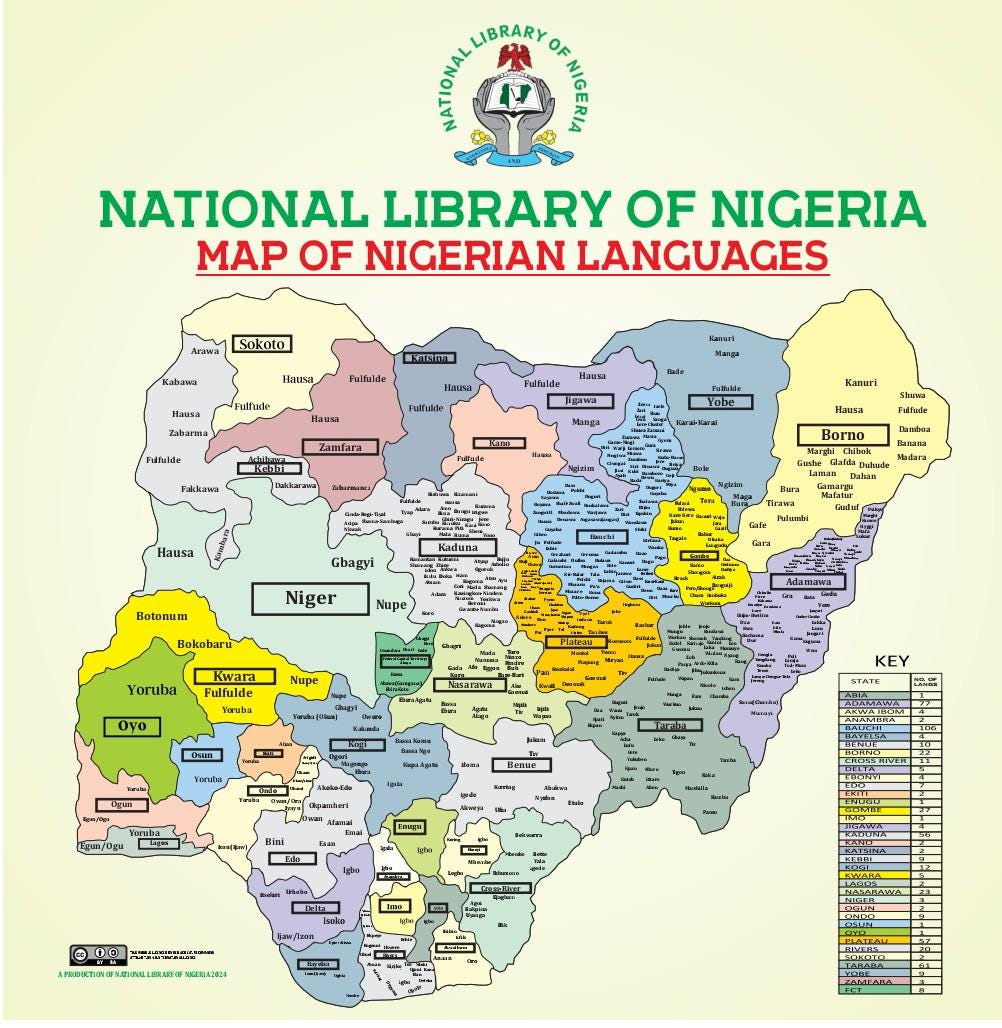
“A is B. B is C. Then what?”
Language Pluralism in Nigerian Classrooms: Opportunities and Challenges for Bilingual and Multilingual Learners
“A is B. B is C. Then what?”
I recently posed this simple syllogism to a class of adult learners. To my surprise, the responses ranged from humorous to unexpected. Some students argued that B is A, others suggested that C is B, while several remained silent, unsure of how to proceed.
Eventually, I supplied the answer myself:
A is C.
At first glance, the incident appeared to be a simple classroom misunderstanding. However, on reflection, it revealed something much deeper about language, cognition, and learning in multilingual contexts such as Nigeria. It also raised an important question: when multilingual learners struggle with abstract reasoning tasks in English, are they demonstrating cognitive limitations or the complex realities of processing knowledge through a second language?
Nigeria: A Naturally Multilingual Society
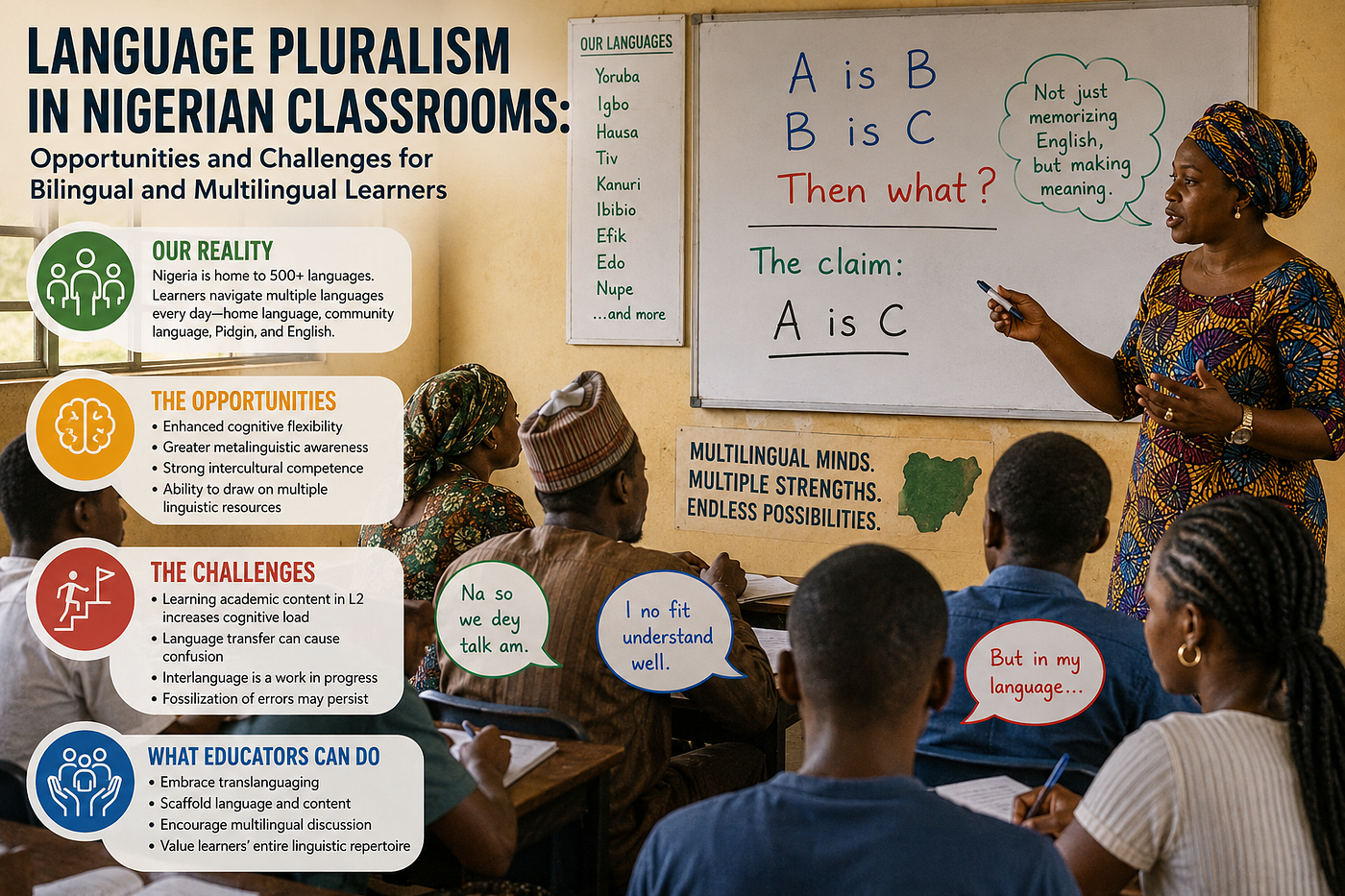
Nigeria is one of the most linguistically diverse countries in the world, with more than 500 indigenous languages spoken across its regions (Eberhard, Simons, & Fennig, 2024). For most Nigerians, multilingualism is not an academic construct but an everyday reality.
A typical Nigerian learner may speak Yorùbá, Igbo, Hausa, Tiv, Ibibio, or another indigenous language at home, communicate in Nigerian Pidgin among peers, and then encounter English as the language of instruction in formal educational settings. Consequently, many learners navigate multiple linguistic systems simultaneously.
This linguistic diversity is a significant asset. Research increasingly suggests that bilingualism and multilingualism can enhance cognitive flexibility, metalinguistic awareness, and the ability to switch between different perspectives and problem-solving strategies (Bialystok, 2017; Grosjean, 2010). Yet, the same multilingual environment also presents important pedagogical challenges.
The Cognitive Burden of Learning Through a Second Language
For many Nigerian learners, English functions as a second or even third language. Learning academic content through a language that is not one’s dominant language imposes additional cognitive demands.
According to Cummins (2000), learners often engage in a dual process: they must first decode the language of instruction and then process the academic content embedded within it. This phenomenon increases cognitive load and may affect classroom participation, comprehension, and reasoning.
The classroom syllogism illustrates this challenge:
A is B.
B is C.
Therefore, A is C.
To proficient users of English, the logical relationship appears straightforward. However, for many adult second-language learners, the linguistic structure itself can become an obstacle to reasoning. Their cognitive resources are divided between understanding the language and solving the logical problem.
The difficulty, therefore, may not lie in reasoning ability but in the cognitive demands of reasoning through a second language.
Language Transfer and the Influence of the First Language
One explanation for these challenges is language transfer.
Odlin (1989) defines language transfer as the influence resulting from similarities and differences between the target language and previously acquired languages. Learners often interpret English structures through the framework of their first language.
Transfer can be beneficial when similarities exist between languages. However, negative transfer occurs when learners apply familiar linguistic patterns to contexts where they do not fit.
In multilingual classrooms, students frequently negotiate meaning by drawing on their existing linguistic repertoires. Consequently, difficulties in understanding abstract relationships expressed in English may stem not from intellectual inability but from the interaction of multiple linguistic systems during cognitive processing.
Interlanguage: The Dynamic Language System of Learners
Second-language learners do not move directly from their first language to native-like proficiency in another language. Instead, they develop what Selinker (1972) famously termed interlanguage, a transitional and evolving linguistic system containing elements of both the first and target languages.
Interlanguage is not evidence of deficiency; rather, it is evidence of learning in progress.
Many familiar expressions in Nigerian English demonstrate this process:
“I am coming” to mean “I will be right back.”
“I did not hear you” to mean “I did not understand.”
“I have graduated since last year.”
These expressions reveal how learners creatively draw on available linguistic resources to communicate meaning.
Similarly, the students who struggled with the syllogism were operating within an interlanguage system where abstract logical relationships expressed in English had not yet become automatic or fully internalized.
Fossilization and Adult Second-Language Learning
Some language patterns eventually become resistant to change. Selinker and Lamendella (1978) referred to this phenomenon as fossilization, whereby certain non-target forms persist despite prolonged exposure to the target language.
Adult learners are particularly susceptible to fossilization because they possess long-established linguistic habits and often prioritize communicative success over grammatical precision (Han, 2004).
In many Nigerian classrooms, students may have studied English for years while still struggling with specific linguistic structures and academic registers. Their difficulties with abstract reasoning tasks may therefore reflect entrenched language habits rather than deficiencies in intellectual capacity.
The Hidden Strength of Multilingual Learners
Despite these challenges, multilingualism remains a powerful cognitive resource.
Research has consistently shown that multilingual individuals often demonstrate enhanced metalinguistic awareness, greater attentional control, and increased cognitive flexibility (Bialystok, 2017; Cook, 2016). Multilingual learners possess the ability to draw upon multiple linguistic repertoires and perspectives when constructing meaning.
The problem, therefore, does not lie in multilingualism itself. Rather, it lies in educational systems that continue to operate as though monolingualism is the natural or default condition of human societies.
Indeed, scholars increasingly argue that monolingualism is historically and globally atypical, while multilingualism represents the norm for much of the world’s population (García & Wei, 2014; Makoni & Pennycook, 2007).
Implications for Nigerian Classrooms
The realities of Nigerian education demand pedagogical approaches that recognize and embrace linguistic diversity.
Teachers should:
- Recognize translanguaging as a legitimate pedagogical resource.
- Distinguish language difficulties from cognitive difficulties.
- Scaffold abstract reasoning tasks linguistically before assessing them cognitively.
- Encourage multilingual discussion and collaborative meaning-making.
- Value learners’ entire linguistic repertoires rather than suppressing them.
As García and Wei (2014) argue, multilingual learners do not possess separate language systems that operate independently. Rather, they draw upon an integrated linguistic repertoire to make meaning and learn.
A Lesson from a Simple Syllogism
That classroom exercise remains a powerful reminder.
When students struggled to conclude that A is C, they were not simply failing at logic. Many were navigating the complex cognitive demands of learning and reasoning through a second language while simultaneously drawing upon multiple linguistic systems.
Their responses reveal an important truth about Nigerian education:
Our classrooms are multilingual spaces inhabited by multilingual minds.
To teach effectively in such contexts, educators must move beyond monolingual assumptions and appreciate the intricate relationship between language, cognition, and learning.
After all, in Nigeria, multilingualism is not the exception.
It is the norm.
References
Bialystok, E. (2017). The bilingual adaptation: How minds accommodate experience. Psychological Bulletin, 143(3), 233–262.
Cook, V. (2016). Second language learning and language teaching (5th ed.). Routledge.
Cummins, J. (2000). Language, power and pedagogy: Bilingual children in the crossfire. Multilingual Matters.
Eberhard, D. M., Simons, G. F., & Fennig, C. D. (Eds.). (2024). Ethnologue: Languages of the world (27th ed.). SIL International.
García, O., & Wei, L. (2014). Translanguaging: Language, bilingualism and education. Palgrave Macmillan.
Grosjean, F. (2010). Bilingual: Life and reality. Harvard University Press.
Han, Z.-H. (2004). Fossilization in adult second language acquisition. Multilingual Matters.
Makoni, S., & Pennycook, A. (2007). Disinventing and reconstituting languages. Multilingual Matters.
Odlin, T. (1989). Language transfer: Cross-linguistic influence in language learning. Cambridge University Press.
Selinker, L. (1972). Interlanguage. International Review of Applied Linguistics in Language Teaching, 10(1–4), 209–231.
Selinker, L., & Lamendella, J. T. (1978). Two perspectives on fossilization in interlanguage learning. Interlanguage Studies Bulletin, 3(2), 143–191.
메타데이터
- post_id
- dff08c34de26
- slug
- language-pluralism-in-nigerian-classrooms-opportunities-and-challenges-for-bilingual-and-dff08c34de26
- url
- https://medium.com/@danabdul_69417/language-pluralism-in-nigerian-classrooms-opportunities-and-challenges-for-bilingual-and-dff08c34de26
- canonical_url
- https://medium.com/@danabdul_69417/language-pluralism-in-nigerian-classrooms-opportunities-and-challenges-for-bilingual-and-dff08c34de26
- author_url
- https://medium.com/@danabdul_69417
- status
- ok
- fetched_at
- 2026-08-07 22:57:39