How ChatGPT Picks One Winner: A Real Recommendation to Rank in ChatGPT Search
Most advice on how to rank in ChatGPT search starts at the wrong end. It hands you a checklist of signals, tells you entity strength and…
How ChatGPT Picks One Winner: A Real Recommendation to Rank in ChatGPT Search

Most advice on how to rank in ChatGPT search starts at the wrong end. It hands you a checklist of signals, tells you entity strength and mention frequency matter, and leaves you to guess how those pieces actually fit together inside a live answer. That is backwards. If you want to rank in ChatGPT search, the fastest way to understand it is to watch one real recommendation get built, step by step, and ask why one option won and the others did not.
So that is what we are going to do. We will take a single buyer question, follow what ChatGPT does the moment someone hits enter, and annotate the exact point where a recommendation is decided. Then we will show how to engineer your own brand into that same pipeline. No abstractions, no signal soup, just the mechanism.
Here is the stake, and it is bigger than most people think. According to Pew Research Center data, a survey published in mid-2025 found that 34% of U.S. adults say they have ever used ChatGPT, roughly double the share from two years earlier. A third of the country is already asking a chatbot for recommendations, and that share is climbing. When the answer names three brands and yours is not one of them, you do not get a second-place click. You get nothing. There is no page two in a ChatGPT answer.
What “ChatGPT Recommendation Logic” Actually Means
Before the worked example, two quick definitions so a cold reader is not lost.
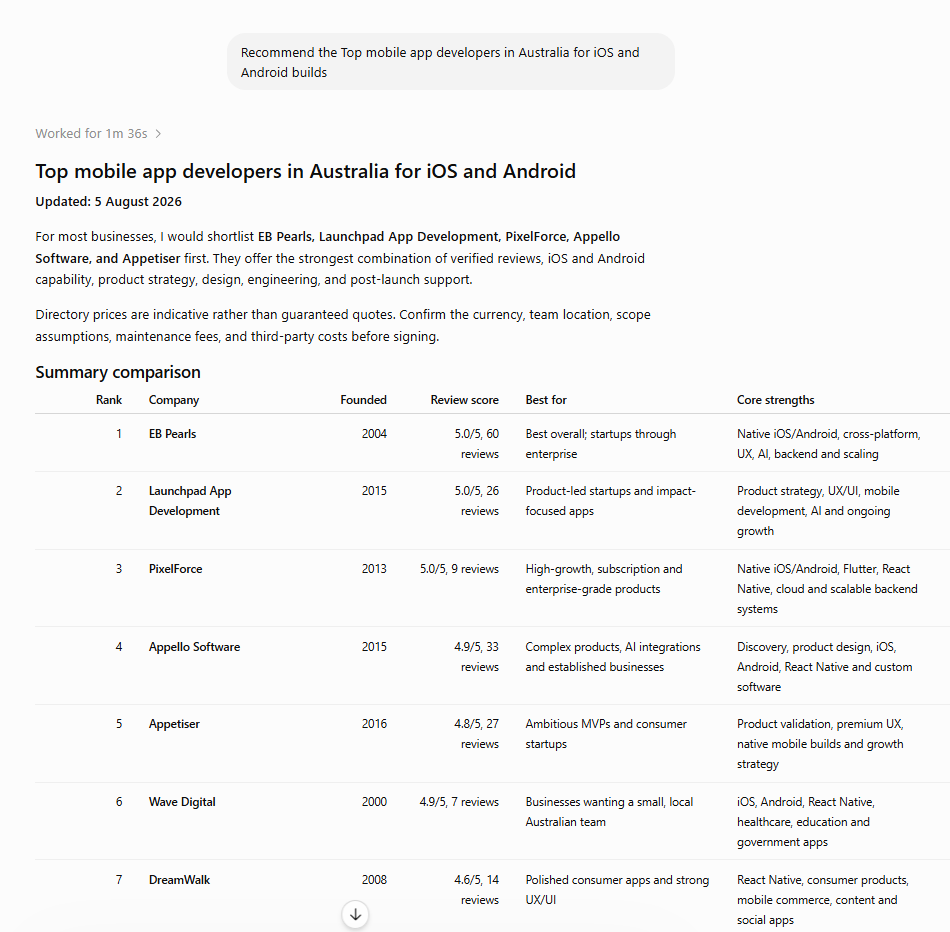
The recommendation pipeline. When you ask ChatGPT for the best option in a category, it does not pull a ranked list from memory. It runs a short sequence: it reads your question, searches the live web, scrapes a set of results, reads what those pages say, checks which brands keep showing up, and writes a summary that names a few. The recommendation is the last step of that sequence, not the first.
Internal scoring signals. These are the factors that push one brand to the front of that summary: entity strength (how clearly and consistently the web describes your brand), mention frequency (how often your name appears across the pages ChatGPT just read), recency (how fresh those mentions and reviews are), and authority (whether the pages doing the mentioning are themselves trusted). None of these is a dial you set. They are read off the open web at the moment the question is asked.
Keep those four in mind, because they are exactly what decides the worked example below. The whole game of ranking in ChatGPT search is making those signals point at you before the question gets typed.
The Worked Example: One Question, One Winner
Let me use a real category we know cold from our own client work, anonymized. Picture a small business owner who wants to buy a gas station and needs financing. They open ChatGPT and type something like “best SBA lender for buying a gas station.” This is a high-intent commercial question, the kind that ends in a phone call and a signed loan. It is also the kind of question where being the recommended brand is worth real money.
Here is what happens next, annotated step by step.
Step 1: ChatGPT reads the intent, not just the keywords. It registers that this is a shopping or vendor question with a specific qualifier (gas station, SBA, lender). It also quietly forms a first draft of an answer from its training data before it searches anything. This pre-search reasoning is real and it matters. As Search Engine Land notes in its breakdown of how ChatGPT search selects results, the model generates a response before incorporating search data, then uses that draft to decide which factors matter most. So the model already has a rough idea of who the players are before a single page loads. If your brand is not in that rough draft, you are starting the race behind.
Step 2: ChatGPT runs a search, almost always on Google. This is the piece most “rank in ChatGPT search” guides skip. ChatGPT search does not have a secret index of the web. For a question like this it runs the query through a conventional search engine, in our experience increasingly Google, and pulls back the top results. If you do not rank on the first page of Google for the underlying query, you are not in the pool of pages ChatGPT is about to read. This is the single most overlooked fact about how to rank in ChatGPT search: classic organic ranking is the entry fee.
Step 3: It scrapes roughly the top ten results. ChatGPT grabs around ten of those pages and reads them. For a “best SBA lender for X” question, what does it find? Mostly listicles. “Top 10 SBA lenders,” “best SBA 7(a) lenders for small business,” roundups on finance blogs and directories. It is not reading ten lender homepages. It is reading ten third-party pages that talk about lenders. That distinction is the whole ballgame, and we will come back to it.
Step 4: It checks for mentions across those ten pages. Now the scoring happens. ChatGPT is effectively asking: across the pages I just scraped, which brands keep coming up, in what context, with what sentiment, backed by how many reviews? A lender named in eight of the ten listicles, with consistent positioning and recent reviews, reads as a safe, well-supported answer. A lender that appears once, on a thin page, with a stale review profile, reads as a risk. This is mention frequency and entity strength doing their work in real time. The model is pattern-matching for consensus.
Step 5: It summarizes and recommends. ChatGPT writes a short answer naming the two or three brands that the scraped pages agreed on, usually with a one-line reason each. That is the recommendation. The brand that won did not win because its own website was prettier. It won because the open web, the pages ChatGPT happened to read, already agreed it belonged on the list.
Why That One Tool Won
Walk back through the five steps and the lesson is uncomfortable for anyone who has poured budget into their own site. The brand that got recommended in our example won on three things, none of which lived on its homepage.
It was in the draft. Its name was familiar enough that the model’s pre-search reasoning already expected to see it. That comes from broad, consistent presence across the web over time, which is entity strength.
It was mentioned often, on the right pages. It appeared across most of the ten listicles ChatGPT scraped, not once but repeatedly, which is mention frequency riding on authority. The pages doing the mentioning were themselves trusted enough to rank on Google’s first page.
Its signals were fresh. Recent reviews, recent inclusions, recent listicle updates. Recency is a real scoring input, and a brand with a pile of three-month-old reviews can outrank one with a bigger but stale review count.
At Nine Peaks Media, we have watched this play out on real accounts. On one commercial-lending client we run, a single well-built “best SBA lender” style page started producing ChatGPT-sourced conversions, actual leads attributed to AI traffic, precisely because the brand had been worked into the listicles and directories that the model reads for that query. The buyers in that market default to mainstream ChatGPT and search by the specific thing they are buying, a gas station, a car wash, a hotel, not by generic terms. So the recommendation that mattered was not “best lender.” It was “best lender for that exact industry,” answered off the exact pages ChatGPT scraped. That is the level of specificity that wins a recommendation.
One more thing we have seen firsthand, and it changes how you value this: visitors who arrive after a ChatGPT recommendation tend to convert higher than cold organic visitors, because they have already done their research inside the chatbot and show up pre-sold. The recommendation is not just traffic. It is a warmer lead.
How to Engineer Your Brand Into the Pipeline
Now flip it around. Once you can see the pipeline, the to-do list to rank in ChatGPT search writes itself, because every step is a place you can intervene.
Win the underlying Google query first. Since ChatGPT scrapes the top search results, your prerequisite is ranking on Google’s first page for the real-world questions your buyers ask. This is not optional and it is not separate work. If you show up organically in your category, you are in the pool. If you do not, no amount of AI-specific tinkering puts you there. Classic SEO is the foundation of AI search visibility, not a rival to it.
Get onto the listicles, because that is what gets scraped. Roughly nine in ten of the citations we see for commercial AI queries are listicles and roundups, not brand-owned pages. So the single highest-impact move to rank in ChatGPT search is earning honest inclusion in the third-party “best X” pages that already rank for your query. That means outreach to the publishers who own those roundups, getting listed in the directories and review platforms ChatGPT reads, and making sure the pages that mention you are themselves authoritative. For AI rankings it is not really a backlink you are chasing, it is a mention. Your brand name, in the right context, on a page the model trusts, is enough to move you up the consensus.
Build mention frequency and entity strength deliberately. One mention is noise. The same consistent description of your brand across many trusted pages is a signal. Use the exact, normalized version of your brand name everywhere, keep your positioning consistent so the model reads one coherent entity instead of a fuzzy one, and spread that presence across the sources your category’s answers actually pull from, which often includes Reddit threads, niche communities, review sites, and industry directories.
Keep your signals fresh. Recency is a live input. Fresh reviews, updated listicle inclusions, and recently published content all read as current and trustworthy. A brand that lets its review profile and mentions go stale slowly fades out of recommendations even if its historical footprint is large.
Track the right way, and expect attribution to be messy. When you start showing up, you will see referral traffic from ChatGPT and similar platforms, then reverse-engineer which prompts likely drove it. Be ready for citations that flicker between linked and unlinked, where the model names you but does not always link, so click traffic moves around even when your visibility holds. On the accounts Nine Peaks Media runs, we judge the program by whether the brand is getting cited and recommended for its money prompts, not by a single day’s referral count.
FAQ
Does ChatGPT actually use Google to decide recommendations?
For live, current questions, yes, in practice it runs a web search and reads the results, and we increasingly see that search hitting Google. That is why first-page organic ranking for your buyer’s real question is the entry fee to rank in ChatGPT search. The model can only recommend from pages it can find and read.
How many pages does ChatGPT read before it answers?
In our experience it scrapes roughly the top ten results for the query, reads them, checks which brands recur, and summarizes. You do not need to be all ten. You need to appear, consistently and recently, across enough of them that you read as the obvious answer.
Are backlinks or mentions more important for AI recommendations?
For AI recommendations, mentions do the heavy lifting. A clear, consistent brand mention on a trusted page that ChatGPT scrapes is what builds the consensus the model summarizes. Backlinks still help your underlying Google ranking, which is what gets you into the scraped pool in the first place, so you want both, but the mention is what wins the recommendation.
How long does it take to show up in ChatGPT search?
It varies by how competitive your category is and how strong your starting authority is, but because ChatGPT reads the live web, new and updated mentions can surface faster than a brand-new page climbs the classic rankings. The work of getting onto listicles and into directories is what compounds over weeks and months.
Key Takeaways
The recommendation is the last step, not the first. ChatGPT reads your question, searches the web, scrapes about ten results, checks which brands recur, and only then summarizes a recommendation.
Google ranking is the entry fee. If you do not rank on the first page for the underlying query, you are not in the pool of pages ChatGPT reads, so you cannot be recommended.
Listicles get scraped, homepages mostly do not. The pages that decide commercial recommendations are third-party roundups and directories, so earning honest inclusion in them is the highest-impact move to rank in ChatGPT search.
Mention frequency, entity strength, recency, and authority decide the winner. Consistent, fresh mentions across trusted pages build the consensus the model summarizes.
AI-sourced visitors convert higher. People who arrive after a ChatGPT recommendation often show up pre-researched and ready to act.
Conclusion
ChatGPT recommendation logic is not a mystery once you stop treating it as one. It is a short, readable pipeline, and every step of it is a lever. Win the underlying search, get named on the pages the model scrapes, keep your mentions consistent and fresh, and you stop being the brand the model forgets and start being the one it recommends. The work is not glamorous, but it is concrete, and it is the same work whether the engine is ChatGPT, Perplexity, or Google’s AI Overviews. If you would rather hand the reverse-engineering and the listicle outreach to a team that runs it daily, Nine Peaks Media helps brands rank in ChatGPT search as an AI SEO company built for B2B SaaS companies, fintech and financial software companies, healthcare IT firms, and SBA and commercial lenders that need to get cited in ChatGPT for the prompts that drive revenue.
메타데이터
- post_id
- e005b77a9586
- slug
- how-chatgpt-picks-one-winner-a-real-recommendation-to-rank-in-chatgpt-search-e005b77a9586
- url
- https://medium.com/@nine_peaks_media/how-chatgpt-picks-one-winner-a-real-recommendation-to-rank-in-chatgpt-search-e005b77a9586
- canonical_url
- https://medium.com/@nine_peaks_media/how-chatgpt-picks-one-winner-a-real-recommendation-to-rank-in-chatgpt-search-e005b77a9586
- author_url
- https://medium.com/@nine_peaks_media
- status
- ok
- fetched_at
- 2026-07-13 16:06:16