When AI Agents Learn to Work Together, Everything Changes
The future of work isn’t human vs. AI. It’s specialized AI agents collaborating like expert teams.
The AI Revolution Nobody Saw Coming
When AI Agents Learn to Work Together, Everything Changes
The future of work isn’t human vs. AI. It’s specialized AI agents collaborating like expert teams.
Right now, you ask ChatGPT to help with a business problem. It gives you a decent answer from one perspective. One knowledge base. One way of thinking.
But imagine asking the same question and getting responses from a specialized team: a marketing expert AI, a financial analyst AI, a product strategist AI, a legal AI, and a technical architect AI — all working together simultaneously, debating, challenging each other’s assumptions, and delivering a stress-tested plan in 30 seconds.
This isn’t science fiction. This is the next revolution: Collaborative AI Agent Ecosystems.
Non-members? Read this story free with this link 👉 Non-members link
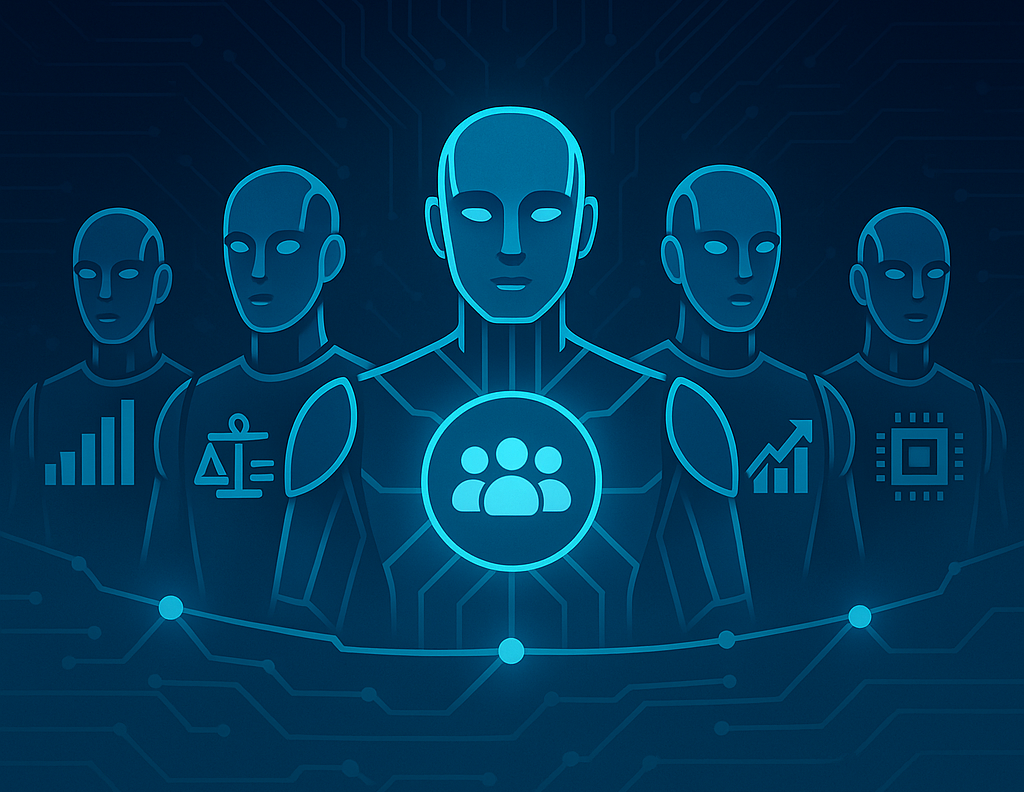
Source: Image by author.
The Problem With Current AI
Today’s AI systems are generalists. ChatGPT knows a little about everything but isn’t an expert in anything. Ask it about quantum physics, tax law, and marketing strategy, and you’ll get decent surface-level answers on all three. But none will match the depth of a specialized expert.
More importantly, current AI operates in isolation. You get one answer. No debate. No alternative perspectives. No one catching blind spots. It’s like hiring a consultant who never gets a second opinion.
And the workflow is sequential: Ask AI for analysis → wait → get output → ask another AI → wait again. While specialized human teams work in parallel, collaborating in real-time, AI works one step at a time.
We’re not leveraging the power of specialization or collaboration.
How Collaborative AI Ecosystems Work
Instead of one generalist AI, imagine an ecosystem of specialists:
- Strategy AI — Long-term planning and competitive analysis
- Financial AI — Budgeting, forecasting, and risk assessment
- Legal AI — Compliance, contracts, and regulatory requirements
- Technical AI — Architecture, security, and infrastructure
- Marketing AI — Customer acquisition and positioning
- Research AI — Market trends and competitive intelligence
Each is trained specifically on its domain. Each is world-class at what it does.
They work together through an orchestration layer — a project manager AI that breaks down complex problems, assigns tasks to specialists, facilitates real-time communication, resolves conflicts, and synthesizes outputs into coherent solutions.
Real Example: SaaS Product Launch
User Request: “Help me launch a new SaaS product in healthcare.”
What happens behind the scenes:
Research AI investigates the healthcare market while Legal AI simultaneously checks HIPAA compliance requirements. Technical AI explores healthcare-specific architecture. Financial AI models pricing strategies. Marketing AI analyzes customer segments.
When Legal AI discovers that telehealth regulations require state-by-state licensing, it immediately flags this to Strategy AI, which adjusts the financial model with this constraint. The orchestrator detects conflicts and mediates them.
Result: In minutes, you have market analysis, regulatory compliance plan, technical architecture, financial projections, marketing strategy, and integrated roadmap — all coordinated and consistent.
A human consulting team would need weeks. The ecosystem delivers this in hours.
Why This Is Revolutionary
Specialization Breakthrough
Current AI is a jack of all trades. Collaborative ecosystems are masters of specific trades. A legal AI trained on nothing but law will outperform a generalist on legal questions every single time. Add ten specialized experts collaborating, and you get quality that no individual — human or AI — could match.
Collaboration Multiplier
Human teams communicate through meetings (slow). AI ecosystems communicate instantaneously. No scheduling. No delays. The work that takes a human team weeks happens in hours — not because each AI is faster, but because collaboration itself is exponentially more efficient.
Accessibility Revolution
McKinsey-level consulting currently costs $500K and takes six months. A top law firm charges $50K for weeks of work. Most companies can’t afford this level of expertise.
Collaborative AI ecosystems change everything:
- Enterprise-grade strategy analysis: $10K + 2 days
- Top-tier legal research: $1K + hours
- Pharma-level research: $100K + months (vs. millions + years)
Small startups suddenly compete with Fortune 500 analysis quality. Researchers at modest institutions can conduct studies rivaling major universities.
Human Augmentation, Not Replacement
A doctor with a medical AI ecosystem becomes better than any doctor in history. A lawyer with a legal AI ecosystem handles cases that would overwhelm any human lawyer. A researcher with a research AI ecosystem pursues investigations that would take a lifetime.
Humans provide: vision, ethics, judgment, relationships, and accountability.
AI ecosystems provide: expertise across domains, tireless analysis, pattern recognition at scale, rapid iteration, and comprehensive perspective integration.
Together: superhuman capability.
The Timeline
2024–2025: Primitive multi-agent systems exist in labs. Manual coordination required.
2026–2027: First commercial collaborative ecosystems deployed. Early adopters (consulting firms, pharma, finance) see dramatic results.
2028–2029: Mainstream adoption. Every professional service transformed. Professionals who embrace ecosystems become 10x more productive.
2030+: Ubiquitous. Human-AI hybrid teams become the standard.
Real-World Impact
Drug Discovery: Instead of years to identify promising candidates, days or weeks. Instead of testing thousands of compounds, test the three most promising. Result: Drug development accelerated 10–50x.
Legal Strategy: Comprehensive research, stress-tested strategies, evidence gaps identified, and jury insights produced in hours instead of weeks.
Scientific Research: Research that takes 3–5 years completes in 12–18 months. Scientific productivity multiplied 3–5x.
Business Strategy: Mid-market companies access consulting-grade analysis for 1/50th the cost and 1/100th the time.
The Challenges
Echo chambers: Multiple AIs trained on similar data might reinforce each other’s biases instead of catching errors.
Coordination failure: Different AIs might assume conflicting timelines or parameters, creating execution disasters.
Responsibility gap: When multiple AIs contribute to a decision, who’s accountable if it fails?
Opacity: Collaborative ecosystems are even less transparent than single AIs — the output is a synthesis of dozens of AI-to-AI communications.
These challenges are solvable but require careful design and oversight.
The Bottom Line
The current AI revolution gave us individual genius AIs. The next revolution gives us teams of specialist AIs collaborating at machine speed.
This isn’t incremental improvement. It’s a paradigm shift.
The implications:
✓ Expertise becomes accessible to small companies ✓ Quality improves through multiple expert perspectives ✓ Speed increases 10–100x through parallel processing ✓ Costs decrease 90%+ compared to human teams ✓ Humans become superhuman through AI augmentation
The timeline is 2–5 years. Companies building collaborative AI ecosystems now will dominate the 2030s. Professionals who learn to work with AI teams will be unstoppable.
This isn’t about AI replacing your job. It’s about AI making you 10x better at your job.
When AI agents learn to work together, they stop being tools and become teammates. That’s when everything changes.
메타데이터
- post_id
- e00f4f00a0fc
- slug
- when-ai-agents-learn-to-work-together-everything-changes-e00f4f00a0fc
- url
- https://ai.plainenglish.io/when-ai-agents-learn-to-work-together-everything-changes-e00f4f00a0fc
- canonical_url
- https://ai.plainenglish.io/when-ai-agents-learn-to-work-together-everything-changes-e00f4f00a0fc
- author_url
- https://medium.com/@rohanmistry231
- status
- ok
- fetched_at
- 2026-08-08 04:44:00