Why Research Integrity Quietly Breaks Down in Collaborative Research
Most research integrity problems do not begin with obvious misconduct.
Why Research Integrity Quietly Breaks Down in Collaborative Research
Most research integrity problems do not begin with obvious misconduct.
They usually begin when collaboration becomes harder to manage than people expected.
In the early stages of a project, things feel simple enough. Everyone works from the same draft, references are still manageable, and most discussions happen in one place. Even if the workflow is slightly messy, researchers can usually keep everything together through memory and constant communication.
The problems start once the project becomes larger.
More people begin editing the paper, feedback starts arriving from different places, and suddenly nobody feels fully certain whether the document in front of them is actually the latest version anymore.
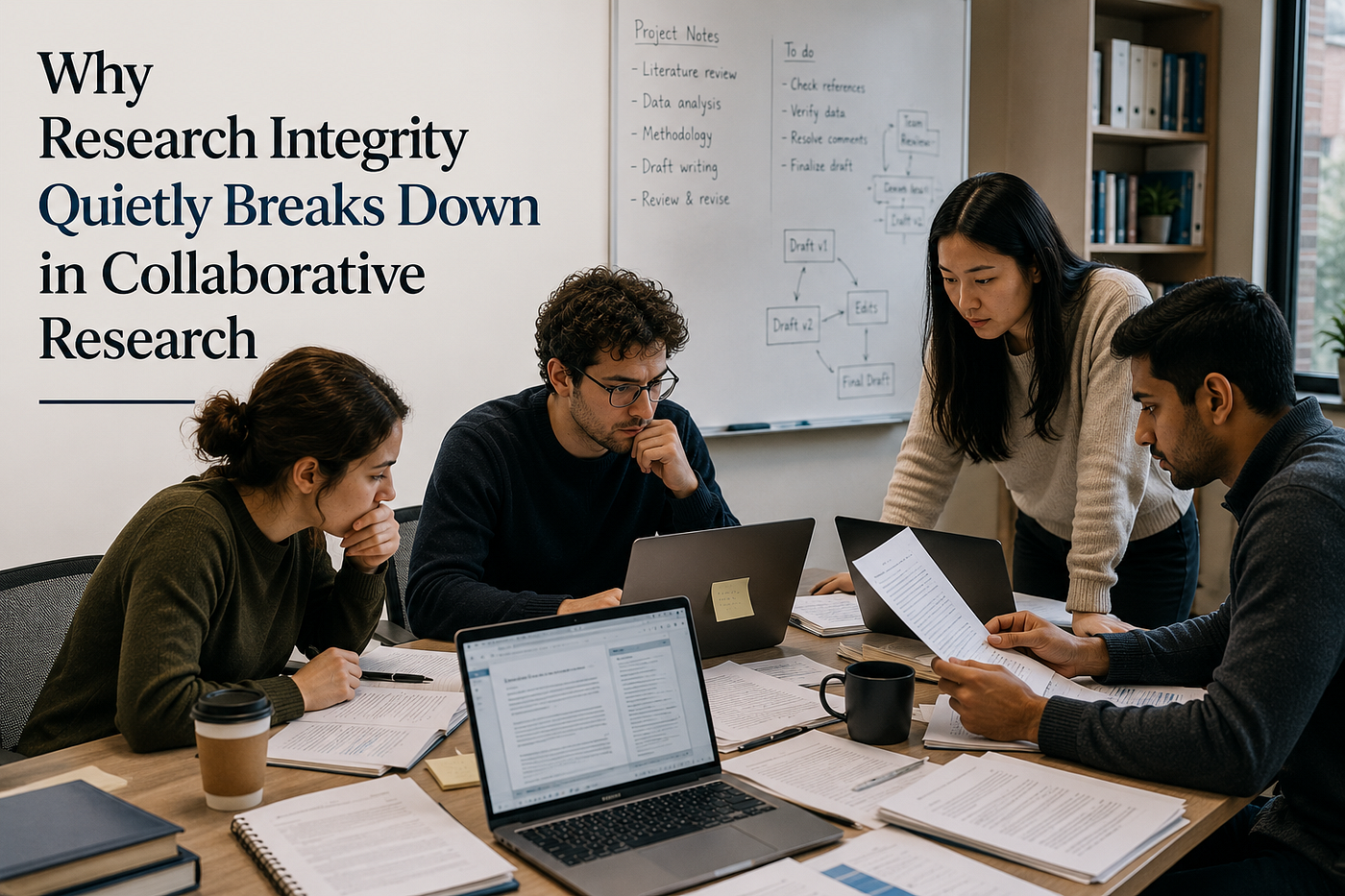
One researcher updates references directly inside the manuscript while another edits the shared library separately. Someone reviews an older draft without realizing a newer version already exists. Comments from meetings stay buried in personal notes while revisions continue somewhere else.
None of these issues seem serious at first.
But after a while, the workflow itself becomes difficult to trust.
Researchers begin reopening older drafts just to confirm whether sections were already updated. References get checked repeatedly because people are no longer fully confident that the bibliography is still accurate across every version of the paper. Even small edits start taking longer because nobody wants to overwrite someone else’s work accidentally.
At that point, the research slows down even when the researchers themselves are capable.
A lot of universities discuss research integrity mainly through ethics policies, plagiarism rules, and publication standards. Those things matter, but many integrity problems appear much earlier than that.
They appear when collaboration loses clarity.
Information slowly becomes scattered across shared drives, emails, document comments, PDFs, meetings, and chat platforms. Researchers spend more time reconnecting discussions and verifying changes than they expected when the project first started.
This becomes even harder in interdisciplinary teams where everyone manages information differently. Some researchers organize references carefully inside shared collections while others keep papers locally. Some document decisions clearly while others rely mostly on conversations.
The issue usually is not the people.
The issue is that the workflow surrounding the collaboration was never designed to stay organized as the project became more complex.
Strong research teams usually avoid this by creating structure early. Everyone knows where references belong, how revisions are tracked, which draft is current, and where important decisions should be documented.
That consistency removes a surprising amount of confusion later in the project.
Researchers spend less time searching through folders, checking versions, and trying to remember where something was discussed. More energy stays focused on the actual research instead of the coordination around it.
The tools teams use can help support that structure, but tools alone are rarely enough. Many research workflows still separate writing, communication, references, datasets, and project tracking across completely different platforms. Researchers manage those gaps manually at first, but the workload grows quietly as the collaboration becomes larger.
This is one reason more research teams are paying attention to how their workflows are structured, not just which tools they use. Platforms like Colabwize reflect this shift by trying to keep collaboration and research coordination more connected instead of spreading information across too many separate places.
Once teams stop trusting the workflow, even simple parts of the project start taking longer than they should.
And in long collaborative research projects, that friction builds up much faster than most people realize at the beginning.
메타데이터
- post_id
- e018469bc00e
- slug
- why-research-integrity-quietly-breaks-down-in-collaborative-research-e018469bc00e
- url
- https://medium.com/@clawncoremultitech/why-research-integrity-quietly-breaks-down-in-collaborative-research-e018469bc00e
- canonical_url
- https://medium.com/@clawncoremultitech/why-research-integrity-quietly-breaks-down-in-collaborative-research-e018469bc00e
- author_url
- https://medium.com/@clawncoremultitech
- status
- ok
- fetched_at
- 2026-06-09 15:37:30