Burning Tongues
Reading female Afghan poets in English translation
Burning Tongues
Reading female Afghan poets in English translation
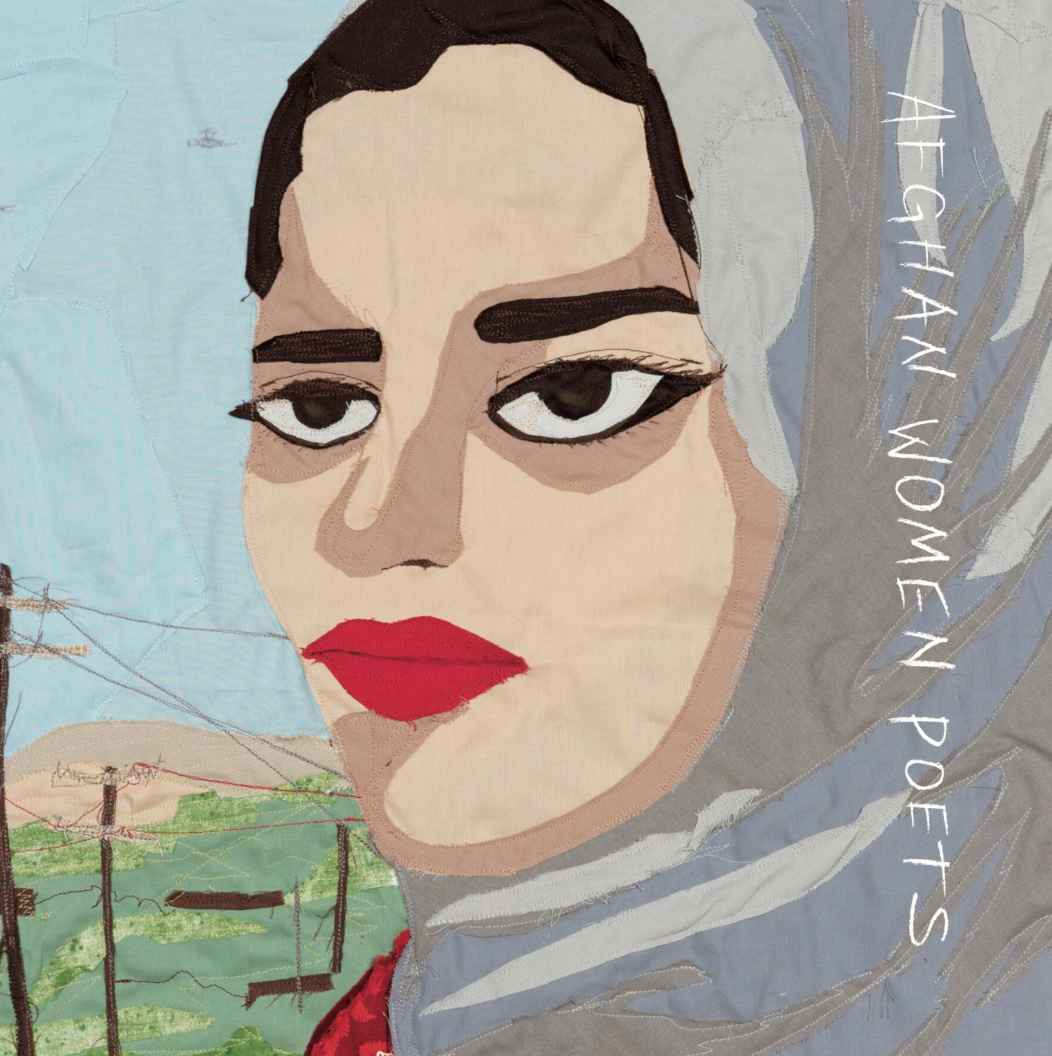
Book cover for Hair on Fire: Afghan Women Poets (Two Lines Press, 2025).
These days
poetry
can’t work its poetry
— Mahbouba Ibrahimi, from “Woman, Homeland,” tr. Zuzanna Olszewska
In 1995, when the Taliban took over the northwestern Afghan city of Herat, a group of young women gathered in the adolescent student Laila Raziqi’s home. Forbidden from attending school, the women met to sew–a permissible and seemingly anodyne activity. After several meetings, one of the members, a young woman named Nadia Anjuman, brought something other than needles to the group. As Raziqi remembers it:
“One day [Nadia] came to me with a notebook (chatalnawes) and said, ‘I’ve written some poems but haven’t shown them to anyone.’ She asked if I wanted to see, since I liked writing and such things. I saw that they were very good poems.”*
In the subsequent years, the women’s “sewing group” morphed into an underground literary society, called Suzāni Talāyi (“Golden Needle” in Persian). Members would share, discuss, and edit their poems, forming a powerful secret community around literature while evading Taliban scrutiny. As another member of the original group, Gulsoom Sediqi, recalls when thinking back on this period of dangerous, clandestine poetry composition among women:
“When even basic literacy and security were not available, what good would literature do?”
“But,” she said, “it brought us joy.”**
Joy in such a time. Poetry allows space for this. Poetry also allows for sorrow and for anger, for mourning and lament. In the anthology *Hair on Fire: Afghan Women Poets *(2025), five poets (including Nadia Anjuman, the poet who catalyzed the Suzāni Talāyi women’s poetry group) and eight of their translators go forth with the work of poetry.
The anthology, which brings together selected works by the aforementioned Nadia Anjuman (tr. Diana Arterian & Marina Omar), Mahbouba Ibrahimi (tr. Fatemah Shams & Armen Davoudian, and Zuzanna Olszewska), Maral Taheri (tr. Hajar Hussaini), Mariam Meetra (tr. Sabrina Nouri & Samantha Cosentino), and Karima Shabrang (tr. Nouri & Cosentino), is the twelfth book in the Calico Series, edited by Sarah Coolidge.
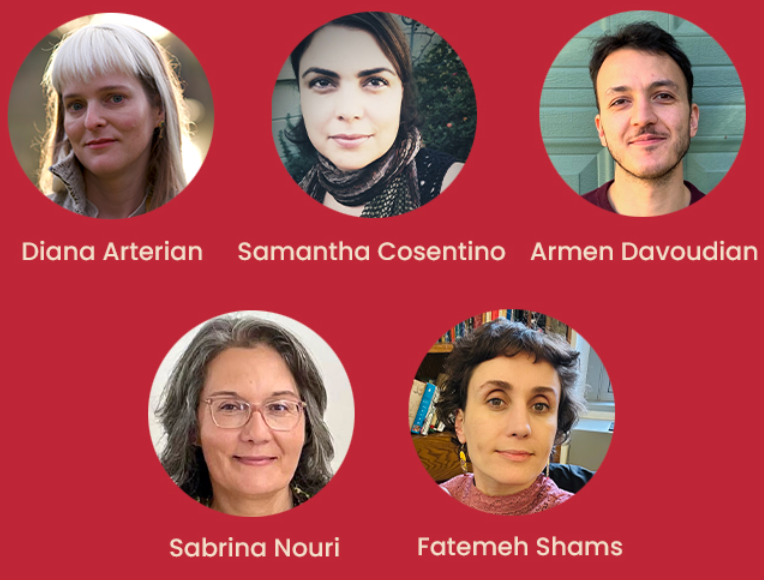
Selected translators for Hair on Fire: Afghan Women Poets: Diana Arterian, Samantha Cosentino, Armen Davoudian, Sabrina Nouri, and Fatemeh Shams.
The book is introduced by Aria Aber–herself an Afghan diasporic poet and novelist–and the cover is emblazoned with a close-up from Canadian-Afghan textile artist Hangama Amiri’s 2021 piece “Woman with Red Lipstick” from her exhibit “Spectators of a New Dawn.” Each of the people involved in the Hair on Fire project are worthy of essay-length studies on their work, biographies, and the varied ways that they intertwine politics with their artistic practices.
A category under pressure
The anthology gives readers flickers of these writers’ different poetic and translational approaches, but refuses to offer the reader a cohesive framework for thinking about how the poets’ works might relate to one another. Anjuman, Ibrahimi, Taheri, Meetra, and Shabrang’s poetic projects are wildly different: Anjuman reworks classical Persian poetic forms to speak to contemporary Afghan women’s suffering, Ibrahimi captures moments of daily life in exile, Taheri fuses Persian and French poetics and philosophy in a gory, cacophonous scream-in-verse, Meetra calls up metaphors of trees, houses, and shadows as a way of dealing with the pain of remembered violence, and Shabrang mixes screams with kisses and silent terror with hope, creating a medley of colors and emotions.
However, each of the poets are presumably included in a collection subtitled “Afghan Women Poets” because of a shared national history (a history that goes largely unremarked in the anthology). In her introduction to Hair on Fire, Aber brings the tension among their wildly disparate writing styles and their inclusion in the singular discursive category of ‘Afghan Women Poets’ to the fore. “Despite being fluent in both English and Persian,” the Afghan-German Aber writes, “I hesitate to claim to belong to a group or to speak with authority on the subject of ‘Afghan Women Poets.’” She goes on to say:
It would be more precise, perhaps, to locate the fraught first-person plural in the global diaspora; a ‘we’ among those diasporic readers and writers among us who feel more comfortable reading the translated poems in this anthology than the original. […] The question of Afghan poetry brings up the question of unity. What constitutes literary unity among a people who are as diasporic as Afghans?
Aber attempts to swerve around the self-imposed question by suggesting that Afghan poetry is in fact “a decentered poetry” — a “poetry of fragmentation, multiethnic positionalities and languages, and geographic variation.” By highlighting decentralization and fragmentation as the defining markers of “Afghan women’s poetry,” then, Aber does not discard the utility of the category altogether, preferring to simply loosen the boundaries of it. But she is sure to warn that the very practice of categorization itself, as she elegantly phrases it, tends to “foreclos[e] the possibilities of myriad creativity and diversity” among poets, rather than illuminating that diversity. For Aber, to categorize is to box in, to shut out.
At the same time, however, the use of the “Afghan Women Poets” label can be seen as a meaningful and utilitarian gesture, serving to make female Afghan poets visible in the anglophone book market, employing the very categories that have otherwise worked to marginalize them. While I do wish that the Hair on Fire collection included more historical, political, literary, and biographical context on the five poets in its pages, giving more ‘footholds’ for anglophone readers to access their work and enriching the meaning of the ‘Afghan Women Poets’ subtitle, I also respect the decision of the editor, Sarah Coolidge, to choose poems and translations that she feels can “speak for themselves.” That the anthology prints the poems bilingually, with Persian on the left and English on the right, is a testament to the thoughtfulness and care with which Hair on Fire was conceived.
Mahbouba Ibrahimi: exile and the everyday
The anthology opens with six poems by Mahbouba Ibrahimi (b. 1977) — the first four translated by the Iranian poets Fatemeh Shams and Armen Davoudian, and the final two translated by the social anthropologist Zuzanna Olszewska. “Footprint,” (tr. Shams and Davoudian) is a breathy and halting poem that speaks to the diasporic reality of the over 2.6 million registered Afghan refugees around the globe, displaced primarily to neighboring countries such as Pakistan and Iran–countries that have recently forcibly deported thousands back to Afghanistan. In Ibrahimi’s poem, a first-person poetic voice “wakes up” in different cities:
Waking up in Stockholm I was alone in the arms of morning blank cold […] Waking up in Tehran I did not exist or I did only for my grey clad-comrade so she could share her depression with me like a secret
It is only in Kabul, Ibrahimi’s hometown, that the poetic voice feels like “my own self”:
Waking up in Kabul I washed the bedsheets and returned the sun to my turquoise sky
Recurrent in Ibrahimi’s verse is this first-person female voice, one who makes a deft lyricism of the everyday. In “Jagged Words,” she talks to her daughter, pours milk for her son, and inspects her mouth in the mirror: “jagged words / fly out broken / slashing the edges of my lips”. In “Butterflies,” she brushes her daughter’s hair, and catches a glimpse of her own hands in the mirror: “When did white butterflies / emerge from their cocoon?” In the latter two of Ibrahimi’s poems featured in Hair on Fire–translated by Olzewska–the poetic speaker addresses a “mother” figure, one who appears alternately as a specific person, and as the “homeland” (watan). There is pain here, and anger, as the poet writes:
Regret exile aloneness I did not deserve these. […] Take your bombs, your guns and your trash clear out and go home, comfortable people of the world!
It is an apt message for a US-based, anglophone audience (arguably the “comfortable people of the world” in this context). After all, the Hair on Fire collection is published in the wake of the 2021 US military withdrawal from Afghanistan, when the country has largely dropped off of the map for most Americans. However, Afghanistan’s worsening economic, climate, and health crises can arguably be seen as a corollary of American “comfort.” The US-led military forces have “clear[ed] out and [gone] home,” but the bombs, guns, and trash remain in Afghanistan, making the occupation’s violence ongoing. (For more on the lingering environmental, psychological, and corporeal effects of US-led war and occupation see reportage by Lynzy Billing and Al Jazeera).
Maral Taheri: the grotesque and the profane
In Hajar Hussaini’s translation of Maral Taheri (b. 1984), French and Persian poetic and philosophical traditions mingle with coarse descriptions of mass consumer culture, the body, death, and sex. The language is hallucinatory, following a delirious logic. “A man’s left rib” is at once a reference to the Judeo-Islamic story of the first woman deriving from the rib of the first man, and a description of the actual body part of a man, a bone that the poetic speaker carries in her teeth, going to physically bury “at his graveside they spread saliva over the corpse.” In the same poem, titled “Cybersex…” fallopian tubes, “embryos for sale,” and a “corpse-eating fetus” cacophonously blend discussions of women’s reproductive healthcare with critiques of religiously-endorsed misogyny. Another poem, “the poem could have been a wound that never wants to ooze,” toggles between two desires: love and suicide.
it’s enough for someone to say I love you for my blood to gush onto their shirt it’s enough for someone to say trees for me to say all I want is a reliable rope
While the words of a lover cue a desire for an intimacy so acute that it becomes violent, the sight of a tree triggers a desire for a kind of extreme self-harm that feels like closeness–her suicide rope is a “reliable” one. Taheri’s willingness to link love to violence is unusual, profane, brave. The poem asks: “what happiness could god imagine for me that suicide can’t?” Since the Perso-Arabic script does not have lowercase or uppercase letters, Hussaini’s decision not to capitalize any of Taheri’s words in her translation (including “god,” the first word of the poem, or its title) is a way of signaling the unconventionality of Taheri’s meterless verse to an anglophone audience.
At other moments in Taheri’s work, it is the juxtaposition of images that rankles. In “Embrace me,” the poem slides from ecstatic praise of eating ice cream in the shower to describing a fear that is “like this blood that has spilled over my ice cream / and has made it sour”. The poem moves between a droning list of “needs” and a desire for self-destruction, making the link between the banal and the suicidal seem logical, evident.
I need to get to work I need to get up I need to change my pad I need to smear deodorant over my armpits’ burning sweat I need to go outside and lean against my front door […] I should embrace my knees set my fingers on fire one by one
Taheri is an Afghan poet and translator born and raised in Iran, who taught French language and literature in Iran while sharing her thematically wide-ranging poetry on blogs and through social media. Because of the radical and apocryphal nature of her work, Taheri was never granted permission to publish in Iran, and did not try to have her poems published in Afghanistan due to censorship in the country. After the withdrawal of US forces from Kabul in 2021, and the aftermath of the “Zan, zendigi, azadi [Woman, life, freedom]” movement in Iran, Taheri moved to Europe and is now based in France. The content of Taheri’s poems is perhaps the most grotesque of the five sets of poems included here; they aim to arouse fear and disgust, and are impatient with those who can go to work/get up/change their pads/smear deodorant on, without the need to set their fingers on fire. (I am excitedly awaiting the full-length collection of Taheri’s work in Hussaini’s translation, forthcoming from Deep Vellum.)
Mariam Meetra: memory after violence
Mariam Meetra’s poems (b. 1992), translated by Sabrina Nouri and Samantha Cosentino, meanwhile, approach painful topics with more tenderness. Meetra’s poems are usually about memory–memories soaked with sadness, or childhood memories stolen by war and violence. In “Return,” the poetic speaker does the classic therapeutic exercise of remembering a room from one’s childhood. She remembers an old house, and imagines planting a tree in the center of it. The tree, sheltered from the explosions, blood stench, and flames that surround the house, becomes a stand-in for “a little girl’s see-through dream” –a “tender garden of childhood” poetically protected from violence. In another poem, “Deep Break,” someone thinks about the recurring nature of traumatic memories:
What difference does it make how many years have gone by? I still sleep next to those visions that keep a hand on my head […] even if a thousand years go by I will remember
In “Shadow,” the past also recurs as a torturous drumbeat:
I find myself standing each new day shoulder to shoulder with a sadness that permeates the walls / turns a key in my head and plays havoc with the beat of time
But time, in Meetra’s poems, can be shaken from its horrendous repetition. The last of Meetra’s poems to appear in Nouri and Cosentino’s translation, “Barren Plain,” conjures the “scorched smell of country girls’ hair,” which “rises from the breast of history even now”. But the poem also calls up the possibility that “you” might “say something / your fear burning your tongue”. Speech from a fear-burning tongue is where the poem ends–the text ultimately rests in the idea of a changed future moment.
Karima Shabrang: speaking against silence
Karima Shabrang (b. 1985) –whose pen name means “the color of night” or “darkness” in Persian– is another poet who appears in Hair on Fire. In 2010, Shabrang published her debut collection, Farāsu-ye badnāmi (Beyond Scandal) in the northwestern Afghan city of Badakhshan with the Anjuman-e Qalam-e Afghānistān (Afghan PEN Association, affiliated with the international PEN organization). The thirty-four poems in Beyond Scandal raised many eyebrows in their local context, animating and agitating readers with their mentions of nakedness, illicit touch, and “the pleasure of a kiss.”
“They say my poems are full of sin,” Shabrang brazenly states in the opening of one poem, calling up the lines of the influential female Iranian poet Forough Farrokhzad in her “Sin [Gonāh].” She then courageously confirms this accusation later on in the poem, albeit rephrasing the gossip on her own terms: “I am a woman, a free woman / a naked woman who wants kisses […] my poems are full of sin.”
In the wake of the collection’s publication, Shabrang began to face death threats, and Beyond Scandal was swept from bookstore shelves. Since 2010, however, Shabrang has published four more collections of poetry, and presently lives in Berlin, even composing poetry in German. Hair on Fire features three poems by Shabrang, in Nouri and Cosentino’s joint translation.
“Of all things silent I am afraid,” Shabrang writes in the first poem, “of silent streets at night / when I know / that tomorrow will birth terror”. The fears go on:
Of the silent newborn I am afraid […] Of long hypnotic beards I am afraid […] Of all things silent I am afraid, of a silent God who dwells where the hands of orphans can’t reach.
In Shabrang’s verse, silence becomes sinister because of what it will lead to–streets of blood, a boy raised on war, mass executions–and because its presence implies a God who has chosen to remain at a remove from human suffering. But by naming these silences, by composing, writing, reciting, and maybe even singing these silences aloud through her poetry, Shabrang liquifies their airtight grip.
In the third of her (untitled) poems, Shabrang incorporates a line from the Iranian writer Ahmed Shamlu’s poem “Speak your most beautiful word”. The verse she riffs on comes from Shamlu’s longer stanza, in which the poet urges the reader-listener to “reveal the hidden torment of your silence,” and “do not fear those who might say / you sing a useless song”. Shabrang concludes her own poem with the lines: “and I don’t care if they say / my songs are useless”. Poetry is–for Shabrang as for Shamlu–an inherently meaningful act in the face of silence.
Nadia Anjuman: the ghazal after the Golden Needle
The final poet to be featured in the collection is Nadia Anjuman, whose work appears in Diana Arterian and Marina Omar’s translation. Anjuman, who was born in 1980 in Soviet-occupied Afghanistan, had a lifelong passion for literature. As a child, she would spend evenings sitting around her family’s dasturkhan, composing poetry orally and spontaneously with her siblings and parents, and would recite her poetry at school assemblies. With the 1995 Taliban takeover of her home city of Herat, however, Anjuman and her female classmates were prohibited from attending school and engaging in literary activities, and pivoted to holding Suzāni Talāyi meetings in secret to meet their need for literary discussions and exchange.
Anjuman’s poetry drew from classical Persian poetic forms such as ghazal and qasida, as well as from “new” free verse modes, in the styles of her poetry idols Sohrab Sepehri or Nima Yushij. When the Taliban fell in 2001, Anjuman was able to pick up her formal education once again, and became a student in Herat University’s Literature Department, where she aspired to go on and obtain a doctorate. But when Anjuman was only two years into her degree, she married, and her poetry subsequently grew more sombre in tone. Although she continued to pursue literary activities, and published a collection of her poetry with the Herat Literary Association in 2005–Gol-e Dudi (Smoke Bloom), which would become a nationwide bestseller–she was constantly fighting with her mother-in-law and husband to do so. At the end of 2005, when she was 25 years old, Anjuman was murdered by her husband.
Five of Anjuman’s poems appear in Hair on Fire. The first, “Baziche” (Plaything), explores the objectification of women through a second-person address of a doll. “Plaything”, like another of Anjuman’s selected poems, “Bāgh-e man” (My Garden), is written as a ghazal. The ghazal–a transregional poetic form shared across Persian, Urdu, Arabic, Turkish, and Pashto literary cultures–is a poetic form composed of rhyming couplets. In the hemistich of the first couplet (matlaʾ), the poet introduces a refrain (radif), usually consisting of a word or even a single syllable, which is then repeated at the end of each subsequent hemistich, with a variation in the preceding words only. The pleasure of reading or listening to such a poem, then, is to see how the poet spins the radif differently with each new couplet, adding on new layers of meaning to a single word or sound. A reader of Perso-Arabic script may note that, while Anjuman’s Persian ghazals keep with this traditional radif-rhyming scheme, Arterian and Omar’s English translations of the poems are less concerned with preserving a rhyme. The result is an elegantly pared-down translation, which avoids any sing-song lightness of tone that a rhyming scheme might create in an anglophone literary context.
Ghazals traditionally explore themes of love, mysticism, and devotion. While Anjuman’s “Plaything” toys with the ghazal form by shifting this conventional thematic focus from the mystical beloved to the objectified bodies of women, symbolized through the figure of the doll, in her ghazal “My Garden,” written in 2000, Anjuman writes cryptically about a conventional Persian site of poetic effusion–the lush, fertile garden–recasting it as a place where poetry can be planted, and can spring forth in the future. In the second of Anjuman’s poem’s included here– “Taʾam-e Ghazal” (A Taste of Ghazal)–the reader can further see Anjuman’s bittersweet love for the ghazal form bloom in a mischievously free verse style:
One is enough my small life is once again in the land of ghazals where smiles emerge and my heart opens […] And yet anyone who knows the taste of my ghazals will furrow their brow
Arterian and Omar’s co-translation of Anjuman’s entire Gol-e Dudi collection was published by World Poetry Books as Smoke Drifts in November 2025. Readers who savor the “taste” of her translated poetry that we get in this collection should further delve into Anjuman’s oeuvre. As literary ethnographer and translator Farzana Marie Hervey has written of Anjuman’s life, “understanding her story, in many ways, is foundational for understanding the context of other women writers since her death.” Placing Anjuman at the end of this anthology is a powerful choice: it makes her words the last that a reader might see, hopefully extending their resonance.
I will trust the meaning of hope I will shut the door on grief and find another path
– “My Garden,” Nadia Anjuman, tr. Diana Arterian and Marina Omar
What translation makes visible
In an interview, editor Sarah Coolidge declares that her goal with the Hair on Fire anthology was “to bring never-before-translated poems to an Anglophone audience.” “We’re not just collecting work you can read elsewhere,” Coolidge says, “We’re introducing new work (or new in English, at least) to readers who may discover a new writer.” Whether it be in the translated poems of Anjuman, Ibrahimi, Taheri, Meetra, or Shabrang, there is indeed much for anglophone audiences to find in Hair on Fire. But for substantive historical, biographical, or cultural context, readers will have to look elsewhere.
The collective corpus produced by the poets and translators in Hair on Fire is, as Aber puts it in her introduction, “a decentered poetry,” one that remains historically and biographically unmoored, but sparkles linguistically. What makes Hair on Fire indispensable is not that it resolves the question of what “Afghan women’s poetry” is, but that it lets the category remain unstable while allowing each poet’s voice to burn through it.
Book discussed: *Hair on Fire: Afghan Women Poets (Two Lines Press, 2025). *Poems by Mahbouba Ibrahimi, Maral Taheri, Karima Shabrang, Mariam Meetra, and Nadia Anjuman. Translated from the Persian by Fatemeh Shams, Armen Davoudian, Zuzanna Olszewska, Hajar Hussaini, Sabrina Nouri, Samantha Cosentino, Diana Arterian, and Marina Omar. Introduction by Aria Aber.
메타데이터
- post_id
- e01b84592b14
- slug
- golden-needles-burning-tongues-e01b84592b14
- url
- https://medium.com/global-literary-theory/golden-needles-burning-tongues-e01b84592b14
- canonical_url
- https://medium.com/global-literary-theory/golden-needles-burning-tongues-e01b84592b14
- author_url
- https://medium.com/@learna
- status
- ok
- fetched_at
- 2026-06-15 20:49:13