The Stable Diffusion Bookshelf: Which Book Actually Answers Your Question?
A field guide to six books on diffusion models — and how to tell which one you need before you spend $40 finding out
The Stable Diffusion Bookshelf: Which Book Actually Answers Your Question?
A field guide to six books on diffusion models — and how to tell which one you need before you spend $40 finding out
The problem with “best Stable Diffusion book” lists
Search for a book on Stable Diffusion and you’ll get a strange assortment: a $79 O’Reilly hardback sitting next to a $9 Kindle prompt catalogue, a Manning early-access title next to a self-published guide with three reviews. The star ratings are close enough to be useless. The descriptions all promise to take you “from beginner to advanced.”
They can’t all be right, and the reason isn’t that some of them are bad. It’s that they’re answering four completely different questions, and none of them says so on the cover.
Here are the four questions:
1. “Which slider do I move?” You’ve got AUTOMATIC1111 or ComfyUI open. You want better images by Friday. You do not care what a variational autoencoder is and you are correct not to care.
2. “How do I put this in my product?” You’re a developer. You need a working pipeline, a stable environment, VRAM that doesn’t explode in production, and code you can actually ship.
3. “Why does any of this work?” You can already run the pipeline. What bothers you is that you don’t know what guidance_scale is doing. You want the mechanism, not the recipe.
4. “How do I make good art with it?” You’re an artist or designer. The technology is a brush. You want to know how to hold it.
Almost every complaint in the one-star reviews of these books is a mismatch between the question the reader had and the question the book answered. “Too basic.” “Too mathematical.” “Just a list of prompts.” Those aren’t quality judgments. They’re routing errors.
So this article is organised by question, not by ranking. But since people want a ranking, I’ve given one — with the reader it’s for attached to it, because a ranking without that is meaningless.
The short version
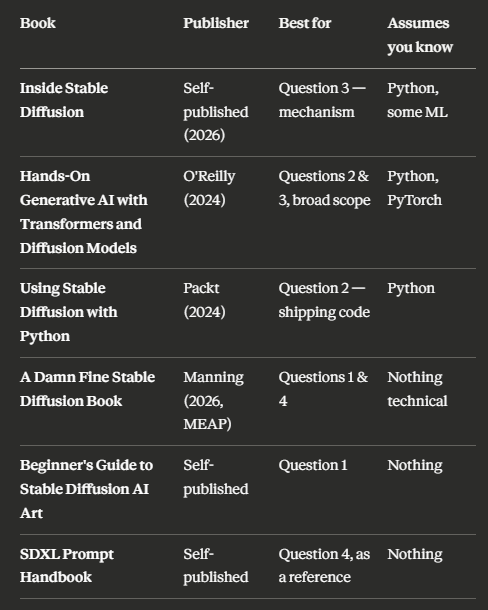
1. Inside Stable Diffusion: The Same Idea, Worn a Hundred Ways
2026. ~390 pages, paperback and hardcover.
The book I’d hand to someone who can already generate images and is annoyed that they don’t know why it works.
Full disclosure applies here — this is mine. So let me describe what’s in it and let you judge the pitch.
The organising claim is in the subtitle. Every diffusion model does one thing: corrupt data with noise, then learn to walk that corruption backwards, one step at a time. Everything else — text conditioning, LoRA, ControlNet, video, SDXL’s refiner, protein structure prediction — is that single idea wearing a different outfit. The book follows the idea rather than the tool, on the theory that once you can see the mechanism you’ll recognise it inside the next model before anyone tells you diffusion is underneath.
The structure. It opens with the forward and reverse diffusion process from first principles (Chapter 3), including the shortcut that lets you jump straight to any noise level without simulating every step — which is the single trick that makes training tractable and which most treatments skip past. Chapter 4 then does something I haven’t seen elsewhere: it trains diffusion in raw pixel space first, so you feel exactly how expensive it is, and only then introduces latent space as the thing that rescues you. Latent space stops being an arbitrary architectural choice and becomes an obvious one.
From there it’s three ways to teach the model a new concept, each with the internals opened up:
- Textual Inversion (Ch. 6) — including a long section on why a single vector in embedding space can encode a visual concept at all, and the argument that embeddings behave like directions rather than definitions
- LoRA (Ch. 7) — with a section on intrinsic dimensionality that explains why a low-rank update is enough, rather than just asserting that it is
- DreamBooth (Ch. 8) — the two-loss system, prior preservation, and why class images exist
Then control: ControlNet across pose, depth, facial landmarks, hand keypoints and limb connections, plus multi-ControlNet pipelines (Ch. 9). Video with AnimateDiff and Motion LoRA (Ch. 10). SDXL’s dual encoders and base/refiner ensemble (Ch. 11). CLIP and BLIP for the image↔text round trip (Ch. 12). Then a long chapter on img2img (Ch. 13) that treats the strength dial as the master concept and derives sketch rescue, inpainting, outpainting and two-pass upscaling from it — including a direct answer to the question people keep asking on Reddit about whether img2img and ControlNet compete (they don’t, and the chapter explains the division of labour).
The last substantive chapter goes outside images entirely: audio via the spectrogram loophole, 3D generation via a score-distillation trick, protein folding, and robot motion planning as diffusion policy. That chapter is the payoff for the whole “same idea, worn a hundred ways” framing.
The unusual part. The failures stayed in. When a bug taught more than the feature it broke, the debugging is in the text: a masked region that refused to change, a colour bug three layers deep, a training loop that looked correct and quietly wasn’t. Most technical books present a clean path that no one actually walked. I think that does readers a disservice, because the skill you actually need is diagnosing why your output looks wrong, and you can’t learn that from code that always works.
Where it’s weak, honestly:
- It’s new and self-published. No reviews yet, no publisher’s technical review process behind it. The O’Reilly and Packt books went through editorial review that this one didn’t.
- It assumes Python fluency and some ML background. If you don’t know what a loss function is, start elsewhere.
- It’s an SD 1.5 / SDXL book. It is not an SD 3.x or Flux book. The mechanisms transfer — that’s the whole argument — but the code targets what’s stable and widely deployed.
- Print is black and white, which for a book with this many image comparisons is a real limitation. The Packt book prints key images in colour and that matters.
Buy it if: you can already generate images, you’ve read the diffusers docs, and you’re irritated that you still can’t explain to a colleague what the scheduler is doing.
Don’t buy it if: you want to make nice pictures this weekend. It will not help you and you’ll be annoyed.
2. Hands-On Generative AI with Transformers and Diffusion Models
Omar Sanseviero, Pedro Cuenca, Apolinário Passos, Jonathan Whitaker. O’Reilly, December 2024. 4.4★ (27 reviews at time of writing).
The one to buy if you want the broadest, most authoritative single volume — and the one I’d recommend over mine for most readers who want both transformers and diffusion in one place.
This is the heavyweight, and it’s the heavyweight for good reasons. The author list is essentially Hugging Face — these are people who build and maintain the diffusers library rather than people writing about it from outside. Whitaker co-created the Fast.AI "From Deep Learning Foundations to Stable Diffusion" course with Jeremy Howard, which is one of the better free resources in this space.
The scope is the selling point and the trade-off. It covers transformers and diffusion, which means you get language models and image models under one roof and can see the shared machinery. If you’re building generative AI systems broadly — not just image pipelines — this is the more useful book. It’s also the most likely of any book here to still be relevant in three years, because it spends its budget on foundations rather than on the current tool surface.
The cost of that breadth is depth per topic. A book covering transformers and diffusion cannot spend forty pages on ControlNet’s hand keypoint conditioning, and it doesn’t. If your interest is specifically image generation and specifically deep, you’ll finish some chapters wanting more.
It’s also the most expensive book here at $79.99 list, though it discounts heavily and is on O’Reilly’s subscription platform.
Buy it if: you want one authoritative book on generative AI, you care about transformers as much as diffusion, or you want the safest purchase on this list.
3. Using Stable Diffusion with Python
Andrew Zhu (Shudong Zhu) and Matthew Fisher. Packt, June 2024. 352 pages. 4.1★ (10 reviews at time of writing).
The most directly practical book here if your goal is shipping a product.
Zhu is a Microsoft applied data scientist and a contributor to the Hugging Face diffusers library, and the book reads like it was written by someone who has actually deployed this stuff and hit the walls. Its distinguishing feature versus most of the market is that it assumes you're driving Stable Diffusion from code, not from a web UI — which turns out to be a much bigger difference than it sounds, because almost every "Stable Diffusion book" on Amazon is secretly an AUTOMATIC1111 manual.
Strong areas: environment setup (CUDA, PyTorch, the parts that eat your first afternoon), VRAM management and performance optimisation, working with community models and LoRAs from Civitai, and the prompt-handling problems that bite in production — the 77-token limit, weighted prompts, scheduled prompt parsing. It also covers face restoration, upscaling and image restoration, and closes with real applications in medical imaging and remote sensing, which is unusual and useful if you’re pitching this internally to people who don’t care about anime portraits.
Practical detail worth knowing: key images print in colour, which for this subject matter is worth actual money.
The limitation is that it’s a how book more than a why book. It’ll get you to a working, optimised application faster than anything else here. It spends less time on the underlying mathematics, so if you finish it and something breaks in a way the book didn’t anticipate, you may not have the model to reason about it.
Reader reviews consistently praise the clarity of the explanations and the setup coverage, which matches my experience of it.
Buy it if: you have a deadline and a product. This is the fastest route from zero to a working Python-driven pipeline.
4. A Damn Fine Stable Diffusion Book
Will Kurt. Manning. MEAP since April 2024, full publication estimated April 2026. ~275 pages.
The best-positioned book for people who want great images and don’t want a data science degree.
Kurt wrote Bayesian Statistics the Fun Way, and the same instinct is on display here: the explicit premise is that you can make genuinely good images with Stable Diffusion without being a data scientist, and the book is built to prove it.
Two caveats. First, at time of writing this is still MEAP — Manning’s early access program — with full publication estimated for April 2026. You’re buying a work in progress, which Manning is upfront about and which means chapters arrive over time. Second, it’s printed in black and white, which is an odd choice for a book about image generation, and worth knowing before you order print.
But the positioning is smart and there’s a real gap it fills. Between the “here are 200 prompts” Kindle books and the “here is the ELBO derivation” technical books, there is very little for the person who wants to be good at this as a craft. Kurt is aiming at exactly that person.
Buy it if: you want to make excellent images, you’re comfortable being slightly technical but don’t want to write training loops, and you don’t mind buying a book that’s still being finished.
5. Beginner’s Guide to Stable Diffusion AI Art
“Stable Diffusion Art,” Kindle and paperback.
The right first purchase if you have never generated an image and don’t intend to write code.
This is the entry point. It covers installing and running Stable Diffusion on Windows, Mac and Google Colab, then walks through the essential techniques with the free software ecosystem. It comes from the team behind the stable-diffusion-art.com tutorials, which are genuinely among the better free resources out there, and the book is essentially a structured, sequenced version of that material.
It will not teach you anything about why diffusion works and doesn’t try to. What it will do is get a complete beginner from “I have heard of this” to “I have a working install and I understand what a sampler and a CFG scale are,” which is a real service and worth the low price.
Its weakness is the weakness of all tool-surface books: it ages fast. UI screenshots go stale, extensions get deprecated, and the model landscape moves. Check the publication date before buying.
Buy it if: you’re starting from absolute zero and want the shortest path to a working setup.
6. The Stable Diffusion XL Prompt Handbook
E. D. Aaron. Self-published.
Not really a book. A very useful reference.
This is a catalogue of over 100 prompts and negative prompts producing distinct art styles with base SDXL — no LoRAs, no extra model downloads. Each style comes with example images so you can see what you’re getting.
Judged as a book it’s thin; there’s little instruction and no theory. Judged as what it actually is — a style reference you flip through when you’re stuck — it’s genuinely handy. Think of it as a swatch book, not a textbook.
There’s a category of similar titles on Amazon (Mastering the Basics of Stable Diffusion, various prompt engineering handbooks) that occupy the same niche with varying quality. Check the sample pages before buying any of them, because quality in this category varies wildly and the descriptions all sound identical.
Buy it if: you generate images regularly and want a physical style reference on the desk.
Choosing: a decision tree
Start here: can you already generate an image you’re reasonably happy with?
No → Beginner’s Guide to Stable Diffusion AI Art. Come back in a month.
Yes. Do you write Python?
No → A Damn Fine Stable Diffusion Book, plus a prompt reference if you want one. Skip everything else on this list; it will only frustrate you.
Yes. What are you trying to do?
- Ship a feature, soon → Using Stable Diffusion with Python. Fastest path to production.
- Understand generative AI broadly, including LLMs → Hands-On Generative AI with Transformers and Diffusion Models.
- Understand diffusion specifically, deeply, at the mechanism level → Inside Stable Diffusion.
- Fine-tune models on your own data and want to know which method to reach for → Inside Stable Diffusion for the reasoning, Using Stable Diffusion with Python for the pipeline. They complement each other; there’s little overlap.
If you’re buying two books, the pairing I’d actually recommend for a working developer is the O’Reilly book plus the Packt book: broad foundations plus production practice. Mine is the third book, for when you’ve read those and still want to know why the thing works.
A note on the state of this whole category
Something worth saying plainly: books about Stable Diffusion have a hard structural problem, which is that the field moves faster than publishing does.
A book acquired in 2023 ships in 2024 describing a model that was superseded in 2025. SD 1.5 gave way to SDXL gave way to SD 3.x, and Flux arrived and rearranged expectations again. Any book anchored to a specific UI, a specific extension ecosystem or a specific checkpoint has a short half-life, and quite a few of the cheaper titles on Amazon are already dead on arrival.
The books that survive are the ones that spend their pages on mechanisms rather than menus. The forward and reverse diffusion process hasn’t changed. Classifier-free guidance hasn’t changed. Low-rank adaptation works the same way in a 2026 model as in a 2023 one. Latent space is still the reason any of this fits on consumer hardware. That’s the material with a shelf life, and it’s a reasonable heuristic for evaluating any book in this space: flip to the middle and ask whether what you’re reading would still be true if the model were replaced tomorrow.
The second thing worth saying: the free material is genuinely good. The Hugging Face diffusers documentation, the Fast.AI diffusion course, the stable-diffusion-art.com tutorials, and the original papers themselves will get you a long way for nothing. What a book buys you is sequence and coherence — someone deciding what order the ideas go in and making them fit together. That's worth money if you value your time, and worth nothing if you enjoy assembling it yourself. Both are legitimate.
Closing
If you take one thing from this: figure out which of the four questions you’re actually asking before you buy anything. Most disappointment with technical books is a routing error, not a quality problem. The prompt catalogue isn’t a bad book because it doesn’t explain the UNet. The mathematics-heavy book isn’t a bad book because it won’t help you get better hands in your portraits.
And if you’re the specific reader I described at the top of section one — the one who can already run the pipeline and is bothered that they don’t know what’s happening inside it — that’s Inside Stable Diffusion for. It’s on Amazon in paperback and hardcover.
메타데이터
- post_id
- e02471306ec5
- slug
- the-stable-diffusion-bookshelf-which-book-actually-answers-your-question-e02471306ec5
- url
- https://medium.com/@zhaoyi0113/the-stable-diffusion-bookshelf-which-book-actually-answers-your-question-e02471306ec5
- canonical_url
- https://medium.com/@zhaoyi0113/the-stable-diffusion-bookshelf-which-book-actually-answers-your-question-e02471306ec5
- author_url
- https://medium.com/@zhaoyi0113
- status
- ok
- fetched_at
- 2026-08-06 16:46:06