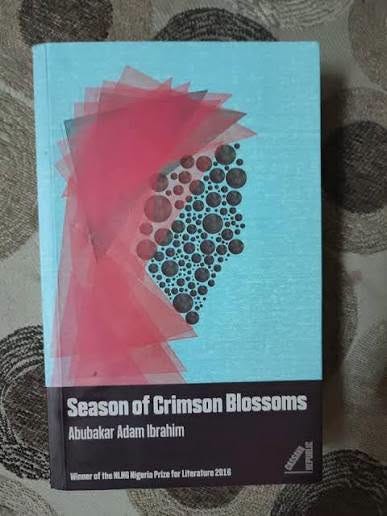
Book Review — “Season of Crimson Blossoms” by Abubakar Adam Ibrahim
This is the arresting opening line of the book:
Book Review — “Season of Crimson Blossoms” by Abubakar Adam Ibrahim
This is the arresting opening line of the book:
“Hajiya Binta Zubairu was finally born at fifty-five when a dark-lipped rogue with short, spiky hair, like a field of miniscule anthills, scaled her fence and landed, boots and all, in the puddle that was her heart.”
With those words, the trajectory of Season of Crimson Blossoms is set. What follows is an intriguing, boundary-pushing narrative that serves as both a tender exploration of human loneliness and a brutal mirror held up to the socio-political realities of Northern Nigeria.
For me, reading this book was a deeply educational and immersive experience. Immersing myself in the rich textures of Hausa culture and language — a landscape I am admittedly not entirely used to — was incredibly rewarding. Ibrahim breathes spectacular life into his characters. There is the tormented, deeply grieving Faizal; the charismatic yet profoundly troubled young gang leader, Reza; and, at the center of it all, Hajiya Binta.
Binta is a fascinating paradox. A character who functions simultaneously as a heroine and a villain within her own social ecosystem. I loved her deeply. Her yearnings and her unexpected capacity for compassion kept me turning the pages, often with a knot of anxiety in my stomach. Reza, on the other hand, is a fiercely troubled young man. Reading his arc, you instantly understand why Binta wanted to save him from himself. Whether their bond was a true love story or an intense, grief-fueled lust story (which I’m convinced it is) remains open to debate, but at its core, this book is about the desperate human search for companionship in the face of absolute isolation.
Ibrahim uses this unconventional, age-inappropriate romance to fearlessly examine themes that are often swept under the rug. There is middle-aged female sexuality, the private desires of Muslim women, the underworld of political thuggery, and the casual societal attitudes toward joint (Indian hemp).
Amidst these heavy themes, the book also dropped unexpected moments of personal nostalgia for me. It was on these pages that I learned that Hadiza is actually the corrupted version of Khadijat. The revelation took me straight back to secondary school, where I harbored a massive crush on a girl named Hadiza. For a long time, I thought it was the most beautiful name in the world. Reading it here, the name still glides off the tongue with the same old elegance.
However, the book quickly jolts you out of nostalgia and into the grim realities of Nigerian history. Ibrahim’s depiction of the sectarian Jos crises is harrowing and deeply necessary. He illustrates the horror of Christian and Muslim youths embarking on retaliatory killing sprees, bringing back the terrible ghosts of the stories we heard growing up. Crucially, the book balances the scales by highlighting a truth many Southerners often overlook: that Christian youths also slaughtered innocent Muslims during those riots.
This climate of fear is compounded by the looming, ominous shadow of Boko Haram encroaching on the fringes of the narrative, alongside a vivid reminder of the cursed 2014 political electioneering that eventually brought Muhammadu Buhari to power. Ibrahim brilliantly captures the palpable, almost breathless hope and aspirations that Northerners held for the man at the time. Looking back now, it feels tragic, knowing how severely he would ultimately let the nation down with his historic incompetence.
The book is not without its flaws. The plot takes a considerable amount of time to truly develop and the pacing can feel a bit drawn out. The prose occasionally leans toward being overwritten and the sheer depth and suddenness of the connection between our star-crossed lovers requires a temporary suspension of disbelief.
There are also frustrating glimpses of institutionalized patriarchy that sting to read, such as Binta forcing her younger daughter to return to an unhappy marital home. Yet, Ibrahim balances this bitterness with brilliant, dark humor. I laughed out loud when that same daughter, who had spent weeks lazily lounging around her mother’s house, suddenly couldn’t wait to run back to her husband the moment she realized a new co-wife development was underway that could jeopardize her standing.
The ending, when it finally comes, is utterly devastating. It is a slow-moving crash that you see coming from miles away, yet it breaks your heart all the same. The final pages left me with a profound sense of grief, knowing that after everything that transpired, true peace will likely never find its way back into Hajiya’s heart again.
Season of Crimson Blossoms is an evocative read. It is a story of a world marred by political violence and religious fundamentalism, but ultimately lived by everyday people who are often in grief and looking to escape loneliness.
메타데이터
- post_id
- e024a88b75c4
- slug
- book-review-season-of-crimson-blossoms-by-abubakar-adam-ibrahim-e024a88b75c4
- url
- https://medium.com/measured-voices/book-review-season-of-crimson-blossoms-by-abubakar-adam-ibrahim-e024a88b75c4
- canonical_url
- https://medium.com/measured-voices/book-review-season-of-crimson-blossoms-by-abubakar-adam-ibrahim-e024a88b75c4
- author_url
- https://medium.com/@tosinadeoti
- status
- ok
- fetched_at
- 2026-07-11 14:08:24