Column 2 — Limitations of the Band Theory
Band theory is one of the great successes of solid-state physics — built on the radical premise that electrons ignore one another. Landau’s…
Column 2 — Limitations of the Band Theory
Band theory is one of the great successes of solid-state physics — built on the radical premise that electrons ignore one another. Landau’s Fermi liquid theory justified that it works well even in the presence of electron-electron interactions, by showing how the interactions merely ‘dress’ electrons into quasiparticles. This column traces that justification, then turns to where it fails: Mott insulators, superconductors, and stranger phases beyond.
Mott Insulator
I have mentioned before in column 1 that the band theory has one critical assumption: it does not take into account the interactions between electrons, treating them as independent. Let’s think of a situation that directly challenges this assumption. In a material with strongly localized orbitals and large electron-electron repulsion, the dominant energy is not the kinetic energy that delocalizes electrons into Bloch waves — it is the electrostatic cost (U) of putting two electrons on the same site. If U is large enough compared to the bandwidth, — which is a measure of how much kinetic energy the electron gains by hopping between sites — then the electrons prefer to sit one per site, locked in place by mutual repulsion, rather than delocalize into a metallic state.
This physics is captured cleanly by the Hubbard model, which is the minimal model for this competition:
[embed]
The first term describes nearest-neighbor hopping with amplitude t — the kinetic energy that drives delocalization. The second term penalizes double occupancy with energy U. The ratio U/t controls which tendency wins. When U/t is small, the hopping dominates and the system is metallic. When U/t is large, the repulsion wins, and each electrons freezes onto its site. Charge excitations — moving electron from a singly occupied site to a doubly occupied one — cost an energy comparable to U, producing an effective insulating gap. This is a Mott insulator.
Mott insulator cannot be understood with the single-particle framework. The Mott insulating gap is not in the band structure — it arises from correlations between electrons, from the many-body physics that band theory explicitly ignores.
The Real Question: Is the Band Theory Useless?
How strong, then, must the electron-electron interactions be to break down the single-particle framework? Landau made a point that what matters is whether the ground state of the interacting system can be continuously connected (adiabatically connected) to the non-interacting ground state as you slowly turn on the interactions.
Imagine starting with a non-interacting Fermi sea and smoothly dialing up the interaction strength from zero to its physical value. If no phase transition occurs along the way — no level crossing, no sudden rearrangement of the ground state — then there is a one-to-one correspondence between the states of the interacting system and those of the non-interacting system. The labels we put on free-electron states (e.g., quantum number k, the band index, spin) can still be used for the interacting states. This interacting system is then called as a Fermi liquid.
Landau called these objects that carry the labels quasiparticles. A quasiparticle is not a bare electron — it is an electron dressed by a cloud of interactions with all the other electrons around it. It is a collective excitation of the many-body system. Still, it carries well-defined quantum numbers (momentum, spin), it obeys the Pauli exclusion principle.
How Long Does a Quasiparticle Last?
The quasiparticle picture only makes sense if quasiparticles have a long enough lifetime to be well-defined objects. If an electron excitation immediately decays into a complicated many-body mess, labeling it and tracking it would be useless. It turns out that quasiparticles near the Fermi surface have fairly long lifetimes in the low-temperature regime due to the Pauli exclusion principle.
For an electron in state k above the Fermi surface to scatter, it must find a second electron to scatter with, and both electrons must scatter into empty final states. At T = 0K, all states below the Fermi surface are filled and all states above are empty. If the initial electron has energy only slightly above the Fermi energy E_F, the phase space available for all of these constraints to be satisfies simultaneously — both of the initial states occupied, final states empty, and total energy and momentum conserved — shrinks to essentially none. (Both of the final states must lie above the Fermi surface, while the scattering partner must be below. From the perspective of energy conservation, an electron with small excitation energy simply lacks the energy to complete this process.)
At the Fermi surface, the available phase space is exactly zero: no scattering is possible. The lifetime of a quasiparticle right at E_F is infinite. Moving slightly above the Fermi surface to energy E_1 > E_F opens up phase space proportional to the square of energy difference, giving a scattering rate:
[embed]
This is the key result. The scattering rate goes to zero quadratically as you approach the Fermi surface in energy. And crucially, this happens regardless of how strong the interactions are — the phase-space suppression is a kinematic consequence of the Fermi surface, not a statement about interaction strength. This is why band theory, with its independent electron approximation, is self-consistently justified for states near E_F.
To wrap up, the band theory works not because interactions are small but because the Fermi surface geometry kinematically suppresses scattering for low-energy excitations. The theory knows this implicitly when it focuses on electrons near E_F. Landau made it explicit.
When Even Fermi Liquid Theory Breaks Down
Fermi liquid theory is a powerful framework, but it carries a condition: the ground state of the interacting system must be adiabatically connected to the non-interacting ground state. When that connection is broken — when a phase transition intervenes as interactions are turned on — the quasiparticle description fails entirely, and something new and often more interesting takes its place.
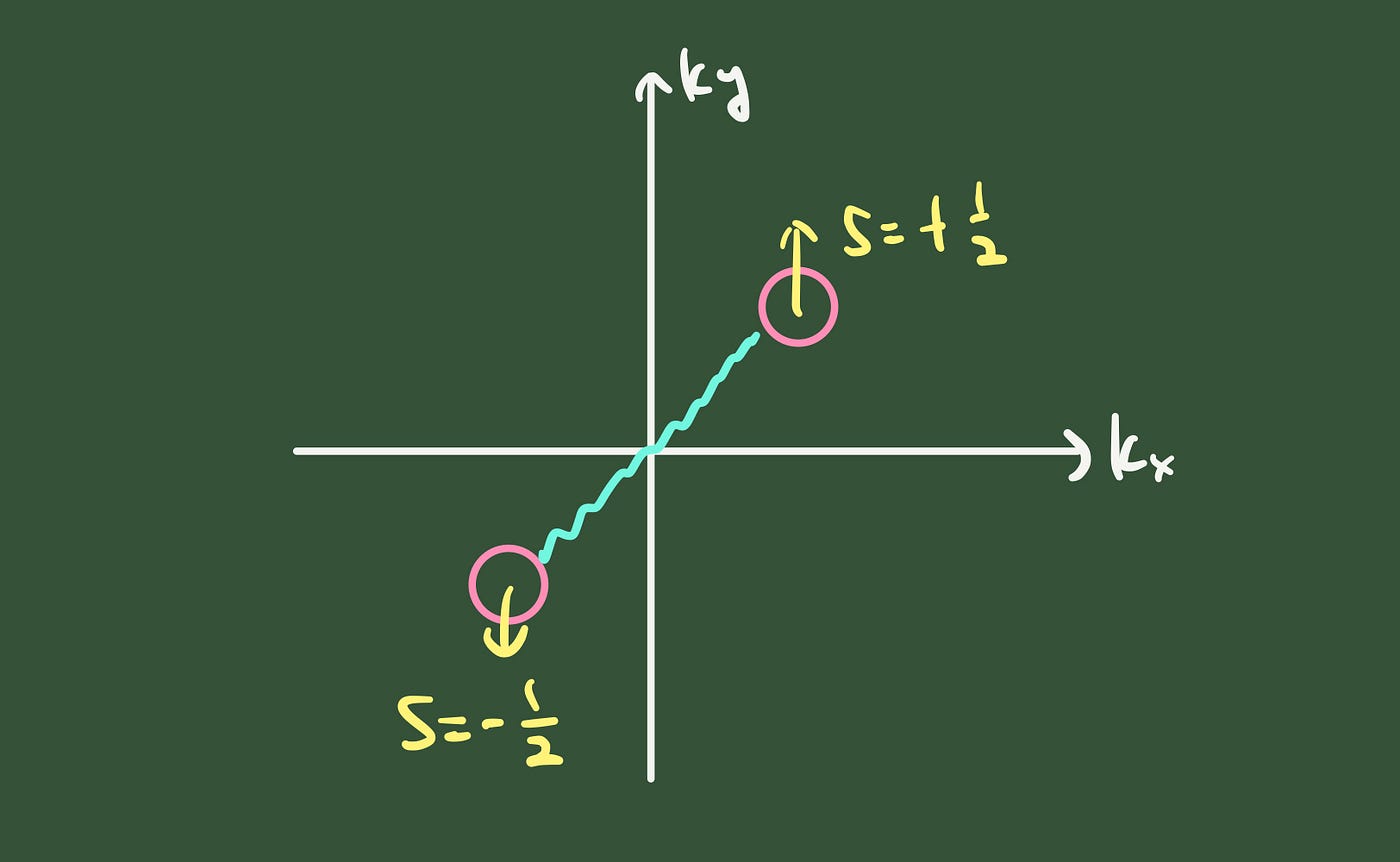
One classic example is superconductivity. In a Fermi liquid with even a weak net attractive interaction between electrons, the Fermi surface is unstable against the formation of Cooper pairs — bound electron pairs with opposite momenta and spins. The pairing instability changes the ground state discontinuously: an excitation gap opens at the Fermi surface, and the concept of individual quasiparticles moving through the system is replaced by a condensate of pairs. The superconducting state cannot be built perturbatively from the Fermi liquid, no matter how carefully you add corrections.
The Question the Rest of the Series Answers
Take stock of where we are. Band theory, built on Bloch’s theorem, correctly classifies most materials and gives a quantitative account of their electronic properties — an achievement that still impresses. Fermi liquid theory provides the deep reason this works: even in the presence of strong interactions, phase-space constraints near the Fermi surface protect quasiparticles from rapid decay, and the independent-electron picture remains valid as long as the ground state is adiabatically connected to the Fermi sea.
But that connection breaks in materials where correlations are strong enough to drive a phase transition: Mott insulators, superconductors, and more exotic phases where the entire quasiparticle concept fails. These materials are not edge cases. They include some of the most technologically important and scientifically fascinating systems known.
The rest of this series examines what happens in those materials. What are the theoretical tools that replace band theory when it fails? What new phases of matter emerge from strong correlations, and what are their signatures? And what does it mean for a quantum state of matter to be fundamentally different from a free electron gas?
The band theory story is the starting point. The interesting physics begins where it ends.
References
- Girvin & Yang, Modern Condensed Matter Physics (2019)
- Ashcroft & Mermin, Solid State Physics (1976)
메타데이터
- post_id
- e02530331d5e
- slug
- column-2-limitations-of-the-band-theory-e02530331d5e
- url
- https://medium.com/@grhncgzsvb/column-2-limitations-of-the-band-theory-e02530331d5e
- canonical_url
- https://medium.com/@grhncgzsvb/column-2-limitations-of-the-band-theory-e02530331d5e
- author_url
- https://medium.com/@grhncgzsvb
- status
- ok
- fetched_at
- 2026-07-18 11:12:31