Rethinking the First Chapter of the Tao Te Ching: Beyond Mysticism Toward Process and Relationship
The opening chapter of the Tao Te Ching is perhaps the most frequently quoted — and most frequently misunderstood — passage in all of…
Rethinking the First Chapter of the Tao Te Ching: Beyond Mysticism Toward Process and Relationship
The opening chapter of the Tao Te Ching is perhaps the most frequently quoted — and most frequently misunderstood — passage in all of Daoist philosophy. Many readers, especially those drawn to mysticism, regard its closing line —
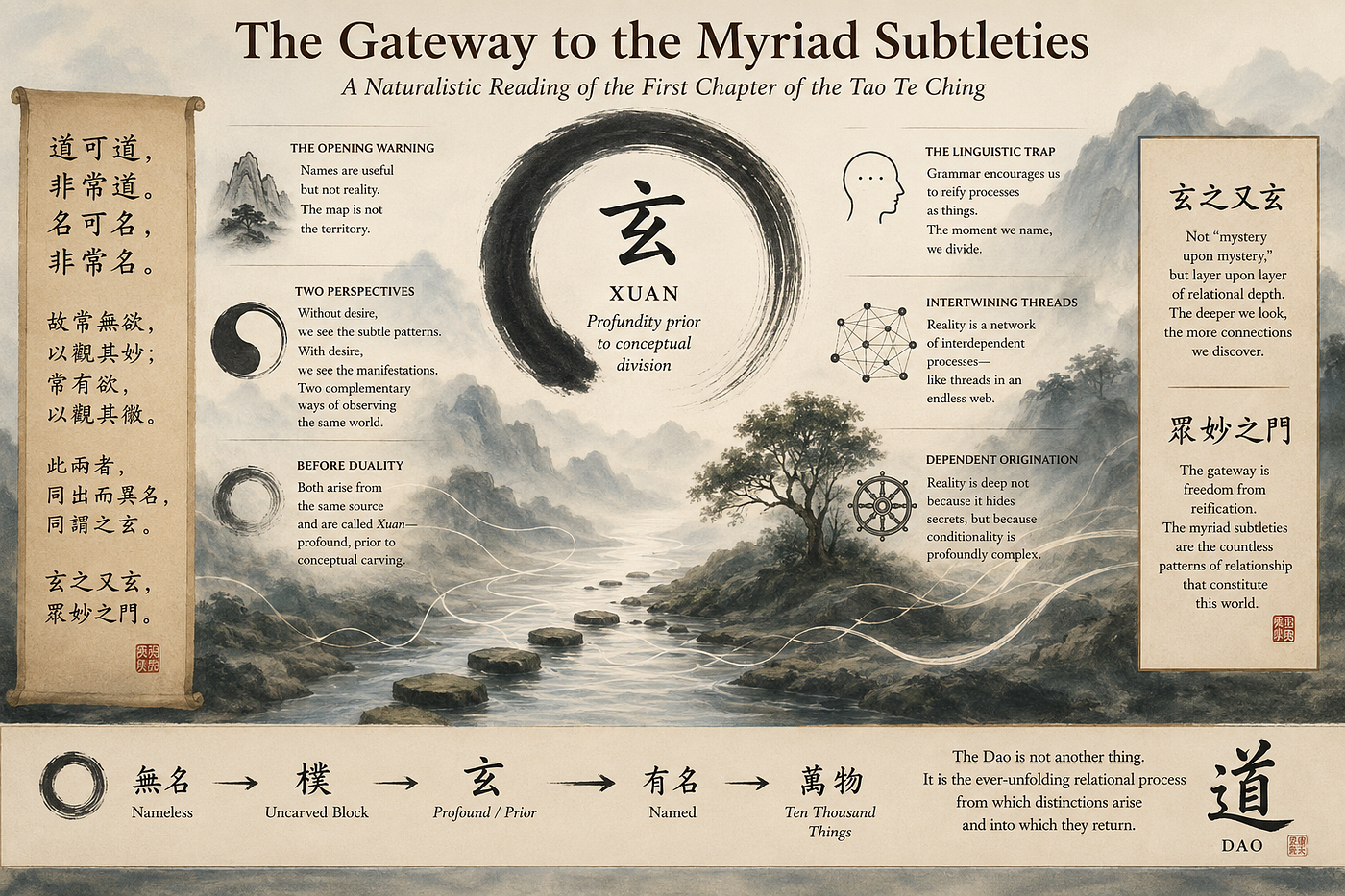
玄之又玄,眾妙之門 “Profundity upon profundity, the gateway to all wonders.”
— as a promise that behind ordinary reality lies a hidden cosmic secret waiting to be decoded. If only we meditate deeply enough, we will supposedly discover the ultimate metaphysical truth concealed behind appearances.
I believe this reading misunderstands both the first chapter and the philosophical spirit of the Tao Te Ching. Rather than pointing to an occult reality, Laozi warns us against one of the oldest traps in philosophy: the tendency to mistake our concepts for reality itself.
The Chapter Begins with a Warning About Language
The chapter opens with the famous lines:
道可道,非常道。 名可名,非常名。
The warning is immediate. Once we name something, we are already simplifying and dividing reality. Language is indispensable, but it is not reality itself.
This insight anticipates a theme that later fascinated the philosopher Ludwig Wittgenstein. He argued that ordinary language contains an entire mythology. Grammar encourages us to believe that because we have a noun, there must be a corresponding thing. Thus we speak of “the self,” “mind,” “time,” “consciousness,” or “Dao” as though each were an independently existing object.
Grammar is not neutral. It silently shapes our metaphysical assumptions.
The Tao Te Ching begins by cautioning us against precisely this mistake.
Desire and Desirelessness Are Not Opposites to Be Judged
The next lines are equally revealing:
故常無欲,以觀其妙; 常有欲,以觀其徼。
These two statements are presented in perfect parallel.
Laozi does not say that desire is bad and desirelessness is good. Instead, each offers a different way of observing reality.
Without desire, we perceive its subtle patterns. With desire, we perceive its concrete manifestations.
The chapter immediately reinforces this neutrality:
此兩者,同出而異名。
These two arise from the same source, though they bear different names.
This is not a moral contrast but an epistemological one. The text describes two complementary perspectives rather than prescribing one as superior.
Indeed, becoming attached to “desirelessness” would simply transform desirelessness into another object of desire.
Before Duality
The key lies in the next sentence: 同謂之玄。
Both are called xuan.
Traditionally, 玄 is translated as “mysterious” or “mystical.” Yet these translations often invite readers to imagine a hidden metaphysical realm.
A more fruitful understanding is to see xuan as pointing to what precedes conceptual division.
The Tao Te Ching repeatedly uses different images for this pre-conceptual condition: the Nameless (無名), the Uncarved Block (樸), the Valley, the Mother, and here, 玄.
These are not different metaphysical substances. They are different metaphors for reality before the mind divides it into separate and distinct things.
Only after naming do distinctions emerge: beautiful and ugly, good and bad, gain and loss, desire and desirelessness.
Chapter Two immediately continues this theme:
“When everyone recognizes beauty as beauty, ugliness already exists.”
Beauty and ugliness arise together. They are relational distinctions rather than independent realities.
The Linguistic Trap
This brings us back to Wittgenstein. Language naturally divides continuous processes into discrete objects.
Western languages often reinforce this tendency through their grammar. We instinctively ask: What is Dao? What is consciousness? What is qi?
Each question subtly assumes that these words refer to independently existing entities possessing fixed essences.
Classical Chinese is generally less committed to such rigid distinctions. Many words can function naturally as nouns, verbs, or processes depending upon context.
Even 道 itself can mean:
- The Way,
- a path,
- to guide,
- to speak,
- an ongoing course.
Likewise, 名 means both “name” and “to name.”
Classical Chinese resists rigid reification.
This helps explain why the opening sentence is so difficult to translate. It deliberately plays with these grammatical ambiguities.
“Profundity upon Profundity”
The final line is often read as an invitation into mysticism:
玄之又玄,眾妙之門。
But perhaps Laozi means something quite different.
Every time we believe we have finally grasped reality through concepts, another layer of complexity appears. Every explanation reveals further relationships. Every category leaves something out.
Reality continually exceeds our conceptual framework.
In this sense, the phrase 玄之又玄 does not point toward an occult secret. It points toward the inexhaustibility of reality. The gateway is not supernatural knowledge. It is freedom from confusing our concepts with reality.
Another Way to Understand Xuan
There is another intriguing possibility.
The word 玄 has long been associated not only with darkness and profundity but also with the image of intertwined threads.
Whether or not this imagery was intended by Laozi, it provides a remarkably illuminating philosophical interpretation.
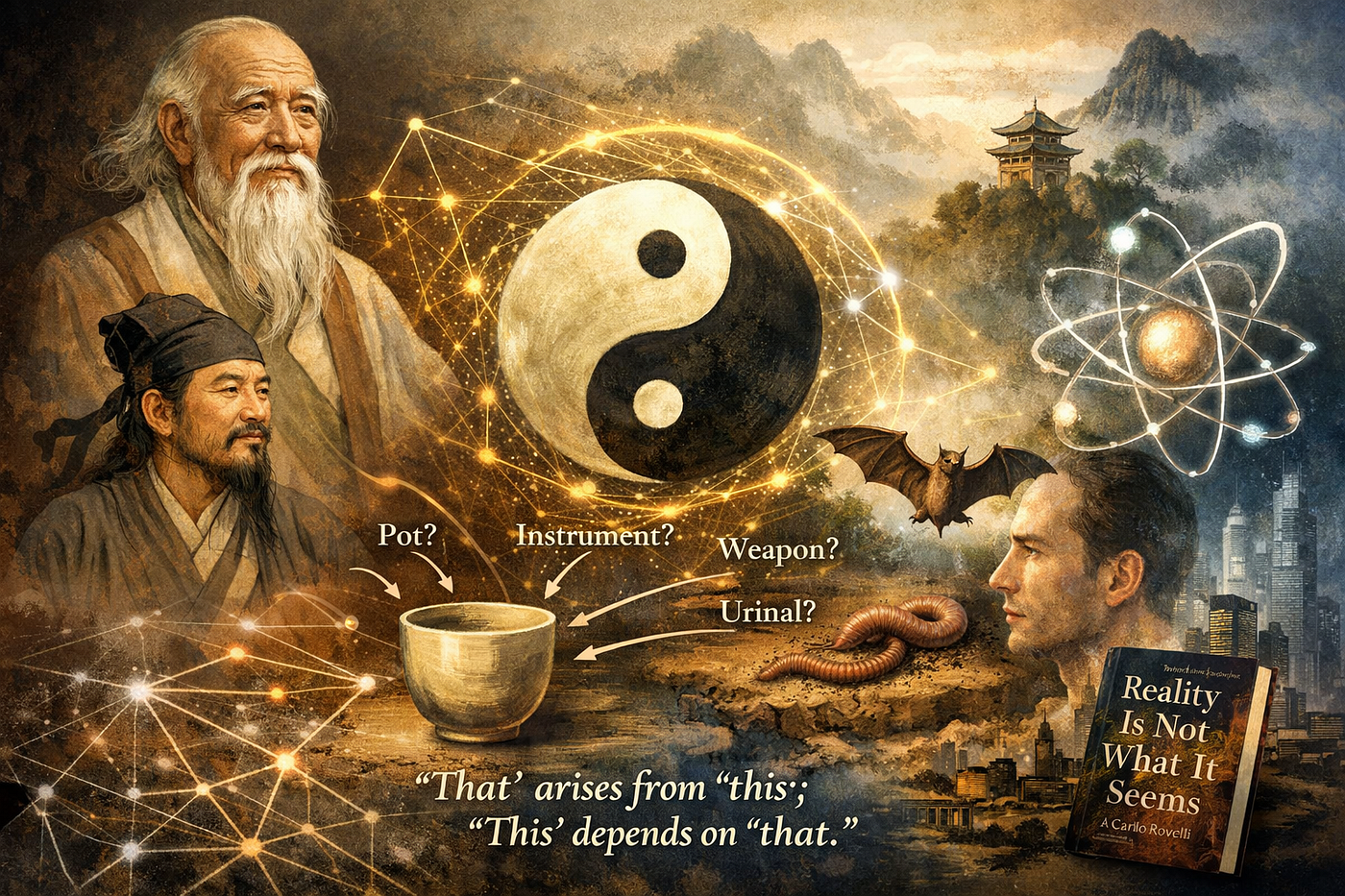
Reality is not mysterious because it hides a secret. Reality is profound because everything is interconnected. Every phenomenon exists within countless relationships. Every cause becomes another effect. Every effect feeds back into new causes.
The world is less like a collection of isolated objects than like an intricate web whose threads continually intersect.
This understanding resonates deeply with the Buddha’s teaching of dependent origination.
When Ānanda remarked that dependent origination seemed straightforward, the Buddha corrected him:
“Do not say that, Ānanda. This dependent origination is deep and appears deep.”
Why?
Not because it is supernatural, but because reality consists of extraordinarily intricate networks of conditions.
Modern systems theory, ecology, and complexity science all describe the world in similar terms. Feedback loops. Emergence. Interdependence. Nonlinear causation.
Seen this way, 玄之又玄 describes layer upon layer of interconnected processes rather than hidden metaphysical substances.
The Gateway to the Myriad Subtleties
The final phrase, 眾妙之門, is therefore not the gateway into an invisible world. It is the key to appreciating the countless subtle relationships that constitute this world. The wonders are not miracles. The wonders are the astonishing patterns arising from interconnected processes.
The deeper our understanding of these relationships, the more subtle reality appears.
Conclusion
The first chapter of the Tao Te Ching is not an invitation to seek an esoteric doctrine hidden behind appearances.
It is a warning against the very human tendency to create such doctrines.
Language divides. Concepts simplify. Names reify.
Yet reality itself remains an ongoing network of relationships that continually transcends our conceptual boundaries.
The deepest insight of Chapter One may therefore be surprisingly simple: The Dao is not a hidden substance waiting to be discovered. Nor is it an ultimate object of mystical realization. It is the ever-unfolding relational process from which all distinctions arise and into which they continuously dissolve.
Perhaps this is why Laozi concludes not with an answer but with 玄之又玄.
Reality is profound not because it conceals a cosmic secret, but because every attempt to capture it in fixed concepts reveals yet another layer of relationship, interdependence, and subtlety.
That, I believe, is the true gateway to the myriad wonders.
메타데이터
- post_id
- e028dacc6e44
- slug
- rethinking-the-first-chapter-of-the-tao-te-ching-beyond-mysticism-toward-process-and-relationship-e028dacc6e44
- url
- https://medium.com/@kleong54/rethinking-the-first-chapter-of-the-tao-te-ching-beyond-mysticism-toward-process-and-relationship-e028dacc6e44
- canonical_url
- https://medium.com/@kleong54/rethinking-the-first-chapter-of-the-tao-te-ching-beyond-mysticism-toward-process-and-relationship-e028dacc6e44
- author_url
- https://medium.com/@kleong54
- status
- ok
- fetched_at
- 2026-07-10 18:03:05