The Day Kurt Cobain Helped Defeat an Anti-Gay Oregon Ballot Measure
Grunge rockers Nirvana helped save queer Oregonians from being legally categorized as “abnormal, wrong, unnatural, and perverse.”
The Day Kurt Cobain Helped Defeat an Anti-Gay Oregon Ballot Measure
Grunge rockers Nirvana helped save queer Oregonians from being legally categorized as “abnormal, wrong, unnatural, and perverse.”
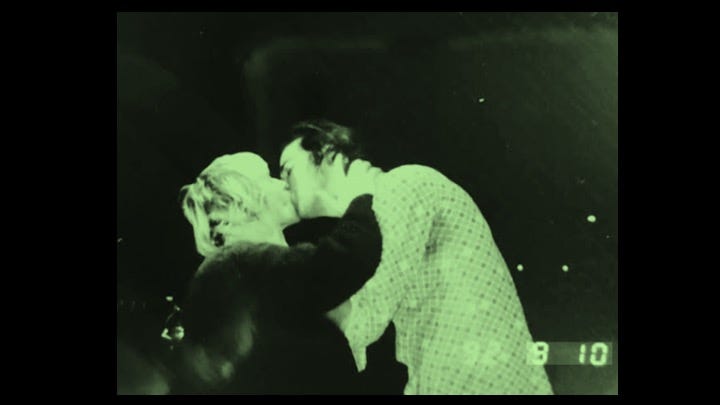
Kurt Cobain (L) and Krist Novocelik (R) kissing on stage at Portland Meadows, Sept. 10, 1992, screen capture from Instagram, color treatment by the author
What else can I say? Everyone is gay.
— Kurt Cobain, “All Apologies” © Primary Wave Tunes, The End Of Music
My home state of Oregon has a well-earned reputation as a bastion of progressivism. In the state’s urban meccas of Portland and Eugene, freedom reigns, queer and trans folks remain unbothered, and pretty much anything goes.
However, in 2024, 13 of Oregon’s more rural, easternmost counties voted to succeed from liberal Oregon and join a new state they planned to call Greater Idaho. While these counties’ succession has yet to come to fruition — and it’s doubtful it ever will — the 2024 vote proved that there are a whole lot of right-wingers, and right-leaning regions in this majority-blue state.
Oregon’s history of explicitly anti-gay ballot measures
Thirty-six years earlier — 1988, to be precise — in response to Governor Neil Goldschmidt’s executive order banning discrimination against LGBT Oregonians seeking public employment, a Christian conservative group called The Oregon Citizens Alliance (OCA) sponsored Ballot Measure 8.
The ad blitz in favor of the measure promoted the idea that gay men are sexual predators and that sexual molestation at a young age naturally leads to the development of gay identity.
It worked. Measure 8 passed. And, from that point on, Oregon’s governor would no longer have the power to ban discrimination based on sexual orientation.
Four years later, queer Oregonians once again found themselves smack dab in the center of OCA’s intolerant crosshairs, this time with Ballot Measure 9.
The LGBT community in general was terrified.
— Scot Nakagawa, Director of Statewide Development on the No on 9 Campaign
From the text of the proposed constitutional amendment:
All governments in Oregon may not use their monies or properties to promote, encourage or facilitate homosexuality, pedophilia, sadism or masochism. All levels of government including public education systems must assist in setting a standard for Oregon’s youth which recognizes that these behaviors are abnormal, wrong, unnatural and perverse and they are to be discouraged and avoided.
Passage of the measure would have, among other things, prevented LGBT people from teaching in Oregon’s public schools.
Ballot measures are tricky propositions.
Public education on the consequences of checking “yes” or “no” is essential for voters to make an informed decision… or, to make any decision at all. All too often, ballots are left unmarked on such measures, due to a lack of knowledge.
And, as queer Oregonians and LGBT allies learned with Measure 8, a well-funded misinformation and fear campaign can be very effective in swaying public opinion.
The No on 9 campaign found itself underfunded and desperate.
Gay film director and native Oregonian Gus Van Zant (One Flew Over the Cuckoo’s Nest, My Private Idaho, Good Will Hunting) reached out to Danny Goldberg, chairman of the ACLU Foundation of Southern California and a manager of Nirvana, in the hopes that Nirvana — then, arguably, the biggest rock band in the world — would perform a benefit concert for the No on 9 campaign.
Guitarist/lead singer Kurt Cobain never relished the idea of Nirvana being associated with politics per se. But he had always been an LGBT ally and passionate about issues regarding sexual orientation, especially when it came to bullying.
In an interview with fanzine writers Jim Grotty and Michael Lane, Kurt described his hometown of Aberdeen, Washington as “a very small community with a lot of people who have very small minds. Basically if you’re not prepared to join the logging industry you’re going to be beaten up or run out of town.”
Then, Kurt added, “If I wasn’t attracted to Courtney (referring to wife, Courtney Love), I’d be bisexual.”
Feminist music historian Ann Powers remarked on being impressed by “the way Kurt presented himself to the world, the way that he performed queerness even though he himself was into women.”
According to No on 9’s Nakagawa, Nirvana signing on to do the benefit was a key inflection point in the campaign:
An evangelical right-wing group gathered enough signatures, in record time, to put a question on the ballot that was widely understood to be, in essence, ‘is this group fully human?’ Donors to oppose the initiative weren’t coming forward. We needed to change the story and the Nirvana concert helped to do so.
The concert
On September 10, 1992, at Portland Meadows, a tatted, ragtag lineup of punk and grunge rockers, headlined by superstars Nirvana, changed minds and won hearts.
One of the 10,000-plus concert goers was heard to say, “I thought this was just a Nirvana show. I didn’t know it was gonna be about faggots.”
A highlight of Nirvana’s triumphant, extended set was the yet-to-be-released, soon-to-become-classic “All Apologies,” in which Kurt sings “What else can I say? Everone is gay.”
And at the conclusion of the show, as the crowd roared its adoration, Kurt Cobain and bassist Krist Novocelic locked lips in an extended kiss.
Recalls Nakagawa:
Nirvana helped make the campaign magnetic. The number of volunteers soared, donor confidence rose, and many in the community felt redeemed. They felt less alone, less scared. It made us cool, and cool is more than a pair of sunglasses. Cool is current, culturally relevant, influential, and included.
In November of 1992, Oregon Ballot Measure 9 went down by a decisive 16 points.
Today, thankfully, the music industry has come to embrace queerness and queer performers. Too, straight allies are speaking out on behalf of folks being their truest selves.
Keith Urban’s performance of Chappell Roan’s “Pink Pony Club” at Mar A Lago, in my opinion, represented a highlight of in-your-face queer advocacy.
Rock and pop fans have long embraced queer-presenting, gender-bending performers, as far back as Johnnie Ray and Little Richard in the 1950s, and into the 70s and 80s with artists like David Bowie. As a gender-playful, bisexual glam rocker in the early-to-mid 70s, I would have been delighted to see into the future, and how far the music business would eventually come in its acceptance of queer, trans, nonbinary, and genderqueer artists.
But, in 1992, with AIDS on a killer rampage, it took balls of steel for a band of rockers to risk their superstar status by standing in the spotlight, speaking and singing on behalf of LGBT rights, then conclude the show with two male bandmates kissing defiantly at center stage.
Consider this piece long-belated thanks to Kurt Cobain and Nirvana for helping the voters of my home state to make the right decision, to avoid altering Oregon’s constitution to re-categorize gay and bi folks alongside pedophiles and declaring homosexual behavior as “abnormal, wrong, unnatural, and perverse.”
Save that kinda crap for Greater Idaho.
Rand Bishop’s latest novel, *Long Way Out*, is available in e-book and print editions wherever books are sold online. The audiobook, narrated by the author, is available through Audible and most audiobook distributors. Verified customer reviews are essential to the success of any self-published book. Thank you.
메타데이터
- post_id
- e02e48494ce1
- slug
- the-day-kurt-cobain-helped-defeat-an-anti-gay-oregon-ballot-measure-e02e48494ce1
- url
- https://medium.com/prismnpen/the-day-kurt-cobain-helped-defeat-an-anti-gay-oregon-ballot-measure-e02e48494ce1
- canonical_url
- https://medium.com/prismnpen/the-day-kurt-cobain-helped-defeat-an-anti-gay-oregon-ballot-measure-e02e48494ce1
- author_url
- https://medium.com/@randbishop
- status
- ok
- fetched_at
- 2026-06-20 20:29:01