How to Add Verifiable Execution to an AI Agent in Under 30 Minutes
Your AI agent made a decision last week.
How to Add Verifiable Execution to an AI Agent in Under 30 Minutes

Your AI agent made a decision last week.
Today, someone asks you to prove exactly how it happened.
Which input did it receive?
Which tools did it call?
What sequence of steps led to the outcome?
What changed in the workflow?
Can you prove the record was not modified after the fact?
For most teams, this is where confidence starts to collapse.
Not because the agent necessarily failed.
Because the evidence does.
As AI agents move from demos into financial workflows, internal automation, support systems, and operational tooling, this problem becomes much more serious. It is no longer enough to say an agent worked. You need to be able to show what it did, how it did it, and whether that record can still be trusted later.
That is where most systems break.
And that is exactly where verifiable execution becomes useful.
The Problem Most Agent Builders Eventually Hit
At first, agent workflows feel manageable.
You can inspect logs, review traces, and debug errors as they happen. In early prototypes, that is often enough.
But once agents start making decisions that matter, the questions change.
You are no longer only asking:
- Did the workflow complete?
- Did the tool call succeed?
- Did the model return a result?
You are now asking:
- What exactly happened during this run?
- Can we reconstruct the full chain of actions?
- Can we explain this decision to someone else?
- Can we verify the execution without trusting our own internal systems?
These questions show up fast in the real world.
For example:
- a support agent issues the wrong refund
- a fraud agent flags a legitimate transaction
- an operations agent triggers the wrong workflow
- a compliance agent escalates the wrong case
- a multi-step agent behaves differently from one run to the next
When that happens, logs help, but they rarely give you a clean answer.
They give you fragments.
And fragments are not evidence.
Why Logs Are Not Enough for Agent Systems
Logs are useful. They are essential for operating software.
But they were built for observability, not proof.
That difference matters a lot more in agent systems because agent execution is usually:
- multi-step
- dynamic
- dependent on tool calls
- influenced by changing runtime context
- spread across multiple systems and services
So when you try to answer a simple question like:
“Can you prove what the agent actually did?”
you often end up pulling from:
- application logs
- model traces
- API records
- database entries
- monitoring dashboards
- tool-specific logs
At that point, you are no longer looking at one record.
You are running a reconstruction exercise.
That introduces real problems:
- records are fragmented
- context is incomplete
- timelines are hard to correlate
- outputs are difficult to defend
- external validation is nearly impossible
Even if you log everything, you are still relying on:
trust in your own infrastructure
That is exactly the thing many teams need to reduce.
The Stakes Are Getting Higher
This is not just a debugging issue anymore.
It becomes more serious as agents move into workflows involving:
- money
- approvals
- compliance
- customer actions
- internal operations
- regulated processes
In these environments, the standard changes.
The question is no longer:
“Did the system seem to work?”
It becomes:
“Can you defend what it did when the decision is challenged?”
That is a much higher bar.
And standard logs were never designed to clear it.
The Shift: From Logging Agents to Certifying Them
There is a better model.
Instead of trying to reconstruct an agent’s behavior after the fact, you capture the execution as it happens and turn it into a tamper-evident artifact.
This is the core idea behind verifiable execution.
And for agent workflows, that means generating a Certified Execution Record, or CER.
Definition: Certified Execution Record (CER)
A Certified Execution Record is a structured, tamper-evident artifact that captures an AI execution, including inputs, parameters, context, and outputs, in a form that can be independently verified later.
The key difference is simple:
Logs describe events.
CERs capture the execution itself.
What You Are Building in Under 30 Minutes
By the end of this process, you will have:
- an AI agent that emits a Certified Execution Record
- a portable artifact that captures inputs, tool calls, decisions, and outputs
- a way to verify the execution independently
- a workflow that produces audit-ready execution evidence by default
That means you are not just running an agent.
You are creating a record of what it did that can be:
- stored
- reviewed
- shared
- verified later
Step 1: Install the NexArt SDK
npm install @nexart/agent-kit @nexart/ai-executionThe goal here is to remove friction.
You should not have to manually assemble execution artifacts or wire low-level primitives just to make an agent verifiable.
That is what @nexart/agent-kit is designed to handle.
Step 2: Wrap Your Agent Execution
Here is a minimal example:
import { runWithCer } from "@nexart/agent-kit";const result = await runWithCer({
input: "Should we approve this transaction?",
agent: async (input) => {
const decision = await yourAgent.run(input); return {
output: decision,
tools: decision.toolsUsed,
reasoning: decision.reasoning
};
}
});What happens here:
- your agent runs normally
- execution context is captured automatically
- a Certified Execution Record is generated as part of the run
This is the important shift:
you are no longer treating verification as something you add later.
It becomes part of the execution path itself.
Step 3: Export the CER
import { exportCer } from "@nexart/ai-execution";const cerBundle = exportCer(result.cer);This produces a portable execution artifact.
That means the result can now be:
- stored for future review
- attached to a workflow
- sent to another team
- used in audit or incident analysis
- validated independently later
This is where the system starts to feel different.
You are no longer left with logs buried inside an internal stack.
You now have a standalone record of what happened.
Step 4: Verify the Execution
Once the CER exists, you can verify it independently.
Option A: CLI
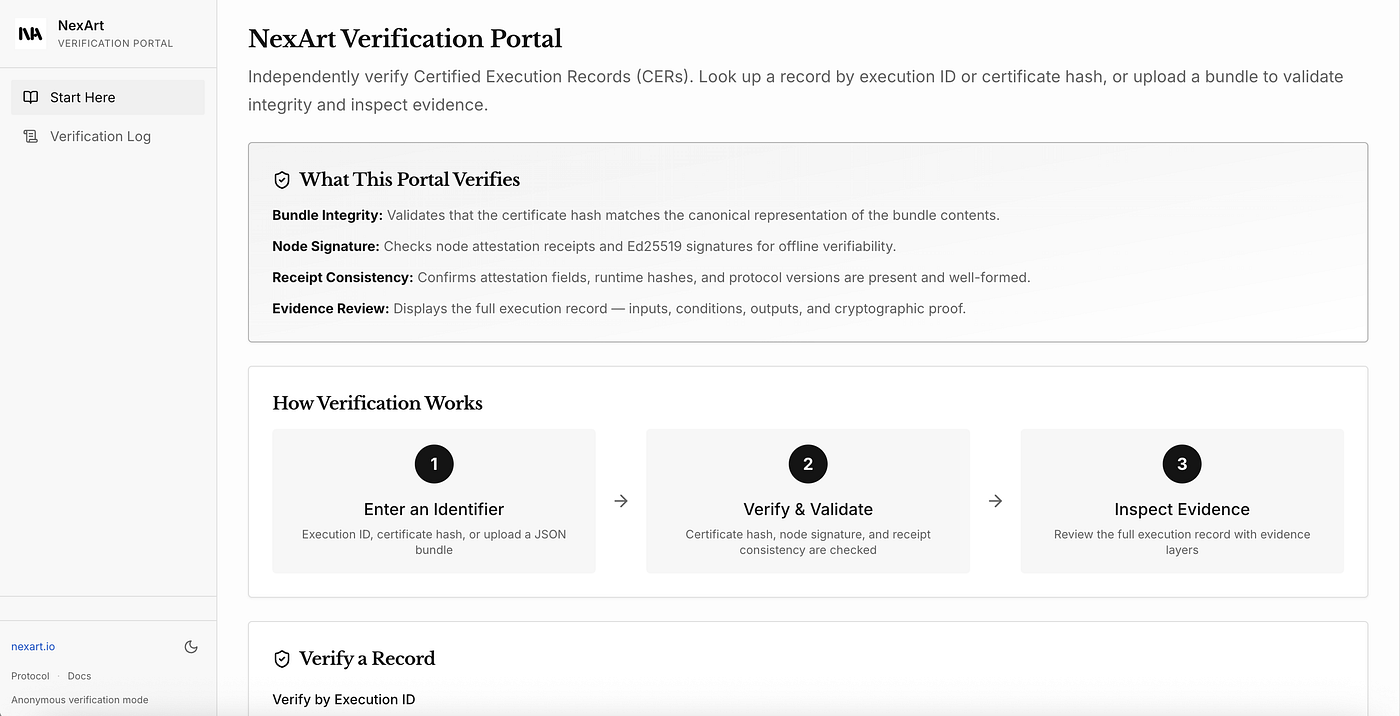
npx nexart ai verify cer.jsonOption B: Public verifier
You can:
- upload a CER
- inspect execution data
- verify integrity
- review attestation if present
No login required. No dependency on your internal system. No need to trust the original application.
That changes the trust model completely.
What This Looks Like Before and After
Before
- the agent runs
- logs are scattered across systems
- debugging is manual
- audits require reconstruction
- trust is implicit
After
- the agent runs
- a CER is created automatically
- the execution is captured in one artifact
- verification is immediate
- trust becomes checkable
That is the practical difference between observability and execution evidence.
Why This Is Easier Now Than It Used to Be
This workflow is much easier to adopt today than it was even recently.
The NexArt builder stack has been tightened around a cleaner execution-evidence workflow so builders can certify agent execution without dealing with unnecessary assembly work.
That includes improvements across the stack:
- agent workflows can emit standard CERs directly through @nexart/agent-kit
- CER packages can be detected, assembled, exported, imported, and verified through @nexart/ai-execution
- the CLI can verify both raw CER bundles and CER packages
- the broader stack now aligns around the same supported artifact shapes
That matters because execution evidence only works if builders can use it without fighting the tooling.
The goal is not just stronger verification.
It is making strong verification easy enough to become part of everyday development.
Just as importantly, these changes remain additive and backward-compatible.
That preserves one of NexArt’s most important properties:
previously created CERs must remain independently auditable and verifiable over time.
Why This Matters Specifically for Agents
Agent systems are harder to reason about than simple model calls.
A single execution may involve:
- multiple prompts
- tool selection
- branching decisions
- external API calls
- intermediate state changes
- final actions
When something breaks, the problem is usually not just the final output.
The real question is:
What sequence of actions and decisions produced this outcome?
That is an execution problem.
And execution problems need structured evidence, not scattered logs.
CERs give you that structure.
They let you capture:
- what the agent saw
- what it did
- what tools it used
- what output it produced
- whether that record is still intact
That is what makes agent execution defensible.
Where You Should Start
You do not need to make every agent verifiable on day one.
Start where the operational or trust risk is highest.
Good starting points include:
- agents that affect users directly
- agents that call external tools
- financial or operational workflows
- approval or escalation flows
- systems likely to be reviewed later
- anything that could become a dispute or audit issue
That is where verifiable execution creates immediate value.
A Better Mental Model
Most systems today operate like this:
Execution → Logs → Reconstruction
With NexArt, the model becomes:
Execution → Certified Artifact → Verification
That removes a lot of pain:
- less manual correlation
- less guesswork
- less dependence on internal trust
- better portability
- better long-term defensibility
Why This Is Becoming the New Standard
As AI systems move into higher-stakes environments, the standard is changing.
Teams increasingly need:
- execution integrity
- tamper-evident records
- independent verification
- audit-ready evidence
- clearer provenance for agent decisions
In that world, logs still matter.
But they are not enough on their own.
They tell you what happened from inside the system.
Execution evidence lets you prove it from outside the system too.
That is a very different capability.
Try It Yourself
If you want to see this in practice:
👉 Verify a record → https://verify.nexart.io
👉 Get started → https://docs.nexart.io
You can generate and verify your first CER in minutes.
Final Thought
AI agents are becoming decision-makers, not just assistants.
As that happens, the bar gets higher.
It is no longer enough to say:
“We logged what happened.”
You need to be able to say:
“Here is what happened. You can verify it.”
That is the shift from observability to verifiable execution.
And for agent systems, that shift is going to matter a lot.
메타데이터
- post_id
- e038e109a7d5
- slug
- how-to-add-verifiable-execution-to-an-ai-agent-in-under-30-minutes-e038e109a7d5
- url
- https://medium.com/@arrotu-nexart/how-to-add-verifiable-execution-to-an-ai-agent-in-under-30-minutes-e038e109a7d5
- canonical_url
- https://medium.com/@arrotu-nexart/how-to-add-verifiable-execution-to-an-ai-agent-in-under-30-minutes-e038e109a7d5
- author_url
- https://medium.com/@arrotu-nexart
- status
- ok
- fetched_at
- 2026-06-11 05:11:55